Author: Redazione

Embellish your nativity scene with a unique and original scenography

Embellish your nativity scene with a unique and original scenography

Since its first appearance in the popular tradition, the nativity scene has had the double meaning of deep and human expression of devotion, and work of art of absolute refinement and attention to details. Although the subjects represented were for the most part common men…

Christmas symbols and their meaning

Christmas symbols and their meaning

Christmas is the richest holiday in terms of sacred and profane symbolism, all intersected throughout centuries until they became an indissoluble and indistinguishable one. All Christmas symbols and the habits related to each one were preserved form generation to generation. From the Nativity to the…

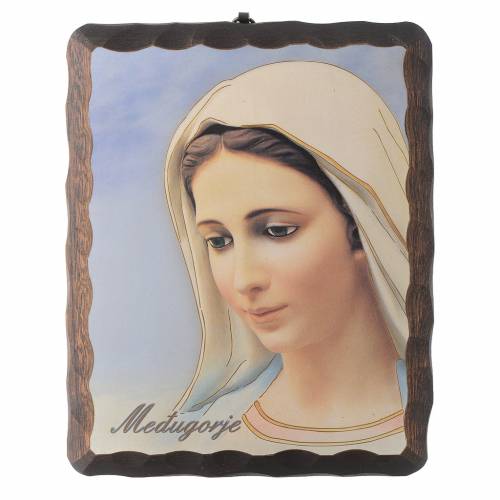
The day Virgin Mary revealed herself to Bernadette Soubirous

The day Virgin Mary revealed herself to Bernadette Soubirous

Still today, those who visit the Grotto of Massabielle, where Marie-Bernarde Soubirous also known as Bernadette reported the miracolous visions of a “lady dressed in white”, experience a feeling of great holiness and intimate comfort.

The niche where the visions appeared is at the top, like a nest, a snug spot. Suspended like out of time, set on a higher ground, accessible only to those who really believe, who really wish to see it. A statue of the Virgin Mary lies in that niche today, donated by two Lyonnaise ladies in 1864.

Even the world surrounding the Sanctuary of Our Lady of Lourdes seems like out of any reality, a place that is not a place, out of time and any common belief. Sacred objects shops show multitude of rosaries of any material. Everything sparkles, like a sea of gemstones. At night the square in front of the Sanctuary lights up with thousands of candles enveloped in their flame arrestors, which turn the whole place into a meadow covered in flowers that shine in the darkness.

Everything is evocative and scenografic. A glimpse of beauty, then the harshness of the sick bodies taking their clothes off to enter the sacred water of the spring that Bernadette herself dug on the Virgin Mary indications; even in those painful images you can read the intensity of Faith, of the endless Love that made that grotto one of the most sacred places in the world and surely one of the main places of pilgrimage for catholics. In this enchanted place Bernadette met the lady dressed in white 18 times, between February and July 1858. During those meetings many miracolous and unexplicable event happened.

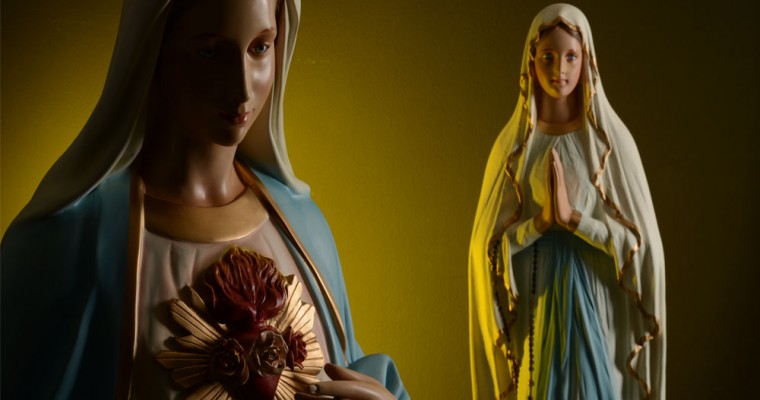
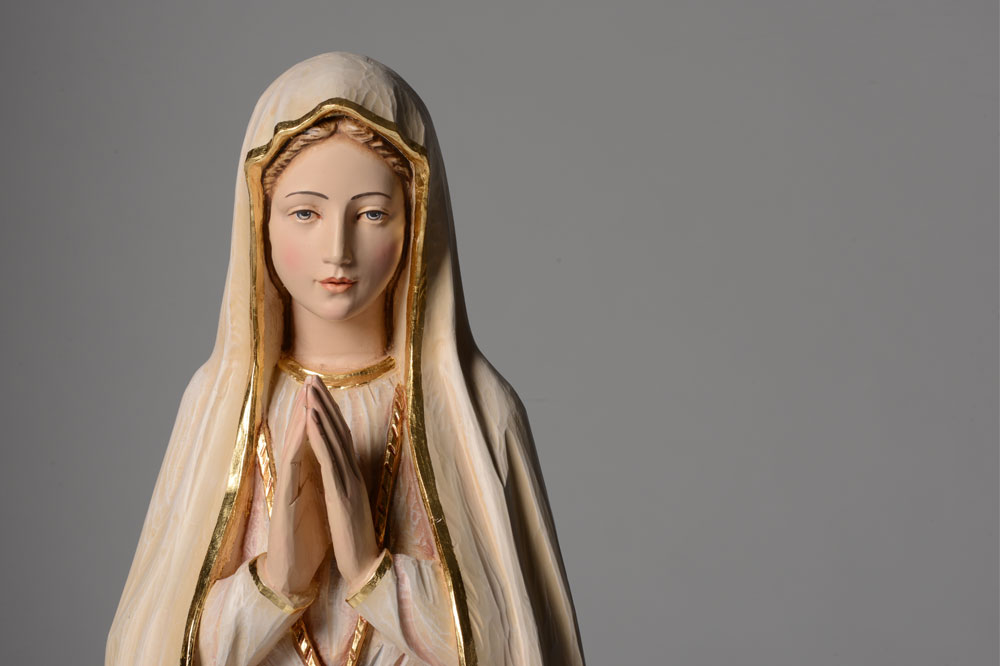
The statue of the Virgin Mary of Lourdes in the grotto, around which the Sanctuary was built, was made by Joseph-Hugues Fabisch according to Bernadette’s descriptions: it represents a beautiful and sweet woman, dressed in white, with a blue belt and golden roses at her feet. That’s the face the Virgin Mary chose to reveal to a simple and faithful maiden, and that image has been the official in classic iconography and for the realization of statues and pictures of the Virgin Mary ever since. An image of infinte beauty and comfort, a warmth that all devotees have never ceased to enjoy.

The importance of the right background for your do-it-yourself nativity scene

The importance of the right background for your do-it-yourself nativity scene

The creation of a nativity scene is a moment of great creativity, which tests imagination and screening ability of those who make it.  Especially if you decide for a do-it-yourself nativity, where every single aspect of the scenography is the outcome of personal initiative, of…

5 good reasons to buy candles online

5 good reasons to buy candles online

We have already spoken in a previous article about the importance of candles in religious celebrations. At home, but particularly within churches and shrines, their light is a constant call to the Light of God, and in particular to the figure of Jesus, the Light of…

All you need to know about the hosts and particles

All you need to know about the hosts and particles

The host is a wafer of unleavened bread, made with wheat flour, usually circular in shape.

The term ostia derives from the Latin hostia, “Sacrificial victim”, which used to indicate, in a generic way, a sacrifice made to a deity.

In antiquity and until the discovery of yeast, unleavened bread was the only type of bread consumed by men. It was produced by mixing water and flour and then cooked on hot stones or ashes.

For the Jews, unleavened bread was of historical, social and religious significance that transcended the use made of it as food. In fact it was consumed to recall the ancient Feast of the Primizie, during which the old yeast was thrown out, which would be used for the bread produced with the flours of the new harvest. After the Escape from Egypt, unleavened bread became a way of preserving the memory of that terrible journey, during which the Jews did not have time to make bread rise, and were forced to consume it unleavened.

The Christians gathered the tradition of unleavened bread, attributing to it a meaning and a value that laid the foundations of religion itself.

In fact it was Jesus Christ who, on the occasion of the Last Supper, blessed a piece of unleavened bread and offered it to his disciples, presenting it as his own body.

Then he took a loaf of bread, gave thanks, broke it, and gave it to them, saying, “This is my body that is given for you; Do this in memory of me.” Luke 22-19)

At the end of the supper, he took a glass of wine and offered it as his blood.

Likewise also the cup after supper, saying, “This cup is the new testament in my blood, which is shed for you”. (Luke 22-20)

last dinner icon
Last Supper Catholic icon 50x70cm, Romania

This is what Christians call Transubstantiation, that is, Consecration that actually transforms bread into the Body of Christ and wine into His Blood. This miracle is renewed at every Mass, when the Priest presents the Eucharist, raising the host (Elevation) before the faithful, and consecrating the bread and wine. This dogma ensures that, at every mass, every time we receive communion, the miracle of the Last Supper is repeated, the promise of salvation made by Jesus to all men with the offering of himself.

On the same occasion, Jesus conferred on his disciples the power to do the same, or to consecrate bread and the wine so that they would become His Flesh and His Blood, so that all men could feed on it, and in this way redeem themselves from sin. Thus began the diffusion of this practice, which has become, in some ways, the very core of the Christian celebration. Consecrated bread and wine stop being simple bread, simple wine. They assume the name of the Most Holy Eucharist, and they are sacred, so much so that any improper use, or blasphemous, is considered a mortal sin. Even simply the fact of breaking them or letting them fall requires special precautions that we will examine later.

Over time, the custom of offering the faithful only bread, in the form of a host, has spread, while wine is drunk only by the priest. For this reason also, bread, in particular, has over time taken on an ever deeper and more solemn value, so much so as to be the object of adoration even beyond the Eucharistic celebration. Once consecrated, the host becomes the Blessed Sacrament and is kept in the Tabernacle, the ‘dwelling’ of God in every church.

This is what makes the act of Communion, the Holy Eucharist, is miraculous: a small wafer of unleavened bread, prepared with water and flour, not unlike that used in the kitchen to prepare sweets, to cover nougat, or  children’s birthday cakes, printed in bright colours and with cheerful images, becomes thanks to the Consecration, the Actual Body of Christ. The host stops being a host, ceases to be simply bread, and becomes the Miracle of all miracles, the tangible symbol of the greatest sacrifice of love of all time.

But how is a host manufactured? What’s in it? Are all hosts all the same, or are there different types? Are there hosts for people with celiac disease?

The difference between a host and a particle

There is a slight difference between the Priestly Host, or the host consecrated by the Priest and raised before the assembled assembly, and the smaller ones offered to the faithful during the Eucharistic celebration. The latter are called particles.

How do they differ?

The host is, as we have already said, a wafer of unleavened bread worked into a circular shape. It is consecrated by the priest and by him, and him alone, consumed during the Eucharist.

Particles are on the other hand, the smallest hosts, given to the faithful who present themselves at the altar to receive communion. They too are consecrated and have in every way, the value of the Body of Christ.

For this reason it is necessary that both, hosts and particles, are handled with great care and respect.

hosts 500 pieces
Hosts 500 pieces

After the First Communion, in which a priest places the particle directly on the tongue of the child, the faithful can choose whether to continue in this way, or place the particle on their left hand and then bring it to their mouth with their right.  The Episcopal Conference authorised this method in 1989, but was previously considered blasphemous and inadequate by many Christians.

In order to preserve the Body of Christ from possible falls and profanation, it is recommended that the celebrants use a saucer, placed under the chin of the faithful, or a tablecloth, in the case of the priestly host, which is consumed by the priest, to avoid the Blessed Sacrament, or part of it, falling to the ground and being trampled on or desecrated. If this happens, the fallen host must be collected with respect and reverence by the priest and the spot washed with  water from the Purificator. Afterwards, the priest can clean the host and put it in his mouth.

If the host or the particle is damaged or soiled irrecoverably, it must be collected, placed in the water of the pot of the ablution and left in it to melt. Then the water is poured into the church shrine.

In recent years there has been widespread production of hosts and particles that are more difficult to crumble and drop, precisely to avoid these unpleasant situations during a mass.

The ingredients of a host

As already written above, the ingredients that make up the host are exclusively water and wheat flour, the same as unleavened bread. Adding other substances would make the host “invalid matter for the Eucharist“, as prescribed by the Congregation for the Doctrine of the Faith. The fact they were given a circular shape was dictated by practicality, even if it was established that since ancient times the bread used for religious celebrations was flat and round.

Hosts can be purchased easily from companies or shops that sell products to cook sweets, from pharmacies (in fact in some cases, hosts are used to take pills), from stores located near or inside churches and shrines. And nowadays, they are available in a wide range also in many online shops.

Hosts for those who have celiac disease

The important increase in cases of celiac disease and gluten intolerance among the population has made it necessary to produce celiac hate, made with flours with a minimum or non-existent gluten content.

celiac hosts
Gluten-free hosts
This allows Christians affected by this pathology to receive the Eucharist without problems. In practice, these are gluten-free hosts, or low in gluten, but which also contain the minimum quantities of wheat to be considered valid by the existing provisions on the subject of the Eucharist. The norms established by the Congregation for the Doctrine of the Faith in fact provide that the hosts necessarily contain wheat starch, even minimally: “The conditions of validity of the matter for the Eucharist are hosts in which the quantity of gluten is sufficient to obtain the bread without the addition of foreign materials and provided that the process used for their packaging is not such as to distort the substance of the bread“(Circular letter of 19 June 1995 to the Presidents of the Episcopal Conferences).

In many countries, however, the use of low-gluten-free wafers is not yet recognized as suitable. For this reason the AIC, Association of celiacs, has sent two letters to Pope Francis, praying to ensure that all the celiac faithful of the world can participate in communion with hosts suitable for their needs, or alternatively  for the use of hosts without gluten by everyone, at least for First Communion and Confirmation.

The types of host

The priestly hosts are those used by the priests for the Consecration. They are, as already mentioned, larger, even if there are of various types, which differ in diameter, according to whether they are used for church mass, or for bigger, more solemn celebrations, perhaps in large squares, outdoors. This would require a larger host, so that was visible to everyone.

In general, the hosts for the elevation differ therefore mainly in diameter.

concelebration hosts
Concelebration holy bread 27 cm

But there are also hosts that differ in consistency and crunchiness, or thickness, that is they are more or less thin. Darker bread wafers are also made, the taste of which we recall more than the real bread.

In addition to standard size hosts, many companies also supply those with customizable measures.

All hosts must be produced according to the liturgical norms in force, with a guarantee of genuineness and long life in storage.

The types of particles

Even the particles are available in more or less crunchy versions, and of various thicknesses.

They can be normal, ultra-thin, white or with the colour and taste of bread.

In particular, closed-edge particles, of Polish origin, are specifically designed not to crumble and to make it easier to receive in the mouth of the faithful. It is in fact essential that the Body of Christ never falls onto the ground, either in whole or in part.

Tips for facing the winter: infusions, herbal teas and syrup

Tips for facing the winter: infusions, herbal teas and syrup

Winter is a season that is beautiful in its own way, full of suggestive atmospheres, a unique light, a harsh climate, but one that evokes a desire for warmth and comforting intimacy, which inevitably takes us back to our childhood, when winter meant snowball fights…

Liturgical candles: when and why they are important

Liturgical candles: when and why they are important

Light has always had a very deep and essential meaning for men. There is no religion that hasn’t made it a key element in its mythology, no civilization that hasn’t celebrated it as an assimilable, if not overlapping, element to the very concept of life.…

Prayer rings: a gift made with faith and love

Prayer rings: a gift made with faith and love

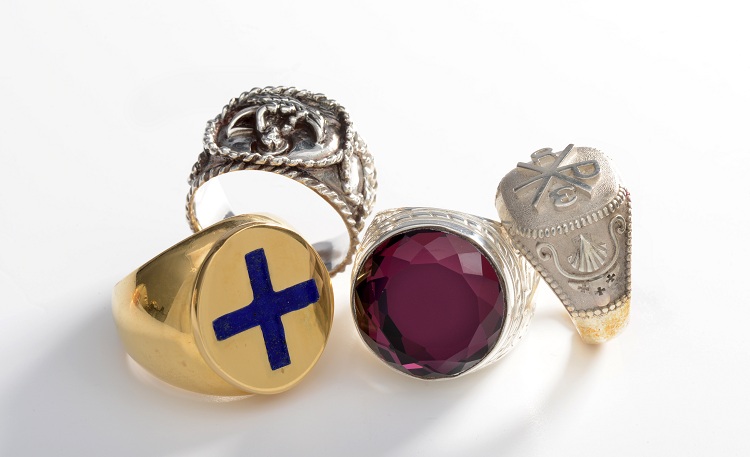
Among the sacred objects that can be worn, prayer rings deserve a special mention.

The symbolism of the ring is complex and has its roots in ancient traditions, drawn from various cultures and civilizations. It seems that rings have been widespread since the Bronze Age, and have always been the subject of particularly precise workmanship. The ring, by its very form, calls to infinity, to eternity, to divinity. It has no beginning or end, it is an Uroburo made matter. We recall that the Uroburo is an ancient symbol, which occurs in many different civilizations and religions, and represents, in fact, the infinite, in the form of a snake biting its tail.

At the same time, the ring expresses a sense of completeness and stability. Its closed form indicates a containment, the concentration of energies in a circumscribed place, somehow made sacredPrayer ring by its own configuration. Reminiscent of sacred constructions in times gone by, stone circles, and so on. For this reason, in Mesopotamian and Roman civilizations, it symbolized authority and power, and in this sense it was worn or used as a seal by ambassadors, kings, senators, and spiritual leaders, and used in this sense by priests as a symbol of veneration and their being with God.

Also in Rome, the custom of using rings for engagements and marriages had been widespread since ancient times. Once again the sense given to this ornamental object lay in the sense of stability that it expressed, but also in the expression of eternal union, a bond without beginning, without end, inseparability. On the occasion of the Sponsalia, the ceremonies that preceded the actual marriage service, after the various documents and legal agreements involving the spouses and their families were drawn up, the future bridegroom gave the fiancée a ring. It was not simply a gift, but a symbolic object with which the bridegroom tied the bride to himself, a chain that defined the possession of the latter by her husband. The woman, for her part, wearing the ring committed herself to belong only to the groom, and to be faithful to him forever. This ring was called anulus pronubus and was put on the penultimate finger of the left hand, the anularius, which was said to hide a vein connected directly to the heart.

Heraldry also acquired the symbolic meaning of a ring, offering it in various forms, as a sign of stability, eternal loyalty, and honour.

The symbolic value of the ring made it powerful even when it was broken. A broken ring foretold of calamities and misfortunes. When someone died, it was customary to remove the rings from their fingers, to make them easier to detach from this world. The Pope’s Fisherman’s ring was broken after his death. From this we also note the identification between the ring and earthly life.

In the Christian context, the ring is used in various ways and with different meanings.

There is the wedding ring, of course, which symbolizes the indissoluble bond that unites the spouses. As in Roman times, it is worn on the ring finger of the left hand, on the side of the heart.

Even some religious figures wear rings as a symbol of their union with the Church. We’re thinking of Bishops, who wear an Episcopal Ring on their right hands, as a sign of their fidelity to their dioceses, Abbots, Abbesses, and so on. Some communities of Nuns wear a ring as a sign of marriage to Jesus, referring to the tradition of Saint Catherine of Siena, who in one of her mystical visions claimed to have met Christ who, accompanied by the Virgin and a host of saints, gave a gift of a visible ring to her alone, with which he had married her and consecrated her to himself.

The use of rings as religious symbols remains to this day, and over recent years has undergone a revival with the spread of the prayer rings and rosary rings.

What does these entail?

Rosary rings

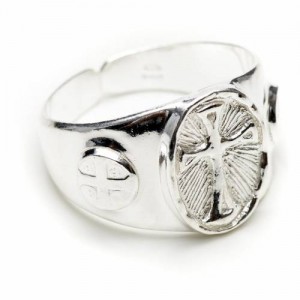
Rosary rings are genuine, miniature rosaries, which enable us to pray by turning the ring around a finger and rubbing the various beads with the thumb and forefinger. These rings are used in such a way as to present a small embossed crucifix and a series of raised grains, which are used just like those of the traditional rosary. Rosary rings, or ring rosaries, are also called dozens rosaries, and can be genuinely beautiful and refined objects, often enriched by precious stones, crystals, and made of noble metals like  gold, silver and platinum. This is why they can be important gifts for special occasions and ceremonies. Robust and resistant, they can be used at any time, in absolute practicality, even while engaged in other matters.

A rosary ring should be worn in the index finger of the dominant hand, just below the knuckle, so that it can be turned easily.

Naturally the gestures of the rosary ring differ from those of a traditional rosary. Here’s how you can pray with a rosary ring:

  1. Make the sign of the crossrosary rings
  2. Turn the rosary ring so your thumb can touch the crucifix engraved on it and recite the Creed and then the Our Father.
  3. Turn the rosary ring to the right (left if you are left-handed) until your thumb touches the beads placed three spaces from the cross. Recite the Ave Maria.
  4. Move your thumb on the forefinger, near the crucifix, on the left if you are right-handed, on the right if you are left-handed, and recite a second Ave Maria.
  5. Move your thumb to the next bead and press down as before. Recite the Hail Mary three times. Move your thumb to the crucifix, press down and recite the Gloria.
  6. With the thumb pressed on the crucifix recite the first mystery.
  7. Move your thumb to the right, closer to the grain of the crucifix, push down and recite three Hail Marys.
  8. Continue to turn the rosary and recite a Hail Mary for each bead. When you return to the crucifix, recite the Gloria.
  9. Recite the following Mystery, until you have reached the five mysteries for the day.
  10. Recite the Salve Regina, touching the crucifix after the fifth and last Gloria.
  11. Make the sign of the cross

Prayer rings

Another popular religious object is the prayer ring. This is a ring, usually made of steel, but also bronze or silver or decorated with coloured enamel, on the walls of which a prayer is engraved, most often the Our Father or Ave Maria. These are aesthetically very beautiful and special rings, which can be elegant and unique fashion accessories, but which also symbolise, to the faithful, a constant and continuous bond with God, a never exhausted dialogue that is consumed every day, in every small gesture. The prayer ring accompanies the wearer throughout the day, and becomes an excuse for many small moments of recollection, thoughts addressed to Jesus or the Madonna, whispered, like an invisible friend walking beside us, at all times.

In addition to being prestigious gifts, in their meaning of religious jewels and art objects, prayer rings are also purchased by those who want to use them for themselves, as instruments of faith and devotion. A pleasant routine in which to indulge, to remind you that you are never really alone.

Electric candles: when a cult loses its sacredness

Electric candles: when a cult loses its sacredness

When we think of a church, the first image that is formed in our mind is probably that of a known religious building, with a bell tower, the Cathedral of our city, or perhaps a place of worship that is particularly dear to us for…

Trees and plants in the Christian tradition

Trees and plants in the Christian tradition

In ancient times, the relationship between man and nature was much closer than itis today. Everyday life was inextricably linked to the alternation of the seasons, atmospheric precipitations, excessive heat, or excessive cold. Our ancestors certainly did not live an easy existence, victims of a…

The hour of Mercy

The hour of Mercy

Mercy This is a word that often comes up when we talk about Our Lord.

Mercy: origin and meaning

The term derives from the Latin misereor (I have mercy) and cor -cordis (heart), but conceptually it has always existed, in the context of the Christian religion. We could define it as a kind of profound empathy, a movement of compassion inspired by the suffering of others. It is a feeling that moves the heart to pity when confronted by the physical or spiritual pain of another person, which pushes us to open up, to cloak, with a transcendent and beneficial embrace, those who are near to us, to help them, and to save them.

Mercy is a fundamental component in the life of a Christian. It is no coincidence that many of the religious and secular brotherhoods, have always engaged in the works of charity and in helping the needy, have names that derive from Mercy, or contain it. One thinks of the Venerable Arciconfraternita della Misericordia, founded in Florence in the thirteenth century to help plague victims, the Priests of Mercy, the Sisters of Mercy, the Daughters of Mercy, and so on.

The Catholic religion holds this sentiment in high esteem, as the true impulse of the Christian, an internal impulse that manifests itself in generous actions, good works, charitable and human attitudes towards the less fortunate and, in general, towards all brothers.

The Madonna is often invoked as Madonna della Mercede (of Mercy), depicted as she opens her own large cloak to welcome the faithful around her, offering them its shelter and protection.

In the Old Testament, it is written that God is merciful. In the Book of Exodus, for example, he addresses Moses thus: “The Lord, God merciful and compassionate, slow to anger and rich in love and fidelity” (34.6).

A merciful Father, therefore, who loves his children with tenderness, who protects them, helps them, is ready to give himself entirely for their welfare, and their salvation. A Love that does not need to be returned to be love, like that of a mother, without any limits, almost thoughtless. A special love addressed to all of us, in the name of which God became human and sacrificed himself, accepting a cruel and unjust death, enduring the greatest of evils, to give us hope.

The hour of Mercy

The Misericordia takes on a further specific meaning if associated with a particular context, at a particular moment in the life of Jesus: we speak of the Hour of Mercy.

Whenever you hear the clock striking three o’clock, remember to immerse yourself in My Mercy, to adore and exalt it;  invoking his omnipotence for the entire world and particularly for the

Merciful Jesus Val Gardena
Divine Mercy with
blue and red rays

poor sinners, since it was at that hour that he threw himself open for every soul (1572)”

These words were written in the diary of Sister Maria Faustina Kowalska, a young Polish nun, a propagator of devotions to the merciful Jesus and considered to be the Apostle of Divine Mercy.

The Hour of Mercy corresponds to three o’clock in the afternoon, the exact time Jesus died on the cross on Good Friday. The climax of His agony, the moment of His death.

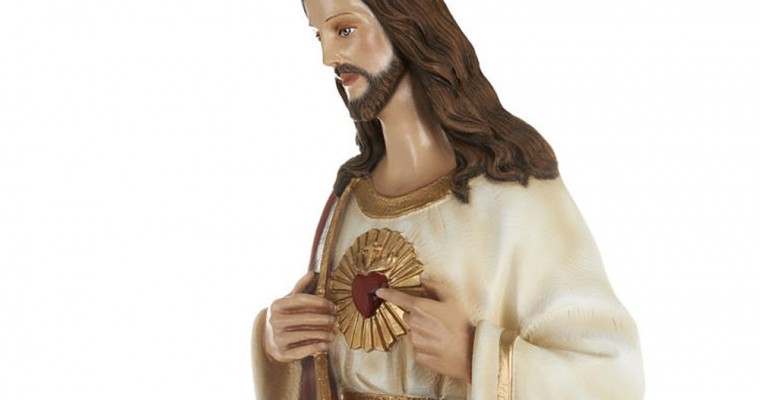
Sister Maria Faustina contributed enormously towards disseminating the cult of Divine Mercy. Her intense mystic life, the numerous visits she received from Christ, led to codification of this particular form of devotion and to the representations of the Merciful Jesus, who is portrayed dressed in a white robe, with one hand raised in a blessing, the other placed on his chest, from which two huge rays depart, one red and the other white.

Good Friday. At three o’clock I saw Jesus Crucified looking at me and saying, “I am thirsty.” Suddenly, I saw that the same two rays in the picture came out of His side. At the same time I felt in my soul a great desire to save souls and to destroy myself for poor sinners. Along with Jesus in agony, I offered myself to the Eternal Father for the salvation of the world. With Jesus, for Jesus and in Jesus, I am united with You, Eternal Father“(Diary of Santa Faustina, #648).

An invitation to prayer, therefore, but also an invitation to Mercy, to sacrifice for the weakest and  most unfortunate of our brothers. The vision of Jesus aroused in the Holy the uncontrollable desire to imitate him, to sacrifice themselves like him for the salvation of sinners, and of all the souls of the world. Because in the moment of the greatest sorrow He was capable of the most immense love, a love that brought us closer to God and makes us part of His Mystery.

It was Jesus who asked the Saint to paint an image that would show the way, so that it could be understood by everyone and venerated. Jesus also told her that he wanted the first Sunday after Easter to become the feast of Mercy.

Pope St. John Paul II, who beatified Sr. Maria Faustina, confirmed the feast of Mercy on that day.

The chaplet of the Divine Mercy

In another revelation, Jesus taught Sister Maria Faustina a special prayer: the Chaplet of Divine Mercy .  Jesus accompanied this gift with the words: “My mercy will envelop in life, and at the hour of death, those souls who recite this chaplet.”

Rosary with Padre Pio and Merciful Jesus in wood
Rosary with Merciful Jesus in wood

In fact, the Chaplet of Mercy ensures the grace of conversion and the forgiveness of all sins, especially if recited at the point of death.

In particular, the Chaplet manifests all its effectiveness if recited in conjunction with the Hour of Mercy. Reciting it at three o’clock in the afternoon, the time Jesus’ death is honoured, one meditates on his agony, and on his immense sacrifice. From this meditation and the prayer that accompanies it, the spirit should feel in some way infected by the Mercy of God, which thanks to the faith and the devotion of those who pray, extends to the entire world, even to the most undeserving, in an outpouring of love and pity.

Whenever you hear the clock striking three o’clock, remember to immerse yourself in My Mercy, to adore and exalt it;  invoking His omnipotence for the entire world and for poor sinners in particular, since it was at that hour that he threw himself open, for all souls (1572).” In that hour, you will receive everything, for yourself and for others. At that hour grace was granted to the whole world – Mercy was victorious for justice“(Diary of Santa Faustina, 1572).

[…] At that time, try to do the Via Crucis if your commitments allow it, and if you cannot do the Via Crucis, enter the chapel at least for a time and honour my heart, that in the SS. Sacramento, is full of mercy. And if you cannot go to the chapel, gather in prayer at least for a brief time where you are […] In that hour, you will get everything for yourself and for others (Diary of Santa Faustina, 1572). In that hour, I will not refuse anything to the soul that prays for My Passion“(Diary of Santa Faustina, 1320).

Therefore, the practice of the Hour of Mercy is training for the soul, as well as a way to protect and guarantee salvation to all. It is enough to dedicate a brief moment of prayer to God, at three o’clock in the afternoon, to gather for a in a private and special conversation with Him, to feel part of His plan of love, and to remember how precious and unique it is.

The various meanings of liturgical clothing

The various meanings of liturgical clothing

The term liturgical clothes, or  liturgical vestments, generally indicates the clothing used by priests of various ranks in the context of religious ceremonies and festivals. These clothes differ in various characteristics and, in particular, vary in colour, depending on the time of year and the…

The apparitions of Our Lady of Guadaloupe

The apparitions of Our Lady of Guadaloupe

By the Apparitions of Guadalupe, we refer to the four appearances of Our Lady to Juan Diego Cuauhtlatoatzin, an Aztec convert to Christianity. These apparitions took place within a few days of each other in December 1531, on Tepeyac hill, near Mexico City. The definition…

The cult of Archangel St. Michael

The cult of Archangel St. Michael

St. Michael the Archangel is one of the three archangels recognized by Christianity, and not just that.

His figure is in fact the object of worship and veneration also by other professions of faith, such as Judaism and Islam. Indeed, he is recognised by all of them as the Archangel par excellence, before this term was used for Gabriel and Raphael. His name means “Who is like God?”, His symbols have always been the sword, or the spear and the armour. Michael is a celestial warrior, indeed, the warrior, commander of the angelic hosts, the one who led the armies of Paradise against Lucifer and his rebels, driving them over the clouds and making them fall to Hell.

For the Muslims, he was the angel who, together with Gabriel, instructed Muhammad with the Koran, an austere and shady angel who never laughed. Some traditions, especially Eastern ones, represent it with a balance in hand, intent on weighing and judging the souls of the dead.

St. Michael the Archangel is an emblematic figure, which crosses the history of Europe, not only the religious, object of veneration by the Byzantines and the Lombards, compared by the latter to the God Odin, which traced the warlike virtues and the war dimension , and elsewhere in Hercules, Mitra, Hermes. His cult has spread to the East and West, leading to the construction of places of veneration placed along a straight line, the so-called Sacred Line, which connects Ireland with Israel, passing through England, France, Italy, Greece.

Patron of many cities and towns, Protector of the Jewish people, Guardian of the Catholic Church, Protector of the Sick and Paramedics; of the Police Forces, from the Police to the Sailors, from the Paratroopers to the Firemen; Radiologists and Grocers and all those who use scales, such as pharmacists, pastry chefs, merchants; of swordsmen, masters of arms; of the gilders; of the manufacturers of tubs,

It is definitely worth knowing it better.

History of Archangel St. Michael

Saint Michael the Archangel in the Bible is mentioned five times, and always as the supreme head of the heavenly army.

Once upon a time he and Lucifer guided the divine militias together, as the most shining among the angels, the strongest, the bravest, the closest to God.

Revelation 12.7-8: 7 Then a war broke out in the sky: Michael and his angels fought against the dragon. The dragon fought together with his angels, 8 but they did not prevail and there was no more room for them in heaven.

After the treason of Lucifer, after his rebellion, the perfection represented by these two angels was broken, and became bitter enemies. Michael made the war against his old brother the reason for his very existence, driving him from heaven, persecuting him through the millennia, defending humanity from its snares and its temptations. Since then the Archangel Michael has become the punisher of all those who rise up against God, the proud, the defenders of the Faith, of Truth, of the Church itself.

As we’ve already written, its name derives from the Hebrew Mi-ka-El which means “who is like God?”

“Archangel” derives from the Greek and is a word composed of àrchein, “comandare” and ànghelos, “messenger”). So the Archangels, and Michael in particular, are those who command the other angels.

Often the cult of St. Michael is intertwined with that of the Virgin Mary. Both fight against the devil, both are represented as they crush it under their feet, in the form of a snake or a dragon. Both, above all, are protectors of humanity, against its flattery, and guardians of God’s flock against Evil. According to an ancient tradition, St. Michael the Archangel will be the one who will play the trumpet of the Judgment announcing the end of the world.

St. Michael the Archangel is celebrated together with the other two Archangels, Gabriele and Raffaele, on 29 September.

Archangel

Read more:

Archangels: who are they and what is their function?
The Catholic Church recognises the existence of only three Archangels, or the three mentioned in the Scriptures: Michael

We have already mentioned how the cult of St. Michael the Archangel spread from East to West, and how its spread in the West was due in large part to the Lombards, who adopted it the sixth century, on the occasion of their travels to Italy, as a great devotion and erected many religious buildings in his name, including the Sanctuary of San Michele Arcangelo on Monte Gargano, in Puglia.

Here, where today stands the village of Monte Sant’Angelo, with its splendid sanctuary dedicated to San Michele, it is said that the Archangel appeared to the young archer Galgano, while he was chasing a marvellous white bull. Through the intercession of the Archangel the arrows thrown against the bull came back and struck his hunter, who converted to Christianity.

It was Pope Gregory the Great who brought the Lombards to conversion, above all thanks to Queen Teodolinda. Saint Michael immediately liked these ferocious warriors from the north, because he embodied Odin’s talents, and chose him as protector. Thanks to the Lombards the cult of San Michele spread throughout northern Italy.

Even today there are testimonies of this diffusion in Pavia, former capital of the Lombard kingdom, and in the Val di Susa, in Piedmont, where the Sacra di San Michele still stands, a monastery perched on the peak of Mount Pirchiriano, which was for centuries used by pilgrims between Italy and France. This superb architectural complex was inspired by Umberto Eco for his novel ‘Il Nome della Rosa’.

 The sacred lay line of Archangel St. Michael

We have also spoken about the sacred line that connects all the most important places of worship dedicated to St. Michael the Archangel, otherwise known as the Ley Line of St. Michael:

  • Skellig Michael in Ireland
  • St Michael’s Mount in Cornwall, England
  • Mont Saint Michel in Normandy, France
  • the Sacra di San Michele in Val di Susa,
  • San Michele, Monte Sant’Angelo, Puglia
  • San Michele Monastery on the Island of Simi, Greece
  • Monastery of Monte Carmelo in Israel.

Besides being along the same, imaginary straight line, three of these important places are also equidistant from each other: these are Mont Saint Michel in France, the Sacra di San Michele in Val di Susa and the sanctuary of Monte Sant Angelo on the Gargano.

“Ley Lines” are straight lines that join places on the Earth that have always been considered special, perhaps energy nodes of the planet, whose meaning is impossible to trace. The Ley Line of St. Michael, or Ley Line of the Dragon, is, among other things, perfectly aligned with the setting of the Sun on the day of the Summer Solstice. It is therefore no secret that, since ancient times, the cult of Archangel St. Michael has been studied from many perspectives, following suggestions that often transcend religion and the spiritual value of places of devotion.

Prayers to the Archangel St. Michael

We have already mentioned that sometimes the cult of St. Michael the Archangel is associated with that of the Virgin Mary. Both are emblems of the fight against evil, both are guardians and protectors of humanity, both fight the Devil, crushing him under their feet, driving him to hell.

Prayers which are addressed to St. Michael the Archangel are above all requests for help, protection.

The Prince of the Celestial Militia relies on it in the everyday troubles, but also in view of the Last Judgment. It is invoked as a guide, as a protector, as a shield against evil and support. Never as in the prayers addressed to other Saints it is clear that the invocations to St. Michael the Archangel are real weapons of faith, to be challenged in daily battles. And how could it be otherwise, given the iconography that characterizes this beautiful and implacable Archangel? Since the origins of his cult, therefore, invocations, consecration, angelic crowns were dedicated to St. Michael the Archangel.

One prayer in particular deserves further study. It was written in October 1884 by Pope Leo XIII, following a frightful vision in which the Devil threatened to destroy the Church and Saint Michael stood in his defence. Leo XIII made it law that this prayer be recited at the end of each mass, and inserted it among the most powerful exorcisms, in Exorcismus in Satanam et Angelos Apostaticos. This exorcism hides a prophecy that touches us closely, given that the exorcism dates back to the nineteenth century, and speaks of events that would take place in the immediate future.

According to the prophecy, Lucifer and his allies will take control of the Papacy, but nevertheless they will not succeed in destroying the Church. Exorcism can only be recited by an authorized priest, but the prayer written by Leo XIII can be recited by the faithful, and although it is not as efficacious as exorcism in the case of overt possession, it can prevent possession from taking place, protecting those who have been targeted by the evil one.

We report only the abbreviated version reported by the Roman Ritual and published in 1902:

Glorious Prince of the Celestial Militia, Archangel Saint Michael,

Defend us in this ardent battle against all the powers of darkness and their spiritual malice.

Come to the aid of men, whom God created immortal, made in his own image and likeness, and redeemed at a great price from the tyranny of the devil.

You are revered by the Holy Church as her guardian and patron, and to you, the Lord has entrusted the souls who will one day occupy the heavenly seats. “Oh, pray to the God of peace, that He may put Satan under our feet, conquered so resoundingly that he will no longer be able to hold men in captivity and harm the Church.

Present our prayers to the Most High, with your own, so that His Divine Mercies will descend upon us soon, and you can chain the dragon, the ancient serpent Satan, and throw him into the abyss. Only in this way will he seduce souls no longer.

Since the prophecy and exorcism of Leo XIII, it is clear that now, more than ever, the gravity of what is happening around us, the succession of wars, suffering, prevarication, which are now so frequent and constant they have been normalised, and are taken for granted, requires the intervention of a benign force, equipped with the appropriate weapons to defeat evil. The Archangel St. Michael is a symbol of inexhaustible spiritual strength, courage, loyalty, purity still capable of guiding and saving souls who wish to follow the right path.

Another prayer dedicated to St. Michael the Archangel worth mentioning is the angelic Crown, composed by Antonia de Astonac, a Portuguese Carmelite, in 1751. Recognised by Pope Pius IX, it is a sort of Rosary which is addressed above all to the Archangels and the angelic choirs. It is in fact made up of an invocation to God (Gloria), an invocation (composed of one Our Father and three Hail Marys) for each of the nine angelic choirs, and four Our Fathers, three for each of the Archangels and one for the Guardian angel.

Representations of St. Michael the Archangel in art and the collective imagination

In general, the salient features with which Saint Michael Archangel is depicted are armour, a sword, or a spear, with a warlike posture. Since the cult of St. Michael the Archangel was founded in the East, or in any case in the Byzantine area,  he is very often depicted with elegant robes, like a Byzantine dignitary, as can be seen in many of the icons of St. Michael the Archangel, as well as in the works of Simone Martini, for example.

In this context, the Saint is usually dressed by a purple cloak or the imperial loros; in his hand he carries the Labar, a banner bearing the trisághion, an ancient anthem, bearing the text: “Holy God, Holy Strength, Holy Immortal, have mercy on us.” As regards the Byzantine’s devotion to St. Michael,, it is worth remembering that Emperor Constantine I had the Michaelion built in his name in Constantinople, a huge sanctuary, while in the West the first basilica dedicated to St. Michael probably dates back to the fifth century.

As regards Byzantine iconography, the western tradition prefers Saint Michael presented at the Apocalypse, a as  celestial warrior, a prince in armour with his wings spread, who guides the divine armies against the Evil One. The Archangel Michael is generally depicted on foot, in the form of a young beardless, hieratic man, with his wings spread, a spear or a sword in his hand, and a crossed globe in the other. He wears a flowing tunic, sometimes a cloak, but is always the armour.

On the contrary, we owe the Islamic tradition the occurrences, in some representations of him, to a scale, that the Archangel uses to weighs souls, with a view to their Judgement. This is a tradition that has its origins in paganism, in particular in the Egyptian myth of Osiris, and in Persian mythology, but has been portrayed by many artists. It spread, particularly in the Romanesque-Gothic context, to both the East and West. In this interpretation, St. Michael the Archangel appears as protector of the dead, their psychopomp or guide, as was Hermes or Charon in the Greek tradition, and as a weigher of souls.

Moreover, the iconography of Saint Michael, as he appears in the icons, paintings and statues that depict him, owes much to that of gods and heroes of pagan mythology, in which a heroic figure appears at the end of time, and defeats Evil, which is often represented by a monster. Think of the Babylonian god Marduk, of Mithras, or Hermes, all of them are connected by the characteristic of being a mediator between the heavenly powers and man, the bearers of light and salvation, which we also find associated with St. Michael.

As regards the statues dedicated to Archangel Michael, they are innumerable, and again take on the pictorial iconography of the warrior armed with a sword that defeats the Devil, or a Dragon, as well as the more oriental interpretation of a St. Michael who judges the souls of men.

In addition to the Byzantine and Romanesque bas-reliefs, of which there are many examples all over the world, we can consider in particular the Statue of the Archangel Michael in the Basilica at Monte Sant’Angelo, or the numerous statues of San Michele that succeeded on the top of Castel Sant ‘Angelo in Rome, the first, in wood, since the eleventh century, and finally, the San Michele di Raffaello  by Montelupo, made from marble and metal, with magnificent painted wings, which unfortunately have been lost, and  the bronze statue by Peter Anton van Verschaffelt, which was erected in 1752, and even today, watches over the Eternal City.

The roles of Altar Servers

The roles of Altar Servers

Altar Servers, more commonly known as altar boys, are children or teenagers who assist a priest during Mass. Their name comes from the Latin word “ministrare” which means ‘’to serve’’. Their role is recognized by the Conciliar Constitution as an integral part of the liturgic…

Way of the Cross for children: how to tell your child about the 14 stations

Way of the Cross for children: how to tell your child about the 14 stations

It is not easy to explain certain things to a child. Not even for modern children, used to witnessing impressive scenes on television every day, bombarded on all sides by disturbing images, suggestions, media solicitations completely disrespectful of their age, the fragile condition of their…

Sacred or profane favours?

Sacred or profane favours?

Baptisms, Communions, Marriages: what do these three occasions have in common? We guess that the first thing that for many of you, the first thing that came to mind was: the favours. And it’s perfectly true. On the occasion of all these celebrations, it is traditional to distribute small items to keep to invited relatives and friends, as a thank-you for taking part, and to leave them with a memory of the event, accompanied by confetti. Boxes, frames, and over recent years homemade jams, books, objects of all kinds, depending on tastes, or, for children who are celebrating a Baptism or Communion, the tastes of their parents.

There’s nothing wrong with any of this, except that, in recent years, the true meaning of these ceremonies seems to have been lost, and some favours have to some extent played a role in this progressive oblivion. The reason is simple: more and more often we choose to give guests ‘profane’ favours, which have little or nothing to do with the sacrament that they should commemorate. Baptism, First Communion and Marriage are, indeed, sacraments, and as such they should be remembered with something that emphasizes its religious significance, its spiritual importance.

So the choice is between sacred or profane favours, but how should we move in this colourful and infinitely varied world, made of tulle, ribbons, precious and delicate materials, and, above all, of delicious colourful sweets?

The history of the candy box

The candy box has been a recurring object in the history of the West for centuries. Its origins are rooted in the custom of making small containers full of sweets or ‘gluttons’ for friends and relatives on special occasions, not necessarily marriage, even if it seems that in Italy it was already common in 1400 to exchange boxes filled with sugared almonds the spouses. Even in fifteenth century Italy, a future husband often gave his future bride an amatory cup, which depicted a female face inside, or alternatively the effigy of a pregnant rabbit: drinking together from this cup was a guarantee of good fate, prosperity and fertility.

More generally, these containers were widespread since far more remote times. Its presence is attested to by the Assyrians, the Phoenicians and ancient Chinese civilizations. Often they were made of precious materials, like gold, silver, mother of pearl and ivory, and were offered as a sign of gratitude, good wishes, for example for the new year, or friendship.

The ladies of high society, at the court of Elizabeth I of England, had these little boxes (the “Sweetmeat boxes”) that were real works of art, filled with small and delicious sweets to savour in every moment.

It was however in the 18th century that wedding favours were officially associated with the sacrament of Matrimony. Also in this context, it assumed the name with which we know it today, a favour, in fact, from “bombonniere”, a container destined to welcome bon-bon.

Regardless of their use, these small containers for sweets grew in popularity and spread over time, and thanks to the work of skilled artisans and goldsmiths, they became increasingly beautiful, precious and coveted. In addition, their use in the nuptial context enhanced the religious and spiritual meaning, which subsequently determined its use also on the occasion of other important sacraments, such as the Baptism and the Communion.

Therefore the very history of the wedding favours sees sacred and profane motivations intertwine, but it is undoubted that the diffusion of these objects on the occasion of the ceremonies and celebrations is to be found precisely in their being symbols of religiosity.

The confetti

Only some curiosity about the confetti, which are traditionally contained in wedding favours, regardless of their shape, usually in bags of tulle or fabric. The confetti must be in odd quantities, and usually five, to symbolize health, wealth, happiness, fertility, longevity. Even the composition of the candy, or an almond covered with coloured sugar, is not accidental: the almond has a sweet taste, but with a bitter background, as is often the life, while the sugar that covers it symbolizes the will by those who love the celebrated or the celebrated to sweeten their existence and make it lighter.

The colour of the confetti changes according to the ceremony, even if for the sacraments usually white is preferred, with a pink or blue concession for the Baptism of little girls and children.

Sacred favours for Baptism

Baptism is the first big party in the life of a Christian. It determines its entry into the Church, through the purification from the original Sin. The following sacraments will in many ways be a confirmation of this participation in religious life. It is therefore important that the ceremony of baptism be accompanied by a party that solemnly highlights this fundamental passage.painting holy family leaf shaped
Often the celebrated is too small to fully appreciate it, but those who will be invited to participate in this so precious event will have to cherish a memory that recalls its profound significance. Even more than on other occasions, therefore, the choice of sacred favours for Baptism it is desirable.

This does not mean giving up colourful and beautiful objects, far from it! The religious favours made for the baptism of children take into account the age of the celebrated and the occasion that is going to celebrate. There are many types and colours; cross-shaped party favours, but also of an angel, of heart or favours in the shape of a vine leaf. They are decorated with drawings and engravings often made with a childish and playful stroke, painted in bright colours. If they represent the Holy Family, they will do it with colourful children and the features of children. Beautiful sculptures that represent a large hand that collects and protects a child inside, like a casket that contains a precious jewel.

Sacred favours for the Communion

Also the First Communion represents a fundamental passage in the life of a young faithful, because it represents the first time in which he or she approaches the Eucharist. It is still, usually, children and girls, but no longer unaware, like the baptized. Indeed, those who are preparing to receive First Communion do so after a long journey of Catechesis, which has educated them on the story of Jesus and made them aware of the importance of the sacrament who are preparing to receive.

Also in this case the sacred favours for the Communion they will favour childish, colourful and graceful images, even if with a more mature and conscious symbolism. I widespread squares with the image of the spike or bread, symbols of the Body of Christ that nourishes, or of the vine leaf, of the bunch of grapes and of the Wine that symbolize the blood of Christ that quenches thirst. Also for the Communion recur the forms of the dove, of the angel, of the hands that protect or that, arrived in prayer, remind to the celebrated its new duties of Cristiano.

Sacred wedding favours for the wedding

The choice of sacred favours for the wedding It is considered fundamental by many future brides. Also in this case it will be important to consider not only personal tastes, but also the true meaning of the step that is about to take place. Marriage more than any other sacrament had its consecration in favours, since it is precisely in the context of this celebration that the tradition of wedding favours was born.

So even in this case the choice of religious favours is varied and not attentive to fashion, trends, as it should be. Choosing sacred favours does not mean necessarily having to give up a trendy wedding and that also satisfies the desire for beauty. There are splendid religious favours made of crystal and silver, adorned with amber and Swarovski crystals that can rival peacefully with many furnishing accessories and with objects present in the most refined wedding lists. It is important for young married couples to realize this fundamental point, because too often, despite choosing marriage in the Church, in organizing the ceremony and the reception, one tends to forget the spiritual component of this passage, its most authentic and deepest meaning.