Author: Redazione

Basilica of San Zeno: the bronze tiles of its famous portal

Basilica of San Zeno: the bronze tiles of its famous portal

Contents1 The Basilica2 The altarpiece of San Zeno3 The panels of the portal of the Basilica of San Zeno on Holyart The Basilica of San Zeno in Verona is one of the masterpieces of Lombard Romanesque. Its portal, composed of 73 bronze tiles, tells a…

Natural hardstones: list by name and meaning

Natural hardstones: list by name and meaning

Contents1 Aquamarine2 Amethyst3 Coral4 Hematite5 Garnet6 Lapis Lazuli7 Malachite8 St Lucy’s Eye9 Tiger’s Eye10 Onyx11 Pearl12 Moonstone13 Lava Stone14 Rose Quartz15 Turquoise16 Topaz Precious or semi-precious, natural hardstones have always represented a valuable resource for the manufacture of ornaments and jewellery. But some also have…

What is the difference between a duomo, a cathedral and a basilica? Let’s clarify

What is the difference between a duomo, a cathedral and a basilica? Let’s clarify

What is the difference between a duomo and a cathedral? And between a cathedral and a basilica? Three types of religious buildings that are similar to each other, yet defined by precise characteristics

In the world of religious architecture, one often hears about Duomos, Cathedrals and Basilicas. We are so accustomed, from childhood, to hearing these terms, which define the religious buildings in our cities, that we tend to think they are interchangeable. In reality, they identify very different religious buildings and represent distinct and specific concepts within the Catholic Church. What is the difference between a duomo and a cathedral, and why is a basilica defined as such? To clarify these three types of religious structures, let us examine their main differences and the characteristics that distinguish them.

What is a duomo?

The term “Duomo” is often used to refer to the main church of a city, particularly in Italy, but also in Europe. The term refers to the religious function of the structure and its role as the principal church of a diocese or a region, but it does not necessarily mean that the Duomo is also a Cathedral. It may be, but it is not necessarily so. The Duomo is the house of God, as suggested by the word itself, from the Latin Domus, meaning house, and it is also the most prestigious and important church in the city. The Duomo is defined as a Cathedral when the city hosts a bishop’s seat, that is, the episcopal “cathedra”, the throne on which the bishop sits. Let us think of one of the most famous cathedras in the world, that of Saint Peter in the basilica of the same name in Rome.

Chair of Saint Peter

Read more:

The Chair of Saint Peter: the meaning of the work and the origins of the feast
What is meant by the Chair of Saint Peter? What is and where is this precious artefact? What is celebrated

One of the main characteristics of a Duomo is its central location. The Duomo is usually situated in the heart of the city or of the diocese it serves, and it is often a significant landmark for residents and visitors.

Moreover, the Duomo stands out from the other churches in the city due to its size and magnificence, for its imposing presence and architectural beauty. Duomos are often decorated with frescoes, sculptures and artistic stained-glass windows.

In one city there may also be more than one Duomo.

What is a basilica?

The term Basilica, from the Greek *basilikós* meaning “royal”, signifies the house of the king. Within the Catholic Church, the term has been adopted to mean the house of the Lord. It is often associated with churches of particular historical or religious importance, although not all basilicas are cathedrals or duomos. They may be parish churches or other structures which have nonetheless distinguished themselves through something unique and special that sets them apart. The designation of “basilica” is in fact granted by a special act of the Holy See and is an honour reserved for churches that have demonstrated significant religious or historical importance.

The main characteristic of a basilica lies in its special designation, namely the official recognition by the Pope, who selects it based on its historical, religious or cultural importance. Unlike cathedrals, basilicas do not necessarily represent the religious centre of a diocese and are not necessarily linked to episcopal administration.

Some basilicas are among the most visited places of worship in the world, destinations of pilgrimage and devotion for faithful people coming from everywhere. We have already mentioned Saint Peter’s Basilica in Rome, an ancient Constantinian basilica built on the site of the burial of Saint Peter and which has become the heart of the Catholic Church worldwide. But Rome hosts other famous basilicas, which are visited every year by thousands of pilgrims and contain the Holy Doors: the Basilica of Saint John Lateran, the Basilica of Saint Paul Outside the Walls, and the Basilica of Saint Mary Major.

Among other examples of famous basilicas, remaining in Italy, we can also think of the Basilica of Saint Zeno in Verona, one of the masterpieces of Lombard Romanesque architecture, with its portal composed of 73 bronze panels depicting stories from the Old Testament and the life of Saint Zeno, or Saint Mark’s Basilica in Venice.

The Seven Churches Tour

Read more:

The Seven Churches Tour: pilgrimage itineraries for the Jubilee
The Seven Churches Tour is an ancient devotional itinerary still undertaken by…

Worldwide, the Basilica of Our Lady of Guadalupe, located on Tepeyac Hill near Mexico City and dedicated to the Virgin of Guadalupe, the protector of all Spanish-speaking peoples and patroness of the Americas, and the Basilica of the Holy Sepulchre in Jerusalem, a spiritual reference point for Christians from all over the world and of every denomination, are also famous.

Like cathedrals, basilicas have often been decorated with frescoes, mosaics, sculptures and stained-glass windows, and their beauty makes them even more appreciated by the faithful and tourists who come from all over the world to visit them.

the Holy Sepulchre

Read more:

The Basilica of the Holy Sepulchre in Jerusalem
The Basilica of the Holy Sepulchre in Jerusalem is a spiritual landmark for Christians worldwide, regardless of…

What is a cathedral?

As for the difference between a basilica and a cathedral, it lies in their function and official recognition within the Church, as well as in their size and position.

We have already seen how the term Cathedral derives from cathedra, and how the cathedral is the church that contains the bishop’s throne.

The cathedral is therefore the spiritual and administrative heart of a diocese, the place where the bishop of the diocese holds his cathedra, a symbol of his spiritual and pastoral authority over that region. For this reason, historically, cathedrals are usually the largest and most imposing churches, decorated with works of art and treasures.

The History of Saint Florian of Lorch, the Patron Saint of Firefighters

The History of Saint Florian of Lorch, the Patron Saint of Firefighters

Contents1 Who was Saint Florian?2 Iconography of Saint Florian3 The Cult of Saint Florian in Northern Italy and Austria Saint Florian of Lorch is a much-loved saint in Austria and the neighbouring regions. The protector of firefighters, in life he was a Roman veteran who…

Litany of Loreto: the most popular prayer to the Madonna

Litany of Loreto: the most popular prayer to the Madonna

Contents1 What are litanies and why “Lauretan”?2 When is the Litany of Loreto recited?3 The structure of the litanies Having become part of the recitation of the Rosary, the Litany of Loreto represents one of the oldest and most popular forms of Marian devotion. The…

Saint Efisio and the Most Famous Festival in Sardinia

Saint Efisio and the Most Famous Festival in Sardinia

Saint Efisio the Martyr saved the city of Cagliari from the plague, and since then he has been commemorated on 1 May with a solemn procession, one of the oldest and longest in Europe.

On 1 May, Cagliari and the whole of Sardinia celebrate Saint Efisio the Martyr. The statue is taken from the church in the district of Stampace and carried in procession through the streets of the city to Pula, a small town within the metropolitan city of Cagliari, and then to Nora beach, the nearby archaeological site dating back to the Phoenician and Roman periods, where a small Romanesque church stands, on the very spot where Efisio is said to have been beheaded.

In the little church of Stampace, there are three statues of Saint Efisio. The most recent, on display at the archaeological museum, was commissioned in the 18th century from the artist Giuseppe Antonio Lonis, and it is the one used on Maundy Thursday, when it is taken on the traditional tour of the seven churches, on Easter Monday, and during the procession of 15 January.
The oldest statue is that of Sant’Efis Sballiau (“the mistaken Saint Efisio”), dating back to the 16th century. The nickname “sballiau” refers to the fact that the Saint is depicted with the stigmata on his left hand and the palm of martyrdom on the right, the reverse of the usual iconography.
Finally, there is the statue used on 1 May, for the festival of Saint Efisio in Pula, which is carried in procession from Cagliari to Nora and back between 1 and 4 May, retracing the stages of his martyrdom, from the place of his imprisonment to that of his death — the beach of Nora, precisely. The journey starts in Cagliari, passing through Capoterra, Sarroch and Villa San Pietro before reaching Pula, and then continues to Nora, where the statue remains for two days of celebration. The statue dates from the 17th century and depicts Saint Efisio in a Spanish-style fashion, with a goatee, moustache and nobleman’s attire.

The Saint is also highly venerated in Pisa, where he is celebrated on 13 November. It was only in 2011 that Cagliari was able to obtain the relics of Saint Efisio, which were previously held in Pisa and displayed on the occasion of Low Sunday (the Sunday after Easter).

relics of Saint Efisio

When is Saint Efisio Celebrated?

The Church has established his liturgical feast on 15 January, but the 1st of May marks the main celebration, known as “sa festa de sant’Efis su martiri gloriosu”, commemorating the miracle by which the Saint saved Cagliari from the plague in 1656. On that occasion, the councillors of Cagliari pronounced the Perpetual Vow, which has bound the city to Saint Efisio ever since, with the promise to honour him every year.
Even at Easter, on Maundy Thursday, the statue of the Saint is removed from its usual place in the Stampace churchand taken in procession to the city’s seven historic churches, while on Easter Monday it is brought to the cathedral, to recall another miracle and another Vow pronounced in 1793, when the Saint protected the city from the bombardments of the French revolutionary army.

Chrism Mass

Read more:

Chrism Mass and the blessing of holy oils
The chrism mass celebrates the mystery of the church, its unity and communion while waiting for Easter.

It is the Archconfraternity of the Gonfalone and of Saint Efisio the Martyr that oversees the celebrations in honour of the Saint. On the occasion of the great festival of 1 May, groups of costumed participants in traditional dress from all over Sardinia arrive in Cagliari. The procession beginning on 1 May is one of the oldest and longest in Europe, covering 65 km on foot over four days.

Each year, in preparation for the festival, the Archconfraternity elects a Third Guardian, who must plan every aspect of the celebration together with a municipal representative known as the Alter Nos. On 25 April, a gilded carriage drawn by two oxen is brought to the church and blessed. On the 29th, the statue of Saint Efisio is dressed and adorned with gold jewellery and ex-votos. On the morning of 1 May, the oxen are also decorated with floral crowns, and the Third Guardian and the Alter Nos begin the celebration by attending Mass in the little church of Stampace.

Holy Martyrs

Read more:

Holy Martyrs: sacrificing one’s life in the name of God
The Holy Martyrs are men and women, often very young, who sacrificed their lives for the love of God

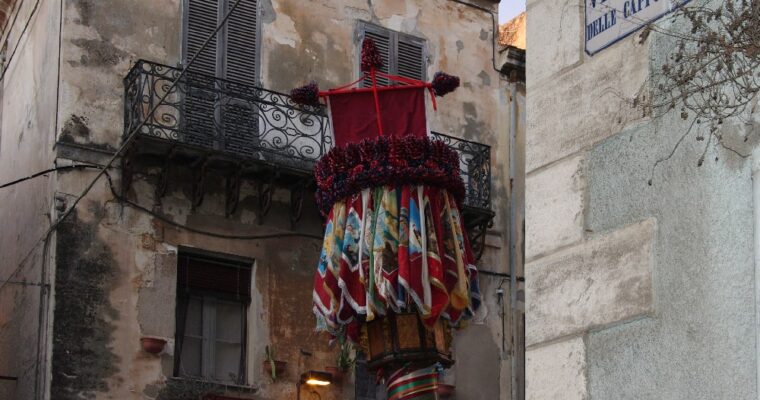
The procession involves over 3,000 people in traditional clothing, more than two hundred horsemen, the Campidanesi, the Militiamen, and the Guardians. Religious devotion and folklore come together in the festival of Saint Efisio, amidst songs, vibrant colours, and moving rituals that attract thousands of devotees and visitors. The procession advances on a carpet of pink, red and yellow petals in the ritual known as sa ramadura, and the air is filled with fragrant aromas and the poignant sacred chants of the four a cuncordu choirs. Flower- and fruit-decorated carts, called traccas, accompany the carriage carrying the statue of the Saint.

The Festival of Saint Efisio has reached its 366th edition and is set to be included in UNESCO’s Intangible Cultural Heritage of Humanity list.

Why Is Saint Efisio So Important to Cagliari?

Efisio was originally from Antioch, in Asia Minor, born around 250 AD to a pagan mother and a Christian father. Raised in the worship of eastern deities, he joined the imperial army and, under Diocletian, harshly persecuted Christians. When he arrived in Italy with the army, one night he saw in a dream a radiant Cross among the clouds, and a voice from Heaven condemned him for his violence against Christians. Efisio realised it was Jesus who had spoken to him, and he converted at once, left the army, and began preaching the Gospel. His preaching brought him to Sardinia, from where he wrote to the Emperor himself, urging him to convert as well. Diocletian had him arrested and condemned to death. However, no matter how severely he was tortured, his wounds would miraculously heal, gaining him more and more followers and sympathisers. He was beheaded in Nora on 15 January 303 AD, invoking God’s protection over the entire island.

The people of Cagliari attribute many miracles to Saint Efisio. The most important is linked to the plague that struck the city in the spring of 1656. The disease, which had arrived in Sardinia from Catalonia aboard a sailing ship, claimed many lives — ten thousand in Cagliari alone, starting with the city’s Archbishop. Saint Efisio is said to have appeared to the island’s viceroy, asking him to make a Perpetual Vow in exchange for saving the city. The plague vanished with the September rains, and from the following year onwards, uninterruptedly, Cagliari has upheld its vow by offering the Saint the 1st May procession.

miracles

Read more:

Miracles: what they are and how they are classified
Healings and exorcisms, apparitions, mastery over nature, even the resurrection of the dead.

Feast of Saint Francis: the Eighth Centenary and its recognition as a national holiday in Italy

Feast of Saint Francis: the Eighth Centenary and its recognition as a national holiday in Italy

Contents1 800 years since the death of Saint Francis2 Saint Francis National Holiday3 Celebrations and initiatives In 2026, the feast of Saint Francis will coincide with the Eighth Centenary of the Saint of Assisi. On this occasion, it will once again be recognised as an…

The Sacrament of First Confession: what it is and how it takes place

The Sacrament of First Confession: what it is and how it takes place

Contents1 What is the First Confession2 The First Confession explained to children.3 Thoughts for the First Confession First Confession is a fundamental moment for the spiritual growth of a child, because it teaches him the concept of Repentance and divine forgiveness and prepares him to…

Saint Mark the Evangelist: the disciple of Saints Peter and Paul

Saint Mark the Evangelist: the disciple of Saints Peter and Paul

Saint Mark the Evangelist, patron saint of Venice, was a missionary with Saint Paul and a disciple of Saint Peter. He founded the Coptic Church in Egypt and wrote the first of the four canonical Gospels. Here is his story.

We do not know much about Saint Mark the Evangelist, who was a disciple of Saint Paul, and whom Saint Peter called his “son”. The two saints mention him, and brief passages about him can be read in the Acts of the Apostles and in some apocryphal documents. Yet his importance is undeniable, considering that his Gospel is one of the four canonical Gospels of the Christian religion, used as the primary source by Matthew and Luke for their respective Gospels. Written in Greek, probably in Rome around 70 AD, the Gospel of Mark is in fact the oldest among the Gospels, and also the shortest. It consists of 16 chapters and focuses in particular on the mission of Jesus, described as the Son of God, exorcist, healer, man of action, and on the difficulty the disciples had in understanding His preaching, especially the parables and miracles. Mark’s account begins with the Baptism of Jesus by John the Baptist and focuses above all on the last week of His life. The numerous explanations attributed to Jesus Himself and the linguistic clarifications suggest that the text was written for non-Jewish readers.

Since the Gospel of Mark is anonymous, its attribution to the disciple of Peter and Paul has always been the subject of study and debate.

When is Saint Mark the Evangelist celebrated? The Church celebrates the liturgical memorial of Saint Mark on 25 April, the date of his probable martyrdom in Alexandria, Egypt. On that occasion in Venice, one of the main cities of which the Saint is patron, a solemn procession takes place in the Basilica dedicated to him, recalling the most sumptuous processions of antiquity, in which all the religious and civil authorities and representatives of the city’s guilds took part.

Venerated by the Catholic, Orthodox and Coptic Churches, of which he is patriarch, Saint Mark the Evangelist is the patron saint of notaries, scribes, glassmakers and opticians.

So who was Saint Mark the Evangelist?

Passion of Jesus

Read more:

The events of the Passion of Jesus: from the Last Supper to His Crucifixion
The Passion of Jesus is the highest and most terrible moment of…

The life of Saint Mark

Little is known about the life of Saint Mark the Evangelist, beyond what was written about him by Peter and Paul and in the Acts of the Apostles. It seems that he was the son of Mary, the widow who owned the house near the Garden of Olives, which hosted Jesus and the Apostles during the Last Supper. According to some traditions, Mark himself was the young man who followed Jesus as He was taken away, wearing only a linen cloth. A Jew of Levitical descent, we do not know what work Saint Mark did before becoming a missionary and then the author of the first Gospel. Mark was his Gentile name, while his Jewish name was John, by which he is referred to in other passages of the Acts. He is also mentioned as the cousin of Barnabas, the name given to Joseph of Cyprus, a preaching companion of Saint Paul, first in Antioch and then on the island of Cyprus, then known as Salamis, where the two cousins are said to have preached together with Paul on his first missionary journey. Mark then returned to Jerusalem, but continued to follow Paul on other journeys, as attested by the words of the Apostle to the Gentiles himself in a letter to his companion Timothy: “Do your best to come to me quickly… Only Luke is with me. Get Mark and bring him with you, because he is helpful to me in my ministry” (Timothy 4:9–11).

The Mount of Olives

Read more:

The Mount of Olives, among the places dearest to Jesus
The Mount of Olives has since ancient times been a place of mysteries, the scene of great biblical events.

Saint Mark was also bound by a close friendship with Saint Peter, who wrote of him in his first letter: “She who is in Babylon, chosen together with you, sends you her greetings, and so does my son Mark.” Saint Mark was probably at Peter’s side in Rome, and may have received Baptism from him. His connection with the apostles Paul and Peter recurs repeatedly in all documents concerning him. After the death of both, Saint Mark evangelised Egypt and founded the Church of Alexandria, becoming its first bishop.

How did Saint Mark the Evangelist die? There is no certain information regarding his death. According to the Golden Legend and other chroniclers, he was martyred in Alexandria, Egypt: his body was dragged through the city several times. His remains were hidden in Alexandria, saved from the flames by his disciples, and here in the year 828 two Venetian merchants are said to have found them and brought them to Venice in a basket of pork and vegetables. The lagoon city immediately welcomed the Saint, dedicating several churches to him over the centuries, culminating in the magnificent Basilica we all know: Saint Mark’s Basilica, the cathedral of Venice famous throughout the world.


The symbol of the Evangelist Mark

In the tetramorph, the iconographic representation composed of the four symbols of the four evangelists, Saint Mark is represented by a winged lion, and with this symbol he has always appeared in iconography and in the history of art. We recall that the symbols of the other evangelists are: a winged man for the Gospel of Matthew, a bull or calf for that of Luke, and an eagle for the Gospel of John.

The symbols of the Evangelists

Read more:

The symbols of the Evangelists and their meaning
The symbols of the Evangelists have been part of the history of sacred art and theology for centuries.

The Lion of Saint Mark, or the Lion of Saint Mark, is often depicted with a halo on its head and a book between its paws, and in this form it has for centuries been the symbol of the city of Venice. On the book is inscribed: “Pax tibi Marce evangelista meus”, part of the phrase that, according to a very ancient tradition, an angel in the form of a winged lion addressed to Mark, who had landed by chance in the Venetian lagoon, foretelling the place where his remains would one day rest: “Pax tibi Marce, evangelista meus. Hic requiescet corpus tuum.” (Peace be with you, Mark, my evangelist. Here your body shall rest.)

The patron saint of Venice

Many are the traditions that Venice has dedicated to Saint Mark the Evangelist over the centuries. One particularly romantic custom holds that on 25 April, the day of his liturgical memorial, lovers give a “bocolo”, a bud of red rose, to the woman they love. A legend tells the troubled love story between Maria, daughter of Doge Orso Partecipazio, called “Vulcana” for the intensity of her gaze, and Tancredi, a storyteller. Maria persuaded Tancredi to set out with the paladins of Charlemagne to prove his worth to her father the Doge, and he covered himself in glory, like Orlando and Rinaldo. When the paladins returned to Venice, however, Vulcana searched for him in vain among them: Tancredi had died in battle, betrayed by his own ardour. One of his companions gave her a red rose stained with his blood. Vulcana shut herself in her room with the rose, and there she was found dead, beside the bud, which had become fresh again as if just picked.

Spiritual discernment: what it is and how it is practised

Spiritual discernment: what it is and how it is practised

Spiritual discernment is a gift from God that helps us in the knowledge of ourselves and of life, and the Holy Spirit is our guide The term discernment has a very broad meaning, and even within Christian Catholic spirituality it can take on different meanings…

For an urgent cause, address your prayers to Saint Expeditus

For an urgent cause, address your prayers to Saint Expeditus

Saint Expeditus the Martyr is invoked for urgent and desperate causes. Here is how his cult originated and spread Praying for a grace should never be done in haste. Yet it is also true that today, and even more so in the past, men and…

All of Jesus’ parables

All of Jesus’ parables

Jesus’ parables are allegorical stories through which He communicated deep, complex spiritual teachings to His disciples using simple words and everyday situations.

A parable is an incisive literary and didactic form used by Jesus in the Gospels to teach listeners spiritual or moral principles through short, simple stories. Jesus’ parables are allegorical tales that use familiar elements to convey a more profound message or spiritual truth. Through metaphors and analogies, they illustrate spiritual or moral concepts clearly and engagingly, and they translate complex truths into simple statements, usually using characters and situations taken from everyday life.
The term parable comes from the Latin “parabola”, which in turn originates from the Greek παραβολή, comparison, allegory.
Jesus Christ used parables, on the one hand, to reveal the truths of the Gospel message to his disciples and, on the other, to hide it from unbelievers. When the disciples asked, he explained the meaning of the parable to them.

Jesus’ parables are not reported in the canonical Gospels in the same way.
There are parables present in all the Synoptic Gospels and also in the Gospel of Thomas, an apocryphal one that does not narrate the life of Jesus, but collects his sayings, such as the Parable of the Sower (Matthew 13:1-23; Mark 4:1-20; Luke 8:5-15; Gospel of Thomas 9) or the Parable of the Murderous Winemakers (Matthew 21:33-44; Mark 12:1-11; Luke 20:9-18; Gospel of Thomas chapter 65) and many others.

The Gospel of Luke contains the three Parables of Mercy: the Lost Sheep (Luke 15:1-7), the Lost Coin (Luke 15:1-10), and the Prodigal Son (Luke 15:11-32). Of these, only the lost sheep is also present in the Gospel of Matthew and in the apocryphal Gospel of Thomas, while the other two are not present elsewhere.

Similarly, the Parable of the Tares and the Parable of the Merciless Servant are mentioned only in the Gospel of Matthew (Matthew 13:24-30 and Matthew 18:23-35).

Only in the Gospel of Mark do we find the Parable of the Seed that Sprouts By Itself (Mark 4:26-29).

In the Gospel according to John, we find only three parables of Jesus: the Pericope of the Good Shepherd (John 10:1-16), the Parable of the Wheat Grain (John 12:24), and the Parable of the Vine and the Branches (John 15:1-8). The three parables do not appear in any other of the Gospels.

The Gospel of Thomas also reports two parables not present elsewhere: that of the Empty Jar (Gospel of Thomas, 97) and the Parable of the Murderer (Gospel of Thomas, 98).

How many parables of Jesus are there

How many parables of Jesus are there? If we only count the parables contained in the synoptic Gospels, there are 42, to which are added the 3 parables present only in the apocryphal Gospel of Thomas.

Parables common to the four Gospels

The Parable of the Sower

(Matthew 13:1-23; Mark 4:1-20; Luke 8:4-15; Gospel of Thomas 9)

The Parable of the Sower tells of a farmer who goes out to sow his seeds. While sowing, some seeds fall along the way, and the birds eat them. Others fall on rocky ground, where they sprout quickly, but then die because they have no deep roots. Still others fall through the thorns, where they grow, but are suffocated by weeds. Finally, some seeds fall on good soil and produce a bountiful crop. The meaning of this parable is that the seeds represent the word of God, and the sower is the one who announces the Gospel. In contrast, the different types of soil represent different attitudes towards the divine message.

The Parable of the Murderous Winemakers

(Matthew 21:33-44; Mark 12:1-11; Luke 20:9-18; Thomas chapter 65)

In the Parable of the Murderous Winemakers, Jesus tells of a master who plants a vineyard, rents it to winemakers and sets off on a journey. When the time comes for the harvest, the master sends his servants to gather the harvest. However, evil winemakers beat, mistreat, and kill servants sent by their master. The master sends other servants, but they, too, are mistreated and killed. In the end, the master decides to send his son, thinking that the winemakers will at least respect him. However, the winemakers conspire against the son, kill him and appropriate his inheritance. With this account, Jesus warns the listeners about the conduct of the Jewish religious leaders of the time, who had rejected the prophets sent by God and who would soon rebel against Himself, the Son of God.

The Parable of the Mustard Seed

(Matthew 13:31-32; Mark 4:30-32; Luke 13:18-19; Thomas 20).

In this parable, Jesus says that the Kingdom of Heaven is similar to a small mustard seed that a man takes and sows in his field. The grain, despite being one of the smallest seeds, grows to become a large tree, so much so that the birds of the sky find shelter among its branches.

The Parable of the New Wine in the Old Cupboards

(Mark 2:18-22; Matthew 9:16-17; Luke 5:33-39; Thomas 47).

In this parable, Jesus uses two images to illustrate the mission He is carrying out and the incompatibility between His teachings and the Pharisees’ religious traditions. Jesus suggests that if you put a patch of new fabric on an old dress, the new cloth will shrink when washed, causing further damage to the old fabric. Jesus also compares His teaching to fresh wine, which must be stored in new containers to avoid being contaminated by old ones.

The Parable of the Strong Man

(Mark 3:27; Matthew 12:29; Luke 11:21-22; Thomas 35).

This parable is often interpreted in the context of Jesus’ ministry and his confrontation with the forces of evil and the devil. The image Jesus paints is of a strong man protecting his home, and only if he is bound can he be robbed. This symbolises Jesus’ power over Satan and His dominion over evil. Jesus suggests that His ministry cannot be hindered or defeated by adverse forces; rather, it is meant to prevail over wickedness and bring freedom and salvation to people.

Parables common to the three Gospels

The Parable of Yeast

(Matthew 13:33; Luke 13:20-21; Thomas 96).

In this parable, Jesus compares the Kingdom of Heaven to a small amount of yeast that a woman takes and mixes into flour until the entire dough is fermented. Yeast, although initially a small and seemingly insignificant quantity, has the power to influence and transform the entire mass of flour. This parable highlights the gradual growth and spread of the Kingdom of God.

The Parable of the Budding Fig Tree

(Matthew 24:32-35; Mark 13:28-29; Luke 21:29-33)

In this parable, Jesus uses the image of the budding fig tree to teach His disciples to observe the signs of the times, just as they observe the tree’s budding, which heralds the approach of summer. Similarly, some signs herald the coming of the Kingdom of God and the return of Jesus.

The Parable of the Lost Sheep

(Luke 15:1-7; Matthew 18:12-14; Thomas 107).

The Parable of the Lost Sheep is one of Jesus’ most famous parables. In this parable, Jesus uses the image of a shepherd who loses one of his hundred sheep and takes care only to find that one, abandoning the others, to illustrate God’s great love and care for each individual.

The Parable of the Lamp

(Matthew 5:14-16; Mark 4:21-23; Luke 8:16-18).

In this parable, Jesus invites His disciples to be like a lamp placed on a skylight, which emits a light that illuminates the surrounding environment. As followers of Jesus, believers are called to bring the light of God’s truth and love into the world, manifesting his presence through their actions and witness.

The Parable of the Faithful Servant

(Matthew 24:45-51; Mark 13:33-37; Luke 12:42-48).

In the Parable of the Faithful Servant, Jesus uses the image of a faithful and prudent servant to illustrate the importance of responsibility and vigilance in awaiting His return. This parable highlights the importance of faithfulness and diligence in serving the Lord as he awaits the end times.

The Parable of the Wedding Banquet

(Matthew 22:1-14; Luke 14:16-24; Thomas 64).

In this parable, Jesus uses the image of a king organising a large wedding banquet for his son. He sends his servants to invite the guests, but they refuse to come. The king sends his servants again, but some ignore the invitation, and others mistreat and kill the king’s servants. The king, angry, sends his servants into the streets to invite anyone they meet, good and bad, to fill the banquet hall. The wedding banquet symbolises the Kingdom of Heaven and God’s invitation to participate in it. Initial invitees who decline the invitation represent those who decline the invitation to salvation, while those who are invited from the streets represent those who respond positively to the invitation.

Parables common to two Gospels

The Parable of the House Built on Rock

(Matthew 7:24-27; Luke 6:46-49).

In this parable, Jesus uses the image of two men building two houses, one on the rock and the other on the sand, to illustrate the importance of basing one’s life on the solid rock of His Word. This parable highlights the importance of listening to and putting into practice Jesus’s words.

The Parable of the Talents

(Matthew 25:14-30; Luke 19:12-27).

In this parable, Jesus uses the image of a master setting out on a journey and entrusting his servants with different sums of money, each according to their abilities. On his return, the master asks for an account of the talents entrusted to him. This parable underscores the importance of wisely using the gifts and resources God has entrusted to us.

The Parable of the Weeds

(Matthew 13:24-30,36-43; Thomas 57).

The Parable of the Weeds tells of a man who sows good seed in his field, but during the night, the enemy comes and sows weeds among the wheat. When the wheat and tares grow together, the master’s servants ask if they should uproot the tares, but the master replies by letting them both grow until the time of harvest. Only at that time, the master will send the harvesters to collect the tares first to burn them and then the wheat to store it. The weeds are the children of the evil one, and the enemy that sows the weeds is the devil. At the end of the world, there will be the harvest, or the final judgment, in which the angels will separate the wicked from the righteous.

The Parable of the Hidden Treasure

(Matthew 13:44; Thomas 109).

A man finds a treasure hidden in a field. The treasure is so precious that a man sells everything he has and buys that field. This short parable illustrates the great value of the Kingdom of Heaven and the importance of investing everything to obtain it.

The Parable of the Pearl

(Matthew 13:45-46; Thomas 76).

A merchant searches for precious pearls and finds a pearl of great value. The merchant, recognising the great value of that pearl, sells everything he has and buys the pearl. The pearl of great value represents the Kingdom of Heaven, which is so precious that it is worth sacrificing everything we have to obtain it.

The Parable of the Net

(Matthew 13:47-50; Thomas 8).

In this parable, Jesus uses the image of a net thrown into the sea that collects fish of all kinds. When the net is complete, the fishermen pull it ashore and sit down to separate the good fish from the bad. The good fish are put in the baskets, while the bad ones are thrown away. This parable illustrates the final judgment, when angels will separate the righteous from the wicked.

Parable of the Salt of the Earth

(Matthew 5:13; Mark 9:50).

Jesus compares His disciples to the salt of the earth. Salt performs several functions: it preserves, flavours and purifies. So believers should also influence the world around them. This parable, therefore, invites us to live an authentic life consistent with the principles of the Gospel, to be a positive force in the world, and to preserve morality and justice in society.

The Parable of the Rich Fool

(Luke 12:16-21; Thomas 63).

One man had accumulated a lot of wealth. Since his harvest had been abundant, he thought of demolishing his warehouses to build bigger ones, so that he could store even more. After doing this, he thought about relaxing, eating, drinking, and enjoying life. However, he had not considered his mortality or thought about what would happen after his death. He had lived only to accumulate material wealth, without worrying about his actions or his relationship with God.

Parable of the Children in the Square

(Matthew 11:16-17; Luke 7:31-32).

Jesus uses the analogy of children sitting in the public square, expressing their disappointment in their peers, to highlight the harsh reality of people’s lack of acceptance and understanding of John and Him, despite differences in their approaches and messages. They were like those children who tried in vain to involve their playmates.

Parables exclusive to the Gospel according to Mark

The Parable of the Seed that Sprouts on Its Own

(Mark 4:26-29).

This parable is linked to that of the sower and that of the mustard seed. The Kingdom of God continues to grow, guided by God himself and following his times, without depending on human action. The disciples only have to persevere in their work, aware that their progress is entrusted to divine providence.

Parables exclusive to the Gospel according to Matthew

The Parable of the Vineyard Workers

(Matthew 20:1-16).

In this parable, Jesus tells of a landlord who hires workers for his vineyard at different times of the day: in the morning, at noon, in the afternoon and even an hour before sunset. Ultimately, the employer pays all workers the same salary, regardless of how long they work. This parable illustrates God’s generosity and mercy, which are not just about amounts of time or effort, but depend on his grace and love. It also symbolises the inclusiveness of the Kingdom of Heaven, where even those who convert late to the faith or repent shortly before the end still receive the Kingdom reward.

The Parable of the Two Sons

(Matthew 21:28-32).

It tells of a father who asks his two sons to work in the vineyard. The first child initially refuses, but later repents and goes to work. The second son agrees to go, but ultimately he does not. The parable of the two sons urges us to reflect on our response to God’s will in our lives. It reminds us that obedience to God does not consist only in our words but requires concrete actions that demonstrate our faith and commitment to him.

The Parable of the Ten Virgins

(Matthew 25:1-13).

Ten virgins prepare to meet the groom for a wedding party. Five of them are wise and carry extra oil for their lamps, while the other five are foolish and have not prepared properly. This parable highlights the importance of vigilance and preparation for the coming of the Kingdom of God. The lamps represent faith and spiritual preparation, while the extra oil symbolises prudence and perseverance in the spiritual life.

The Parable of the Merciless Servant

(Matthew 18:23-35).

This parable illustrates the importance of forgiveness and compassion. Jesus tells of a king who wants to deal with his servants. One of them is presented as owing a considerable sum. Since he is unable to repay the debt, the king orders that he, his family, and his assets be sold to pay off the debt. The servant, begging the king for mercy, begs for patience and promises to repay everything. Moved by compassion, the king forgives his debt and sets him free. However, that servant, once out of the king’s palace, meets another servant who owes him a much smaller sum. Despite his appeal for a postponement of payment, the merciless servant throws him in prison until he has paid all the debt. Some other servants, witnesses of this behaviour, report it to the king, who, indignant at the lack of mercy shown by the servant who had been forgiven, hands him over to the torturers until he has repaid all that he owed him.  The king represents God, whose forgiveness is generous and free.

The Parable of the Scribe Disciple of the Kingdom of Heaven

(Matthew 13:51-52).

In this parable, a Jewish scribe who converted to Christianity is compared to a landlord who extracts both old and new things from his family treasure. The parable emphasises the importance of understanding both the Old Testament and Jesus’s new teachings, as both are essential to carrying out God’s plan.

The Parable of the Sheep and Goats

(Matthew 25:31-46).

Jesus explains how one day the Son of Man will come in His glory and all the nations will be gathered before Him. He will separate people like a shepherd separates sheep from goats: sheep (representing those who have lived according to the principles of the Kingdom of God) on the right and goats (representing those who have neglected the needs of others) on the left. This parable highlights the importance of compassion and solidarity towards those in need as an expression of our love for Jesus himself.

Parables exclusive to the Gospel according to Luke

The Parable of the Prodigal Son

(Luke 15:11-32).

The Parable of the Prodigal Son is one of Jesus’ most famous parables. It tells the story of a father who had two sons. The younger son asks his father for his share of the inheritance and goes away, squandering everything in a dissolute life. After wasting everything, the young man finds himself in poverty and despair. When the father sees his son far away, he runs to meet him, hugs him and orders a big party to celebrate his return. This parable emphasises the mercy, love, and forgiveness of the father, who welcomes the prodigal son with open arms despite his wrong actions. It represents God’s infinite generosity in forgiving the repentant sinner and celebrating his return to grace.

The Parable of the Good Samaritan

(Luke 10:25-37).

The Parable of the Good Samaritan tells of a man who is attacked by robbers on the road to Jerusalem, robbed, beaten and left half dead. A priest and a Levite, both representatives of the Jewish religion, pass by, but they ignore it. Then comes a Samaritan, a member of an ethnic and religious group considered an adversary by the Jews. The Samaritan, however, shows compassion for the wounded man, heals him, carries him on his donkey and takes him to an inn, where he takes care of him. The Parable of the Good Samaritan teaches the importance of compassion, love and solidarity towards others, regardless of race, religion or social status. It questions prejudices and social divisions, showing that love for one’s neighbour goes beyond cultural and religious barriers.

The meaning behind the parable of the Good Samaritan

Read more:

The meaning behind the parable of the Good Samaritan
The parable of the Good Samaritan teaches us that love and compassion know no differences or prejudices…

The Parable of the Sterile Fig Tree

(Luke 13:6-9).

A man owned a vineyard and planted a fig tree there. Every year, he went to check if the plant bore fruit, but he found nothing. So, he decided to prune it because it was sterile and did not bear any fruit. The keeper of the vineyard said to him, “Lord, leave it another year, until I dig around it and fertilise it. If it bears fruit, fine; otherwise, you will cut it off next year.” This parable represents a spiritual lesson about responsibility and the possibility of change. The vineyard owner represents God, while the sterile fig plant represents humanity.

The Parable of the Disloyal Farmer

(Luke 16:1-13).

In this parable, Jesus tells the story of a rich man who had a farmer who ran his business. The rich man learned that his farmer was wasting his possessions. The rich man called the farmer and asked him to give an account of his management. Knowing he was about to lose his job, the farmer called his master’s debtors one by one and asked them to reduce their bills. The master, surprisingly, praised the disloyal farmer for his cunning, because he had acted wisely towards his earthly future, albeit dishonestly. This parable may seem challenging to understand, as it seems that Jesus is praising injustice and dishonesty. However, the main point of the parable is not so much the approval of the farmer’s dishonest behaviour, but rather the exhortation to use material resources wisely and cunningly for the eternal good.

The Parable of the Lost Coin

(Luke 15:8-10).

The Parable of the Lost Coin tells the story of a woman who had ten silver coins and lost one. She lights a lamp, sweeps the house, and searches diligently until she finds the lost coin. Then, happy to have found her again, she calls her friends and neighbours to celebrate with her. This parable illustrates God’s love and mercy toward those who have turned away from Him. The lost coin represents a repentant sinner who has turned away from God.

The Parable of the Pharisee and the Publican

(Luke 18:9-14).

In this parable, Jesus tells of two men who go to the temple to pray. The first is a Pharisee who thanks God for his devotion and prides himself on being better than others, including a publican nearby. The publican beats his repentant chest. This parable highlights the importance of humility and sincerity of heart in prayer and a relationship with God. The Pharisee, despite his outward observance of the law, is condemned for his pride and lack of humility. The publican, on the contrary, despite his lower social and moral status, is justified before God by his humility and his awareness of his sin.

The Parable of Lazarus and the Rich Epulon

(Luke 16:19-31).

The rich Epulon lived in luxury and pomp, while the poor Lazarus lay begging at his door, covered with sores and eager to feed on the crumbs that fell from the rich man’s table. After death, Lazarus is carried by the angels to Abraham’s bosom, while the rich Epulon ends up in hell, tormented by flames. This parable highlights the consequences of a selfish and insensitive lifestyle.

The Parable of the First Places and Invitations

(Luke 14:7-11).

Jesus tells of a man who organises a large wedding banquet and invites many guests. When the banquet is ready, he sends his servant to warn the guests that everything is ready.
However, one by one, the guests begin to apologise. One says he has bought a field and must see it; another says he has bought five pairs of oxen and must try them; and yet another says he has just married a wife and therefore cannot participate. The landlord is enraged by these excuses and orders the servant to quickly go into the squares and streets of the city and invite the poor, the disabled, the blind and the lame to fill the banquet hall. This parable highlights the importance of accepting God’s invitation and the responsibility to respond to His love and grace.

The Parable of the Importunate Friend

(Luke 11:5-8).

A man goes to his friend at midnight to ask for three loaves of bread, because a friend of his has come from a trip and has nothing to offer him. The friend he asks for bread is already in bed with his family, and although he does not want to get up to give it to him, he will do so because the man keeps knocking and asking insistently. This parable highlights the importance of perseverance and trust in prayer. Jesus urges the disciples to pray with constancy and confidence, knowing that God will answer their pleas.

The Parable of the Master and Servant

(Luke 17:7-10).

This parable teaches that even God’s most faithful servants must maintain humility, as they do their duty and nothing more. No one, not even the most virtuous or diligent, can consider themselves indebted to God.

The Parable of the Unjust Judge

(Luke 18:1-8).

This parable tells of a judge in a particular city who did not fear God and had no respect for anyone. There was also a widow in that city who came to him frequently, demanding justice against her opponent. For a while, the judge refused to listen to her, but eventually she had to give in to his insistence. This parable highlights the importance of persistence in prayer and trust in God, even when it seems that our requests are not met immediately. Jesus urges us to persevere in prayer, trusting that God will promptly do justice to His elect.

The Parable of the Two Debtors

(Luke 7:41-47).

Two people were in debt to a certain creditor; one owed five hundred days’ monies, and the other owed fifty. Since they could not pay, the creditor forgave them both of the debt. This parable highlights the concept of divine forgiveness and our response to it. Jesus illustrates that those who have received much forgiveness tend to love more, while those who have received little forgiveness tend to love less. It is an invitation to recognise the extent of divine mercy toward us and to respond with gratitude and love.

The Parable of the Unfinished Tower

(Luke 14:28-33).

This parable highlights the importance of planning and reflection before embarking on a spiritual commitment or life as a follower of Jesus. It is a reminder of the seriousness of the spiritual path and the need to consider the cost and effort required to follow it carefully.

Parables exclusive to the Gospel according to John

The Parable of the Good Shepherd

(John 10:1-16).

The Parable of the Good Shepherd is one of Jesus’ most famous parables. In this parable, Jesus presents himself as the good shepherd who knows his sheep and leads them with love and dedication and who is ready to give his life for them, unlike a mercenary who would abandon the flock in the face of danger. He offers his life willingly for the sheep, demonstrating his love and care. The Parable of the Good Shepherd illustrates Jesus’ unconditional love for His disciples and for humanity.

Jesus the Good Shepherd

Read more:

Jesus the Good Shepherd: Why the Comparison?
On the fourth Sunday of Easter, the liturgy celebrates Jesus the Good Shepherd. Where…

The Parable of the Wheat Grain

(John 12:24).

This parable addresses the central concepts of the Resurrection and the Kingdom of God. The image of the grain of wheat that dies in the earth and then bears fruit is interpreted as a metaphor for the death of Jesus, His burial, and the Resurrection, which bears fruit in the salvation of man.

The Parable of the Vine and the Branches

(John 15:1-8).

Jesus uses the image of the vine and its branches to illustrate the relationship between Him and His disciples, and the importance of remaining united to produce spiritual fruits. The parable emphasises the importance of a personal, ongoing relationship with Jesus for spiritual life and fruitfulness. It teaches that only by remaining united to Jesus can the disciples hope to bear meaningful spiritual fruit.

Parables exclusive to the Gospel of Thomas

The Parable of the Empty Jar

(Thomas 97)

The Parable of the Empty Jar tells of a woman carrying a jar of food. Along the way, the jar breaks, and all the contents spill out, dispersing. When she arrives home, the jar is empty. The parable may be intended as a warning not to allow the Kingdom of God to be scattered like wasted food. The empty jar could also symbolise a meaningless life, with people believing they have fullness in life, but ultimately realising that it is empty despite all their activities.

The Parable of the Assassin

(Thomas 98)

In the Parable of the Assassin, Jesus uses an analogy to illustrate the Kingdom of God. It tells of a man who wished to kill a powerful man. This man takes the sword in his house and sticks it in the wall, before going out and killing the powerful man.
This parable, like the warrior king and the unfinished tower in the Gospel according to Luke, invites reflection on prudence and the importance of carefully evaluating the actions to be taken, considering the consequences, and taking the necessary precautions. It also reminds us that we can overcome seemingly insurmountable challenges with courage and determination, following the example of those who have acted wisely and prudently in pursuing justice and the good.

Testimony of Faith: What does it mean to be a Christian?

Testimony of Faith: What does it mean to be a Christian?

Contents1 Who are the witnesses to the faith?2 What does it mean to be witnesses to the faith?3 Some stories of faith For a Christian, the testimony of faith is not just a declaration of one’s belief. Faith becomes daily action, mercy, service to others,…

The Trial of Jesus: From Arrest to Crucifixion

The Trial of Jesus: From Arrest to Crucifixion

Contents1 Last Supper and Jesus’ arrest2 Before Caiaphas and the Sanhedrin3 Pontius Pilate and Jesus4 Crucifixion The trial of Jesus, as narrated in the New Testament Gospels, is one of the central events of Christianity. The Trial of Jesus represents one of the first, dramatic acts of…

Jesus and the Samaritan woman at the well: the explanation of the parable

Jesus and the Samaritan woman at the well: the explanation of the parable

With the meeting with the Samaritan woman at the well, Jesus reveals his identity as Messiah and speaks revolutionary words, anticipating the work of evangelisation of the disciples

The story of Jesus and the Samaritan woman at the well is told in the Gospel of John (Jn 4:5-42). While travelling from Judea to Galilee, Jesus meets a Samaritan woman at Jacob’s well in Samaria. The result is a dialogue between the most revolutionary of the New Testament, which makes the encounter with the Samaritan woman not a parable in the traditional sense, but a story full of symbolic and metaphorical meanings that illustrate theinclusiveness of Jesus’ message, his offer of salvation and eternal life through faith in him and theimportance of a personal relationship with God.

The Gospel of the Samaritan woman

The Gospel of the Samaritan woman is a passage from the New Testament, precisely chapter 4, verses 1-42 of the Gospel according to John.
This narrative is often referred to as “The Story of the Samaritan woman” or “The Dialogue of Jesus with the Samaritan woman at the Well”. In short, Jesus travels through the region of Samaria and stops at a well, where he meets a Samaritan woman and engages in a substantive discussion with her about her physical and spiritual thirst. During this meeting, Jesus reveals to the woman His identity as the Messiah and His mission to bring eternal life to those who believe in Him.

Women in the Bible

Read more:

Women in the Bible: Jesus and the relationship with his disciples
What was the role of women in the history of Salvation? Let us…

Who was the Samaritan woman

The woman’s name is not given in the text, but she is commonly known as “the Samaritan woman” or “the Samaritan woman.” Given her origin, the woman represented a double minority in the eyes of the Jews of the time, as a woman and because the Samaritans were considered marginalised by the Jews. In His interaction with her, Jesus breaks down all social and cultural barriers by speaking to her and even revealing His identity as the Messiah. After the encounter with Jesus, the Samaritan woman, shaken by a great spiritual upheaval, runs into the city and witnesses her experience, leading many others to meet Jesus and believe in Him as the Saviour of the world. Thus, despite her social and cultural background, the Samaritan woman exemplifies faith and witness in Christ, demonstrating that He came for everyone, regardless of their origin or social status.

The differences between Judaism and Christianity

Read more:

The differences between Judaism and Christianity
What are the differences between Judaism and Christianity? Is the God of the Jews the same as the Christians?

The Parable of the Samaritan woman’s meaning.

Here are the fundamental points of the Gospel account and their interpretation.

5 So he came to a town in Samaria called Sicàr, near the land that Jacob had given to his son Joseph. 6 Here was Jacob’s well.

It is no coincidence that the meeting between Jesus and the Samaritan woman occurs at Jacob’s well, mentioned in both the Old and New Testaments. In fact, this place has a profound symbolic and historical value. It is associated with the patriarch Jacob, son of Isaac, who, according to biblical tradition, excavated it near the city of Shechem (or Sichar). It has since become an important landmark and a symbol of family bonds and spiritual heritage for the Israelites. The use of Jacob’s well in the gospel account links Jesus’ message to the Old Testament roots of Judaism. This demonstrates the continuity between the Old Testament promise and its fulfilment in Christ in the New Testament.

The Major Divisions in the Christian Religion

Read more:

The Major Divisions in the Christian Religion
The Christian religion is actually made up of many religious denominations, similar in some aspects…

7 Meanwhile, a woman from Samaria came to draw water. Jesus said to her, “Give me a drink.” 8 For his disciples had gone away into the city to buy food. 9 But the Samaritan woman said to him, “Why do you, a Jew, ask me, a Samaritan woman, for a drink?” In fact, the Jews do not maintain good relations with the Samaritans. 10 Jesus answered and said to her, “If you knew the gift of God, and who it is who says to you, ‘Give Me a drink,’ you would have asked Him, and He would have given you living water.”

This is how the subversive scope of the dialogue between Jesus and the Samaritan woman, the longest of the Gospels, emerges. In contrast to the water of the traditional well, the water that Jesus proposes symbolises the new Law that He brings, which overcomes and replaces the old one. Jesus offers living water, a symbol of salvation and source of eternal life, freely to anyone who needs it, without distinction of race, gender or social status. This reflects the inclusive nature of the gospel message and the love of God that is available to all. It is an invitation to faith and abundant spiritual life that is offered to all who believe in Him. In addition,

Faced with the woman’s perplexity about how she thinks she can draw water from such a deep well, Jesus replies:

13 Jesus answered, “Whoever drinks of this water will thirst again; 14 but whoever drinks of the water that I will give him will never thirst again; indeed, the water that I will give him will become in him a spring of water welling up to eternal life.”

Jesus says that whoever drinks of living water will never thirst again. This suggests that only through a personal relationship with Jesus Christ can true spiritual satisfaction be found. Living water represents the satisfaction of an individual’s spiritual needs. Elsewhere in Scripture, “living water” is associated with the Holy Spirit. So, in the encounter with the Samaritan woman, Jesus could also allude to the gifts of the Holy Spirit that would be given to believers after his ascension. The Holy Spirit gives spiritual life and guides believers in the truth.

The 7 Gifts of the Holy Spirit

Read more:

The 7 Gifts of the Holy Spirit: What They Are and Their Meaning
The gifts of the Holy Spirit make a person receptive to divine inspiration and define their relationship with God…

The dialogue continues. Jesus and the woman discuss the places where it is right to worship God: the Samaritans claim that it is Mount Gerizim, the Jews claim that it is Jerusalem. In this case, Jesus’ response also runs counter to the prevailing opinions of the time.

21 Jesus said to her, “Woman, believe Me, an hour is coming when neither in this mountain nor in Jerusalem will you worship the Father. […] 23 Yet the time is coming, and now is when the true worshipers will worship the Father in spirit and truth; for such people the Father seeks to be His worshipers. 24 God is spirit, and those who worship him must worship in spirit and truth.”

In Jesus’ time, there were two main temples where the one God was worshipped: the renowned Temple in Jerusalem and another located in Samaria. The latter fact is crucial to understanding the Samaritan woman’s question about the proper place to worship God. Jesus’ answer to this question emphasises that true worship is not tied to physical places or external rituals, but is a matter of an inner, authentic relationship with God. True worship requires deep spiritual involvement and total sincerity of heart. God is not limited by geographical boundaries or ceremonial forms, but desires an authentic and sincere relationship with those who seek Him. In this way, Jesus invites the Samaritan woman and all who listen to his teaching to overcome religious divisions and turn to God with sincerity and spiritual devotion.

25 And the woman said unto him, I know that the Messiah cometh: when he cometh, he shall declare all things unto us. 26 “I am he,” Jesus replied, “the one who is speaking to you.”

Jesus’ statement could not be more explicit. The woman expresses her conviction that the Messiah will come, and Jesus openly reveals to her that he is the One for whom everyone is waiting. The Samaritans saw the Messiah as a human prophet, announced by Moses in Deuteronomy 18:15-18 and similar to Moses himself. The Samaritan woman thus recognises Jesus as the prophet and the expected Messiah. She leaves him to go and share her discovery with her fellow citizens, a forerunner of the Gospel message that the disciples will bear after the death of Christ.

12 apostles

Read more:

Who were the 12 apostles and discover the difference between apostles and disciples
Who were the 12 apostles, companions of Jesus in the short span of his mission and who received from him the task of bringing the Word into the world?

35 “Do you not say, ‘There are yet four months, and then comes the harvest’? Behold, I say unto you. Lift your eyes, and behold the fields which are already blond for the harvest. 36 Already he who reaps is receiving wages and is gathering fruit for eternal life; so that he who sows and he who reaps may rejoice together. 37 For in this case the saying is true, One sows and another reaps. 38 I sent you to reap that for which you have not laboured; others have laboured, and you have entered into their labour.”

In this passage of the parable of the Samaritan woman, Jesus uses the term “reapers” or “harvest” to refer to the process of evangelisation and the reaping of souls in the Kingdom of God. This reference is symbolic and reflects the work that awaits Jesus’ disciples in proclaiming the Gospel and leading people to faith. Jesus urges the disciples to look at the fields, which are already ripe for harvest. This image of the harvest symbolises the opportunity to carry forward God’s work in the world, particularly through evangelism. The reference to harvesting indicates that the time has come for Jesus’ disciples to spread the gospel and gather those who are ready to accept it. This recalls the idea that the Kingdom of God is near and that the disciples are tasked with bringing the good news to all who are ready to hear and respond.

The Jesus’ Sermon on the Mount: what it is and its meaning

The Jesus’ Sermon on the Mount: what it is and its meaning

Contents1 The Beatitudes in Jesus’ Sermon on the Mount2 Sermon on the Mount: meaning3 The Lord’s Prayer With the Sermon on the Mount, Jesus offers a new vision of the divine law, offering a revolutionary model of conduct based on love and forgiveness The Sermon on…

The meaning behind the parable of the Good Samaritan

The meaning behind the parable of the Good Samaritan

Contents1 What the parable of the Good Samaritan teaches us2 Who represents the Good Samaritan?3 Who’s next in the parable of the Good Samaritan?4 The Parable of the Good Samaritan for Children The parable of the Good Samaritan teaches us that love and compassion know…

Healing the person with paralysis: the meaning of the miracle

Healing the person with paralysis: the meaning of the miracle

The healing of the paralytic in Capernaum is one of the many miracles of Jesus, but it contains a series of profound meanings worth exploring.

The healing of the paralytic of Capernaum is an episode described in the synoptic Gospels (Mk 2:1-12; Mt 9:1-8; Lk 5:17-26). According to the narrative, at the beginning of Jesus’ public life, the miraculous healing of a paralytic brought to him by some men occurred. Since they could not approach due to the crowd, they had lowered the sickbed from the uncovered roof of the house. Jesus didn’t just heal him; he said his sins were forgiven. This scandalised the Pharisees, who accused Jesus of blaspheming, for no one had the power to forgive sins except God. But Jesus rebuked them, claiming His power, as the Son of man, to forgive sins. Then he ordered the paralytic to take his bed and go home, and so it happened. But what meaning does this gospel story hide?

the public life of jesus blog

Read more:

The Public Life of Jesus: From Baptism to the Last Supper
From the Baptism in the Jordan to the triumphal entry into Jerusalem. The three years of…

The healing of the paralytic of Capernaum and its meaning

The healing of the paralytic might seem like just one of many miracles in Jesus’ story, then, but it’s fascinating because this episode can be interpreted in different ways. If, on the one hand, the healing of the paralytic demonstrates the power of Jesus to heal physical illnesses and perform miracles, strengthening His spiritual authority in the eyes of His followers, the focus of the episode can be shifted to the demonstration of faith by the men who brought the paralytic to Jesus, confident that He could heal him. Jesus’ response to the faith of the paralysed reflects His compassion and willingness to heal those who suffer, but also the importance He places on men who demonstrate compassion and solidarity with the sick or needy. In this sense, the carriers of the paralytic become the symbol of all those men who commit and invest time and energy to help those who are most in need, and, precisely because of their state of suffering, they are often left on the margins, unable to take part as they would like in community life. In this episode, the faith and commitment of those who help their neighbour are such that they open the roof to allow the sick person to be seen and healed by Jesus. It will be their determination and faith that will move Jesus. The Good News of the Gospel is a message of freedom and happiness offered to all men. This revolutionary news penetrates every corner, even if some try to obstruct it. Nothing can stop its healing and liberating power. Faith opens the roofs of houses and the doors of prisons, bringing hope and freedom to anyone who accepts it.

The miracles of Jesus in the four Gospels

Read more:

The miracles of Jesus in the four Gospels
The miracles of Jesus mentioned in the Canonical Gospels are considered historical events, although…

Another fundamental reading key in this story is the power of forgiveness of sins compared to healing from illness and pain. Jesus does not limit himself to healing man, but declares that his sins are forgiven, recognising in a certain way sin as the fundamental cause of human pain and suffering.
The relationship between sin and disease as a causal link is a complex and controversial issue within religious traditions. Some ancient theological views suggest that sin may be the direct cause of disease and suffering, while others interpret this connection more metaphorically or symbolically. In the Hebrew and Christian scriptures, there are instances in which sin is associated with disease or other forms of suffering. For example, in the Book of Job in the Old Testament, Job is afflicted with severe physical and mental suffering, and his three friends, Eliphaz, Bildad, and Sofar, express a firm belief in divine justice and in the idea that Job’s suffering is the direct result of his sins. They argue that Almighty God is always just and that Job’s suffering is a punishment for some hidden sin or transgression that he must have committed. According to their theological understanding, suffering is seen as a direct consequence of sinful actions and, therefore, they regard Job’s condition as an evident sign of his sin.

In the New Testament, Jesus directly addresses the question of the connection between sin and sickness. In some episodes, such as this one of the healing of the paralytic of Capernaum, Jesus associates physical healing with the forgiveness of sins. However, it is essential to note that Jesus does not always identify illness as a direct consequence of specific sins committed by the individual or his parents, as in the case of the man born blind (Jn 9:1-3). Also on that occasion, the disciples asked Jesus: “Rabbi, who has sinned, he or his parents, so that he was born blind?” and Jesus answered, “Neither he nor his parents sinned, but it is so that the works of God might be manifested in him.”

Faced with the accusations of blasphemy by the Pharisees, Jesus replies that the forgiveness of sins is a test of great spiritual power, much more difficult than physical healing. Speaking the words “your sins are forgiven” may seem simple, but it requires an act of divine compassion and mercy that goes beyond physical healing. The gift of Christ is deeper than a miracle of healing. Forgiveness of sins heals the body through the soul; physical healing joins with spiritual forgiveness, emphasising the interconnectedness of body and soul and the depth of his ministry of redemption.

Considering the concept of paralysis, we can also read a further meaning, which goes beyond the physical limitation of the body. Soul paralysis can imprison individuals in various forms. Some are trapped in the prison of unjust reputation, while the mockery and condemnation of others block them. There is also the paralysis caused by evil, when you let yourself be guided by selfish desires or turn away from God. Jesus invites us to free ourselves from these chains, to move against what paralyses us and prevents us from living life to the full. God always responds to those who cry out to be freed from the paralysis of sin, offering them a hand to get up and start over.