Author: Redazione

The Morning Prayer: how to start your day right

The Morning Prayer: how to start your day right

Jesus told his disciples and his friends that they should pray, always, and never get tired of it. From that exhortation comes the Liturgy of the Hours, which schedules the moment of prayers during the day, so that every moment of our lives is a…

Story and production techniques of Prayer Cards

Story and production techniques of Prayer Cards

The word Paryer Card defines a small rectangular card, displaying on one side the printed or carved image of a saint or other sacred objects, and on the other a prayer or a hagiographic text related to the portrayed saint. There are Prayer Cards that…

The Novena to Saint Benedict

The Novena to Saint Benedict

Saint Benedict of Norcia is celebrated on July 11th.

This is actually just one of the dates dedicated to the saint from Umbria, founder of the Benedictine order and creator of the so called Rule, which will strongly affect lives and spiritual experiences of all monastic communities after him.

On July 11th the catholic Church celebrates Saint Benedict as Patron of Europe. Another day dedicated to him and particularly celebrated by the religious congregations connected to him is March 21st, anniversary of his death.

Saint Benedict lived in the second half of the fifth century. He approached a religious life very early. At only 12, he was sent to Rome from Norcia were he was born, so that he could study there; he was so disgusted with the decadence of the habits and the lascivious life animating the city, that he dropped out of school and gave up his father heritage in order to live with his wet nurse in the Aniene Valley. And right in her home, still a young boy, he performed his first miracle, putting together a tray that was accidentally crushed by the woman. He later went to Subiaco (a small town not too far from Rome) and met Romano, a monk living in solitude, who initiated him to the hermit life. But Saint Benedict, even though he appreciated isolation and contemplation, felt that that was not the way he wanted to serve God. In fact, his Rule will be detached from the isolated and ascetic lifestyle that was common to most of the religious people of that time, making it revolutionary.

Saint Benedict wanted to associate alone prayers with community prayers, shared with Brothers in any moment of the day, during meals, celebrations, and expressed through singing (Gregorian songs had a great boost with that). In addition to this group prayers, he added work as another way to worship and honor God. Saint Benedict referred to the amanuensis work in particular, whose job was to copy and transcribe sacred texts, but the Rule included any kind of work that could be useful to the community.

No more mortification of the flesh then, no fasting, no sacrifices, no more years in isolation, but rather, a new way to be at the service of God and of the religious community, made of prayer and work, in a physical and mental balance to bring peace and fulfillment of each one’s interior balance. That is why Saint Benedict compared the monastery to a school that was supposed to teach the path to salvation to those who entered. Living according to the rules of the monastery granted the necessary merit to become part of Christ’s kingdom.

Saint Benedict’s Rule stated the importance of prayers, but also of human value, of individual capabilities and of personality that bring the devotee to serve God in the best way possible, guided by a good discipline and an impeccable moral conduct, by mutual compassion and obedience to the abbot. As he said, he wanted to found a “school of service for the Lord, in which we hope we will not have to order anything hard nor strict.

It was not easy for Saint Benedict to elaborate his Rule, let alone impose it to the monks. His first duty as abbot in Vicovaro ended with a poisoning attempt by some monks, stubborn towards rules and discipline. Things were better in Subiaco, where he was able to build a first community of young devotees who were also faithful to his commandments, and Saint Benedict’s Rule had its consecration in Montecassino, the monastery he founded and where he lived until his death.

Patron of Europe

Saint Benedict statue coloured Val Gardena

Why was Saint Benedict declared Patron of Europe? Because his model of monastic life, his Rule, offered the Medieval Europe a new example of life and civilization through its models and laws, while it was racked with barbaric invasions and the unstoppable decadence of the Roman Empire. The multiple places of worship and culture born according to his teaching, the monasteries and hospitality centers for poor and sick, the reception structures for pilgrims, all offered men and women of that dark time a silver lining, an oasis of peace and rationality. There people could find protection, safety and that trust in human beings that doesn’t take anything away from faith and devotion towards God. However, it enriches the religious experience investing more on human potential.

A Christian Humanism, if we may call it as such, becomes even stronger and more precious in its recognition of God and man as His instrument. The Word of God, read and understood, solitary or group prayer, the work carried out with brotherly love and with the will to help each other, offer a life model not only for monks, but also for anyone wishing to live their life in the name of God. In the mid-19th century, Europe was in ruins due to the two world wars, devastated by violence and countless deaths, by the fall of the great and delusive political and social ideologies, by the annihilation of values and morals, which lasted for too many years. People felt the need for a new ethical and spiritual model to rely on. A new model, but inspired to traditions, to the origins of Occidental civilization as we know it. Saint Benedict’s Rule appeared as the most advisable solution to most people.

In 1947 Pope Pius XII recognized his role as Father of Europe, and later, on October 24th 1964, during the consecration of the new cathedral in Montecassino which was rebuilt after the ally’s bombings, Pope Paul VI defined Saint Benedict as Patron of Europe. His life and human and spiritual path models can light our paths still today, offering us a direction towards which we can move as humans and Christians, as worthy members of a religious community, but also as citizens of Europe. Those who are responsible and aware that, working together, believing in the same values and putting our efforts in realizing those values every day, can get much farther.

The cult and symbols

Saint Benedict of Norcia’s life and example made him the main character of many popular forms of devotion, begun when he was still alive. Just think of the Medal of Saint Benedict, one of the

Saint Benedict medal

most popular and beloved sacred symbols. Wearing a necklace with the medal of Saint Benedict is not only a way to protect ourselves from evil in its most deceitful and terrible forms, but most of all a way to claim the presence of God next to us in every moment. In fact, Jesus himself operates through the medal, with His immense power, and guarantees his support to those who believe and trust him in every gesture, in every moment.

In 1742 Pope Benedict XIV granted indulgence to anyone wearing the medal with awareness. And not just that, Saint Benedict’s medal is considered one of the most powerful instrument for exorcism ever. On the medal, besides the image of the Saint holding his own Rule in his hands, there are also the embossed initials of a powerful prayer, which has the power to push evil away and keep it far from those who wear the medal and believe in its protection power.

In general, the image of the Saint from Norcia is beloved and present not only in places of worship, but in all places. Statues of Saint Benedict decorate churches and monasteries all over the world, especially since Pope Paul VI declared him as Patron of Europe in 1964. An important recognition for a Saint that was able to teach his Brothers how to serve the Church with their body, mind and with every gift that God allowed them.

The Novena to Saint Benedict

Another way to express devotion to Saint Benedict is to recite his Novena.

The Novena can be recited in every moment we feel the need to receive Saint Benedict’s support and protection, but in general, it is recited between March 12th and 20th to commemorate his death on March 21st; or else, between July 2nd and 10th to celebrate his consecration as Patron of Europe on July 11th. It can be recited alone or with the family, and there are many versions elaborated throughout the centuries by devotees. We just need to find the one closer to our sensitivity and appropriate to the time we can dedicate to it. In any case it will turn out to be an efficient and powerful spiritual exercise.

The consecration of the Sacred Heart of Jesus

The consecration of the Sacred Heart of Jesus

The worship of the Sacred Heart of Jesus for Christians is twofold: on the one hand, it means worshipping the heart of Jesus as a symbol of his humanity, of having become a man and having sacrificed for us all. On the other, it is…

Altar linens in the liturgical celebrations

Altar linens in the liturgical celebrations

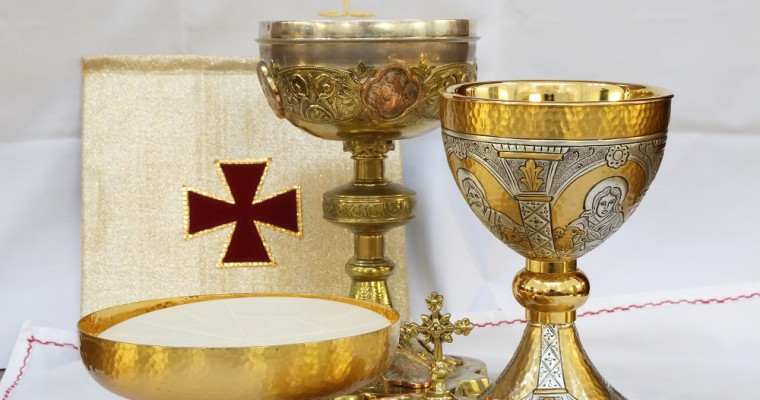
Altar linens are an essential accessory for the celebration. In addition to a true and proper use connected to church supplies, they are valuable for the ornament of the altar and its consecration. Altar linens are usually composed of a corporal (square cloth in linen…

St. Joseph: the supposed father of Jesus

St. Joseph: the supposed father of Jesus

St. Joseph is a very beloved figure venerated by Christians and with affection and incomparable devotion. In his being considered the supposed father of Jesus and faithful and respectful husband of the Virgin Mary, has ended up becoming the father of the whole Church, of which is in fact the Patron, and the symbol of all the fathers in the world.

His decision to serve God by submitting himself entirely, made him an ideal caretaker of the Family, not just the Holy Family composed by him, Mary and baby Jesus, but all families in every place and every time.

St. Joseph is also patron of workers in general, particularly of carpenters and joiners, given his profession in life. To him we turn the prayers and hopes of those who come to fight with death.

A fair man, given by God to the Virgin as a husband, not only as a companion in life, but as a witness to his virtues, guardian and protector of his immense mystery.

St. Joseph is the object of great veneration starting from the sixteenth century. It was especially the Jesuits to contribute to the flourishing of his cult.

Figurative art represents St. Joseph as an old, bearded man. He often wears work clothes, or at least nothing that points to a noble and solemn role, but rather to his humility and dignity. St. Joseph statues are countless. In them, St. Joseph often brings with him a flowering rod, symbol of the choice made by God to him as the husband of Mary. Other St. Joseph’s attributes are his wanderer stick, the working tools and the lily, symbol of purity of the Virgin.

In Italy, the cult of St. Joseph statues goes hand in hand with that of the Holy Family statues, mostly from the Baroque period onwards.

There are statues of St. Joseph of all sizes and materials, from wood to fiberglass, suitable for any context and devotion. They are often beautiful works of artisanship, carved and painted by hand, enriched with precious decorations and gold leaf to make them even more valuable. In addition, statues of St. Joseph of lesser material value can be priceless objects for prayer and comfort at all times.

The symbolic value of bishop rings

The symbolic value of bishop rings

The Bishop is among the priests, one of the most important and invested figures with meaning for the faithful. In his role of “supervisor” (from the greek επίσκοπος, episkopos) he embodies in himself the value of souls pastor, the supreme minister of religion, teacher and…

Mary’s immaculate Heart

Mary’s immaculate Heart

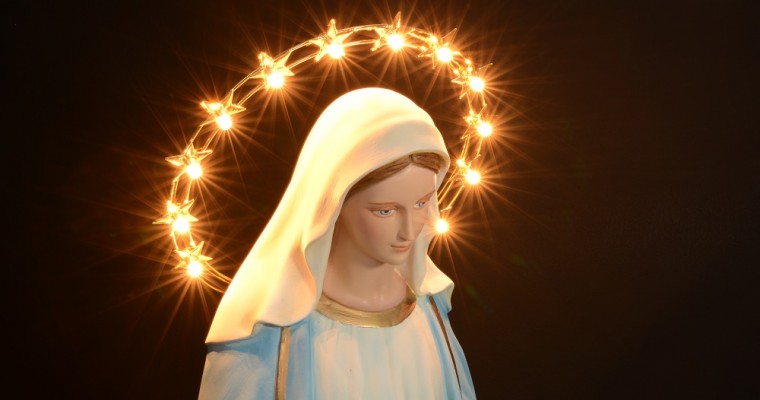
May was the month dedicated to Marian Devotion. Pope Francis, like all of his predecessors, is a great supporter of the love for Virgin Mary; he invited all devotees in this occasion to pray the rosary every day of the month so that our prayers,…
The meaning of the Tree of Life

The meaning of the Tree of Life

All religions, since the origins of mankind, are somehow tied to trees.

We already explored this subject in a previous article, lingering on some of the 100 trees and plants cited in the Sacred Scriptures, and besides them, on how plants have been appointed with a deep religious meaning throughout times.

Let’s just think about the wheat seed, associated to the word of Christ and His own sacrifice, He, who died in the ground to be born again and give fruits, like a seed.

Or the olive, another symbol of Jesus and of the renewed alliance with men wanted by God, sanctioned by His death on the cross.

We can think of the spruce of course, which we decorate every year for Christmas, and like every other evergreen, symbol of Christ resurrection and rebirth, but which was already present in previous civilizations such as the Celts and the Greeks, and associated to the concept of hope, new life and fertility.

The tree of life deserves a special mention. It appears in the Holy Scriptures, from Genesis to Revelation, and was present also in the Hebrew culture first, and Christian culture after, acquiring deeper and more spiritual meanings along the way.

It was a tree that God planted in the Garden of Eden, right next to the tree of knowledge of good and evil. Until Adam and Eve could feed on the fruits given by the Tree of Life, they were both immortal, untouched by the flow of time, old age nor sicknesses. Sacred texts teach us that, by committing sins of pride and arrogance, the two ate the fruits provided by the other tree, the tree of knowledge of good and evil, even though God ordered them not to. With this unfortunate and rebel action, they condemned all men and women to wander through the world and to live with sin and pain.

Biblical references

“The man has now become like one of us, knowing good and evil. He must not be allowed to reach out his hand and take also from the tree of life and eat, and live forever.” (Genesis, 3:22)

Consequently, men were banned from the Garden of Eden and from the inestimable gifts given by the Tree of life. Knowledge, the perception of oneself, of our own wishes and others wishes, marked the beginning of the end. Only by staying pure and innocent, one could benefit from the fruits of immortality. Shame, envy, extortion and war are all generated by this stolen knowledge, which men clearly cannot handle, and that will quickly cause the wrath of God, so hard that He will unleash the great Deluge.

However, despite the man’s sin and consequent ban, the Tree of life does not disappear from sacred texts. God, in his endless goodness and foresight, leaves a glimmer of light for His rebel sons. There will come a day when worthy men, those who will have been able to listen to God’s Word and live according to His precepts, will be able to enjoy the fruits given by the Tree of Life again, along with all other joys of Heaven: “Whoever has ears, let them hear what the Spirit says to the churches. To the one who is victorious, I will give the right to eat from the tree of life, which is in the paradise of God.” (Revelation, 2:7)

In fact, in the New Jerusalem, the city of elected ones that will be awakened by Christ to live a new era of peace and glory on Earth, we will find the Tree of life again: “On each side of the river stood the tree of life, bearing twelve crops of fruit, yielding its fruit every month. And the leaves of the tree are for the healing of the nations.” (Revelation, 22:2)

But the promise concealed by the symbol of the Tree of life goes well beyond.

Because the river running through the new Heaven is the Word of God, as we can read in many quotes from the sacred texts, and in it we can live every day of our life starting from now, enjoying His nourishment, His holy water, as if we were trees ourselves: “Blessed is the one who does not walk in step with the wicked or stand in the way that sinners take or sit in the company of mockers, but whose delight is in the law of the Lord, and who meditates on his law day and night. That person is like a tree planted by streams of water, which yields its fruit in season and whose leaf does not wither — whatever they do prospers.” (Psalms, 1:1-3)

This simile between those who believe and live following our Lord’s will, and the trees full of fruits growing along a lively and fresh river recurs also in other passages of sacred texts, in the words of prophets and sages.

The Tree of Life associated with the Cross

Therefore, we can be trees of life ourselves, rich in fruits everyday, every season, if we only let the Holy Spirit’s enlivening water keep running inside us and quench our thirst, and nourish us.

Another meaning attributed to the Tree of life inside the Christian sphere is Christ’s cross. It is indeed thanks to the cross that Jesus established our salvation, deliberately choosing to offer himself in order to bring life where there was only death.

In this vision, quoted in many passages of the sacred texts, the cross is compared to a tree. For example, in the Liturgy of the Exaltation of the Cross, we can read:

“For you placed the salvation of the human race on the wood of the Cross, so that, where death arose, life might again spring forth and the evil one, who conquered on a tree, might likewise on a tree be conquered, through Christ our Lord” (preface).

Men lost their grace by going against God, defying him, acquiring the knowledge of good and evil, and with it, originating sin in all its forms. Adam tried to become like God, without having the skills, nor the right. A son defying his Father, with the arrogance and impudence typical of who, too young and immature, does not understand the extent of his own actions.

And here is a new Son, standing tall to defend humanity, a Son that recognizes his Father’s superiority and will so much, that he is willing to be nailed to a cross to fulfill His plan. Jesus accepted his fate with humility and obedience, and for his act of submission, the Cross on which he dies became the new Tree of Life. The faults of mankind have been washed from blood and water that spilled from Jesus wounds, and the original sin has been questioned. The cross is the new Tree of life, and gave us hope to be saved, to be able one day to enter the new Heaven, if we will follow Jesus advice and we will know: “how to recognize the greatness of God and accept our smallness, our condition of creatures, letting the Lord fill it with his love” (Pope Benedict XVI, General Audience of February 6th 2013)

The tree of Life into different cultures

Today the Tree of life has become a symbol that goes beyond Christian values, taking much from paganism and eastern philosophies. But the truth is, as it is for any other symbol, that the important thing is what we see in this symbol.

In all cultures and religions, the Tree of life is anyway a vital symbol, which regenerates and gives hope and strength. Its roots symbolize our origins and our internal strength, which has to be solid and resistant; the trunk is life itself, which spans between the past and a future that is rich in luxuriant leaves and fruits.

Giving someone a necklace with a Tree of life pendant will always be a good way to wish him good luck on a new beginning, whether it is a new job, a new life, a relocation to a new house or a wedding. It is a way to remember that we would never be what we are now, if we had not been something different before; just a tiny seed that rooted deeply into the ground, generating a tree with solid roots and branches towards the sky. If we were able to choose our nourishment wisely, our Tree of life will grow more and more luxuriant, and rich of precious fruits.

cross tree of life design valgardena
Cross Tree of Life Environment Design in maple wood of Valgardena, waxed finish with gold thread. Finishing with colorless wax, decorated with a painted thread. Sculpture in painted maple wood, made by hand by artisans of Valgardena, according to the best local artistic tradition. The artisans and artists sculpt the wood of the alpine woods and paint it with mastery in every detail. It is made of maple wood from Valgardena, by specialized artisans.
Buy on Holyart
ten rosary bracelet tree of life
Tens rosary with 10 mm rosewood wood beads with silver plated pendant tree of life.
Buy on Holyart
icon tree of life
Icon printed on wood and gold background whose image depicts the Tree of Life. Handmade object, ideal as a gift or souvenir of special occasions and sacraments. The icon can comfortably hang on the wall thanks to a practical hook.
Buy on Holyart
silver amen necklace tree of life
Amen necklace with double chain and double pendant. A pendant encloses the Tree of Life rhodium and rosé, the other pendant is in rosé silver in the shape of an angel covered with white zircons.
Buy on Holyart
tree of life earring
Drop earrings with medal representing the Tree of Life in rosé finish on rhodium circle, with lobe angel embellished with white zircons. Earrings entirely in 925 silver with rosé and rhodium finish with butterfly clasp. 12 mm diameter earrings, made in Italy by a specialized company with guaranteed quality.
Buy on Holyart
The true meaning of the Hail Mary

The true meaning of the Hail Mary

There are words that are passed throughout time, from mouth to mouth, for years, centuries, uttered by a million different voices, in many different languages. The words of prayers for example, written by men and women inspired by God a long time ago, and said…
Most Sacred Heart of Jesus

Most Sacred Heart of Jesus

The feast for the Sacred Heart of Jesus is one of the so called movable Feasts, that is, it occurs on a different date in different years. The most evident movable Feast is Easter, whose date changes every year. Actually, most of the movable Feasts…

5 must-have sacred images and pictures

5 must-have sacred images and pictures

Since the origins of Christianity, people felt the need to reproduce the object of their devotion, or something that recalled it, in a tangible and visible way. For the first Christians, forced to hide their faith, this was often unavoidable, and was manifested through carving of symbols and messages that only other members of the sect could understand, so that they could communicate their faith to each other without risking persecution.

With time, with the affirmation of Christianity as official religion and its amazing spread all over the known world, the realization of sacred images has had an unstoppable boost.

The reasons for this spread can be found in many factors.

Even though many ancient (and also modern) religions were iconoclastic, that is, they prohibited the representation of divinity, Christianity never condemned the realization of pictures, statues, artistic and artisanal works of any kind that showed the image of God, Jesus, Mary or the Saints. On the contrary, this kind of works was pushed since the very start, because it was the only way, along with the priests words, to share the faith precepts with common people. The possibility to see some episodes of Jesus life depicted on churches walls, or to admire a picture representing Mary’s sweet face, or even an image showing the hieratic sanctity of a martyr, was an even more powerful tool for dissemination of faith than words themselves. The human mind is susceptible to images, it captures and interprets them more easily than it can get from words, and during past centuries this was even more true, given the scarce culture and the low level of education in the majority of people.

We need to say that even though the Bible condemns idolatry, it must be kept separated from the devotion raised by a sacred image, picture or print. In many ways these images of Jesus, Mary and the saints became real sacred decors that cannot miss in our churches, but also in our homes. On the contrary, placing a sacred image of any kind in our homes should be an unavoidable necessity for a Christian. It is a way to keep our own devotion alive, to give ourselves the chance to dedicate even brief moments to the adoration of God in every moment of the day, through something that represents him, that directly or indirectly recalls Him. The veneration of a sacred image pushes us closer to the sky, because it is not addressed to the object itself, the sacred picture or print, but to what it stands for.

The fact that most of the sacred images available on the market are reproductions of famous pictures or frescos, of works of art that belong to our history and culture, makes them decor elements that can make our homes beautiful and elegant, giving it value. Formerly, being able to decorate homes and palaces with sacred images on walls, furniture and furnishings, was a distinctive sign of wealth and nobility. That way people showed their devotion towards God, and at the same time, they could show off their wealth without sinning in vanity.

In our times, when showing our own spirituality is mainly an intimate and interior matter, placing a sacred image in our homes is most of all a personal choice of faith, but the choice of which image we should show depends on our personal taste, our sensitivity, and of course, on the style and interior design of our homes.

Some sacred images are now part of the modern iconography so much that they go beyond their original meaning.

Madonnina of Ferruzzi

Let’s think about the Madonna and child by the Dalmatian painter Roberto Ferruzzi. With this enchanting picture the painter won the Venice Biennale in 1897. The painting depicts a sweet girl with her face towards the sky, in a blue dress, holding a sleeping baby in her arms. The title of the painting was “Maternity”, but was immediately changed into “Madonnina”, because everyone associated that delicate maiden image with the Virgin Mary, and the baby in her arms with Jesus. The Alinari Brothers, owners of the namesake photo studio, bought the painting at a remarkable price, and with it they also acquired all the rights to reproduce it on any support and in any format. That is how the fortune of the Madonnina of Ferruzzi began, which was actually the portrait of Agelina Cian, a girl from Luvignano aged eleven, holding her baby brother Giovanni in her arms. Unfortunately Angelina had a tragic destiny, becoming a widow while still very young, and ending her days in a mental institution. But the picture that represents her became one of the most recurrent sacred images in Christian homes, for her beauty, the sweetness it conveys and for the elegance that makes it a wonderful decor, besides being a devotional object.

Ultima cena by Leonardo da Vinci

There is no need to give much explanations to the Last Supper by Leonardo da Vinci, one of the most celebrated masterpieces of the Italian Renaissance, kept in the former refectory of the Sanctuary of Santa Maria delle Grazie in Milan. It was commissioned by Ludovic the Moor, who chose the church of Santa Maria delle Grazie as place for the celebrations of the Sforza family; it was realized as a fresco, but using a technique that was usually meant for paintings on canvas, which emphasized the brightest areas, but that was not suitable to last on walls. Irremediably ruined by time, bad weather and men, the fresco was restored after a long and patient work that lasted 20 years, and was declared world heritage by Unesco in 1980. The work represents the Last supper of Jesus with his apostles, and exactly the moment described in John’s Gospel 13:21, when Jesus states that he will be betrayed by one of them. It is a worldwide recognized image, but nevertheless it has amazing charm and emotional impact. A reproduction of the Last supper by Leonardo, maybe with a beautiful golden important frame, makes it a picture for the living room, or a quality hall, or anyway an environment that can emphasize its solemnity, its artistic and spiritual value.

Raphael’s Angels

A completely different impression, but not less fine, is given by a print of Raphael’s Angels. It is a detail of one of the most famous and celebrated paintings by Raphael, the Sistine Madonna. In the painting, Mary seems descending form the sky with the Baby in her arms, on a background made of countless cherubs heads merging with the clouds, between Saint

Sixtus Pope and Saint Barbara. On the lower edge, there is a parapet on which these two thinking angels are leaning, which became a sacred image on its own with time, almost more famous than

the whole painting. Raphael’s angels, looking so delicate and a bit naughty, bring joy and light heart to the house, and can be a perfect print on wood to hang in the kids room, or anyway, someone young.

“The creation” by Michelangelo

Another option for wooden print, but also on other formats, the Creation of the Sistine Chapel in the Vatican Museums in Rome can look good in homes. Among the masterpieces by Michelangelo, this one is undoubtedly one of the most complex and hard ever made. Stylistically speaking, the Sistine Chapel Creation represents one of the highest point of modern art history. To ultimate it, the artist took 16 days, beginning from the image of God and the Angels, and later painting the image of Adam. The suggestive position of the two main characters, with their arms reaching out just one moment before touching each other, represents the strength of the divine creation flame in an exceptional way, passing from God to his “creature”, and the latter reflects the same move, awakening God’s strength. An important painting, suitable for any room of a house, but specifically for living rooms or bedrooms.

Madonna of Lippi

Another option for the bedroom, but actually wonderful for any room of the house, could be a printed and shaped wooden board of the Madonna with Child and angels called Lippina, by Filippo Lippi. The original painting, tempera on panel kept at the Uffizi Museum in Florence, is one of the most famous from the Florentine artist and friar, and surely represents a point of reference for all later artists, at least for what concerns the representation of the Madonna and Child.

The painting depicts a Madonna with a sweet but sad face, contemplating her Baby in her arms as if she wanted to protect him with prayer and her love from the tragic destiny that awaits him (the Passion). The pleated dress, her hairdo, the veils, the pearls as symbol of pureness, all are expression of the unrivaled mastery of the artist.

Two angels are next to the Madonna, one is smiling in the foreground, while the other is partially hidden behind the baby’s arm. The naughty smile of the angel in the foreground compensates for the drama of the painting and its suffused sadness.

Sacred furniture: typical decors of every Christian church

Sacred furniture: typical decors of every Christian church

The church is the place par excellence where Christians gather to share their faith and celebrate the related solemn rituals. Since its origins it was necessary to give it a special solemnity and sacredness. This was obtained by acting both on the architecture of the…

Religious jewels: fashion or devotion?

Religious jewels: fashion or devotion?

There is a lot of talk around the trend that has become popular during the last few years, that is wearing religious jewels without knowing their meaning in depth. Many stylists chose to reproduce crucifix, rosaries and medals dedicated to Mary or the Saints, making…

Angel caller jewels: because we are never alone

Angel caller jewels: because we are never alone

During the last few years a new trend of very particular jewels has become popular: angel caller necklaces and bracelets.

What are they? There are various types, made of more or less precious materials, for all tastes and budgets. As a general line, the angel caller is composed of a metal pendant, which can be openwork or not, with a chime ball inside that generates a sweet and delicate sound when moved. These pendants are usually attached to a necklace or a bracelet, and enriched with other decorations, such as hearts, pearls, angels or precious stones varying according to models.

The origin of these particular jewels is probably tied to rattles, used in ancient times not only as toys for toddlers but with other purposes often including the sacred sphere, such as religious celebrations, dialogs with gods and celestial spirits.

In particular, angel caller necklaces and bracelets come from a type of rattle used by pregnant Mexican women, the so-called Mexican bola, which probably comes from a similar tradition from Bali.

In both cases, they are spherical or drop-shaped silver pendants, and contain a small xylophone. They were worn on long strings, went down to the belly of the woman wearing them, and produced a delicate and celestial tinkling at every step or movement; the sound had the double effect of calming the baby in the womb, and call the angels protection on the baby, attracted by the pleasant sound as well.

They are very cute trinkets, suitable for everyone, whose ornamental value is implemented by this pleasing and calming sound that follows the wearer everywhere.

However, the angel caller necklaces and bracelets value and charm is not over here.

The link with the guardian angels

For believers, the presence of a guardian angel next to each one of us is a fact. As a messenger of God, this spiritual being made of the same essence of the Father is next to us in every moment of our life, from our very first breath to the moment of our death. They are unique figures, inseparable from the people they are tied to, they fight at their side, supporting them against all odds and protecting them from evil. The role of a guardian angel is also to mediate between the believer and God. It is the angel that collects our prayers, our anxieties, our hopes, and takes them to the Father’s ears, granting for us at His eyes and asking to offer us His help.

Even though the guardian angel, especially today, is a dear figure for children, to which we teach to address their prayers and look for its protection from the very start, the idea of this celestial and friendly presence by our side, messenger of love and hope, is able to comfort adults as well, especially in hard times.

That’s when the angel caller necklaces and bracelets gain a deeper and more spiritual meaning. We must not mistake them for magic amulets or talismans, but rather as the symbol of a thought directed to the Sky, as we usually do with sacred jewels, even in everyday life. Wearing an angel caller jewel, as wearing a medal or a crucifix, is a proof of our faith, of our wish to touch something that is an expression of it with our own hands, and that reminds us in every moment who we are and what we believe in. They are material objects, but they recall to a deeper, higher meaning, and express our faith, the awareness of our beliefs, worn as a beautiful ornament indeed, with pride, fierceness and comfort.

Angel caller necklaces and bracelets can also be a precious gift to our loved ones, and even in this case, they are not just nice trinkets.

We recently talked about the joy coming from the arrival of a baby in our home, of how such an event can have a deep influence on the lives of a whole family. Giving an angel caller jewel to a woman expecting a child is a very sweet way to wish her and her baby all the best. It is a way to tell her that the angels will watch over her baby, that they are already protecting the baby even if not born yet. The sound of an angel caller necklace or bracelet will relax the mom-to-be and indirectly the baby in her womb as well, and will join both of them until the most beautiful moment, the birth. The angel caller pendant can turn into a decoration for the baby’s crib afterwards, calling the protection and the presence of an angel on him, or just cradling him with that now familiar sound.

An angel caller necklace can also be a gift for friends going through a hard time, or to which we want to show our affection, making them understand that we worry about them in every moment and invoke the angels’ protection on them.

Even special celebrations, such as communions or confirmations, or even weddings, can be perfect occasions to give an angel caller jewel. Because we never stop needing something that reminds us that we are not alone, that there are ethereal and ineffable presences watching over us every moment.

Holyart catalog offers a wide variety of angel caller necklaces and bracelets.

Their common feature is the openwork pendant, which makes the sound of the chime ball even sweeter and softer. Holyart angel caller necklaces are in silver 925 and are available in different colors and shades: rhodium, pink and gold. Both Holyart necklaces and bracelets are adjustable and can be clasped with a safety snap-hook.

amen necklace calls angels silver 925 roses and zircons
AMEN angel caller necklace with chain approximately 92 cm in rhodium silver 925 and details in pink silver. In the spherical pendant there is an angel on both sides, embellished with white rhinestones and a small heart with the writing Amen on it. The necklace has a snap-hook clasp and is adjustable.
Buy on Holyart
amen necklace calls angels golden silver
Amen angel caller long necklace with golden finishing. The necklace has a snap-hoop clasp and 2 cm adjustable chain.
Buy on Holyart
amen necklace calls heart angels and zircons 925 silver
AMEN angel caller necklace with long chain of approximately 96 cm, rhodium silver 925. The spherical pendant has a heart on both sides embellished with white rhinestones and a small heart pendant with the writing Amen inserted into the ring holding the bigger spherical pendant. The necklace has a snap-hoop clasp and 2 cm adjustable chain. Amen jewel of quality and reliability guaranteed by the producing factory.
Buy on Holyart
necklace amen calls angels arg 925 rhodium and roses with white cubic zirconia
AMEN angel caller necklace with chain approximately 92 cm in rhodium silver 925 and details in pink silver. The spherical pendant has a strip with the writing Amen carved on; in the ring holding the pendant there is a pink silver angel with white rhinestones. The necklace has a snap-hook clasp and is adjustable.
Buy on Holyart

Besides the silver pendant that makes these jewels unique and peculiar, they can be embellished with further decorations, such as small silver hearts, pearls, beads, rhinestones or angel-shaped decorations. In some models, the spherical pendant has an angel on both sides, and is embellished with white rhinestones and a small heart with the writing Amen on it. Because we must never forget that these are not only precious and important jewels, but also symbols of faith, of spirituality, which remind us in every moment that we are not alone, that an angel is always watching over us and those we love.

AMEN silver 925 angel caller bracelet
AMEN silver 925 angel caller bracelet finished in rhodium with white beads on the perimeter and with rhodium applications. Its characteristic pendant is openwork and has opaque rhodium finishing. Practical snap-hook clasp and 3 cm adjustable chain.
Buy on Holyart
AMEN angel caller bracelet - golden silver 925
AMEN angel caller bracelet in golden Silver 925 with white beads on the perimeter and with silver applications. Its characteristic angel caller pendant is openwork, with opaque and golden finishing. Practical snap-hook clasp and 3 cm adjustable chain.
Buy on Holyart
Amen angel caller bracelet in pink Silver 925
Precious Amen bracelet in Silver 925 with pink finishing. Its characteristic angel caller pendant is openwork with opaque and pink silver finishing. On the bracelet perimeter there are white beads and silver applications. Practical snap-hook clasp and 3 cm adjustable chain.
Buy on Holyart
Amen angel caller bracelet Silver pave 925
Amen angel caller bracelet Silver pave 925, with details in pink silver and white rhinestones. Bracelet with double chain and Angel Caller openwork pendant, and central strip in pink silver. Small Angel-shaped pendant with pave rhinestones. Practical snap-hook clasp and 3 cm adjustable chain.
Buy on Holyart
Our Lady of Medjugorje: how Our Lady of Peace is represented

Our Lady of Medjugorje: how Our Lady of Peace is represented

We already talked about Our Lady of Medjugorje in other articles, who appeared to six seers in 1981; some of them claim they see her everyday. The first apparitions took place in the town of Medjugorje in Bosnia-Herzegovina, from which comes the name. Our Lady…

Crib medal for newborns: the joy of welcoming a new life

Crib medal for newborns: the joy of welcoming a new life

The arrival of a baby in a home is always a reason for joy. Even when it gives concerns, or when the conditions don’t look perfect to welcome a baby in this world, so hard even for adults, a baby that is about to come…

DIY Rosaries in few easy steps

DIY Rosaries in few easy steps

In a previous article we largely talked about Rosaries, one of the devotional objects par excellence. Saying the Rosary has always been considered a way to fulfill our Christian duties, praying without tiring ourselves out, as taught by Jesus himself. On the other side, saying the Rosary has always been a way to ask and obtain graces for ourselves or our loved ones, offering our prayers and thoughts for all men and their salvation in exchange.

We talked about a devotional object because we want to linger on how it is made, on what the various parts it is made of mean, leaving the spiritual value of the Rosary aside for a moment.

The Rosary owes its name to the ancient tradition of decorating Mary’s statues with roses wreaths. Form there comes the Latin word rosārium, “rose garden”, and then rosary. The Rosary is made of beads of various sizes, five arranged in sets of ten (decades), which correspond to the Hail Mary that have to be said; other bigger beads, which correspond to the five Mysteries, in conjunction with them we have to say Our father and Glory to the Father; a crucifix, while touching it we say the opening prayer, the Credo.

The structure of prayer

So, the structure of the prayer is more or less as follows:

  • Sign of the Cross,
  • Touching the cross with our fingers we say the Credo
  • Moving our fingers along the bigger bead next to the Cross we say a Our Father
  • On the three smaller beads that follow we say three Hail Mary (for the gifts of faith, hope and charity)
  • On the following big bead we say the Glory
  • Once we reach the crown we say the First Mystery, followed by the First Decade:
  • On the first big bead we say a Our Father
  • On the first decade of small beads we say ten Hail Mary
  • On the following big bead we say a Glory to the Father and the prayer of Fatima
  • Going forward on the following beads for all five Mysteries, which change according to the day of the week.
  • At the end of the five decades, we say a Salve Regina, a Our Father, a Hail Mary and a Glory.

About the Mysteries, as mentioned above, they change according to the day of the week: on Monday and Saturday we say the Joyful Mysteries; on Thursday we say the Luminous Mysteries; on Tuesday and Friday we say the Sorrowful Mysteries; on Wednesday and Sunday we say the Glorious Mysteries.

Exactly for its ‘physical’ nature and its structure specifically thought to help with prayers running the fingers along the beads, it could be an interesting idea to make a DIY Rosary. Furthermore, making your own rosary, or make one to give it to someone we love, could be a devotion gesture itself, given the commitment, the time and the dedication we will put into making it with our own hands.

How can we make our own Rosary?

diy rosary kit
DO IT YOURSELF 144 rosaries kit 

As we already mentioned, the Rosary necklace is composed of 53 small beads that stand for the Hail Mary prayers, six bigger beads (or of different color) that stand for the Our Father and the Glory, and one crucifix. Beads are held together by a string of various materials. The most used today is nylon.  You can easily find all you need to make your own Rosary in religious shops. You can even find complete kits to make your own Rosary, containing all you need: string, clasps, metal details and cross.

Create your rosary in a few easy steps

You need a string about 1 meter long. Then you will have to mark one point 15 cm from the edge with a pen or pencil, the starting point for your crown. Tie a knot here, big enough to block the beads you will insert. So let’s begin inserting the ten beads for the first decade, letting them go until the knot, then block them with another knot. Remember that when you’re saying the Rosary, beads must flow among your fingers, so leave some space among them.

After the second knot, insert the bead for the Our Father, which can be bigger or a different color. Repeat for four times, and complete the five decades. Now insert the last bead for the Our Father and close it up with a knot, carefully leaving enough string to finish the Rosary. There are more beads and the crucifix in the ending part to insert, to which we can add the connector medal that will split the Rosary in two parts. Insert now a big bead for the Our Father and fix it with a knot, then three small beads for the three Hail Mary, then another bead for the Our Father. Last, the cross.

There are many beads in stores, of any material and color, shiny or opaque. Beads can be wooden, maybe olive, or paler, like maple; but also colored and polished wood, or even scented wood. A more elegant and refined alternative can be beads made of resin imitating mother-of-pearl, available in many shapes, diameters and colors, spherical or oval.  Below we present the products described, available on our site!

grains in round olive
Grains in round olive tree to make DIY Rosaries. Pack of wooden beads for the realization of 12 rosaries. The grains are available in 4 different sizes.
Buy on Holyart
round maple wood grains
Spherical maple wood beads for DIY Rosaries. Wooden beads package for 12 rosaries. Beads are available in diameter of 10 mm.
Buy on Holyart
grains black wood round
Black wooden beads perfect for DIY Rosaries. Wooden beads package for 12 rosaries. Beads are available 4 different sizes.
Buy on Holyart
beads rosaries imitation blue pearls round
Blue spherical mother-of-pearl style beads. PVC beads packs for 12 rosaries. Beads are available in diameter of 7 mm.
Buy on Holyart
fragrant wood grains pink 6 mm
Red wooden beads with peculiar rose scent. Wooden beads package for 12 rosaries. Beads are available in diameter of 6 mm.
Buy on Holyart
rosari beads imitation pink oval mother of pearl
Rosary beads, pink oval mother-of-pearl imitation. PVC beads packs for 12 rosaries. Beads are available in 2 sizes.
Buy on Holyart

The center of the Rosary can be a connector medal. There are many types, silver or golden, with carved images of the Madonna of Fatima or the Merciful Madonna, with Saint Francis and Saint Chiara, with Father Pio portrait or the picture of Pope Francis.  Below we present the products described, available on our site!Besides string and beads, to assembly a Rosary you will need golden or silver jump rings, and of course head pins for a safety clasp.

cross rosary oxidized metal father pio
Oxidized metal Rosary Cross, Father Pio DIY Rosary oxidized silver metal Cross. With color image of Saint Father Pio on one side, and Mary's face on the rear side, metal.
Buy on Holyart
cross Pope Francis and Merciful Jesus
Ancient galvanic silver Cross, with carving of Pope Francis on one side, and Merciful Jesus on the other side.
Buy on Holyart
golden metal cross madonna lourdes
DIY Rosary golden metal Cross. Cross with color image of Madonna of Lourdes.
Buy on Holyart
cross for rosary madonna di fatima
Cross for DIY Rosary. Entirely made of antique galvanic silver with the image of the apparition of Mary to the shepherds of Fatima on one side, and the crowned Madonna of Fatima on the other side.
Buy on Holyart

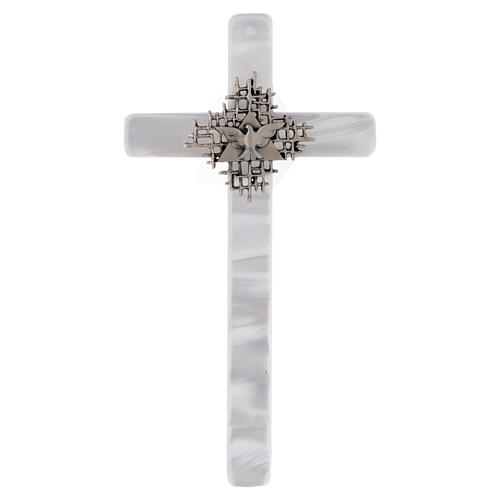
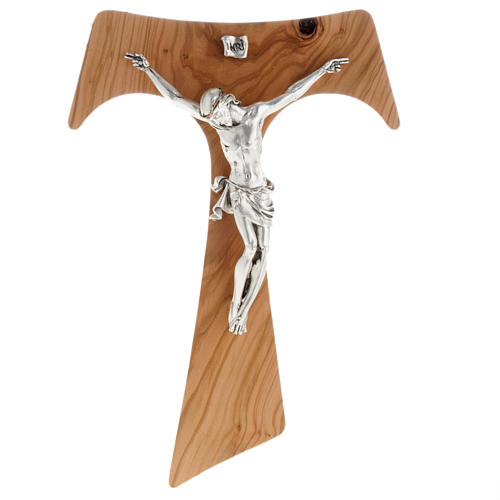
Of course, a big relevance is given to the metal cross,  maybe with golden finishings if you chose resin beads, or a wooden cross if you chose wooden beads, with or without Christ body on it, decorated with a dove or a Tau cross, or a polished silver galvanic cross. If the Rosary is meant as a Communion gift, for the Godfather or Godmother at Confirmation, you can find beautiful communion crosses that are perfect for that purpose.

Rosary case

If the DIY Rosary you plan to make is a gift, or even if you’re doing it for yourselves, it could be nice giving it a finishing touch with a rosary case. What is it? There are many types. It can be a wooden or filigree box, a leather case resembling a chest, or a coin purse. Other rosary cases are statues representing Jesus or Mary, Theresa of Calcutta or the Pope, to which you can hang the Rosary letting it fall into the case. A way to give more value to your DIY Rosary and to have it always in front of you, or to give it as precious gift to someone we love.

Here we will show you the described articles available on our website!

rosary case filigree arg 800 oval
Rosary Case Silver 800, oval shape. 3.5x3 cm Box with filigree conveying an elegant openwork effect. The Rosary case can contain rosaries up to 3 mm.
Buy on Holyart
Rosary Case or Holy Water Font - John Paul II
Table Rosary Case, natural wood heart-shaped, with statue of God's servant John Paul II. The statue is hand-painted and is an original product of the artisans from Val Gardena. Suitable for any environment, to store your precious rosaries or as a gift idea.
Buy on Holyart
Mother Teresa of Calcutta - Rosary Case
Pretty Rosary Case with hand-painted statue of Mother Teresa of Calcutta. The Rosary case is made of natural wood and is heart-shaped. Ideal as gift, available in two sizes.
Buy on Holyart
Rosary Case - Holy Water font Madonna and Baby
Madonna seating with sleeping baby, in white porcelain, created and signed by Francesco Pinton, To be used as Holy Water Font or Rosary Case. Available in two sizes.
Buy on Holyart
Miraculous Madonna Rosary Case
White Rosary Case with printed image of the Miraculous Madonna. Practical Rosary Case pouch with zipper, perfect as gift idea.
Buy on Holyart
Leather chest Rosary case
Rosary Case chest-shaped, handcrafted in real leather, with Baby Jesus image in the center. Available in multiple colors, practical and convenient, with zipper. Perfect as a gift.
Buy on Holyart