Author: Redazione

5 sacred objects that cannot miss in our homes

5 sacred objects that cannot miss in our homes

Crucifixes, sacred pictures, icons, statues. Objects we keep in our homes to remind us we live in the grace of Baptism and in the love of God at any time. A crucifix, a religious picture, an icon of the Holy Family, a statue of the…
7 types of religious bracelets to wear with style

7 types of religious bracelets to wear with style

Religious bracelets tell us a different way to live our Faith. Fancy jewels, precious metals, but most of all symbols that we can always carry with us. Jewels. Symbols of vanity, born to ornate, embellish, with no other purpose. It’s not always like that. Rosary…

The Priest Chalice: a short guide to a conscious choice

The Priest Chalice: a short guide to a conscious choice

The Priest Chalice, the vase that contains Christ’s Blood during a Mass. Symbol of communion between God and men, of the salvation incarnated in Jesus.

The chalice is the sacred vase containing the wine that turns into Christ’s Blood during Eucharist. It symbolizes the chalice Jesus used during the Last Supper, therefore a normal glass. In fact, the Latin word calix means glass, cup, a common object in every house. Private houses were the first places of cult for Christians; it is therefore obvious that they used a normal glass to consecrate Liturgy wine.

The Chalice is then a symbol of the communion between God and men, of the ancient alliance of the Old Testament, which renovates and gains a totally new meaning through Jesus’ sacrifice. His blood, offered to atone for all sins, becomes symbol of Jesus son’s obedience on one side, and the mean of salvation for all men on the other side. Through consecrated Bread and Wine during each Mass, that sacrifice is renewed, as is the communion that saw apostles eat and drink during the Last Supper, becoming integral part of that immense Mystery.

It is therefore obvious that the chalice for the Communion owes its importance mainly to what it will contain, that is, the wine turning into blood. But it also carries its own intrinsic symbolic value, since it recalls the cup Jesus used during the Last Supper, that Holy Grail that is the main character of many wonderful legends and stories passed on throughout centuries.

Liturgical accessories used by Ministers during liturgical celebrations

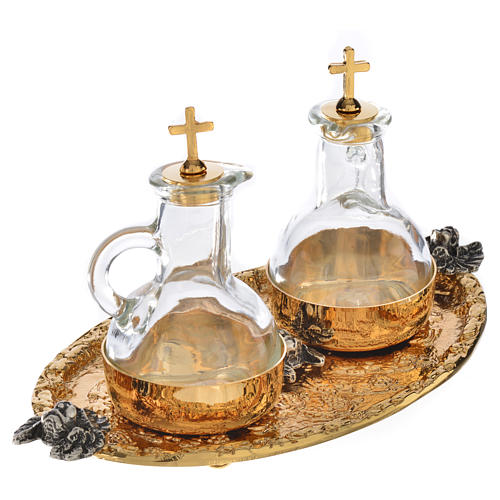
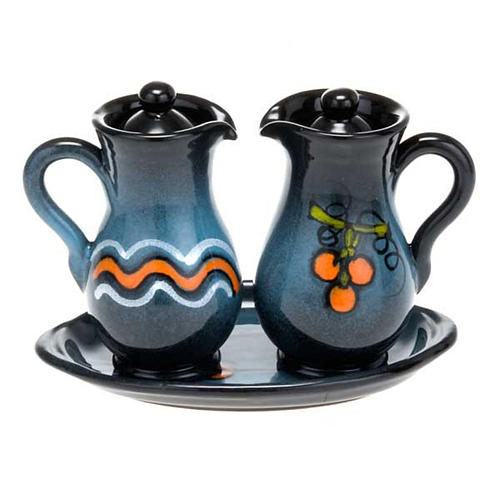
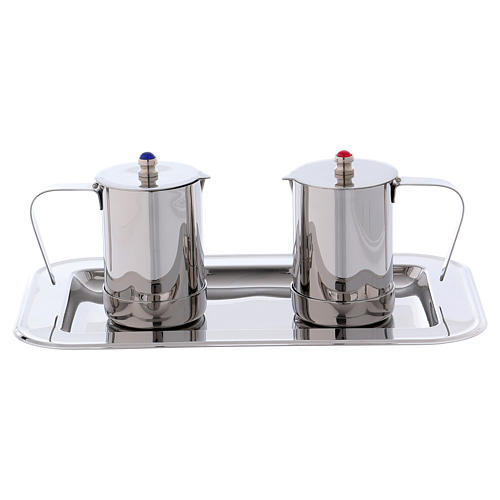
The same can be said for all other sacred furniture Priests use during the Liturgy. Next to the communion chalice, we can find the pyx, the chalice for the hosts (even if it can also be a bowl), which will contain the consecrated particles; the ampullas, usually in glass, which contain water and wine before they are poured: the paten, that is, the plate where the priest places the biggest host during the Consecration. There are also textiles, equally important for the ceremony: the corporal, which is the starched square cloth placed on the altar to receive Christ’s Body; the pall, a small starched cloth that covers the priest chalice; the purificator, a napkin used to cleanse the chalice and the paten after the communion; the manuterge, used by the priest as towel.

The Liber Pontificalis, a list of biographical notes written in chronological order about the Popes who seated on the Papal throne until the end of the IX century, often names the priest chalices, dividing them into calices and scyphi, depending on the use they were destined to: the consecration of wine, the distribution of Eucharist, or just as votive decors.

According to the Liber Pontificalis, chalices could be catalogued according to different features, and be:

  • maiores o minores, depending on size:
  • sacri o sancti, if used for consecration;
  • ministeriales, if used to distribute the Communion to the devotees;
  • offertorii, if destined to contain the wine to consecrate;
  • quotidiani, for daily and non-festive use;
  • stationales, used during functions of station rites;
  • ad baptismum, for new Christians;
  • pendentiles o appensorii, merely votive and decorative objects.

Later, in the XII and XIII centuries, the followings were added to the list:

  • ad communicandos infirmos, to distribute the Communion to the sick;
  • viaticus, a smaller, travel chalice;
  • funerarius, to ornate priests’ tombs.

Here is a further, more modern and generic, cataloging of chalices:

  • Chalice with handles: big, with two handles, popular in the Carolingian age;
  • Chalice with bells: decorated with bells falling down from the cup or the base, popular in Spanish countries;
  • Chalice for foretaste, small, with handles and lid, used to taste wine before the Mass;
  • Missionary’s Chalice: small, suitable for long journeys;
  • Seminarist’s Chalice: not consecrated and made of non-precious materials, it is used to teach seminarists how to celebrate a Mass.
  • Funerary Chalice: as the already mentioned funerarius, it was small and light, made of humble materials such as wood, lead or tin, and was put into priests’ tombs;
  • Papal Chalice: reserved to the Pope, it has a lid covering it;
  • Purificator Chalice: until the XVII century, it was used to offer devotees who received the communion some non-consecrated wine to rinse their mouth;
  • Viator Chalice: small, sometimes it can be disassembled, used during journeys.

How a liturgical chalice is made

How a liturgical chalice is made

The priest Chalice has evolved a lot in style throughout centuries, changing its shape from a sort of bowl in clay or glass to wonderful and precious chalices, going back again to humble objects, and then again through an artistic blooming between the Renaissance and the 19th century, becoming a true piece of jewelry and integral part of the treasures of churches and cathedrals.

The first calices or scyphi were made of gold or silver, often cantilevered or chiseled, and ornated with pearls and gems. After the year 1000, the liturgical rite was simplified more and more, and the habit of offering wine to the devotees completely disappeared. Even the shape of the chalice became more basic. Romanic chalices looked like large and shallow cups, almost semi-spheres, and laid directly on their knop. The stem and the base were replaced by an upside-down bell. During the Gothic period, chalices became taller: the cup was smaller, the stem was longer and enriched with decorations, and the knop laid on a decorated foot.

In the XVI century, the priest chalice went through another reduction in style. The cup was countersunk, the stem egg-shaped and the base circular. Symbols of the Passion were added to the late-Renaissance decors.

The modern priest Chalice is shaped like a countersunk cup, and is made of three parts: the foot, the stem and the cup. Its lines were furtherly simplified; decors are the same neo-Gothic or Baroque ones, mainly symbols recalling Eucharist and Passion.

The foot of the communion chalice is usually round, but can also be polygonal or have a complex shape made of lines and curves. The important thing is that it is big enough to guarantee stability to the whole structure. That is why it has to be larger than the cup.

The stem can be of various length, but it is usually proportional to the other elements. It is interrupted by a knop, an element that is both decorative and helpful to the priest for handling the chalice during the consecration.

The shape of the cup must consider its purpose. It must not be too deep and a bit long in its final part where the priest will lay his lips.

The size of the priest Chalice

The priest chalice must have specific measures, defined by the Canonical Visitation in Rome in 1904: it must be at least 16 cm, but no more than 28 cm. A good average for an everyday chalice is around 22 cm, with a cup of at least 25 cm diameter according to Saint Charles Borromeo. Chalices made following a particular artistic care can be up to 27 cm, and the cup can be of 32 cm of circumference.

Travel chalices, and the missionary, can be a bit smaller since they need to be carried easily. In that case, 15 cm is acceptable.

Materials a sacred chalice is made of

At the beginning, the Church used common chalices and cups of glass, but they soon began creating chalices for masses with decorations of Christian symbols, and most of all precious materials such as gold, silver, agate, onyx, marble, etc…

In the early medieval age, they went back to use less noble materials besides stone, horns and wood.

Today liturgical rules impose that at least the inside of the chalice cup is made of a precious metal, gold or silver, or at least gilt on the inside. That because it is destined to touch Christ’s Blood or Body.

It is forbidden to use a non-noble metal for the cup, which may break or ruin easily, such as clay, bronze, glass or wood.

Brass is accepted, even though it is not noble, but it is resistant and does not break easily, as long as the internal gilt is replaced when oxidation begins.

The material used for stem, knop and foot is instead irrelevant. Tin is very popular because it has the pro of being cheap and resistant.

The style of the priest Chalice

The style of the priest Chalice
In order from left to right: Baroque style; neoclassical style; medieval style; simple style

Priest chalices can be divided into four categories, depending on the style they are made:

  • baroque style
  • Neoclassical style
  • medieval style
  • simple style

The Baroque chalice comes from the 19th century chalices, finely chiseled and often decorated with angel heads and other very rich decors. Its height goes from 27 to 30 cm.

The Neoclassical chalice draws inspiration from neoclassical models, with linear and not elaborated decors. Its height is between 25 and 27 cm.

The medieval chalice recalls the Gothic art with complex chiseling, embossing, repoussage and low relief. It’s about 25 cm.

The simple chalice is more modern, with clean and thin lines, but rich in chiseling. Its height is between 25 and 28 cm.

10 blessings we need to know

10 blessings we need to know

Contents1 The Papal Blessing (apostolic blessing)2 Urbi et Orbi blessing3 Eucharistic blessing4 Padre Pio blessing5 Saint Francis blessing6 The nuptial blessing7 Blessing of animals8 The blessing of Homes9 The Irish blessing10 The Easter blessing Blessings we should know, some are famous, some others are curious.…

Garden statues: how to choose your outside religious garden statue

Garden statues: how to choose your outside religious garden statue

Garden statues, an ancient but yet current tradition. Enrich your garden with garden statues depicting sacred subjects, made of resin, wood, stone and marble Decorate your garden with outside statues. How to choose the most appropriate garden statues for your taste and inclination. An old-fashioned…

The story of the Miraculous Medal: from apparitions to the novena

The story of the Miraculous Medal: from apparitions to the novena

The Miraculous Medal is a symbol of devotion and love recognized by the Catholic Church. It is a support for those looking for a grace, for those facing a hard time in their lives, or for those who just want to remember every day that they are not alone, and have an endlessly good and loving Mother supporting and sustaining them.

Catholicism recognizes the possibility that, throughout time, some particularly worthy men and women received the visits from Jesus, the Virgin Mary or a particular Saint. During these visits, these men would receive messages, revelations, and even orders, aimed at their own and the whole Christian community’s good. The nature itself of the Catholic religion, deeply focused on an interior dimension made of prayer and personal meditation, makes us understand how important visible, and sometimes even tangible, ‘signs’ are in it. Even though the soul is the preferred channel for the dialogue between man and God, the carnal and material nature of men sometimes demands for a manifestation of His presence on an existence level that is more suitable for men. During such apparitions, God’s love becomes visible, it turns into flesh, presence, a mystical experience that transcends every understanding and completely and irremediably shakes those who live it.

The story of the Miraculous Medal (or Medal of Our Lady of Graces, or Medal of the Immaculate Conception) relates to such experiences. This veneration object has a powerful symbolism, capable of unexpected healings and prodigious acts, and comes from an apparition, from a moment of divine love turned into flesh and light. It comes from the meeting of a young and humble novice aged twenty-four and the Virgin Mary, a night dialogue that lasted for hours, made not only of words but also of looks, gestures, displays of affections and devotions, and vibrant hope.

The Church in particular considers Mary’s apparitions as interventions from a loving Mother towards her children. They are an act of mercy and love from her, who, so close to God, does not forget those who live the anxieties of an earthly life, too fragile and weak to be able to face problems, adversities, and the many obstacles life gives them on their own. Therefore, Mary occasionally descends and reminds the believers and the faithful of her commitment, of her will to help men and women in their daily life, always supporting their cause in front of the Father.

That is what happened for the Madonna of the Miraculous Medal: on November 27th, 1830 she appeared to the future Saint Catherine Labouré, young nun of the congregation of the daughters of Charity of Saint Vincent de Paul in rue du Bac n. 140, Paris.

Virgen

The apparitions and the story of the Miraculous Medal

Pope Pius XII sanctified Catherine Labouré in 1947; she said she witnessed many apparitions during her lifetime. The first happened when she was a teenager: Saint Vincent de Paul appeared in her dreams and invited her to enter his Congregation of the Daughters of Charity. She received more apparitions during her novitiate: she saw Jesus in the Eucharist beyond the appearance of Bread, and as Christ King crucified, deprived of all of his ornaments. She hid the apparitions for her whole life, telling them at the point of death only to her confessor.

The most famous apparitions Saint Catherine is famous for are the ones involving the Immaculate of the Miraculous Medal. They happened in July and November 1830 in the Novitiate Chapel. On July 18th 1830, Catherine had prayed Jesus with fervor in order to grant her wish to see the Virgin Mary. She woke up at 11.30PM because she heard someone calling her name, and saw a mysterious child in front of her bed, inviting her to get up. “The Virgin Mary is waiting for you” the child told her while emanating rays of light at each step. Catherine identified the child as her own guardian angel. He led her into the Chapel where Mary was waiting for her sitting on the right side of the altar. Catherine said: “Then, I flung myself close to her, falling on my knees on the altar steps, my hands resting in her knees. That was the sweetest moment of my life. It would be impossible for me to say what I felt. The Most Holy Virgin told me how I should behave with my confessor and many other things.

When asked about the Virgin’s look, Saint Catherine could hardly find the words: “She was average height, and so beautiful that I cannot describe her. She was standing, her dress was sunrise-white silk and “virgin style”, that is, high-necked and with smooth sleeves. A white veil went down from her head to her feet. Her hair was divided and she wore some kind of bonnet with a 3 centimeters wide crochet on it, gently laid on her hair. Her face was quite visible; her feet were upon a globe, or better, a half-globe, or at least I saw half of it.” The Saint said she had kneeled in front of Mary and rested her hands on Mary’s knees as a reverence.

During the second apparition on November 27th 1830 around 5.30PM, the Virgin Mary entrusted Catherine with the forge of the Miraculous Medal. The Virgin said that the medal would be a sign of love, a pledge of protection and source of grace for those who would trust in it. The Virgin herself showed Catherine what the medal should look like. Catherine said that Mary’s feet were upon a half-globe during the apparition, which symbolizes the Earth, and were crushing a green and yellow snake’s head. The Virgin’s hands were adorned with rings and precious stones, which projected rays of light of different intensity and color downwards. Mary explained Catherine that those rays “symbolize the graces I shed upon those who ask for them“.

Catherine saw some kind of oval frame appearing around Mary, and a writing from her right hand to her left hand, creating a semicircle of words written in gold: “O Mary, conceived without sin, pray for us who have recourse to Thee“.

That became the front image of the Miraculous Medal: Mary crushing the Snake‘s head, as forewarned by the Bible (“And I will put enmity between you and the woman […] he will crush your head and you will strike his heel”, Gen 3,15). Rays of light shoot out from her hands, symbols of the graces granted by God, and the invocationO Mary, conceived without sin, pray for us who have recourse to Thee” framing the whole picture.maria miraculous medal


The apparition continued, and the mystic picture seemed rotating in front of Catherine’s eyes, showing her what the reverse side of the Medal should depict: “There was the letter M (first letter of the name Mary) topped by a cross with no crucifix and with the letter I (first letter of the name Iesus, Jesus) as base. Below there were two hearts, one was surrounded by thorns (Jesus’ heart), the other pierced by a sword (Mary’s heart). Twelve stars surrounded the whole picture. Then everything dissolved, as something that is switched off, and I was left there, full of something I don’t know, good feelings, joy, comfort“.

Here is the explanation of the reverse side of the Miraculous Medal: the M for Mary supports the cross without crucifix. The monogram I for Jesus (Iesus) intersects the M and the Cross, and symbolizes the salvation brought by Jesus and Mary, the indissoluble relationship that ties Jesus and his Most Holy Mother, becoming a witness of the Salvation of humankind carried out by his Son Jesus and making her a participant in Christ’s sacrifice. The heart crowned with thorns is the Sacred Heart of Jesus, while the heart pierced by a sword is the Immaculate Heart of Mary. The twelve stars symbolize the 12 tribes of Israel and the 12 apostles. The Virgin herself is also called Star of the sea in the prayer Ave Maris Stella.

The Virgin spoke again to Catherine, telling her to have a medal forged following that model: “All the people who will wear it will receive great graces especially if they wear it on their neck; graces will be generous for those who will wear it with trust.”

Catherine encountered some resistance, but in the end, the Medal was forged in 1832, in about 1500 pieces, but its power showed immediately through so many healings and conversions that it was necessary to forge a million pieces. Even Popes Gregory XVI and Pius IX used it and the Apparitions Chapel became a place of cult and pilgrimage.

Today we can find billions of reproductions of the Miraculous Medal, in gold, silver and less noble metals. We can find it in all religious articles shops, and of course in online stores.

The meanings of the Miraculous Medal: miraculous, shiny and painful

Miraculous

The Medal the Virgin suggested Saint Catherine so that she could have it forged and distributed is called miraculous Medal, referring to the many healings and conversions it caused. In February 1832, Paris was devastated by a terrible cholera epidemic, which caused more than 20.000 deaths. The Daughters of Charity distributed the first 2000 medals in that occasions, and healings began to show right away, along with conversions. That is why Parisians began to call it ‘miraculous’.

Shiny

The rays of light shooting out from Mary’s rings are the symbol of the graces she grants to all of her children and of her loving mission as intermediary between man and God. The rays of grace falling on Earth spread out love and salvation, and the light they emanate symbolizes Mary’s triumph, the first among those who were and will be saved, immaculate since her conception, bringer of a special grace thanks to the Son she carried in her womb. In this role of Mother and Savior, Mary kills the snake, cause of all humankind’s evil.

Painful

On the reverse side of the medal there are two monograms, of Mary and Jesus, their hearts are pierced; they tell a never-ending story of pain and love and sacrifice. In particular, Jesus’ heart crowned with thorns symbolizes His sacrifice of love for men, while his Mother’s heart, pierced by a sword, symbolizes Christ’s love, who lives and burns within her, and through her it transfers on all humankind.

The Novena to the Miraculous Medal

November 27th, the day Catherine received the visit and the mandate to forge the Miraculous Medal from the Virgin Mary, is the day we celebrate the Blessed Virgin Mary of the Miraculous Medal. For this important date, the Novena to the Miraculous Medal was written, and it must be recited from November 18th to 26th, and anytime we request graces and consecrations. The Novena of the Miraculous Medal should also be recited on November 27th at 5.30PM, the exact time the apparition happened, and while preparing for the feasts of the last Sunday of June.

O Mary, conceived without sin, pray for us who have recourse to thee!

O most compassionate Virgin Mary, that never was it known that anyone who fled to your protection, implored your assistance, or sought your intercession, was left unaided. Inspired with this confidence, I fly unto you, O Virgin of Virgins, my Mother. To you I come; before you I kneel sinful and sorrowful. O Mother of the Word Incarnate, despise not my petitions, but in your clemency hear and answer them. Salve Regina. O Mary, conceived without sin, pray for us who have recourse to thee!

O Immaculate Virgin Mary, Mother of Our Lord Jesus and my Mother, penetrated with the most lively confidence in your all-powerful and never-failing intercession, manifested so often through the Miraculous Medal. I, your loving and trustful child, implore you to obtain for me the graces and favors I ask during this Novena, if they be beneficial to my immortal soul, and the souls for whom I pray. Salve Regina. O Mary, conceived without sin, pray for us who have recourse to thee!

You know, O Mary, how often my soul has been the sanctuary of your Son who hates iniquity. Obtain for me then a deep hatred of sin and that purity of heart which will attach me to God alone so that my every thought, word and deed may tend to His greater glory. Obtain for me also a spirit of prayer and self-denial that I may recover by penance what I have lost by sin and at length attain to that blessed abode where you are the Queen of angels and of all people. Salve Regina.

O Mary, conceived without sin, pray for us who have recourse to thee!

Once the Novena is finished, on the 27th during the Mass we recite the Act of Consecration

O Mary, conceived without sin, Mother of God and Mother of men,

disciple of Jesus Christ, thou are blessed among all women

and all generations proclaim you blessed.

O Virgin Mother of God, Mary Immaculate,

we dedicate and consecrate ourselves to you

under the title of Our Lady of the Miraculous Medal.


May this Medal be for each one of us

a sure sign of your affection for us

and a constant reminder of our duties towards you.

Ever while wearing it,

may we be blessed by your loving protection

and preserved in the grace of your Son.

O most powerful Virgin,

Mother of our Saviour,

keep us close to you every moment of our lives.


Obtain for us, your children, the grace of a happy death;

so that, in union with you,

we may enjoy the bliss of heaven forever.


O, Mary conceived without sin.

Pray for us who have recourse to thee. (3x)

The devotees can also choose to recite the Crown of the Miraculous Medal, which can be the opening for the Rosary or recited as Novena or Triduum before the 27th day of each month, especially in November. The crown of the Miraculous Medal is composed of an opening prayer, the recital of the Credo in its short version, and three pleas alternated with three Hail Mary. It closes with a final Prayer, a Pater, an Ave and a Glory to the Father.

10 questions and answers about hosts and communion

10 questions and answers about hosts and communion

Can you eat the host if it falls on the floor? Should you stand or kneel down? Gluten-free hosts are effective according to the Church? 10 questions and 10 answers about Eucharist.   We will never get tired of repeating the fundamental and essential importance…

Why lighting up a candle in church?

Why lighting up a candle in church?

Lighting up a candle in church is a tangible sign of faith. From the baptism candles to votive candles, light as a symbol of love towards God. We already talked about the importance that light has in the Christian religion sphere; furthermore, lit candles in…

The Botafumeiro, the largest thurible in the world

The Botafumeiro, the largest thurible in the world

The Botafumeiro in the Santiago de Compostela Cathedral is the largest church thurible in the world, loved by all pilgrims that undertake the Camino pilgrimage

The Botafumeiro. A funny, exotic name that evokes suggestions from a distant past, memories of an ancient history told at the crossing of many streets by countless men speaking different languages, but in the end telling the same things for centuries. What is it? It is the largest thurible in the world, stored in one of the places of cult that characterized Western Christian history since medieval age: the Santiago de Compostela Cathedral. Let’s find out something more about this object, about its history, and of course about the unbelievable place where it is kept, and where many pilgrims can admire its dizzying swaying on their heads still today.

The Santiago de Compostela Cathedral is one of the most famous places of pilgrimage in the world. It is located in the namesake city of the autonomous community of Galicia in Spain, a place that was considered one of the most important centers of Christianity since Medieval age. Ancient legends say that this was the place where the souls of the deceased gathered to undertake the path towards the sea, following the run of the sun at sunset. Besides these fascinating suggestions, Santiago de Compostela owes its fame to its cathedral, mother church of the archdioceses of Santiago de Compostela, and one of the most important shrines of the world. Why so much excellence? In its crypt, the Cathedral of Santiago de Compostela stores the mortal remains of the apostle James of Zebedee, also known as Saint James the Great patron of Spain, and adored in this country as Santiago (from Saint Jacobi, in Spanish Sant-Yago). In fact, the Golden Legend says the Saint James the Great, after Jesus’ death, embraced his evangelization work through France and Spain, up to Galicia. The word Compostela instead, comes from Campus Stellae (field of the star, due to the strange lights resembling stars seen by the hermit Pelagius on mount Liberon, which allowed the discovery of Saint James tomb), or maybe from Campos Tellum (field of burial), referring to the burial place of the Saint.

The tomb of the Saint was discovered in the IX century, and the works to build the majestic Cathedral of Santiago de Compostela began in 1075. The Cathedral of Santiago developed in time, enriched with many relics and became the final stage of one of the most famous and diffused pilgrimages since medieval age: the Way of Saint James of Compostela.

The way of Saint James of Compostela

The way of Saint James of Compostela
It is an 800km long path, and should be completed within one month. The Way crosses France and Spain, even if there is an alternative path called Portuguese Way, which goes from Lisbon to Santiago. The pilgrims that wanted to reach Santiago de Compostela had many options. They were all collected in the Codex calixtinus (the Liber Santi Jacobi) and are popular still today:

The Via Francigena was the one chosen by those coming from Italy. At some point, once the pilgrims had crossed the pass of Mont Cenis or the Col of Montgenèvre, it merged with the Arles way (via Tolosana), which connected Arles and Toulouse, and was used by the pilgrims coming from the South of Germany. One other way was Le Puy route, from Lyon and Le Puy-en-Velay, which crosses the Pyrenees at Roncesvalles; then the Vézelay route, the Turonensis route, through the city of Tours, where pilgrims from England, the Netherlands and Northern Germany gathered.

The pilgrims coming from Atlantic harbors of Northern Europe could choose the ancient way of the Ruta de la Costa, the first ever to be travelled, starting from the harbors on the Northern coast of Spain where ships docked.

The crossing of the Pyrenees was, and is today, through Roncesvalles towards Estella (Camino francés, French Way, the most used still today), or through Somport (Camino Aragonés, Aragonese Way). The Camino aragonés touches Jaca, Sangüesa, Enériz; the Camino francés touches Pamplona, Logroño, Burgos and León. The two ways join in Puente de la Reina, where the Monument to the Pilgrim with this engraved writing stands: “Y desde aquí todos los Caminos a Santiago se hacen uno solo”, From here all paths to Santiago become one.

One of the most significant places of the Way is the Cruz de Hierro (iron cross), on the Montes de Leon, close to Foncebadón, 250 km far from Santiago de Compostela. In ancient times there was a pagan temple dedicated to Hermes, protector of travelers. It is a place full of symbolic strength, where an ancient and suggestive ritual is celebrated: each pilgrim, when leaving for the Way, chooses a stone as big as he believes appropriate compared to the sins he wants to receive grace for. The pilgrim carries stone up to the Cruz de Hierro, and will add it the other stones at the feet of the cross. Some pilgrims choose to leave personal effects as well.

The pilgrims’ prayers

There are many pilgrims prayers written throughout the centuries and that are now part of the tradition of the Way of Saint James. There are for any stage of the journey, from the start point to the arrival, in front of the tomb of Saint James. Famous pilgrims left a few, such as the one John Paul II recited in front of the Saint’s tomb in August 1989, while visiting Santiago de Compostela for the International Youth Day. In particular, we want to quote the prayer affixed in the Romanesque church of S. Maria La Real in O Cebreiro: the pilgrim prayer. We will only report the first strophe:

Although I may have travelled all the roads,
crossed mountains and valleys from East to West,
if I have not discovered the freedom to be myself,
I have arrived nowhere.

The Botafumeiro

Botafumeiro uk

Let’s get to the Botafumeiro, or turibulum magnum, the real main character of our article. It is one of the most famous and important symbols of the Cathedral, well known all over the world. It is used in case of solemn masses and particular celebrations during the Holy Year.

It is a church censer, or thurible (from Latin thuribulum, whose stem thur means incense), as we already mentioned, that is, a big container (in this case, it is really huge!) where incense in grains is burned. The thurible is a recurring element in many ancient and modern religions. “Gods love scents”, as the ancient Egyptians used to say. For millennia people believed that the smokes coming from incense were particularly appreciated by gods during religious celebrations. Not just that, incense was also used to purify air, to set it free from spiritual negativities. Thuribles were used in different ways during religious celebrations of any age and culture, to scent, heal, purify and protect. In Christian Catholic liturgy, incense is burned to symbolize prayer and adoration towards God. Moreover, it is also a gift, an honor we give Him, some sort of sacrifice reserved to Someone really important and unique.

Today it is very popular to burn incense at home as well. Once again, if we consider the pleasure of its scent on one side, this gesture also hides a will to purify the ambient not only from bad smells, but also from evil presences and negative energies. The phenomenon of home incense burners is very popular, and not just those who have a strong religious belief practice it.

But let’s get back to our turibulum magnum.

incenses
Over 250 inceses for your home

The Botafumeiro is made of brass and silver, is 1.60 meters tall and weighs about 50 kg; when it is filled with coal and incense, it weighs more than 100 kg. When it is used, it is suspended at a height of 20 meters. To operate it, eight men are needed, the so-called “tiraboleiros”, who give it a pendular motion (columpiar) using a complex system of ropes and pulleys, pushing it almost up to the ceiling of the cathedral at a speed of about 70 km/h. A magnificent, almost hypnotic, display, which makes the celebrations held inside the cathedral of Santiago de Compostela even more suggestive.

Actually, the Botafumeiro had its history, and its use changed throughout time. At the beginning, according to the Codex Calixtinus, it was not exactly a censer used during ceremonies, but a big container used to burn incense and cover the smell of pilgrims looking for shelter inside the cathedral at night.

In the XVI century King Luis XI of France, nicknamed l’universelle aragne, “the universal spider”, donated money to the cathedral, and allowed the construction of the thurible in 1554. At the time, it was just a silver pot. Another tradition says that the King himself donated the pot to the cathedral. Anyway, Napoleon armies later stole it.

The current Botafumeiro dates back to 1851, and was made in brass then covered in silver.

The Botafumeiro began swaying over the devotees’ heads gathered in the Cathedral of Santiago soon, and throughout the centuries inevitable accidents occurred, when the big censer disconnected from its ropes, with often dramatic consequences. The most famous one happened on July 25th 1499, in the presence of Infanta Catalina (future Catherine of Aragon), when the thurible disconnected from its hook and flew against the door of the Praterías square, hitting it violently, and in 1622, when the rope holding it broke and it fell on the floor. Also in the XX century a curious pilgrim, who got too close, wound up with fractured ribs and nose.

When is the Botafumeiro used?

Until January 1st 2017, it was regularly used during the Mass dedicated to the pilgrims on Friday night at 19.30. This has currently been revoked up until further notice. Actually, sending an email with a substantial offer (at least 300 Euro) to the Office of the Pilgrim, people can request the activation of the Botafumeiro when visiting Santiago de Compostela.

To see the Botafumeiro in action, people need to go to the Cathedral in the days dedicated to the most official celebrations:

-……Wise Men Day celebration (January 6th);

…… Pentecost;

…… Jesus ascension into heaven day (May 12th);

….. Anniversary of the Battle of Clavijo (May 23rd);

-…… during Saint James holiday (July 25th);

-……the Assumption of Mary into Heaven (August 15th);

-……All Saints holiday (November 1st);

-…..Immaculate Conception of Blessed Virgin Mary (December 8th);

-….. Holy Christmas;

-….. Commemoration of the translation of the relics of the Saint Apostle (December 30th).

10 mistakes we make when taking the communion

10 mistakes we make when taking the communion

Communion is the highest and solemn moment in a Mass, when bread turns into Christ’s Body. Here are a few mistakes we should avoid when approaching Eucharist. The Eucharist. The Blessed Sacrament. Holy Communion. Whatever we choose to call it, it is undoubtedly the most…

The day the Holy Sacrament landed on space

The day the Holy Sacrament landed on space

Perceiving God’s presence while immersed in a particularly majestic and beautiful natural setting is something that has always joined almost all believers. In fact, how can you be insensitive while contemplating the magnificence of the sky, crossed by wispy vessels made of clouds or quilted…

Hosts for celiacs: let’s shed some light on that

Hosts for celiacs: let’s shed some light on that

The modern world can easily question anything. Centuries-old traditions, actions repeated for millennia, by multiple generations, even rituals codified in time and kept unmodified since the beginning of time, now require modifications to adapt to the needs of modern men. It’s not always about making something harder than it actually is, mainly due to its long and tested management. Sometimes it is about adapting particular realities to new modern contingencies, inventing new ways, variations, to meet essential needs.

It is the case of hosts for celiacs and the need risen in the last few years to satisfy this new category of devotees that are forced to see Eucharist as a possible threat to their health by their illness.

Hosts low gluten
Hosts low gluten content, 75mm

Celiac disease is a recent disease. It is a chronic inflammation of the small intestine, caused by the ingestion of gluten, a protein element of some cereals, mainly wheat. Celiac disease can cause an outbreak of different symptoms, such as diarrhea or development of autoimmune diseases, and if it’s not identified and treated, can even cause death.

So far, everything is clear, celiac disease is one of the many modern diseases, which we haven’t heard of until recently. What changed? Besides having identified the problem, and being able to diagnose it much faster, we need to consider that today we consume much more food made of cereals, and if that’s not enough, those cereals are not the same as the ones we had in the past. Most of the companies that produce bread and baked goods, but also bakers themselves, use flours that contain much more gluten compared to the past. They are the so-called “strong flours”, which are more elastic, and therefore easier and faster to work with. At the same time though, bread made with these kinds of flours forces our bodies to work harder, and in those who are genetically predisposed, it can lead to intolerances such as celiac disease. In fact, celiac disease is an autoimmune disease where our bodies react to an “aggression” coming from gluten.

But let’s get to the subject of this article, that is, the recent need to produce and spread gluten-free hosts for celiacs. If we look closely at how the hosts for the Holy Communion are made, we can immediately see that it can be a big problem for those who are affected by this disease, and of course do not want to give up Eucharist. If we examine the ingredients of consecrated hosts used during masses, we can see that they are water and wheat flour. And here the problems begin for those who are affected by celiac disease.

The first solution was to make gluten-free hosts suitable for celiacs. They can be obtained in two ways: by using flours low in gluten such as some types of cornstarch, or by completely eliminating gluten from the recipe and adding other substances to the dough to make baking possible even without gluten.

However, the Congregation for the Doctrine of the Faith was rather clear about this topic: adding such substances would make the host “invalid matter for Eucharist“, and at the same time, so would the complete lack of gluten.

The first solution is what works best then, but also in this case the issue of hosts for celiacs created a lot of confusion and raised many doubts during the last few years.

Lets’ try to shed some light then.

First, the first piece of advice for those suffering from celiac disease, especially if at a serious stage, is to inform their priest about their problem, so that he can act in the safest way possible. In fact, it is not enough that he uses particular hosts for celiacs with those who ask. It is also necessary to pay attention to the pyx, the container that stores consecrated hosts. It is enough for the gluten-free host to just come into contact with regular hosts to create potential problems.

In July 2017, the Congregation for Divine Worship and Discipline of Sacraments, through the Letter on the bread and wine for the Eucharist, which defines the rules to follow concerning bread and wine meant for Eucharist, stated that the Holy See approves hosts that contain even a minimum amount of gluten.

How much is this minimum exactly?

According to the Italian Association for Celiac Disease (AIC), suitable hosts for celiacs must be either completely gluten-free (actually they’re not completely gluten-free, as those are not valid for Eucharist, but they have a maximum amount of gluten of 20 mg/kg), or with a low level of gluten (maximum 100 mg/kg).

But the AIC goes further. Mainly due to respect and integration issues for celiac children and teenagers, they require the Eucharist host to be gluten-free for everyone, in order to avoid distinctions that could turn out to be emotionally destabilizing for young people, especially concerning their spiritual growth. They invite priests to work cautiously for the sick people, but not making too obvious moves that could make celiac devotees feel “different”, especially the young ones. They suggest using hosts for celiacs for everyone during important and collective celebrations, such as the First Holy Communion and Confirmation.

To that end, the Italian Association for Celiac Disease, in agreement with Aoecs, the Federation of European Celiac Disease Associations, sent a letter to the Holy Father asking that the use of gluten-free hosts became a rule in the whole Catholic world.

However, for now, it is enough that every parish keep their own count on celiac devotees.

During Consecration it is fundamental that the hosts for celiacs are stored in a separate pyx, easy to find, placed in a way that it does not come into contact with regular hosts, or even with their crumbs, in order to avoid contamination.

A sufficient amount of Eucharist bread will need to be stored inside a pyx, carefully closed, in the Tabernacle.

The Chalice that is occasionally offered to the devotees must be separate as well. In fact, the host is usually dipped into wine (immixtio), and if the host is not gluten-free, it can cause problems. Therefore two different chalices will be necessary, both consecrated, and in the one for celiacs, immixtio must be avoided.

Concerning the sale of gluten-free hosts for celiacs, they can easily be found in many religious stores or specialized online stores. Also in this case, a correct packaging and transportation, attentive to contamination, must be guaranteed in order to safeguard the hosts for those with an intolerance to gluten.

Curious facts: how weddings are celebrated around the world

Curious facts: how weddings are celebrated around the world

Have you ever thought about how weddings are celebrated in the rest of the world? Italian habits and customs are deeply rooted in centuries-old traditions, but it would be interesting to find out about particular traditions of other countries, such as lucky days to get…

Jesus said there is no better novena than this one, and it only consists of 11 words!

Jesus said there is no better novena than this one, and it only consists of 11 words!

Why do you confuse yourselves by worrying? Leave the care of your affairs to me and everything will be peaceful. […] Surrender to me does not mean to fret, to be upset, or to lose hope, nor does it mean offering to me a worried…

The saints that changed the world

The saints that changed the world

The history of Europe and of the Western world as we know them goes through many and constant political and social changes, economical and thoughts revolutions. The study of these phenomena is fundamental to understand history, and should also be the core and engine of our awareness of being citizens of a part of the world that defined itself throughout the centuries, evolving and changing according to the thoughts and the actions of men and women who lived it.

In this historical view, but most of all this awareness of today men towards those who came before them and set the rules of the world in which they live, we cannot forget about a list of saints that made a deep impression not only in Church and faith-related matters, but also in the history of thoughts, in the evolution of the society, in political, economic and human events. We are talking about man and women that had an amazing spiritual strength and an unshakable faith, and who in the name of this faith, sacrificed their existence, giving up everything else, and only sacrificed themselves to God’s will and the sake of their brothers. If we want to write down a list of those wonderful people and human, civil and religious behavior models, we cannot only consider martyrs, who sacrificed their lives to faith.

In particular, we should linger on those spiritual strengths and charismatic personalities that contributed to Christianization of Europe and to the birth of the Western society. Saints that made Christianism alive and real, and goes beyond the abstractionism of religion or philosophy. In the name of a God become man, they grabbed the weapons of Love and Charity, making them instruments for a deep and shocking spiritual and human revolution, as all revolutions are. This revolution showed in the form of creation of new ways to perceive monasticism or to relate with the poor and the humble, or even to translate the messages from the Holy Spirit, making them understandable and acceptable by everyone. It allowed all those men and women to gather different, varied and detached populations and unite them under the protection of one creed, one faith, one conception of God and the catholic religion. Their life models and examples of life lifted humankind from the darkening brought by centuries of wars, invasions and decadence that severely strained it for a long time. Thanks to them, Christianism took the role and the immense value of a shining light, built to clear centuries of darkness and uncertainties.

What about today? Today more than ever, our world needs sanctity to restore the decadence of habits and values the whole humankind is going through, the inarguable paradoxes become normality and universally taken for granted. In an era dominated by progress, by the philosophy of being useful at all costs, we miss the figures of men and women that are able to call everything into question, starting from themselves, and to subvert the world with their ability to go beyond things, to raise above the chaos and breakneck speed, in order to force themselves to think, to love, and to show everyone how all of that is still possible.

We will write down a list of saint men and women that changed the world, and to do that, we will follow the example given by Marina Motta, nun and academic, in her book “Carismatica Europa. Come i santi hanno rivoluzionato la storia dell’Occidente” (Charismatic Europe. How saints revolutionized the history of the Western world, Città Nuova publisher). In this book, we can find a gallery of men and women that are amazing for their moral intellect, spiritual strength, and for the effects their choices and actions had on the birth of Europe and the Western civilization. She examines Saint Cyril and Methodius, two devoted and wise brothers, who set a meeting point between East and West, bringing evangelization to the Slavic people; Saints Benedict of Norcia, creator of a new way to dedicate one’s life to God with his Rule; Saint Francis and Saint Clare, who brought men of church among common people to practice charity. There are also mystics that wrote what the Holy Spirit suggested them, as Hildegard of Bingen, the Jesuits, who brought the evangelic message to the whole world with their missionary activities, and so on. Not just single men or women then, but also religious movements and orders, which shaped culture and society, influenced politics, directed history, counting on the strength of their faith, their beliefs and their own and unbelievable human and spiritual energy.

Saint Benedict (480-547)

Saint Benedict cross
Over 120 Saint Benedict crosses

Founder of the Benedictine order and considered father of the Western monasticism, he was the initiator of a new way to perceive monastic life. His love for God, his will to live to contemplate and serve Him, resulted at the beginning in a hermit life, but soon enough he created a community of men who shared his same spiritual yearning and brotherly charity. That way he was able to combine monastic traditions and Eastern hermitage with the Latin world values, which were endangered due to barbaric invasions and the decline of the Roman Empire. Following his example and his Rule, many centers for prayer and many centers of culture and assistance to the poor were built. In those places, there was solitary and community prayer, to which they associated work for the sake of the community, with joy and reciprocal service. The solitude of hermits turned into a communion of men, with their intents, their strength, their faith, which set an example of great strength and effect for all humankind of that time and the following centuries.

Saints Cyril and Methodius

Cyril and Methodius were two brothers born in Thessalonica at the beginning of the IX century. The Patriarch of Constantinople sent them on a missionary expedition to evangelize the people of Pannonia and Moravia, translating the Sacred Scriptures in Glagolitic, a dialect they devised to make them understandable for Slavic people. That way they gave the possibility to all the people they tried to evangelize to understand and make the Word of God their own. Their mission and sacrifice generated a bridge between East and West, which grew stronger with time.

Saint Dominic (1170-1221)

Saint Dominic of Guzmán was a Spanish priest, founder of the Order of Preachers. His life was dedicated to prayer, study, charity and poverty, he gave away all of his belongings, included his books, which he really loved since he was a knowledgeable person, in order to help poor people starving. His apostolic zeal and his spirit of sacrifice showed especially in his fight against Cathar and Valdese heresies. He converted many heretics.

Francis of Assisi (1181 or 1182-1226)

Saint Francis, standing Francesco Pinton 38 cm

Saint Francis of Assisi was able to predict the evolution of Church throughout the centuries with unbelievable foresight and clarity of mind; he also predicted the spread of the evangelic message, the faith that goes through a path of a rather small world, at the time, but of which he could perceive the greatness and variety. His love for Jesus and for the Church led him to give up everything he had, dedicating his own life to prayer, work and preaching. Consecrated to poverty, he wished for a return to that for the whole Church, following Christ’s example; that made him unpopular to some of his contemporaries on one side, but makes us understand the exceptional modernity of his thought and vision on the other side. In this dimension of poverty and sacrifice, he wanted to follow Jesus’ steps, who he could recognize in every suffering and needy brother. His message of love and fraternity arrived to us with amazing intensity and vividness. We owe him the foundation of mendicant orders, united by the vow of poverty and collection of donations as only form of sustenance.

Clare of Assisi (1193-1253)

St Clare with monstrance wooden statue painted

Disciple of Francis, she followed his example and gave up a wealthy and happy life to sacrifice herself in the name of a model of poverty and service for the sick and needy. Her belief in that sense was so strong, that despite the many attempts to take her back to a more appropriate lifestyle for a young woman, she obtained the privilegium paupertatis from the Pope, that is, the faculty to choose not to own any property. Based on this self-induced imposition, Clare wrote her Rule, and became the first woman to accomplish such thing. Her Rule was granted to her women companions, but not to nuns that came after them; anyway, it represents a remarkable precedent that had a great social ad philosophical effect.

Hildegard of Bingen (1098-1179)

Another woman that was a major figure in the medieval spirituality was Hildegard of Bingen, mystic and theologian, wise and extremely knowledgeable woman. She transcribed her many visions, at first just notes, but then turned into books. Her work was not limited to become instrument of the Holy Spirit, “trumpet of God”, as she used to define herself. She left many texts about theology, philosophy, moral, hagiography, science, medicine and cosmology. She was also a delicate poetess and a musician gifted with great sensitivity. Most of all, many personalities of that time, even politicians, turned to her to ask for advice, and Hildegard kept a constant epistolary exchange with some of them. A woman with great appeal and charisma, who left an indelible imprint in the evolution of the Church and the knowledge, but also in the history of her time.

St. Brigit devotional rosary

Saint Bridget of Sweden (1303-1373)

Saint Bridget, Swedish religious and mystic, was the founder of the Order of the Most Holy Savior. She is considered one of the Patrons of Europe along with Saint Cathe

Saint Bridget, Swedish religious and mystic, was the founder of the Order of the Most Holy Savior. She is considered one of the Patrons of Europe along with Saint Catherine of Siena and Saint Teresa Benedicta of the Cross. Mystic and spokesperson of God, dedicated to asceticism and contemplation, she received many revelations from Jesus, Mary and some saints. She told about these revelations to her spiritual fathers. They were often about historical events, contemporary or future, and that gave her much popularity. Saint Bridget condemned political and religious authorities through her revelations, fervently promoting a return to a more Christian life. Her preaching to bring the papacy back to Rome from Avignone, her attempt to reform the Church and bring it back to a greater integrity and morality make her a modern figure with great strength and importance.


Saint Catherine of Siena (1347-1380)

Saint Catherine 160 cm in coloured fiberglass

Religious, theologian, philosopher and mystic, Saint Catherine split her existence between the service towards poor and sick people, which according to her was the real mediation to find God, and the activity of wise woman, which resulted in a constant epistolary exchange with the Pope and other powerful figures of the time, in the writing of Orations and of the “The Dialogue of Divine Providence”, one of the masterpieces of medieval mystic literature. This was even more amazing considering the fact that she had no education at all. She dedicated her life to asceticism since she was young; when she was twenty, she received a vision where Jesus gave her the mystic wedding ring. Attentive to what was happening next to her and the historical events that were upsetting the world, she found the salvation for all Christians and all men in the Church and in the Papacy. Her letters of comfort, suggestions and exhortation addressed to sovereigns, leaders and intellectuals had an unbelievable effect on many events and controversies.

Saint Joan of Arc (1412-1431)

Joan had a fundamental role in the Hundred Years’ war, and in general, in the deep political crisis caused by the Western Schism and the conflicts between France and England.

She presented herself as the paladin of her land, sent by God, and led the French army in battle. She was betrayed by her own king and left into the enemy’s hands, and then burned at the stake as a heretic. Her example arrived to us testifies that the love for your own country can be compared to a Christian value; you must always fight for the truth and not for power; fighting is the extreme remedy to solve disputes and put an end to controversies.

Saint Teresa of Avila (1515-1582)

Spanish mystic and religious woman, she was one of the main characters of the Catholic reformation, to which she gave a great contribution with her writings. She was also founder of the monks and friar of the Discalced Carmelites, who chose to dedicate their whole lives to prayer, or even better, to turn life itself into a prayer.

She was the first woman to be recognized as Doctor of the Church, and contributed to the renovation of the Church itself by offering a new model of charity and interpretation of the Gospel, and choosing a religious life made of austerity and joy, strictness, solitude, in a deep union between mystic and apostolic life. Her look was always attentive and focused on the Church needs, and so she preached to her sisters.

Saint Catherine of Genoa (1447-1510)

She belonged to a noble and influential family in Genoa, and left everything after a religious crisis, dedicating her whole existence to Christ crucified as the highest manifestation of the love of God. She continued her life as mystic and religious with her husband, and is remembered for her mercy towards poor and sick people. She lived the experience of the Love of God with complete courage and abnegation through charity and mercy works for humble, unhappy, outcast and plagued people.

Saint Angela Merici (1474-1540)

Founder of the Company of Saint Ursula, known as Ursulines, first secular congregation of women born in the Church, she dedicated her work to giving the possibility to those women who dind’t want or could not get married, but didn’t even want to join a monastery. She created the consecrated virgins, who lived outside the protection of the convent, in a family or a home, but staying faithful to Christ, leading a life oof penistence and working to support themselves.

Saint Camillus de Lellis (1550-1614)

Founder of the Camillians, Order of Clerks Regular Ministers of the Infirm, dedicated to the care of the sick. After having lived a lascivious and aimless life, he met San Filippo Neri and received the vocation to care for the sick after a ling stay at the Hospital for Incurable cases in Rome. Saint Camillus dedicated the rest of his life to cure and take care of sick people. His borther and he lived according to the vows od poverty, chastity and obedience, to which the added a fourth vow, “to serve the sick, even with danger to one’s own life”. Teir motto was: body before soul, body for soul, one and the other for God. The symbol of the red cross they wore on their garments became later the symbol of care and assistance to neighbors.

Saint Vincent de Paul (1581-1660)

French presbyter, he founded many religious congregations dedicated to works of charity and mercy, such as the Congregation of the Mission (“Lazaristes”), the “Ladies of Charity and the “Daughters of Charity”.

He identified the vision of a poor Chrit into poor people, into the last, and dedicated his life and mission to give them dignity and hope back, and the chance to lift themselves up again from their conditions and be able to work again.

Besides working for the poor, Saint Vincent dedicated his own existence to the evangelization of rural areas. In both cases he talked to people in a simple, clear language so that they could understand, and was always ready to listen to their other needs. Another goal he had was the education of priests that could be able to fulfill both their roles of Gospel ambassadors and real and practical support to those in need.

Saint Alphonsus Liguori (1696-1787)

Saint Alphonsus was bishop and founder of the Congregation of the Most Holy Redeemer. He was a man of intellect and study, and pursued the forensic career with brilliant results before he converted and dedicated his life to the church. He wrote literary and theological works, and he also composed melodies that became famous, such as the Christmas song Tu scendi dalle stelle (From starry skies descending). He was a theologian, very attentive to morals, but also aware of men’s limits; he was close to the cause of the humbles, of those who was abandoned by everyone. Besides the charity works, he also educated priests and catechists, and spreading the need to nourish the Church and renovating it from the basics, in order to bring it back closer to Christ and subdued to the Father’s will with his simple and concrete language.

Saint John Bosco (1815-1888)

Religious man and pedagogist, Don Bosco dedicated his life to the education and care for the youth, especially the most needy, by intervening on them while they were still young to turn them into aware and devoted adults. To educate them, he used sense, religion, affection where, until then, strictness and authority had been the only pedagogic instruments considered valid. An education based on love, on respect, on joy and on a life model to show to young people. He was considered a “social saint“, and was founder of the Salesian and the Daughters of Mary Help of Christians congregations.

Charles de Foucauld tapestry 40x30 cm
Charles de Foucauld tapestry 15×12″

Charles De Foucauld (1858-1916)


After a reckless life and after having traveled to Morocco as an explorer, Charles de Foucauld discovered his vocation. His message and mission became since then the universal love, a concept of fraternity and charity embracing all populations. He considered himself as “everyone’s brother”, and as such he lived, offering mercy and spreading a message of love and tolerance among the nomads of the desert, and anywhere his evangelization travels would take him.

Saint Thérèse of Lisieux (1873-1897)

Also known as Saint Thérèse of the Child Jesus, Thérèse Françoise Marie Martin was a Carmelite nun and mystic. Patron of missionaries and of France, she was the creator of the “Little way”. Thérèse proposed the pursuit of sanctity through small daily gestures made in the love of God. Her abnegation and her complete abandonment to the Father’s will were her way to be close to Jesus. Her instrumets, besides prayer, faith and silence, and deprivations, which will lead her to sickness and death, were also solidarity and charity towards the neighbors.

Edith Stein, Saint Teresa Benedicta of the Cross (1891-1942)

Patron of Europe with Saint Catherine of Siena, Bridget of Sweden, Benedict of Norcia and Cyril and Methodius, Edith Stein was a religious and also philosopher, disciple of Husserl and a feminist ahead of her time. She had Jewish origins, and was theologian and mystic; as nun, she dedicated her own life to MAry. Her martyrdom in Auschwitz made her a emblematic figure, symbol of en era of horrors, but also of deep spiritual and philosophical changes, of which she was protagonist and supporter.

Padre Pio and the Order of Friars Minor Capuchin

Padre Pio and the Order of Friars Minor Capuchin

What makes Padre Pio, known today as Saint Pio from Pietralcina, such an adored and celebrated figure since he was still alive, and yet so discussed? The popular adoration he received since his youth is probably due to his fame as thaumaturge, to the miraculous…

Padre Pio and his favorite prayer

Padre Pio and his favorite prayer

Padre Pio is a figure that was controversial and debated in the Catholic Church sphere for a long time. Even after his canonization on June 16th 2002 by Pope John Paul II, his name kept splitting the public opinion between those who recognize his sanctity…

Priest, friar and monk: three words that are often convoluted

Priest, friar and monk: three words that are often convoluted

The three words priest, monk and friar are often confused with each other.

And it’s a legit confusion actually, because these three religious figures have much in common, and the differences among them are often uncertain. Apart from the fact that a monk or a friar can also be priests, since the role of priest is defined by the possibility to conduct the Ministry, that is, being consecrated to become a minister of the cult and be able to offer sacraments.

Let’s try to define these three figures better.

Priest

According to the Christian Catholic religion, the Priest is the minister of the cult, the spiritual guide that is consecrated to protect Jesus’ herd and lead it to salvation. They are priests, bishops, and anyone in clerical hierarchy that received the call, was consecrated, and chose to live his life at the Church service. The priest is the one who can celebrate the mass and offer sacraments, but he is first of all a role model, a guide indeed, as recommended by Jesus to his disciples.

The word priest is ‘Sacerdote’ in Italian, which comes from the Latin word sacer, sacred, connected to the Indo-European word *dhē-, which means ‘to do’. The Priest is then the one who ‘does the sacred rituals’, who offers sacrifices to the divinity, who is a mediator between God and men. It is a role that was already present in all ancient civilizations and past religions, with different features and names. In general tough, he was a man who was capable to utter the right words, for vocation or studies, to say the correct formulas and prayers to talk to God, and honored by God Himself to offer sacrifices in the name of the population.

For the Jewish the High Priest was the only one allowed to enter the Temple and take care of the ark of the Covenant. He must descend from the Levites tribe, who had no land because their home was indeed the Temple. For the Jewish, the Priest was still the mediator between God and men, as for all other religions of the past. This thing changed with the coming of Jesus. Jesus, dying on the cross to save all men, became the mediator between them and God, making the figure of the Priest, as intended before, useless. The Baptism makes everyone a Priest, appointed with the faculty to talk to God directly. It is the so called common priesthood, different from the ministerial priesthood, which is the one priests, bishops and so on are appointed with. According to the Catholic Church in fact, only those who received the second or third degree of the sacrament of the Holy Order can be considered (ministerial) Priests. The deacon is not a Priest then, while the presbyter and the bishop are indeed priests.

But then, if we all are priests by virtue of the Baptism, what do we need ministerial priests such as priests, vicars, bishops and the Pope for? They have the role that Jesus gave his disciples and apostles, such as guides, protectors, shepherds. The Priest spreads the Word of God among the devotees, he explains it and interpret it in its darkest passages, and at the same time, advises and comforts, encourages and flatters, and scolds when necessary. His role is close to Jesus’ role: head of the Church, Good Shepherd, Brother among brothers.

Monk

The image of the Monk was born in the early medieval age, when the fall of the Roman Empire brought Europe into a period of uncertainties and constant danger. The rage of the barbarians, the loss of values and laws that supported the biggest and strongest Empire ever, made the life of men and women very dramatic. In this setting, many looked for comfort in faith, choosing to embrace an ascetic and solitary lifestyle, leaving the world to live in grueling caverns, thick woods or unreachable places where they could dedicate their life to prayers and contemplation.

Such an extreme choice comes from the experience of Eastern ascetics, who tried to get closer and closer to God and looked for a chance to elevate to sanctity through a complete isolation, a life made of poverty and an extreme mortification of the flesh. Just think of the Priests of the desert, the hermits, the anchorites, the cenobites, who gathered in small groups and lived according to a common rule, but kept the spiritual isolation anyway.

The Monk of the early medieval age is then someone who lives alone, praying and suffering, and expiates for the sins of the whole world that way. The word Monk comes from monos (alone) and achos (pain), united in the Greek word Monachos. A life consecrated to suffering then, to penitence as instrument for self-redemption but most of all for all sinners in the world. Such connotation is tied to the word Monk, which for most of the medieval age keeps meaning men living alone or gathered in monasteries or convents, where they devoted themselves only to prayer, penitence and contemplation.

Between the IV and VIII centuries however, the concept of Monk imported from the West will evolve.

Saint Benedict of Norcia
Saint Benedict statue coloured Val Gardena

Saint Benedict of Norcia, founder of the most ancient religious order in the Western world, the Benedictines, begins his religious experience as a hermit, living for three years in complete solitude and prayer in a cave near Subiaco. Later, he comes to think that those who want to dedicate their lives to God can do so also operating in other ways. We owe the idea of the Western monasticism, as we know it to him, besides the foundation of the Benedictine order and the cathedral of Montecassino, first example of ‘modern’ medieval abbey. Monasteries and abbeys change look. In those places of work and prayers, monks will not dedicate only to contemplation and readings of Sacred Texts anymore, but they’ll practice the common prayer, and will spend their time with manual jobs, for the monastery and the religious community’s sake. Since these places of cult were often located in impervious and inaccessible areas, the monks needed to learn to produce what they needed on their own, not only food and drinks, but also medicines and products for body care and hygiene. Still today, there are monasteries and abbeys all over the world that offer products realized by the monks themselves, or anyway following the recipes passed on throughout the centuries. We can find marmalades, dried mushrooms, oil, typical desserts, and then honey, candies, chocolate cream, not to mention wines, liquors, beer, which was often the only ‘nourishment’ allowed to monks in fasting periods, and that is very famous still today (think of the famous Trappist beer). Besides those food products, the ancient monk tradition brought us health and beauty products, infusions and toning lotions, body lotions and compresses, essential and medicinal oils, which preserve their effectiveness and their immortal appeal through time.

We also owe monks the conservation and copies of ancient texts, which the expert hands of amanuensis saved from the flow of time, and which miniature artists enriched with wonderful decoration that we can admire still today.

Friar

Saint Francis
Saint Francis statue

The word friar has Medieval origins too, and it is tied to the deep transformation that crossed religious life in the late Medieval age, after Saint Benedict’s Rule spread out, but most of all with the ‘revolution’ brought by Saint Frances. Following the example of the Saint from Norcia, the new religious did not live as hermits anymore, only praying; instead, they gathered in active and productive communities, both on the spiritual and the material level. The birth of the mendicant Orders in the XIII century brought men of faith out of the convents and places of worship to get out in the streets, to mingle with the people in the towns, with the poor and the sick to bring them comfort and help. The rising of this new way to experience religion was probably due to a response from the Catholic Church to Cathars and Waldensians movements, which were receiving a lot of approval in Italy and in France during that time.

The existence of Friars is an attempt to imitate Jesus’ experience, living in poverty, chastity and obedience, the three vows that friars needed to embrace, taking their subsistence from donation and offering help and prayer in exchange. The first obligation imposed to those who wanted to become friars was in fact the vow of poverty, that is, giving up all belongings. Even the convents where friars used to gather didn’t have much, they only lived thanks to the offertory, collecting donations and the offers given by devotees. A simple life then, made only of poverty, prayers and charity, just as they thought Jesus’ life with his disciples had been.

Friar comes from the Latin word frater, ‘brother’, and it’s exactly like brothers that these people lived, in a spirit of brotherhood and communion among them and the people they helped. Friars were characterized by a very poor and humble lifestyle, among many other things, and by shabby clothes, with simple garments and just sandals on their feet.