Author: Redazione

How to place the lights on your Christmas tree

How to place the lights on your Christmas tree

We are almost there. Winter hit us after a long and hot summer, and fall seemed hesitant to drive away the warm season. It will soon be the time to begin thinking about how to decorate our home in view to Christmas, the ultimate holiday.…

Holyart miniature Christmas villages

Holyart miniature Christmas villages

Christmas is a multi-faceted holiday. Besides its religious meaning, that is, recalling Our Lord Jesus’ birth every year, it is also filled with remainders from more ancient traditions, which transformed thoughout the centuries and adapted to the Christian message, gaining a new value. In fact,…

How to decorate your Christmas tree

How to decorate your Christmas tree

When we think about Christmas, the first image we have in our minds is probably a spruce decorated with bright lights and colorful hangings, full of delicate and shiny knick-knacks, golden and silver garlands, red ribbons, and crowned with a pointy or star-shaped tree topper.

The Christmas tree is probably the most celebrated and famous symbol of Holidays, around which all ambitions and hopes of men and women of any culture and religion are gathered. A symbol of light, warmth, communion, which goes beyond its religious meaning, embracing the emotional and humanity sphere. Even months before Christmas, the thought of a decorated tree can warm up the most insensitive heart and raise the most distracted spirits, bringing out good warmth in everyone, which throbs in our souls even when we’ve forgotten about it.

The origins of this symbol though are more ancient and complex than what we think, and the habit of placing it in our homes and decorating it has very deep roots.

The origins of the Christmas tree

The tree, meant as symbol of life, or sometimes of death, was spread in many cultures even before the birth of Christianity. Just remember that Christmas fits almost perfectly the ancient pagan feast of winter Solstice, considered by ancient people as the moment of the year when the sun is born.

This holiday was celebrated with many variations between East and West worlds, and one of the recurrent symbols in their ceremonies was always the tree, considered by many culture a symbol of life. Sacred trees and woods are recurring elements in all mythologies and are the central points of many pagan rituals. In Germanic traditions it was believed that the center of the world was occupied by a gigantic ash, symbol for good and evil.

Druids used to believe that evergreen trees were symbols for a long life, since they were always green and blooming even during the winter. During their holidays, people used to decorate them or burn them as a propitiatory sacrifice.

During the Medieval age, these ancient Nordic rituals merged with Christian beliefs. Celebrations that needed the presence of a tree on stage, and that told stories connected to the expulsion of Adam and Eve from Eden began to spread in squares and porches in Northern Europe. Soon the Eden tree, symbol of the original sin shown in the representations, became the symbol for Jesus’ sacrifice and for the rebirth of humanity. Christ’s cross was compared to a tree that produced precious fruits of hope and salvation.

Big trees began to appear in the squares of Northern Europe cities and villages during Christmas holidays, and decorated with dried fruit, apples, paper ornaments. Auspicious branches were brought inside the houses and decorated as well with paper flowers, knick-knacks and sweets. At the beginning, they were fruit trees, which brought with them a meaning of wealth, but in time the spruce began to be used, important in German traditions, a magic evergreen made such by Jesus after the tree had hidden him among his branches to escape from enemies. With time, decorating spruces spread in the rest of Europe and in the whole catholic world. Fruits and paper flowers were replaced by garlands, ribbons, candles and later, delicate glass hangings and ornaments.

Not finding a tree in every home, even a small one, is rare nowadays during Christmas holidays, let alone the thousands that decorate our cities. What is the right way to decorate a Christmas tree?

Given that there is no univocal way to do that, and that everyone should choose what they prefer, to make a tree that is as close as possible to their own experience and family, there are a few objective rules that can be helpful.

Real or artificial tree?

For instance, it is important to choose the right tree, as it will have to support all the ornaments and will decorate our home during the holidays.

On one side, the real, living spruce gives a more suggestive atmosphere to the house, spreading a natural unique scent besides having beautiful green branches; on the other side, it is also true that due to the heating, the majority of real spruces don’t survive the holidays, and are doomed to be thrown away after Epiphany. A real pity for nature lovers and for those who want to show some respect to the environment. Furthermore, real spruces needles fall on the floor, and are also dangerous for pets and toddlers.

Of course an artificial tree can look cold, and sometimes can be made with toxic matrials, which can contaminate your house. On the other hand, it bears any kind of ornament better, with no “pain”, and it’s not necessary to buy a new one eevry year.

A tough choice then, and absolutely personal.

Whether it’s real or not, the important thing is that the tree has a good shape, with symmetrical branches, placed at a regular distance. If artificial, branches will have to be flexible and not distort. If real, it will have to be placed in an adequate vase and regularly watered.

Christmas lights on the tree: some suggestions

Once the tree has been placed, we can choose and place our Christmas lights.

  1. The first thing we have to do with lights is… try them. It is better to find out if they are working straight away, before working so hard to place them nicely on our tree! Make sure the plug is intact and that there are no burned bulbs or live wires.
  2. There is no univocal rule for choosing and placing the lights as well. Some prefer to place them as a spyral, enveloping the tree completely from the top to the bottom, or let them go down in a zig zag pattern.
  3. Let’s keep in mind all the time that electric plugs need to stay close to the socket, with no visible wires hanging down under the tree. A multiple socket will allow us to switch on and off the tree lights all at once and in complete safety.
  4. The top of the tree will have to be properly lit, to give more significance to the tree topper or the decoration we’ll place on top.
  5. Lights must be distributed both on the inside and the outside of the tree, to avoid shadow areas. The best thing is to place the lights on the tree with the wires already connected to the socket, so that we can check the effect along the way.
  6. The wire will have to be as hidden as possible, maybe covered with garlands, wreaths, decorations and silver or golden strands.
  7. Christmas lights on a tree are the decorations that make a tree rich and shiny. That is why, over the last years, we can find more and more artificial pre-lit trees that guarantee a good lighting base, on which you’ll just need to hang your favorite ornaments.
  8. One more thing to remember is the size of lights and their color. If you choose for a color pattern to give your tree some sort of homogeneity and elegance, lights will have to follow that pattern. It is better to not mix up too many colors, to avoid a jumble of shapes and effects. You can choose a basic color for the lights, maybe with bigger bulbs, and then create light games with different colors and smaller bulbs. As a general line, smaller lights give a more elegant note to your tree, especially if they’re white, as they get along better with the colors of the decorations. You can use opaque or bright lights, threads with small lights and sound effects and intermittences. The most important thing is to place them so that there are no empty nor too crowded areas.

Garlands, wreaths and bows

Right after the lights are placed, it is the turn of garlands. There are of any kind and material, paper or PVC, shaped like ice crystals, pearls necklaces and also pop corn. The most common and classic are the metal silver or golden garlands, colored ribbons, flower and bells wreaths. As it is for lights, also garlands and wreaths have to be placed so that there are no empty spaces, to create a beautiful balance in the tree. Plus, if and when necessary, you need to hide hooks and metallic or plastic supports.

Decorations that fall down on every side were very popular years ago, but risk making the tree too heavy. They are still very popular anyway. As an alternative, you can wait till the end to place garlands, after decorations are in place, and just use them to give the tree that extra zip.

Christmas decorations for your house

Every home, every family, keep boxes full of Christmas decorations for the house in the attic or the basement. Objects that are passed from generation to generation, used and then stored back Christmas after Christmas; they survived clumsy hands, vivacious cats, curious little hands or relocations. Taking those boxes and opening them is one of the most thrilling moments when decorating a tree. It allows us and our beloved ones relive so many memories that during the rest of the year are lying in a far corner of our souls, just like those old decorations.

Maybe not all those old hangings and ornaments are used every year, but they give the Christmas tree a unique flavor and give your home such an atmosphere that no new decoration will ever bring, no matter how new and shiny it is.

Having said that, whether they’re old or new, also decorations depend on everyone’s tastes.

As a general line, it is advised to place smaller hangings in the top part of the tree, where branches are shorter and thin, or directly on the tip of the branches; bigger decorations should be placed on the inside. Placing them at the top will also be an extra precaution for toddlers and pets, who could find them irresistible! Concerning more delicate decorations, when they are not used, they should be stored in a special box, to make sure they will stay intact.

Decorations can be of any kind and material: glass, terracotta or plastic balls, paper or fabric bows, reindeer-shaped wooden hangings, crystal angels, fabric or resin Santas, and so on. Some ornaments are real miniature works of art, handmade by artisans specialized in wood carving, glass and metal decoration, or terracotta shaping.

Many people choose to decorate their Christmas tree with biscuits and sweets, with flowers or dried fruit, as it was in the medieval age, or maybe with homemade fabric, polymer clay or salt dough decorations. Decorations don’t have to be necessarily Christmas-themed; the important thing is that they have a meaning to those who hang them on the tree.

When placing the decorations on the tree it is important to keep a chromatic and a volume balance: avoid excessive amounts or combinations of colors that don’t match. It is important to remember that the tree must not be excessively overloaded: you can set up a very beautiful tree even with few decorations, but well combined and coordinated together. Again, that depends on personal taste and sensitivity.

The tree topper

The tree topper, that is, the ornament that will decorate the top of your Christmas tree, is the last touch that creates a perfect Christmas atmosphere. It is usually placed at the top of the tree at the end, when all the lights, garlands and hangings have been placed, but it is not less important. Far from it! It will be the first element to be noticed when you’ll put your eyes on the tree, therefore you need to choose it accurately.

Traditionally, it is shaped as a pinnacle, and the top of the spruce is put through it. They are usually golden or silver, decorated with marquetry or waves, ornated by shiny stones or, in more expensive options, with crystals. They can be made of glass, metal, PVC, ornated with laces, watermarks or glitter.

Tree toppers are not the only option. To decorate the top of the Christmas tree you can choose a star, an angel or a snowflake, even a golden star. The base of the ornament is usually enriched with holly or butcher’s-broom, or even with colorful garlands.

Anniversary of the election of Pope Francis

Anniversary of the election of Pope Francis

Contents1 Pope Francis and Love2 A humble Pope3 Theological studies and communication Pope Francis’ pacific revolution. On the fifth anniversary of his election, recently celebrated, let’s see how the Church has changed and if it is changing under the lead of this special man. ‘There…

Plexiglas or wooden lecterns? Your commodity is priceless

Plexiglas or wooden lecterns? Your commodity is priceless

Have you ever been fascinated by a wooden lectern holding a ponderous, ancient tome? Fine objects, today lecterns are not only a prerogative of churches. We can find wooden or even plexiglass lecterns in libraries, museums, restaurants and even private homes. What is a lectern…

The art of decoupage on cardboard boxes

The art of decoupage on cardboard boxes

Decoupage is an art that merges relatively new techniques with artisanal mastery. Russian decoupage boxes are an example of how ancient sacred and famous images can be reinterpreted in an original way to create beautiful furnishing accessories that fit into any house. There are many more ways to exploit this technique though.

What is decoupage

Decoupage is a relatively easy technique, which does not require any particular artistic skill. That made it very popular in the last few years, and appreciated by those who want to create beautiful and of great effect art objects, even without painting skills. With decoupage, we can create pictures, panels, boxes, kitchen pottery, pieces of furniture and even roof tiles!

This technique consists in cutting (it comes from the French word découper, to cut) pictures and images from newspapers, books, wrapping paper, and glue them with vinyl glue on the object you wish to decorate, which could be made of wood, fabric, glass, metal or ceramic. Then, varnish and sand the surface to make it smooth. At the beginning, decoupage was a technique used to modernize and embellish old pieces of furniture, but today it is used to decorate any object and material. It is often used along with other modern decorative techniques, which make the objects created with decoupage real artistic works. For example, objects can be finished with shiny, opaque or glazed varnish. A popular technique is the crackle finishing, which consists in overlapping two different types of varnish; once they’ve dried, they create very beautiful cracks.

There are many books and tutorials to learn this technique, accessible to anyone. There are different sub-techniques: pictorial decoupage, crackle, trompe l’oeil, stencil, basic decoupage with paper, decoupage with brushes or pastels, decoupage with and on fabric, on all types of materials, such as wood, marble, glass, plastic, pressed flowers, wax, metal, 3D and mosaic.

The materials you need for decoupage are:

  • Glue
  • Paper (of various thickness and type, standard paper, rice paper, newspaper clippings, paper napkins)
  • Brushes (of various shapes and sizes, to finish or to lay paints, cement and varnish)
  • Gold, silver and bronze leaves
  • Medium for crackles
  • Acrylic colors


A little bit of history

Decoupage was born as a poor art. In the XVIII century, Venetian furniture creators began using it to save time when creating lacquered pieces of furniture; they applied Chinese-style decors or elegant scenes using small printed images that were cut and painted. Such technique was called ‘poor lacquer’. This technique, which has some common elements with decoupage, was already popular in China in 1500. Already in the medieval age, the scrolling monks sometimes used images cut elsewhere to embellish the codices. In the Victorian England, decoupage developed quickly.

Russian decoupage boxes

Russian boxes are just an example of how you can use decoupage to create beautiful and elegant objects and furnishing accessories.
Holyart offers a wide choice in its online store. You can use them as jewel boxes, rosary cases, or just as decorative elements for your home. Russian lacquered boxes are produced only in the towns of Palekh, Fedoskino, Mstëra and Khouly. They are unique pieces painted by the artists of orthodox icons using the technique of papier-maché.
The art of Russian lacquers developed as derivation from Byzantine icons paintings, and ended with the fall of the Imperial Russia, when the new regime forbid the production of sacred images. It is an artistic display that is unique in its genre: the production of boxes in papier-maché and the painting process are quite laborious and can go on for days, sometimes even months. The perfect definition of the image, of the embroideries and lines are made using a brush made of just one squirrel hair.
In Holyart catalog, you will find lacquered and papier-maché boxes with sacred images. All of our boxes are handmade of lacquered papier-maché in Russia, and the image is applied using a technique that mixes painting and decoupage.

Let’s see some of them.

Russian lacquered box Madonna with the Baby, stylized reproduction of the original portrait “Madonna with the Baby” by the famous master Sassoferrato, displayed in the Pinacoteca Comunale in Cesena, Italy.

Russian lacquered box La Madonna del Belvedere, stylized reproduction of the famous painting ‘Madonna del Prato’ (Madonna of the Meadow), oil painting on board (113×88 cm, 53×34 in) by Raffaello Sanzio in 1506. The original painted is stored in the Kunsthistorisches Museum in Wien, Austria.

Russian lacquered box Ultima Cena, stylized reproduction of the ‘Last Supper’, the famous plaster painting (460×480 cm, 15.1×15.7 ft) made by Leonardo da Vinci between 1495 and 1498, today stored in the former Renaissance refectory of the convent next to the sanctuary of Santa Maria delle Grazie in Milan.

Russian lacquered box La Madonnina, stylized reproduction of the famous ‘Madonnina’, also known as Madonnina of the Streets. Roberto Ferruzzi made the original painting in 1897 and its current location is unknown.

Russian papier maché laquer Nascita Cristo by David Fedoskino style 11×8 cm (4×3 in), stylized reproduction of the Dutch master Gerard David’s ‘The Nativity’. This small box in papier-maché was handmade following the ancient Russian tradition and painted on a pre-printed base.

Whit he same technique, artisans also create wonderful Russian eggs, which you can find on our website as well.

Russian papier-mâché and lacquer box Madonna with Child 9x6 cm
Russian papier-mâché and lacquer box Madonna with Child 9x6 cm. Russian lacquer box with a reproduction of the famous painting "Madonna with Child" by Giovanni Battista Salvi da Sassoferrato. Papier-mâché box with applied image handmade in Russia using the mixed technique of painting and decoupage.
Buy on Holyart
Russian papier-mâché and lacquer box Madonna del Prato 7x5 cm
Russian papier-mâché and lacquer box Madonna del Prato 7x5 cm. Russian lacquer box with a reproduction of the famous painting "Madonna del Prato" by Raphael. Papier-mâché box with applied image handmade in Russia using the mixed technique of painting and decoupage.
Buy on Holyart
Russian papier-mâché and lacquer box The Last Supper 7x5 cm
Russian papier-mâché and lacquer box The Last Supper 7x5 cm. Russian lacquer box with a reproduction of the famous painting "The Last Supper" by Leonardo da Vinci. Papier-mâché box with applied image handmade in Russia using the mixed technique of painting and decoupage.
Buy on Holyart

How to make a bowl with Papier Maché technique

You can try to make a papier-maché box yourself. You just need basic manual skills, creativity and patience, as the passages are many and you need to wait between one and the other to avoid the mistakes that would compromise the result.

Sacred Icons
Sacred Icons: the ultimate guide

Papier Maché is easy to make and work and can be used in many ways. To make it, you’ll need glue, paper, colors and cut images, if you wish to make a decoupage decoration.

You can buy glue. Wallpaper glue is fine. Otherwise, you can make it at home with 250 ml (8.8 oz) of water and 65 gr (2.3 oz) of flour. Mix them until they’re creamy and fluid.

Then you have to cut the paper into strips about 2-3 cm wide (1 in).

To shape your object, you will need a base to apply the paper on, such as a box or a bowl. Cover it with vaseline or plastic film to avoid that the paper glue too much and break when you’ll need to take it out.

Dip paper strips into the glue and then place them on the base, smooth them out to make them adhere as much as possible. After the first layer, let it dry for one or two hours, then apply a second layer and allow all night to dry in a warm and dry place.

The next day, apply layers of paper and glue until it is about 1-2 cm thick (1 in). You always need to let each layer dry perfectly before applying the following one. It could take a few days. Our object in papier-maché will have to be completely dry in order to maintain its shape, become resistant and not get moldy because of humidity.
Once it is perfectly dry, detach the shape from the base you used. You can use a spatula to leverage, but don’t rush!

Now your papier-maché object is ready to be decorated with colors, with decoupage or whatever you like. In this phase too, make sure that the varnish and glue (if necessary) are well dried before going on.

Saint Teresa of Avila: Spanish nun and mystic

Saint Teresa of Avila: Spanish nun and mystic

Saint Teresa of Avila was a Spanish nun and mystic. One of the few women declared a Doctor of the Church, she reformed the Carmelite order and proposed a model of faith based on the friendship between man and God and on a deeply human…

Sacred Icons: the ultimate guide

Sacred Icons: the ultimate guide

Sacred Icons. Only mentioning them evokes exotic and charming suggestions, a way to live religion that is far from the modern concept only at first glance. Let’s find out all the secrets of this ancient and exciting art. Holyart already talked about sacred icons in…

Holy Water: a constant renovation of Baptism

Holy Water: a constant renovation of Baptism

Each time we get sprinkled with holy Water, dipping our fingers in a holy water font and cross ourselves, we remember our Baptism.

Since we were children, they taught us that each time we enter a Church, it is important that we dip our fingers in the holy water font and cross ourselves with the holy water.

Sacred furniture typical decors of every Christian church
Sacred furniture: typical decors of every Christian church

It is a way to recall the mystic value of our Baptism and to remember how we’ve effectively become part of the Church. By sprinkling ourselves with that holy water, we receive the sacramental grace we received then once again, being born again within the Lord. It like we are renovating our commitment, our will to belong to the people of Christ, to which we belong since the moment we are baptized. And just like Baptism is the sacrament of salvation, being sprinkled by the holy water brings us into direct contact with Jesus. In John’s Gospel, Jesus tells the Samaritan woman: “If you knew the gift of God and who it is that asks you for a drink, you would have asked him and he would have given you living water” (John 4, 10). The ‘living water’ Jesus talks about is himself. Water has always been of fundamental importance in the Sacred Texts as symbol of salvation and purification. Liturgy made this spiritual dimension of water its own, making it one of its most important symbols, with the Sacrament of Baptism, and by making holy water a Sacramental.

Holy Water as Sacramental

Holy Water is one of the Sacramentals, the sacred sings declared by the Church in order to obtain spiritual benefits. They are cults that can be related to Sacraments to many extents, with the only difference that the latter come from a divine order, while Sacramentals are declared by the Apostolic See.
‘Holy Mother Church has, moreover, instituted sacramentals. These are sacred signs which bear a resemblance to the sacraments. They signify effects, particularly of a spiritual nature, which are obtained through the intercession of the Church. By them men are disposed to receive the chief effect of the sacraments, and various occasions in life are rendered holy’ (Catechism 1667)

crucifixes
10 crucifixes for your home: check them out on the Holyart catalog

Two other very important sacramentals that should never be missed in a faithful’s home, such as the holy water, are the crucifix and the blessed salt. Sacramentals have a powerful spiritual effect, and are necessary to sanctify many daily gestures and situations. They are almost like prayers driven by objects in order to obtain God’s benevolence in various circumstances. We must not think of them as magical object though! The object itself carries no power, but the Church attributed a spiritual power to them, therefore Jesus acts through them.

How to use Holy water

Simple devotees can use holy water to cross themselves when they enter a church, dipping their fingers in the font and storing bottles with holy water at home. That allows for a more frequent connection with Jesus, and lets them protect their homes from negative and evil influences.

Holy water bottles box
Holy Water Bottles with Dove (100 pcs)

Holy water is also tied to particular rituals. In fact, it can be used to consecrate, bless and exorcise, but only an ordered minister, or someone acting under his guidance, is allowed to perform such actions. The same is valid for the sprinkling of holy water on coffins during funerals.

  • Consecrate: it means giving a permanent blessing. It can be performed on objects, places or even people. Once something or someone has been consecrated, it belongs to God.
  • Bless: it means invoking God’s protection over someone or something. The Church often uses holy water to bless devotees during Sacraments and ceremonies. Pope Lion IV (847-855) introduced the practice of blessing and sprinkling devotees with holy water every Sunday.
  • Exorcise: as all other sacramentals, holy water is very effective as protection from Evil. That is why it is largely used during exorcisms, but also when someone wants to escape from evil.

How NOT to use holy water

Using holy water, or any other Sacramental or sacred symbol, in an inappropriate way is a serious sin, in some cases it can also be a blasphemy. Non-Catholics often take advantage of the carelessness or ignorance of devotees to discredit them and their beliefs, by taking advantage exactly of the mistakes and levity in using such symbols and rituals. It is very easy to fall into superstition while using sacraments and sacramentals in a wrong way. We cannot force God to give us all we wish just because we behave well, let alone with magic formulas and improvised home rituals!

Holy Water has no magical power. It’s not a medicine, it is not good to clean your house nor to keep evil eye away if we carry it in our pockets or to our necks like a lucky charm. Only God can decide what we deserve or not, what has to happen to us, whether good or bad. The only real ‘magic’ for a Christian is to trust His will, humbly accepting it with abnegation, do his or her best to deal with the burden He chose for us, and of course, treasure every talent and lucks he puts on our path. Everything else does not matter. Therefore, holy water has a meaning only if interpreted as part of the Christian path, as a precious element of salvation and connection with Christ and our Baptism. Any other interpretation and use belong to the superstition sphere, if not even blasphemy or sacrilege, when holy water is used to practice spells and occult rituals.

Holy water and Holy water fonts in history

As we were saying above, water has always been important in the Sacred Texts. It also had an irreplaceable practical use: washing, cleaning the body and make it ready for the ritual. Before entering the Church, the first Christians needed to wash their hands thoroughly. For that reason, in the Church hall, which was once very big, there was a fountain, the so-called cantharus or phiala. We can still see a very big and famous one in Rome, today preserved in the Vatican Museums. It is a bronze pine cone almost 4 meters high, which used to be placed next to the Pantheon in the I century. After many relocations, it finally found its final place in the ‘Cortile della Pigna’ (Pine cone courtyard).

Throughout centuries, the architecture of churches changed, and the hall became smaller and smaller. Fountains left their spots to small basins right at the church entrance. This is how holy water fonts were born.

In the regulations by Saint Charles Borromeo about what holy water fonts should be like, we can read: ‘The vessel intended for holy water … shall be of marble or of solid stone, neither porous nor with cracks. It shall rest upon a handsomely wrought column and shall not be placed outside of the church but within it and, insofar as possible, to the right of those who enter. There shall be one at the door by which the men enter and one at the women’s door. They shall not be fastened to the wall but removed from it as far as convenient. A column or a base will support them and it must represent nothing profane.’

Aspergillum

Aspergillum
Glossy metal sprinkler to be used with holy water pot.

The aspergillum (from Latin asperges) is a sacred object. It is used to sprinkle people or objects with holy Water. It is usually shaped as a paintbrush or a small perforated sphere, connected to a metal handle with a tank containing holy water. In both cases, it is a modern version of the instrument. Originally, they used a small bucket with holy water and an ‘aspergillum’, which was dipped into it, and was used to sprinkle the gathered people. The antiphon singed during the sprinkle comes from the Psalm 50: «Asperges me Domine hyssopo et mundabor, lavabis me et super nivem dealbabor».

10 crucifixes for your home: check them out on the Holyart catalog

10 crucifixes for your home: check them out on the Holyart catalog

Keeping a crucifix in your home. A choice for many, a duty and a need for a Christian. Symbol of Jesus’ sacrifice, it keeps Evil in all of its shapes away and reminds us about the love of God in every moment. The crucifix (also…

What are votive lights for?

What are votive lights for?

Votive candles on gravestones brighten the too dark nights of cemeteries. They are like throbbing sentinels, small fragments of light drawing the path towards the light for our beloved deceased. Here is why they are so important. The cult of the dead has always been…

Sacred party favors: the ultimate guide

Sacred party favors: the ultimate guide

Christening, First Communion, Confirmation, Marriage. Unique and unrepeatable occasions that mark humankind history, but also spiritual events that belong to every Christian. Let’s find out why it is better to choose a sacred party favor for those ceremonies

Party favors are an essential element during the celebration of Sacraments as an auspicious gift, a memory that stays in the hearts and minds of those taking part in them, joining those who receive them.

Party favors were already popular in Italy in the XV century. Future spouses and their families exchanged small boxes full of sugared almonds during the engagement party. The day of the wedding the groom-to-be used to give his future bride the ‘coppa amatoria’ (love cup), a ceramic plate containing sugared almonds as sign of fertility and wealth for their future together.
The word ‘bombonnière’, other name for party favor, comes from the French language; the French used it to describe a box where courtly maids put bon bons, typical sweets of that time, which were usually almonds covered in honey, ancestors of our sugared almonds.
The party favor intended as we do today became famous in 1896 during the marriage of Naples prince, and future king of Italy, Victor Emmanuel to Helen of Montenegro, when the spouses received party favors from their guests, which they donated in turn. Since then, giving party favors as a memory of the event celebrated together has become a tradition, and is also a thank you gift for their presence and gifts.

Party favors available on the market are many, suitable for any taste and budget. Many prefer to make them at home, or choose for fair trade ones, but also artistic models are popular, which are precious in shape and materials. And, of course, sacred party favors.

Holyart already discussed the importance of which type of party favors to choose for special occasions. In particular, we asked a specific question: sacred or profane party favors?

When is a sacred party favor necessary?

Sacred or profane favours
Sacred or profane favours?

The importance of the celebrated Sacrament is behind the choice of the appropriate party favor. That has nothing to do with the style of the party favor we want to choose, nor the available budget. It is fundamental to keep in mind the spiritual meaning and solemnity of some occasions. The Christening sacrament for example, or the First Communion, or even more the Confirmation, are not just simple festive events, such as a birthday can be. Sacraments represent a passage and evolution moment, they are solemn and unrepeatable steps works for Marriage, a sacred and indissoluble bond that ties two people with their lives and their spirits. As Pope Francis wisely said: “A Christian marriage is not just a ceremony held in a church with flowers, gown and pictures, but a sacrament that happens within the Church, and that even builds a church, setting a new beginning for a family community”.

First Communion party favors with sacred images

The First Communion is the moment when children approach the Sacrament of Eucharist for the first time. That happens after a period of Catechesis, which gives the young faithful a basic knowledge of the Christian doctrine. In Holyart online store, you will find many small objects that can be party favors for such occasion, and with them, many sacred party favors for First Communions depicting religious images. Even sacred icons reproduced or painted in wood can turn out to be charming party favors full of spirituality, besides being fine objects to give. The most common subjects for sacred party favors for Communions are the Eucharistic chalice, alone or with children images, or with bread, grapes and ears of wheat, all Christian symbols of the Holy Communion in the Catholic Church. Jesus’ face is another recurrent image as a small picture, or small angels images.

Religious party favors for Confirmation

Confirmation celebrates the descent of the Holy Spirit on the faithful receiving it. It is a very important step in the life of a young Christian because it marks some kind of initiation to a Christian life; it had already began with the Christening, but finds a further confirmation and evolution here. Religious party favors for Confirmation show some specific symbols of this Sacrament, such as the dove or fire, both symbols for the Holy Spirit; water, recalling Christening and the rebirth of faith; angels, often associated with Sacraments for the youngest ones; the Bishop’s miter or hat and cane, or also the Bishop imposing his hands on the head, reminding that Confirmation is usually celebrated by a Bishop.

Sacred party favors for Christening

Christening declares the entrance of a new faithful, washed from the original sin and reborn in Christ. Since in most of the cases it happens on a newborn, even the symbols represented on sacred party favors for Christenings are at a childish level, and carry a familiar warmth. Besides angels, we can find then many religious party favors for Christenings with representations of the Mother and Child, where Mary is cradling or kissing baby Jesus, or the Sacred Family.

Religious party favors for Marriage

The Sacred Family is one of the most popular images even in party favors for Marriages. In an era where it is too easy to lose sight on the values that really count, where building a family, honoring the person we chose to live with is not taken for granted, the Sacred Family becomes a precious and enlightening example. Mary, humble and devoted wife and mother, completely and with blind trust gave herself to God; Joseph accepted his own hard mission to protect and honor his wife. They are the perfect subjects to celebrate an event that is a love union of course, but also a Sacrament given by God, and as such, it is inviolable and sacred.

Amen Collection: when faith meets fashion

Amen Collection: when faith meets fashion

It is not easy to combine faith and fashion. The two concepts could look out of place if put one next to the other. What has faith, the largest expression of spirituality and inner dialog between man and God, to do with something so superficial,…

Metal or olive wood? Check out Holyart chalices, pyxes and patens.

Metal or olive wood? Check out Holyart chalices, pyxes and patens.

Chalices, pyxes and patens. In short: sacred objects. They have always been fundamental elements of Liturgy, and have evolved throughout centuries but never essentially changed their primary concept: storing Christ’s body and blood in a worthy way. There are specific rules that define the use…

Religious wrist cufflinks: the ultimate guide

Religious wrist cufflinks: the ultimate guide

Wrist cufflinks are elegant and refined accessories, which are only apparently old-fashioned. Both men and women can wear them, and they can turn into small unique and precious jewels, able to emphasize the personality of those wearing them.

Let’s find out how they are made, how they have to be worn, and their meaning, but most of all, let’s get to know the charm of religious wrist cufflinks.

Wrist cufflinks were known originally as ‘sleeve buttons’; they are two decorative buttons, which are necessary to close the cuffs of those shirts and suits that have no fixed buttons, such as the ‘French’ cuff shirts. In fact, the cuffs of these particular clothes have two eyelets where there are usually an eyelet on one side and a button on the other side. Since one connection element is missing, the cufflink is an efficient and elegant alternative to join the two sides. It goes through the eyelets and then it is fixed, closing the cuff.

What is the origin of cufflinks?

The use of cufflinks is quite ancient, even if there is no certainty of the exact time they appeared in the history of clothing. They probably date back to the Renaissance in England, where tying the eyelet on cuffs and dresses with two decorative buttons joined by a chain was very popular among aristocrats and bourgeois. At the beginning, those ornaments were called ‘sleeve buttons’, and soon aroused jewelers’ creativity: they immediately began creating wonderful pieces using gold, silver and hard stones, and even making personalized pieces for their rich clients. In the 18th century the trend of cufflinks became popular in Europe as well, it was a real must-have, a symbol of elegance.

Wrist cufflinks with initials are very popular today as well, in particular on special occasions; cufflinks with emblems of clubs and associations, or simple decors expressing the personality of those wearing them are also very popular.

How are cufflinks made?

Wrist cufflinks are made of three elements: two flat parts and a connection chain that can be fixed or movable. In the simplest models, the flat part on the back can also be a metal piece.

Here are the various parts that compose wrist cufflinks:

Cufflinks Silver 925, Miraculous Madonna 1,7x1,7cm
Cufflinks Silver 925, Miraculous Madonna
  1. The front face – the upper flat part of the cufflink can have different shapes, and is the real ornamental element. It is usually made of precious materials such as gold or silver, where the producer can carve initials of the owner, symbols or various emblems. There are also wrist cufflinks with hard stones decorating the upper face, making them real jewels. The flat part of simpler cufflinks can be made of fabrics or other less refined materials, more modern and informal;
  2. The linchpin – it is the fixed or movable element that is inserted in the buttonhole and connects the two flat parts of the cufflink;
  3. The back face, or the swivel bar – the flat part on the back, where the linchpin is fixed to fix the cufflink to the cuff; it can be a metal piece in simpler models, with no decors and lighter, which can anyway fix it to the cuff.

Let’s see how wrist cufflinks must be worn. There are different types of cufflinks, distinguished by the shape and the way they are inserted:

  1. Whale-back cufflinks (the swivel bar has the shape of a whale tail, and is inserted into the buttonhole vertically and parallel to the linchpin; then, it is turned to close the cufflink. Only the front face is visible);
  2. Torpedo cufflink, or with tilting closure (the post is shaped like a small torpedo);
  3. Button cufflinks (they look like buttons, and both faces are decorated. In order to wear them, you need to incline the back face by 90° and let it slide into the buttonhole, then put it back straight);
  4. Cufflinks with chain connection (two identical flat faces connected by a chain. They offer a softer wearability and leave more space for wrist movements);
  5. Sphere cufflinks (the closure is a sphere, a chain connects it to the flat face);
  6. Cufflinks with double action closure (modern, they are closed by a hinges mechanism recalling clocks. They are easy to wear and both faces are decorated);
  7. Cufflinks with silk knot (made of two silk knots connected by a cord. Modern and casual)

Let’s take a look at religious wrist cufflinks. If you are looking for wrist cufflinks in our Holyart catalog, you will find exclusive silver wrist cufflinks for shirts. They are obviously not common cufflinks. Holyart cufflinks are particular because they are decorated with religious subjects. There are of many kinds: button, torpedo, whale tail, all made in Italy by master artisans in natural or gilded silver 800, and embellished by small rhinestones and precious stones.

Maltese Cross Cufflinks, burnished 925 Silver
Maltese Cross Cufflinks in burnished 925 Silver, 1,8cm diameter. Cufflinks with Maltese Cross engraved, diameter 1,8cm. Weight: 4,11gr
Buy on Holyart
Silver 800 rosé, PAX symbol
Cufflinks Silver 800 rosé, PAX symbol 1,7x1,7cm Cufflinks with PAX symbol engraved. These jewels in silver are embellished with little zircons. Weight: 4,84gr
Buy on Holyart
Cufflinks for shirts, Silver 925 Vatican City keys 1,7x1,7cm
Cufflinks for shirts, Silver 925 Vatican City keys 1,7x1,7cm Cufflinks depicting Vatican City's keys, embellished with little zircons. Weight: 4,49gr
Buy on Holyart
Cufflinks with St Benedict cross in gold plated brass
Cufflinks with St Benedict cross made of gold plated brass, diameter 1,7cm. These cufflinks are enriched by small zircons. Cufflinks weights 7.33gr
Buy on Holyart

The subjects are various and different: Saint Benedict’s Cross, Jerusalem Cross, Malta’s Cross, Vatican keys, Agnus Dei, Raphael’s angel, Saint Anthony from Padua, the PAX symbol, or the images of the Miraculous Madonna or Our Lady of Lourdes. There are even religious wrist cufflinks with the words of the Hail Mary or Our Father carved on. In short, a wide variety of exclusive and unique jewels, suitable for any occasion, which you can buy for yourself or give someone else for a special occasion.

When is the best time to give cufflinks?

They are very particular gifts, very personal, but can be worn in many occasions. It all depend on the person that will receive them. They are apt for a ceremony, a wedding, or maybe a promotion at work, but also for an important anniversary. They will surely be an original and appreciated gift.

How much do wrist cufflinks cost?

There are of any price and possibility, in silver or gold, but also other less precious materials, decorated with rhinestones and precious stones; or even made of silk, with small varnish images or other original elements. Look around online to find out where you can buy wrist cufflinks; you’ll discover an elegant and unique world made of precious and timeless style details.

Clergy clothing: the simple elegance of the clergyman

Clergy clothing: the simple elegance of the clergyman

Simple and sober: this is what we expect a priest to look like. Practical clothes that let people can immediately identify them for what they are and the role they have. What defines clergy clothing today? What is the most appropriate clothing for a modern…

Footwear for clergy: how to walk comfortably on the path of faith

Footwear for clergy: how to walk comfortably on the path of faith

We can easily recognize priests and friars by the clothes they wear: the priest shirt and the friar tunic. Clergy clothing has its own rules and meaning, but footwear is also important. Let’s find out something more about that. An article dedicated to clergy footwear…

The halo: origins and meaning

The halo: origins and meaning

Symbol of light and grace given directly by God, the Saints halo expresses their bliss status and the divine majesty they are appointed with.

The saints halo, the nimbus, the vesica piscis (or almond). The irradiating light has been present in art illustrations since very ancient times. It has been used in sacred art as figurative feature since the beginning in many civilizations and cultures to state the divinity, power and regality of a character, and later, in a Christian setting, sanctity. The Egyptians, the Greeks and later the Romans, used a halo of light to underline the power of their gods, and later, even of their sovereigns.

What is a halo? It is a ring of shiny light enveloping the head or the whole figure of a person. The word ‘halo’ means golden, the round shape comes from the fact that the circle is a symbol of perfection, and therefore perfectly represents sanctity. In some cases we make a distinction between nimbus (a light that only envelopes the head), the halo (a light that radiates from the body) and the glory, or almond (combination of both, used only for Jesus and Mary to symbolize their divine nature).

In paintings, the halo went through a remarkable evolution, from big golden circles to halos of light rays, to thin golden rings barely visible to the eyes.

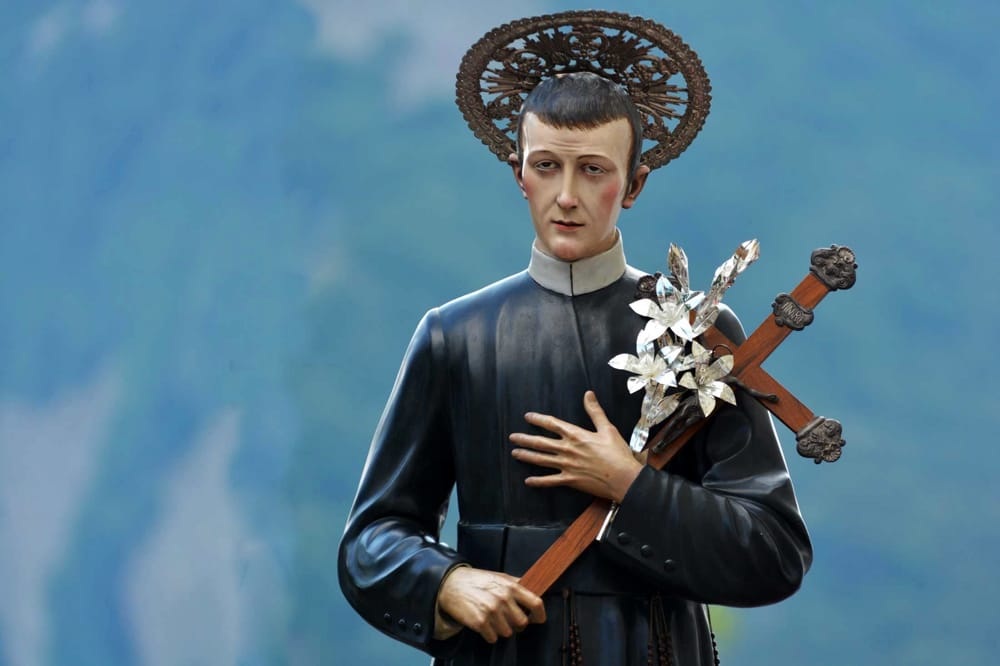
In statues, it was usually represented as a golden disc placed behind the head of the character.

The halo has then always been intended as a symbol of light and grace given directly by God. In pagan civilizations, the halo was expression of general power, divine but also human, and this trend went on even in the Christian era, when the halo was used not only to crown saints’ and angels’ heads, but also famous people’s heads. They were rich clients or intellectual people, at least until the 17th century, when Pope Urban III strictly forbid the representation of still living and not yet beatified men with halos on their heads.

The halo in the Christian iconography

The halo in the Christian iconography

Christians began using the halo in their representations (pictures, statues, mosaics, etc.) only between the II and the III century a.C. and in an extremely lay vision. At the beginning, it was only meant to underline the political importance of some characters, such as princes or emperors. As it was for the Romans, halos identified sovereigns, characters that had great powers and earthly dignity. Rays of light instead surrounded Jesus and the other religious figures. The firsts that brought the halo in a Christian setting were the Byzantine emperor Justinian and his wife Theodora: in the mosaics in the Cathedral of San Vitale in Ravenna, they were both represented with their heads surrounded by a golden disc.

After this first lay representation, from the IV century, Christians began using the halo to underline the spiritual importance of some figures, as symbol of bliss and heavenly glory. At the beginning the halo was a prerogative of Jesus, Mary and the angels; only later apostles and saints deserved to wear it, too.

The origins of the Saints halo

As we already saw, saints were soon given the honor of the halo in sacred art, right after Jesus and Mary, and with the due differences compared to them. The reasons behind this honor are clear. The saints are men and women that were touched in a special way by the divine grace, appointed with the love of God, made instruments of His will. The light they radiate is then of two kinds: on one side it comes from their head and body thanks to their merits, on the other side it is the reflection of the divine light that envelopes them and permeates them.

The halo on the saints’ heads in sacred images is usually represented as a circle painted in gold or blue. Originally, saints had laurel crowns like the Roman emperors and famous people, but later the laurel crown was replaced by a golden crown, and in the end, by a golden circle. The Holy Apostles were sometimes represented with a flame on their heads, symbol of their divine inspiration. At the same way, the Holy Evangelists could be represented as their symbolic animal with a flame surrounding their heads. Even Doctors of the Church and angels were sometimes crowned with the flame of the Divine inspiration.

The different shapes of a halo

There are precise rules that define the use of a halo in the sacred Christian art.

First of all, we need to make a distinction between the rounded halo, only for angels and saints, and the sunburst halo, placed on blessed people’s heads.

Jesus halo is usually inserted in a red cross, with three visible arms recalling Trinity. The body covers the fourth arm.

Cristo en la cruz
Cristo en la cruz – Obra de Fra Angelico – Museo de San Marcos

The Holy Spirit is not represented with any specific halo, as it is usually represented as light Itself, seven flames or a star ray, which symbolize the seven gifts.

In the rare occasions where God is represented as a vulnerable old man with the beard, he has a triangular halo on his head, symbol of the Trinity.

Mary’s halo is decorated with 12 stars or just one star, with one to seven flames.

From the VII century there was also a square halo, used when they needed to represent men or women that were about to become saints but they were not yet been canonized, or even still alive. The artist often represented the buyer of the work with this kind of halo.

Virtues, in their human form, wear polygonal halos.

During medieval age, artists kept representing rounded or oval halos, whose representations developed along with art itself, adapting to new styles and new perspective rules. During the Renaissance, the halo went a bit out of fashion, because artists began preferring a more human and carnal dimension of sacred images. We can still see it in some works as a very thin ring of light, almost invisible.

About colors, Christian iconography attributed red to martyrs, white to virgins and pure people, green to confessors, purple to penitents, gold or blue to saints and angels.

The devil or Jude Iscariot are sometimes represented with a black halo around their head.

Star crowns and halos for statues

Star crowns and halos for statues
Coronas y halos de estrellas para estatuas – Más de 40 modelos disponibles en Holyart

When we wish to represent a saint or a sacred figure, especially Mary, with a sculpture or in general with a statue, we need to use a golden crown for statues, or more often a star crown.
Holyart catalog offers a wide variety of such artifacts, all handmade in Italy, available in all sizes. Upon request, it is possible to personalize most of them according to your tastes and needs.

Holyart Crowns for Mary, Saints halo, star crowns and sunburst halos are often made with filigree: brass threads painted in gold that create games with lights and shadows, particular shadings and contrasts that give the object more brightness and emphasis. Crowns are mostly made of golden brass, and imitate the ones represented in the most famous pictures of sacred art. For Virgin Mary statues, there are crowns with golden roses and stars. Many sunburst and halos are decorated with rhinestones, Swarovski crystals and golden details. Others are made of plexiglas, are equipped with light and led bulbs, which allow the statue to illuminate on its own, creating suggestive effects. Holyart catalog offers also tube-shaped halos with bulbs on the inside. A Holyart halo or star crown will give your statue a solemnity of other times.