Author: Redazione

Symbols of strength and love, here are the patron saints of women

Symbols of strength and love, here are the patron saints of women

Contents1 Mary2 Saint Anne3 St. Mary Frances4 Saint Paschal Baylon5 Saint Gerard Maiella6 Saint Monica7 St. Dominic Savio Women’s patron saints. On the occasion of the March 8 holiday, but remembered every day as examples, symbols and guardians It happens to everyone, at certain times…

Simon of Cyrene, the man who helped Jesus carry the cross

Simon of Cyrene, the man who helped Jesus carry the cross

Who helped Jesus carry the cross? Simon of Cyrene, despite himself a participant in the Passion and protagonist of the fifth station of the Way of the Cross. But who was he? The Synoptic Gospels recount the journey of Jesus to the hill of the…

Jesus’ crown of thorns and its meanings

Jesus’ crown of thorns and its meanings

Jesus’ crown of thorns is one of the most emblematic symbols of the Passion. Let’s find out why and what has happened to it over the centuries

In ancient times, when a Roman soldier performed acts of great bravery, such that he rendered great service to Rome and its inhabitants, he was awarded the civic crown or oak crown, intended only for those who had saved the life of a Roman citizen. To receive it was a great privilege, and the wearer was covered with honors. This crown consisted of a wreath of oak’s leaves, and we cannot help but think that it was precisely this honorific insignia that the Roman soldiers had in mind when they placed the crown of thorns on Jesus’ head.

The episode, recounted in the Gospels of Matthew (27:29), Mark (15:17) and John (19:2), is the moment in Christ’s Passion following the Flagellation, when the Roman soldiers, about to take Jesus to the place of his torture, wanted to mock him by worshipping him as King of the Jews. To do so, they crowned him with a crown of thorns, placed a reed in his hand as a royal scepter, and then bowed down before him mocking and saluting him, “Hail, O King of the Jews!” (Matthew 27:29; John 19:2-5).

A torment more humiliating than painful, in the immense carousel of suffering that is the Passion, in which a symbol of dignity and majesty like the crown was turned into an instrument of unheard-of denigration and violence.

The meaning of the crown of thorns

We have seen what Jesus’ crown of thorns meant to Roman soldiers. For Christians, however, the crown of thorns becomes a symbol of Jesus’ actual kingship: even in the pain, in the affliction inflicted by those whom He was sent to save, He proves Himself to be King and Messiah, the Servant of God (Isaiah 53) prostrated by sorrows at the will of the Most High, and who “gave Himself up to death and was numbered among the wicked, while he bore the sin of many and interceded for sinners,” but also King of kings and Lord of lords, ready to return from heaven riding on a white horse, to judge and fight with righteousness, with eyes like a flame of fire, wrapped in a cloak drenched in blood, and his name is the Word of God (Revelation 19).

Jesus, King of love, King of sorrow, King of sacrifice. In His humility He consciously chooses the unspeakable pains of the Passion, the humiliation of the cruel mockery and derision of the soldiers and the crowd, the agony of the scourging, the extreme mockery of the crowning with thorns, the agony of the crucifixion. Yet as we contemplate Jesus on the cross, we see, yes, a broken, vanquished, beaten man, but one who in the very instant of his fall rises above everything and everyone and triumphs, as King, and wins over his oppressors, subdues death, routs darkness, defeats sin, again for love and in the name of love.

This is the meaning of Jesus’ crown of thorns, a symbol of humility and defeat that become triumph and royal greatness, of victorious suffering that is a message of life and hope and salvation for all.

The crown of thorns kept at Notre Dame

Among the many priceless treasures kept in the Sainte-Chapelle, the church built by Louis IX of France as the palatine chapel of the royal palace, were many precious relics of the Passion. In addition to a fragment of the True Cross of Jesus, the sponge with which Christ was quenched with vinegar, and the Mandylion, a veil bearing what is said to have been His face, the most valuable piece is certainly the Crown of Thorns, which the French king got from the Emperor of Constantinople as a pledge for a loan and brought to Paris in 1239. After the Chapelle was deconsecrated, the relics were transferred to Notre-Dame Cathedral.

The Veil of Veronica

Read more:

The mystery of the Veil of Veronica, the cloth with the imprint of the face of Jesus
The Veil of Veronica is one of the most mysterious and fascinating relics in the history of Christianity. Where does the legend of the veil…

The Crown of Thorns of Notre-Dame consists of a woven circle held together by a golden thread with 70 thorns attached. It is displayed for veneration by the faithful every first Friday of the month. Around the world there are many thorns considered to have come from the crown of Jesus, about 700 have been catalogued, but many of these Holy Thorns are ‘contact’ relics, meaning they were not part of the crown but were placed on it over the centuries. In Italy, too, many churches claim possession of a Sacred Thorn, the object of popular devotion and fervent worship. Think of the Sacra Spina of Andria, the Sacra Spina of San Giovanni Bianco or that of San Gaetano in Barletta.

The meaning of INRI on the cross of Jesus

The meaning of INRI on the cross of Jesus

The meaning of INRI on the cross of Jesus: where does it come from and what does this mysterious abbreviation that appears in all depictions of Jesus on the cross mean? And what is the meaning of the name Jesus? Each one of us, attending…

The Chair of Saint Peter: the meaning of the work and the origins of the feast

The Chair of Saint Peter: the meaning of the work and the origins of the feast

Contents1 The Chair of Saint Peter by Bernini2 The Celebration of the Chair of Saint Peter3 The cathedra Petri What is meant by the Chair of Saint Peter? What is and where is this precious artefact? What is celebrated on February 22? February 22 is…

The face of Jesus: let’s reconstruct his true likeness

The face of Jesus: let’s reconstruct his true likeness

What was the true face of Jesus? What ethnicity did he belong to? A question that has fascinated and divided scholars and theologians for two thousand years

If we were to ask a child what Jesus looked like, he would not have the slightest hesitation: Jesus was tall and thin, with fair skin, a smiling face, long brown hair flowing down the sides of his face, and blue eyes. This of course if we asked a European child. If we asked the same question to an African or Chinese child, we would probably end up with a very different idea of Jesus’ face, with black skin or almond-shaped eyes. This is because Jesus’ physical appearance, his somatic features, are not documented by any certain testimony. Simply put, none of the evangelists, men who knew him in person, bothered to describe what he looked like. Throughout the New Testament there is no description of Jesus’ physical appearance, let alone any indication as to His ethnic origins.

This is why the iconography of Christ has undergone countless evolutions over the centuries, mostly dictated by subjective interpretations, cultural stereotypes, and the desire to standardize the appearance of the Son of God with an aesthetic ideal that reflected the one that was most valued in a given historical time and culture.  Just like the hypothetical children questioned about the face of Jesus, for all of us the likeness of Jesus is the result of a mental image derived from the perpetration of artistic suggestions, over the course of our lives-illustrations, statues, paintings, and even cinematic interpretations, determined by stereotypes that have nothing to do with the historical Jesus.

The iconography of Jesus

It is fascinating to study the evolution of the iconography of Jesus in the history of sacred art, not so much to try to investigate what the Messiah really looked like, but to understand how Christianity grew and transformed parallel to the figure of its inspirer.

In the Gospels, as we said, there is no mention of what Jesus looked like, although we tend to assume that He was Jewish, as were His disciples. And Jews were forbidden to depict the face of God. The first Christians to feel the need to depict Jesus were probably the same ones who were forced to hide in the Catacombs to manifest their faith. For this reason, as well as for the actual lack of descriptions to draw inspiration from, Christ was depicted by them through symbols and allegorical images, without any claim to likeness.

Only when Christianity became the official religion of the Roman Empire did people begin to worry about how to depict Christ. Interestingly, according to the Greek Church Fathers, Jesus had to be ugly, and his beauty had to be exclusively divine, while for the Latins, such as St. Jerome and Augustine of Hippo he had a good appearance, reflecting his inner and spiritual perfection.

As time went on, descriptions that had a claim to truth began to increase, either because they were inspired by visions in which Jesus was said to have manifested himself with one appearance rather than another, or corroborated by the discovery of images not made by human hand (acherotipa), such as the Mandylion, or image of Edessa, worshipped by Eastern Christians, or of relics such as Veronica’s veil, on which the true face of Jesus was said to have been imprinted. From this kind of evidence comes the emergence of the depiction of Jesus with a beard and long hair, because until the fourth century A.D. He was usually depicted as young and beardless. Interestingly, according to St. Paul, Jesus could not wear long hair, as it was considered unseemly in his day.

The mystery of the Veil of Veronica

Read more:

The mystery of the Veil of Veronica, the cloth with the imprint of the face of Jesus
The Veil of Veronica is one of the most mysterious and fascinating…

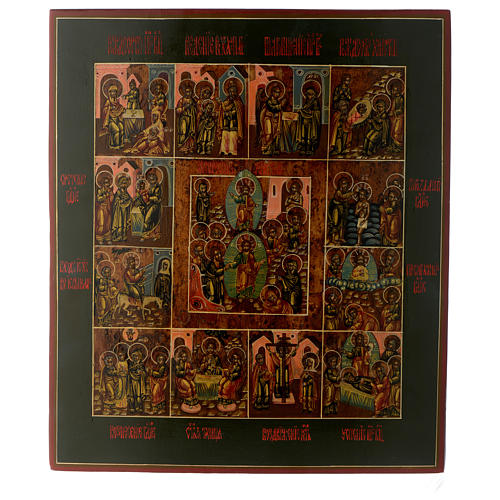
If in Byzantine times Jesus is usually depicted in glory and triumph as Christ Pantocrator. Also very common, especially on icons, is the iconography of the Transfiguration of Jesus. Iconoclastic fury condemning the depiction of Christ led to the destruction of many sacred images in the East between the 8th and 9th centuries. In the West, on the other hand, the figure of Jesus is depicted not as a severe and judgmental ruler but, thanks to the influence of the Franciscans, in His humanity and humility, from the Nativity to the Crucifixion. Western artists are projected to greater realism, with Giotto and, later, with the great masters of the Renaissance.

The story of Jesus the most important events of His life

Read more:

The story of Jesus: the most important events of His life
The story of Jesus, between the Gospel story, historical reality and devotional legend…

Patterns of canonical depiction begin to be defined, both for the Infant Jesus, in the arms of the Madonna, and for the adult Jesus, with long hair loose, his tunic and cloak, and during the Passion, only a cloth covering his sides. An iconography that runs through the history of Western art and permeates it for centuries.

Jesus’s real name

Another not at all obvious element, which has divided scholars and theologians over the centuries, is the true name of Jesus. This is because, in the Scriptures, in addition to the name we all know He is often referred to by titles and appellations.

The most used in the New Testament and considered the true name of Jesus remains Ἰησοῦς, which in Latin becomes Iesus and in Italian Gesù. It is derived from the transliteration of Aramaic Yēšūa’, which in turn is derived from Hebrew Yĕhošūa’, meaning “God-YAH (is) salvation.”

The appellation Christ (Xριστός, Christòs) also appears very often in Scriptures as an honorific title of Jesus. Derived from the Greek, it means “anointed,” and refers to the tradition that wanted the Kings of Israel anointed with aromatic holy oils. By this appellation Jesus is recognized as “elect,” “anointed,” the long-awaited Messiah of the Jewish people.

The honorific definition of Jesus as Lord also goes back to the New Testament: The Greek word, from the Aramaic “mara,” from which comes the full title “our Lord Jesus Christ.”

Nazorean and Nazarene both indicate Jesus’ origin from the city of Nazareth, although the former appellation perhaps refers to a vow of consecration taken by the Nazarenes, who wore their hair long. This would justify the iconography of Jesus always portrayed with flowing hair, when in his day it was considered dishonorable to wear it that way.

Finally, let us mention, among the many names and appellations of Jesus, King of the Jews, also recorded on the titulus crucis affixed to the cross by Pontius Pilate. The Jews were waiting for a Messiah, heir to King David’s throne, and the evangelists Matthew and Luke reported a genealogy meant to confirm this lineage and claim Jesus’ royal right.

Meta description: What did Jesus look like? What ethnicity did he belong to? Was he light-skinned or dark-skinned? Here is how Jesus’ face has changed in history and art.

St. Faustinus: why has he become the saint of singles?

St. Faustinus: why has he become the saint of singles?

February 15 celebrates St. Faustinus, the patron saint of singles in spite of himself. Let’s find out why We are all familiar with Valentine’s Day, the day of lovers, which falls on February 14. Perhaps not everyone knows, however, that February 15 is the day…

How to measure your rings: our mini guide

How to measure your rings: our mini guide

Contents1 How do you measure the diameter of your finger? What about the circumference?2 The variables3 The Holyart rings How to take measurements to give a ring as a gift. A few tricks on ring sizes and everything you need to make sure you don’t…

St. Scholastica, the sister of St. Benedict of Norcia

St. Scholastica, the sister of St. Benedict of Norcia

On Feb. 10, the Church commemorates St. Scholastica, sister of St. Benedict of Norcia, patroness of Benedictine nuns and protector of women who have given birth. Here is her story of sororal love and faith.

Twin pairs have been known to be united by a deep bond that seems to originate while still in their mother’s womb. Even in pairs of heterozygotic twins this union verges on symbiosis in some cases, transcending time and space, and lasting for a lifetime. So it may have been for St. Benedict of Norcia and his twin sister St. Scholastica, who lived in the shadow of her more famous brother, embracing his Rule and becoming his docile instrument and enthusiastic supporter. Protectress of mothers in childbirth, Benedictine nuns, and children suffering from convulsions, she is celebrated on February 10 and venerated as a saint by the Catholic Church, the Orthodox Church, and the Anglican Church.

From the Dialogues of St. Gregory the Great we are offered some hints about the life of this remarkable woman, founder of the female branch of the Benedictine Order. The twins belonged to a family descended from the ancient Roman senatorial nobility. Their mother, Countess of Norcia, died giving birth to them, and their father Eutropius, Captain General of the Romans in the region of Norcia, wanted to send the two children, barely 12 years old, to Rome, to bring them closer to religion and initiate them into classical studies. Upset by the dissolute life in the city, both chose without delay to retire to a monastery. To do so they separated. Benedict became a hermit, retreating, as we know, first to Subiaco, then to Cassino. Scholastica entered a monastery near Norcia, where she took a vow of chastity and renounced earthly goods. She later joined her brother in Subiaco, and after he had founded the Abbey of Monte Cassino she built her own monastery at the foot of the mountain on which her brother’s stood, only 7 kilometers away. It was the monastery of Piumarola, and here she started the female branch of the Benedictine Order, the Benedictine nuns, who were also devout and faithful to the Rule of St. Benedict.

St. Benedict and St. Scholastica

The twins remained united throughout their lives. Although the path they took meant that they had to remain apart, despite living in two places so close together, the two met once a year in a small house halfway between their respective monasteries. Here Scholastica would break her vow of silence only to talk with her twin about God and pray with him. The last of these meetings took place on February 6, 547, and when their time together was coming to an end Scholastica, who was 62 years old, begged her brother to stay a little longer. Benedict refused, citing as his reason the Rule that urged him to return to the monastery and his cell, and departed, despite his sister’s tears. But after walking a short distance he and his people were surprised by a frightful storm and forced to turn back. St. Scholastica confessed that she prayed intensely to God to bring her brother back, and so the two stayed together while bad weather raged outside. That is why even today St. Scholastica is invoked to defend against lightning and to obtain rain. On February 10, Scholastica died. Benedict, learned the news of his sister’s death, which occurred three days after their last meeting, thanks to a divine sign: he saw a white dove rising toward heaven and understood that it was Scholastica’s soul leaving earth. He personally went to pick up his sister’s body and laid it in the tomb he had had prepared for himself, so that, as they had been together in the womb, they could be together in eternal rest.

The monastery of St. Scholastica in Subiaco.

The monastery of St. Scholastica in Subiaco

East of Subiaco, and 510 meters above sea level, still stands the monastery of St. Scholastica, spared from earthquakes, ancient and modern invasions, and bombings. Many hermits lived and retired in prayer in this region, giving this valley the name holy valley. Subiaco’s only monastery until the end of the 12th century, under the name Monastery of St. Sylvester, it was later renamed Monastery of St. Benedict and St. Scholastica, and was later dedicated only to the saint. At the entrance to the structure, composed of buildings from different historical periods, stands the inscription Ora et Labora. Next to the present church, which dates back to 1700 and stands on the ruins of five earlier churches, is a bell tower from the 12th century, a golden age for the monastery, which at that time was also Italy’s first printing press, where books of inestimable value were printed that enriched the large library for centuries.

Quotes of saints to dedicate on the right occasion

Quotes of saints to dedicate on the right occasion

Contents1 Mother Teresa of Calcutta’s Quotes2 St. John Bosco’s Quotes3 St. Francis’ Quotes4 St. Augustine’s Quotes5 Padre Pio’s Quotes6 St. Paul’s Quotes7 St. Francis of Paola’s Quotes8 St. Bernard of Clairvaux’ Quotes9 St. Thomas Aquinas Quotes Quotes of the saints, spoken and written by men…

Saint Blaise and the miracle of the panettone cake

Saint Blaise and the miracle of the panettone cake

Saint Blaise and the Milanese panettone. Let’s find out what the Armenian saint who protects against diseases of the throat and the famous Milanese dessert have in common We have already talked about St. Blaise of Sebaste, physician and patron saint of otolaryngologists and protector…

Presentation of Jesus at the temple until the feast of Candlemas

Presentation of Jesus at the temple until the feast of Candlemas

The presentation of Jesus to the temple is celebrated on February 2. Also known as the Feast of the Purification of Mary, or Candlemas, it is a holiday that has taken on many different and important meanings over the centuries. Let’s find out which ones.

The feast of the Presentation of Jesus at the Temple has been important since its inception in the fourth century AD. In fact, it represents a very significant junction between the history of Jesus and Christianity and Jewish culture. The Old Testament imposed very strict rules and established precise ceremonies that followed the birth of a child in a family, especially if it was a male child. The woman who had given birth was considered unclean (Lev 12) and had to undergo a series of purification rites before she could touch sacred things again and enter the sanctuary. In addition, every firstborn male child was to be consecrated to the Lord and redeemed through a symbolic offering as a sign of gratitude for the deliverance of the Jewish people from slavery in Egypt (Exodus 13:2 and Exodus 13:11-16).

Thus, in Luke’s Gospel (Luke 2:22-40) we read the episode of Jesus’ presentation in the Temple, which occurred forty days after His birth. Joseph and Mary lead the infant Jesus to the Temple in Jerusalem. Here they run into old Simeon, who was foretold that he would not die before seeing the Messiah, and who taking Jesus in his arms blesses him with these words, “Now let your servant go in peace, O Lord, according to your word; for my eyes have seen your salvation, prepared by you before all peoples, a light to enlighten the nations and the glory of your people Israel.”

Later the Holy Family meets the prophetess Anna, and she too recognizes Jesus as the Messiah.

Holy family picture

Read more:

Holy family picture: a symbol to keep at home
The Holy Family, the ideal model of every family nucleus, the incarnation of love, mercy, humility…

This episode serves to confirm what was prophesied by Malachi, the last prophet of the Old Testament, that the recognition of the Messiah would take place in the Temple: “Behold, I will send my messenger to prepare the way before me, and straightway the Lord, whom you seek, shall enter into his temple; the angel of the covenant, whom you sigh for, behold, he comes, says the Lord of hosts.” (Malachi 3:1)

Feast of Candlemas

We had already devoted an article to Candlemas, which coincides with the feast of Jesus’ presentation in the Temple. It is a feast that celebrates the triumph of light over darkness, but also the symbolic end of the Christmas festivities and the beginning of the Easter journey.

La Candlemas

Read more:

La Candlemas: history and curiosities
La Candlemas, the story of a party with great suggestions that has its roots in pre-Christian rites linked to the triumph of light…

On this day candles and tapers are blessed, symbolizing Jesus as the light of the world, a light to enlighten people. Blessed candles and tapers are then distributed to the faithful as protection from evil and calamity.

Like many Christian holidays, it is likely that Candlemas draws its origins from paganism. Indeed, there are many festivals celebrated by ancient civilizations to celebrate the transition from darkness to light, symbolized by the end of winter and the beginning of spring. In mid-February the Romans celebrated the Lupercali, characterized by the lighting of many lamps and candles, but also by purification rites. The Celts for their part dropped the feast of Imbolc, the “Day of St. Brigid,” on February 1, celebrating the culmination of winter and in certain areas the beginning of spring.

Purification of Mary

The feast of Candlemas has long been a Marian holiday. In ancient times it was celebrated on February 14 and commemorated Mary’s purification after childbirth, performed according to the times and customs dear to Jewish culture and religion.

Purification of Mary

Today the focus has shifted from the Mother to the Son, and February 2 has become the occasion to celebrate the Presentation of Jesus at the Temple. This happened as a result of the liturgical reform decreed by the Second Vatican Council. However, the tradition of women’s purification on this occasion remains alive in many countries, especially in rural areas. Until recently in Valnerina, Marche, every woman who gave birth had to go to church 40 days after giving birth to be purified by the priest. The woman had to kneel at the threshold with a lit candle, the priest would bless her there, and then they would enter together, walking toward the altar while she held on to the white stole he wore.

Proverbs about Candlemas

Also in the rural and popular setting are the many proverbs and sayings related to the feast of Candlemas. In the past it was the day when old people in villages tried to guess what the weather would be like between now and the arrival of spring. Many proverbs are linked precisely to this ‘meteorological’ dimension, such as the famous Veneto saying, “Se ce sole a candelora del inverno semo fòra, se rain e tira vento del inverno semo dentro,” of which there are similar versions in Lombardy and Trieste. Basically, in these areas it is believed that if it is sunny on Candlemas day, winter is almost over, while if it rains or pulls the wind it will last for a while longer.

In contrast, in Tuscany and Emilia it is believed to be exactly the opposite: if it snows or hails by Candlemas, winter cannot last much longer. “Se piove o se gragnola dell’inverno semo fora” is the saying in Tuscany, while in Bologna, “Al dé dl’Inzariôla, o ch’al naiva o ch’al piôva dal invêren a sän fòra, mo s’ai é al suladèl a in arän anc pr un msarèl (On Candlemas Day, whether it snows or rains, from winter we are out, but if it’s sunny we’ll have winter for about another month).

Lamp for the Blessed Sacrament: how to use

Lamp for the Blessed Sacrament: how to use

Contents1 The Blessed Sacrament2 Tips for proper use of the Eucharistic Lamp3 What pillar candles are best to use? A symbol of God’s presence in every church, the Blessed Sacrament needs a special lamp that is perpetually lit. It is the lamp for the Blessed…

Struck by lightning on the road to Damascus: what is the origin of this saying

Struck by lightning on the road to Damascus: what is the origin of this saying

Thunderstruck on the road to Damascus, a saying that hides a story of deep faith and spiritual conversion. The protagonist? One of the most revered saints of all time When we say of someone who was thunderstruck on the road to Damascus, we mean that…

Plenary indulgence: meaning, origins and how to get it

Plenary indulgence: meaning, origins and how to get it

What is a plenary indulgence? Here’s why Pope Francis granted it to those participating in the Year of St. Joseph.

To understand what an indulgence is, we need to keep in mind two aspects of sin: guilt and punishment. Guilt is remitted by Confession; punishment is the effect of sin that remains even after forgiveness. Indulgence also takes away the temporal penalty, thanks to the mediation of the Church and certain devout practices that the faithful are called upon to perform. It can be partial or plenary.

The origin of plenary indulgence

The origin of indulgence is in the practices of penance that characterized early Christian communities. Long before the sacraments were structured as we know them today, the faithful had to serve the punishment caused by their sin through very specific, often public, actions and procedures. Over the centuries, particularly around 1000-1100 A.D., the custom became widespread that the punishment to which the faithful was subjected could be alleviated or annulled through the intervention of the Church. With certain works, prayers, pilgrimages, the repentant believer could obtain precisely an indulgence.

The Bull of Forgiveness: the first plenary indulgence in history

The bull of Indulgence

A very relevant episode, speaking of plenary indulgence, is that of the Bull of Forgiveness of Pope Celestine V. In 1294 he became pontiff and granted a plenary indulgence to all the faithful who visited the basilica of Collemaggio from vespers on August 28 to sunset on the 29th. It was the first example of a plenary indulgence, granted by the pontiff to all the faithful from all walks of life.

Plenary indulgence for the deceased

Plenary indulgence can be received both for oneself and for the deceased. By requesting an indulgence for deceased loved ones, the faithful can reduce or cancel the sentence they must serve before reaching Heaven.

The Handbook of Indulgences

To clarify and gather all the guidance on how to obtain plenary indulgences, there is the Manual of Indulgences. The Manual encloses several documents, including the “Norms on Indulgences” and a list of concessions, that is, works to be performed and prayers to be recited in order to obtain the indulgence. Confession and sacramental Communion, and prayer for the Pope’s intentions are always required.

St. Francis of Assisi and the forgiveness of pilgrims

Very famous is the so-called Pardon of Assisi or Indulgence of the Portiuncula. St. Francis himself asked Pope Honorius III if he could grant an indulgence to pilgrims who went to the Portiuncula church. This religious rite is valid always and for everyone. In addition, every year, from 12 noon on August 1 to midnight on August 2, the Portiuncula Indulgence is extended to all parish churches and all Franciscan churches around the world.

St Francis

Read more:

The Canticle of the Creatures of St. Francis
St. Francis of Assisi is one of the most loved and venerated saints by the Catholic Church.

DIY Candles: How to recycle leftover wax during the holidays

DIY Candles: How to recycle leftover wax during the holidays

Recycle DIY candle wax? An idea for savings, but also a creative game. Let’s discover how to make candles An article on how to recycle candles? It’s the right time of the year! After Christmas, you will surely find many wax “leftovers” at home, perfect…

How to store moss for the Nativity scene

How to store moss for the Nativity scene

Nativity moss, a precious gift from nature for our Holidays, deserves to be carefully preserved Everyone likes the natural and inimitable effect of crib moss. Although collecting moss is forbidden in our country, as it is a protected species, there is still a widespread tendency…

History of the Baby Jesus of Prague

History of the Baby Jesus of Prague

The statue of the Baby Jesus of Prague has always been an object of great popular devotion and over the centuries has inspired the spiritual fervor of many faithful all over the world

The Kostel Panny Marie Vítězné, “Church of the Virgin Mary of Victory,” is located in one of Prague’s oldest and most atmospheric neighborhoods, the Malá Strana, the Little Quarter. Built in the early 17th century for German Lutherans, it is famous because it houses the Baby Jesus of Prague, a wax-covered wooden figurine that has always been an object of great devotion and is now a pilgrimage destination for millions of worshippers.

The Child of Miracles, or Little King, as the statue is affectionately called, is just 45 cm tall, and was made in Spain by an unknown sculptor, perhaps at the request of a religious man who was visited by the Baby Jesus in a vision. Later Maria Manrique de Lara, a Spanish duchess who had married a Bohemian nobleman, brought the statue to Prague and made it a wedding gift to her daughter Polyxena von Lobkowicz. It was she, widowed, who donated the statue to the Discalced Carmelites who lived at the Church of Mary the Virgin Victorious.

The cult of the Baby Jesus, and in particular the Baby Jesus dressed as a prince, was widespread in the Baroque era. In particular, St. Teresa of Avila, a Spanish nun and mystic who proposed a model of faith based on the friendship between man and God and on a profoundly human dimension of Jesus Christ, loved to contemplate Jesus, the object of her unconditional love and absolute devotion, at every moment of His human story, including infancy, and she often carried with her a statuette depicting the Baby Jesus, just like the one kept in Prague. St. Therese of Jesus, also known as St. Therese of the Baby Jesus, the theologian of the “little way,” also loved the childlike dimension of Jesus, she very one who promoted an attitude of absolute abandonment and trust in the arms of God the Father.

St Therese of Lisieux

Read more:

Saint Therese of Lisieux and the miracle of roses
Saint Therese of Lisieux, who died at the age of twenty-five, after having spent much of her life in seclusion, left us a unique model of…

On the other hand a great apostle of the devotion to the Baby Jesus of Prague, , was the Venerable Father Cyril of the Mother of God, to whom, according to legend, Our Lady appeared to show him where the statue of the Child should be placed inside the Carmelite church of St. Mary of Victory, already linked to the Miracle of the White Mountain that had occurred a few years earlier. Baby Jesus himself then appeared to him communicating the message, “The more you honor me, the more I will favor you.”  This phrase is found written at the foot of all reproductions of the statue.

A curious detail: the statue of the Baby Jesus of Prague possesses a whole set of little dresses, just like a doll! Over the course of a year, it can wear up to sixty different ones, and they follow the colors of the current liturgical season. So, at Easter the Child will wear a white robe, on Easter Sunday a little red robe, a purple cloak for Advent. Many of these robes have been donated by more or less famous devotees over the centuries and come from all over the world. Some are decorated with pearls and precious stones, gold and diamonds, hand-embroidered by artisans in the service of kings and emperors and constitute a small treasure. Even Pope Benedict XVI, on the occasion of his apostolic visit to the Czech Republic in 2009, gave the Infant of Prague a gift of one of the little golden crowns that encircle his head.

The Shrine of Arenzano

The Shrine of Arenzano, near Genoa, is one of the major centers for spreading devotion to the Baby Jesus of Prague. The cult dedicated to the little statue arrived here in 1900, when the Carmelites living in the village placed a painting of the Infant Jesus in their church. Immediately a large influx of devotees gathered at the shrine, accompanied by graces and miraculous events. The picture was replaced by a statue similar to the one in Prague, and a shrine dedicated to the Baby Jesus of Prague had to be erected to accommodate the ever-growing number of pilgrims. Religious gathering centers and activities sprang up around the shrine, which continue to this day, as do pilgrimages from all over Italy and abroad.

Prayer to the Baby Jesus of Prague

o Father Cyril of the Mother of God the Virgin also revealed a prayer to be addressed to the Baby Jesus of Prague. But many others have been composed over the centuries, and a special Novena is also addressed to the statue of the Child. We report only one of the many orations dedicated to Him:

O Holy Child Jesus,

Who spread Thy graces on those who invoke Thee,

turn your eyes to us,

prostrate thyself before thy holy image,

and hear our prayer.

We commend to you so many poor people in need

Who trust in thy divine Heart.

Stretch upon them your almighty hand,

and succor to their needs.

Stretch it over children, to protect them;

On families, to guard their unity and love;

On the sick, to heal them and sanctify their sorrows;

On the afflicted, to console them;

On sinners, to draw them into the light of your grace;

On those who, gripped by sorrow and misery,

confidently invoke your loving help.

Spread it still over us, to bless us.

Grant, O little King,

the treasures of your mercy and peace

To the whole world,

and preserve us now and always

In the grace of your love. Amen.