Author: Redazione

Saintly Pilgrims: 8 Patron Saints of Pilgrims and Travelers

Saintly Pilgrims: 8 Patron Saints of Pilgrims and Travelers

Contents1 Saint James the Greater2 Saint Roch3 Saint Christopher4 Saint Benedict Joseph Labre5 Saint Gertrude of Nivelles6 Saint Bridget of Sweden7 Saint Bona8 Saint Sebaldus Saintly pilgrims are saints for whom the experience of pilgrimage has been so significant that it became the very reason…

Jubilee Churches, pilgrimage destinations not to be missed during the Jubilee

Jubilee Churches, pilgrimage destinations not to be missed during the Jubilee

Contents1 What are the Jubilee Churches2 The Seven Churches Pilgrimage3 Opening of the Holy Doors Jubilee Churches are those equipped with a Holy Door, through which, during the Jubilee, one can obtain plenary indulgence. Here’s which ones they are and when they will be opened.…

What is the Jubilee: Let’s Prepare for a New Holy Year

What is the Jubilee: Let’s Prepare for a New Holy Year

What is the Jubilee? How often is it celebrated? In anticipation of the Holy Year 2025, let’s discover the origin of this centuries-old devotional practice.

In preparation for 2025, it’s important to understand what the Jubilee is. The Jubilee, or Holy Year, is a special religious event for the Catholic Church, characterized by solemn ceremonies, collective events, and devotional pilgrimages. It occurs at regular intervals, every 25 years, although there are extraordinary Jubilees, which are proclaimed by the Holy Father under certain circumstances.

During the Jubilee, the faithful are invited to make a pilgrimage to St. Peter’s Basilica in Vatican City, Rome, and to participate in rituals and acts of devotion, such as the Seven Church Walk. It’s an occasion for great spiritual growth and allows for the forgiveness of all sins because traditionally, those who pass through one of the Holy Doors during the Jubilee receive plenary indulgence, meaning the remission of all sins.

Pilgrimage to Rome

Read more:

Pilgrimage to Rome: Among Christians’ Preferred Destinations
A pilgrimage to Rome has always been one of the most significant spiritual experiences for Christians from around the world.

But what does Jubilee mean? The origin of the Jubilee dates back to the ancient Jewish tradition of Yovel, which was celebrated every fifty years. The Jewish Jubilee primarily focused on land, property, and land rights. According to the Hebrew Bible, this special period involved a series of practices, including the return of land to its original owners, the remission of debts, the release of slaves and prisoners, the rest of the land, and a special manifestation of divine mercy. These practices aimed not only to ensure a just distribution of resources and promote social justice but also to emphasize the importance of divine mercy and compassion in the human experience. This period was initiated by the sound of a ram’s horn, “jobel” in Hebrew, from which the solemnity got its name, later transformed into Jubilee.

In the Gospel of Luke, Jesus, arriving at Nazareth, quotes a passage from the Book of Isaiah very explicitly, referring precisely to this special year dedicated to God: “The Spirit of the Lord is on me because he has anointed me to proclaim good news to the poor. He has sent me to proclaim freedom for the prisoners and recovery of sight for the blind, to set the oppressed free, to proclaim the year of the Lord’s favour.” (Isaiah 61:1-2). And so Jesus in the Gospel of Luke: “The Spirit of the Lord is on me because he has anointed me to proclaim good news to the poor. He has sent me to proclaim freedom for the prisoners and recovery of sight for the blind, to set the oppressed free, to proclaim the year of the Lord’s favour. (Luke 4:18-19)

The Indulgence of the Hundred Years was a significant event that anticipated and predicted the Jubilee in the history of the Catholic Church. This event occurred during the pontificate of Pope Boniface VIII, although it was not the Pope who instituted it. A tradition of unknown origin guaranteed complete remission of sins and the suspension of all temporal penalties to those who went on pilgrimage to St. Peter’s Basilica in Rome by 1300. It was Pope Boniface VIII who established the first Jubilee, perhaps inspired by the Indulgence of the Hundred Years or the aforementioned Jewish tradition of Yovel. Initially, it was planned for the Holy Year to take place every hundred years. Only later, with Pope Clement VI (1350), was the time interval lowered to 50 years, like the ancient Jewish Holy Year, then to 33 (the years of Christ), and finally to 25.

When does the Jubilee begin?

The Jubilee begins when the Holy Father opens the Holy Door of St. Peter’s Basilica. The opening of the Holy Door marking the beginning of the Jubilee is scheduled for December 24, 2024.

The Jubilee 2025 Events Calendar

Read more:

The Jubilee 2025 Events Calendar
The calendar of events for the Jubilee 2025 has been published, twelve months of events and occasions to deepen faith, live fraternal communion, and walk together as “pilgrims of hope.”

Ordinary or extraordinary Jubilee

In addition to the ordinary Jubilee, as already observed, there is the extraordinary Jubilee. The former is held according to the regular cycle established by the Catholic Church, every 25 years, and involves the opening of the Holy Doors of the Papal Basilicas in Rome, plenary indulgence for pilgrims, and numerous devotional practices.

The extraordinary Jubilee is instead proclaimed in exceptional circumstances to celebrate significant events in the Catholic Church or the world. For example, the Jubilee of Mercy in 2016, proclaimed by Pope Francis, was an extraordinary Jubilee aimed at celebrating and spreading the theme of divine mercy worldwide. During an extraordinary Jubilee, additional spiritual and sacramental opportunities are generally offered to the faithful, along with special indulgences.

Jubilee of Mercy Logo

Read more:

Jubilee of Mercy Logo: what is it and who designed it
The Logo of the extraordinary Jubilee of Mercy was created and designed by an artist and religious man, who was able to instill in it the spirit of mercy that Pope Francis was hoping for this special occasion.

The significance of the opening of the Holy Door

The opening of the Holy Door not only marks the beginning of the Jubilee but also represents a powerful spiritual symbol for Christians. The Holy Door is the door of a church or Christian basilica that is proclaimed by the Pope as holy. During the Jubilee, this door, usually walled up, is opened, and crossing it allows the faithful to obtain plenary indulgence, the complete forgiveness of sins. In addition to its practical significance, the Holy Door has a profound symbolic meaning. In Sacred Scriptures, the door is often seen as the gateway through which the glory of God enters the house or, metaphorically, the human soul. Already in Ezekiel, we find references to this concept, which reflects the concept of welcoming divine grace into the heart of the believer. The Holy Door, therefore, is not only a symbol of physical access to a sacred place but also represents an invitation to let the presence and mercy of God enter our lives and transform our hearts.

Holy Door

Read more:

Holy Door: what it is and what its opening represents
The opening of the Holy Door marks the beginning of the Jubilee, but it also represents a spiritually evocative symbol for Christians. Here’s what it entails.

Jubilee 2025 in Rome

For the Jubilee 2025, the arrival of over 32 million pilgrims in Rome is expected. This event will offer pilgrims a complete experience that combines faith, culture, spirituality, grace, and divine forgiveness. The Jubilee of 2025 offers a rich calendar of initiatives and solemn events, involving believers from all over the world. The chosen theme, Pilgrims of Hope, is more relevant than ever in this era of uncertainty and global upheaval. It aims to convey a message of hope and trust in the future, inviting believers to embark on a spiritual journey toward a greater awareness of divine mercy and a deeper commitment to spreading love and compassion in the world.

The Meaning of the Jubilee 2025 Logo

Read more:

The Meaning of the Jubilee 2025 Logo: Pilgrims of Hope
The logo of the Jubilee 2025 has been unveiled, chosen from nearly three hundred proposals. A symbol of hope and fraternity that will guide us in the faith pilgrimage of the Holy Year.

The Meaning of the Jubilee 2025 Logo: Pilgrims of Hope

The Meaning of the Jubilee 2025 Logo: Pilgrims of Hope

Contents1 Jubilee Logo: Meaning2 Theme: Pilgrims of Hope3 Author of the Jubilee 2025 logo The logo of the Jubilee 2025 has been unveiled, chosen from nearly three hundred proposals. A symbol of hope and fraternity that will guide us in the faith pilgrimage of the…
Santa Caterina da Siena: Patroness of Italy

Santa Caterina da Siena: Patroness of Italy

Contents1 Her Story2 Patroness of Italy3 Novena to Santa Caterina da Siena Santa Caterina da Siena, from a woman of the people to an advisor to Popes and princes. Courageous, wise, and completely devoted to Christ. Let’s get to know better the patroness of Italy.…

Pilgrimage to Rome: Among Christians’ Preferred Destinations

Pilgrimage to Rome: Among Christians’ Preferred Destinations

A pilgrimage to Rome has always been one of the most significant spiritual experiences for Christians from around the world.

Speaking of a pilgrimage to Rome immediately brings to mind past times when people from all walks of life and diverse backgrounds set out from their places of origin to visit one of the pilgrimage destinations of that era. Usually, these were the Holy Land, Santiago de Compostela, or indeed Rome, the cradle of Christianity. But there’s no need to go so far back in time to discover why, even today, among the many pilgrimage sites to visit at least once in a lifetime, a pilgrimage to Rome has always been one of the most significant spiritual experiences for Christians from around the world. The reasons for this relevance can be found in the millennia-old history of the Eternal City, its invaluable historical and religious heritage, and perhaps precisely in its being, since the origins of the Church, when along its streets St. Peter and St. Paul moved and preached, the sacred destination par excellence for believers.

5 places of pilgrimage to go to at least once in a lifetime

Read more:

5 places of pilgrimage to go to at least once in a lifetime
God’s action on this Earth leaves a strong mark that attracts us: here are five pilgrimages of faith to be made at least once in a lifetime.

For this reason, since the Middle Ages, the so-called Roman ways (or roads, or complete) have been identified, as the routes that ancient pilgrims travelled to reach Rome. The famous Via Francigena is just one of the most famous: the pilgrim’s journey connects Canterbury with Rome, passing through many other important cities and touching five different European countries, still today offering pilgrims the opportunity to immerse themselves in the beauty of landscapes and local traditions along the way.

A good opportunity to organize a pilgrimage to Rome can be the Jubilee, a special period proclaimed by the Catholic Church during which believers can obtain particular indulgences. During the Jubilee, the city fills up with pilgrims from around the world, eager to obtain plenary indulgence, who head to the main basilicas and sanctuaries to pray, participate in celebrations, and live an experience of spiritual renewal. Not surprisingly, for the upcoming Jubilee, to be held in 2025, over 32 million pilgrims are expected in Rome!

Rome, with its basilicas, historical monuments, and symbols of pilgrimage, is undoubtedly one of the preferred destinations for Christians wishing to strengthen their faith and connect with the millennia-old history of the Church. Whether for an individual pilgrimage or during the Jubilee, the Eternal City welcomes pilgrims with open arms, offering them an unforgettable spiritual and cultural experience.

Rome Itineraries: Why Do Pilgrims Go to Rome?

From a historical and artistic perspective, Rome needs no introduction. It has always offered an extraordinary wealth of historical, spiritual, and cultural sites that have attracted tourists and travellers from around the world for centuries, as well as believers eager to explore the roots of Christianity and live a unique faith experience. It is a place rich in history, art, and spirituality. Walking its streets is like embarking on a journey through time, and one of the best ways to begin discovering its greatness is by visiting its magnificent Papal Basilicas, the sacred places associated with the Pope.

St. Peter’s Basilica in the Vatican is one of the main points of reference for pilgrims because it offers them the opportunity to participate in papal masses, the Angelus prayer, and to pray at the Apostle Peter’s tomb. Its imposing facade and sumptuous interior leave visitors speechless. The dome designed by Michelangelo and completed by Giacomo della Porta, Michelangelo’s Pietà inside, and the statue of St. Peter are just some of the artistic beauties that attract the attention of devotees and visitors. St. Peter’s Square, overlooking it, is one of Rome’s most iconic places.

St. Peter's Basilica

Read more:

Saint Peter in the Vatican: Church symbol of the whole Christian world
Saint Peter in the Vatican is a basilica full of meanings, mysteries and sacred works of art famous all over the world. Here are some curiosities…

St. John Lateran Basilica houses another of Rome’s holy doors, opened during the Jubilee. St. John Lateran Basilica is particularly important for pilgrims because it is considered the cathedral of Rome and the mother church of Catholicism. Its symbolic significance stems from the fact that it was the first Christian basilica built in Rome and is the place where the Pope celebrates the most important liturgies. For pilgrims, visiting St. John Lateran Basilica means getting closer to the seat of the Papacy and immersing themselves in the millennia-old history of Christianity. The solemn atmosphere and majestic interior of the basilica create a unique spiritual experience that leaves a lasting impression on visitors.

Another significant destination is St. Paul Outside the Walls Basilica, one of Rome’s four major Catholic places of worship, with its majestic facade and imposing columns. Here lies the tomb of the Apostle Paul, to whom the Basilica is dedicated, and it is a place of prayer and reflection for pilgrims. St. Paul Outside the Walls Basilica is located on the outskirts of Rome. The basilica’s interior is impressive, with a central nave supported by marble columns and numerous mosaics depicting biblical stories. In addition to St. Paul’s tomb, the basilica also houses a precious relic, the chain believed to have been used to imprison the Apostle. This sacred place offers pilgrims a unique opportunity to meditate on faith and the Apostles’ legacy.

Holy door

Read more:

Holy Door: what it is and what its opening represents
The opening of the Holy Door marks the beginning of the Jubilee, but it also represents a spiritually evocative symbol for Christians. Here’s what it entails.

St. Mary Major Basilica, located on Esquiline Hill, is another of Rome’s four papal basilicas and is dedicated to the Virgin Mary. This basilica is an architectural marvel, with its frescoes, mosaics, and works of art depicting stories of faith and devotion. Among its many wonders, the Sistine Chapel stands out, one of Rome’s main attractions and one of the greatest masterpieces of art of all time, with Michelangelo’s superb frescoes depicting the life of Mary and Christ.

But Rome is not just about Basilicas, and pilgrims can find many other places of great historical and spiritual value. Even the Colosseum, one of Rome’s quintessential symbols of the Roman Empire, can provide food for thought to visitors regarding the suffering endured by those who witnessed their faith at the cost of their lives over the centuries. And then there are the Catacombs of San Callisto and San Sebastiano, where the early Christians gathered to pray and bury their dead, places where the primitive Church took its first steps.

For pilgrims, another jewel of Rome worth visiting is the Pantheon, an ancient pagan temple converted into a Christian church in the 7th century. Famous for its spectacular dome, with an oculus through which, at Pentecost, rose petals are dropped, and its stunning architecture. Inside the Pantheon, is the tomb of Raphael, one of the greatest Italian Renaissance artists.

Pentecost

Read more:

On the occasion of Pentecost, pray Mary that unties the knots
50 days after Easter, she will untie the knots and celebrate Pentecost, which recalls the descent of the Holy Spirit among the disciples and the beginning of the Church’s mission. This year we celebrate it by reciting…

Pilgrims’ Symbols

As in ancient times, even today Catholic pilgrims are often recognizable by the symbols they carry with them during their spiritual journey. Two of the most iconic symbols are the pilgrim’s staff and the shell. The pilgrim’s staff represents a symbol of support and journey. It is often made of wood with a curved handle and a metal tip. The pilgrim’s staff not only provides physical support during long walks but also has a symbolic meaning of trust in divine providence during the spiritual journey.

The shell, or conch, is another symbol of the Catholic pilgrim, often associated with the pilgrimage to Santiago de Compostela in Spain. Pilgrims attach a shell to their bags or clothing as a sign of identification and belonging. It also represents the pilgrim’s humility since the shell is formed in the water, which flows and shapes its form.

Both of these symbols, the pilgrim’s staff and the shell, represent spirituality, determination, and the search for a deeper sense of purpose and connection with faith. Wearing them or carrying them during the pilgrimage testifies to the commitment and openness to the spiritual experience that the pilgrim is undergoing and can also be a reason for sharing and conversation among pilgrims along the way.

Pilgrimage to Rome for the Jubilee

Going on a pilgrimage to Rome for the Pope, or on the occasion of the Jubilee, can be a fundamental experience in the life of a Christian. The Jubilee has always been an event of great significance in the Catholic tradition, a time of celebration, spiritual renewal, and reflection.

The Jubilee of 2025 will be a moment of joy, hope, and reconciliation. It is expected that the influx of pilgrims from around the world will be significant, creating an atmosphere of unity and solidarity among the different religious communities. Cultural events, concerts, and exhibitions will also be organized to celebrate Rome’s historical and artistic richness, offering pilgrims a complete experience that combines faith, culture, and spirituality. A fundamental element of the Jubilee is the opening of the Holy Door, symbolizing access to divine forgiveness and mercy. During the 2025 Jubilee, the Holy Door of St. Peter’s Basilica will be opened to allow pilgrims to cross that threshold and experience a unique spiritual experience. This symbolic gesture invites the faithful to renew their faith and reflect on their actions.

The Jubilee 2025 Events Calendar

The Jubilee 2025 Events Calendar

Contents1 Jubilee 2025: Dates2 Opening of the Holy Door3 The Jubilee 2025 Calendar The calendar of events for the Jubilee 2025 has been published, twelve months of events and occasions to deepen faith, live fraternal communion, and walk together as “pilgrims of hope.” The Jubilee…

Holy Door: what it is and what its opening represents

Holy Door: what it is and what its opening represents

Contents1 The Holy Door of St. Peter2 Opening of the Holy Door3 How many Holy Doors are there The opening of the Holy Door marks the beginning of the Jubilee, but it also represents a spiritually evocative symbol for Christians. Here’s what it entails. The…

The Children of Adam and Eve: From Cain and Abel to the Entire Human Race

The Children of Adam and Eve: From Cain and Abel to the Entire Human Race

Who Were the Children of Adam and Eve, and How Did the Human Race Originate? Here’s How the Bible Narrates the Birth of Humanity

Before delving into this discourse on the children of Adam and Eve and the origin of the human race, it is essential to recall a fundamental concept that is sometimes overlooked. It would be absurd to take everything written in the Sacred Scriptures literally, especially when referring to its oldest books. While it is true that the Bible was inspired by God, it is equally true that men wrote it, reinterpreting the divine message compatibly with the world in which they lived.

The History of Adam and Eve

Read more:

The story of Adam and Eve
Who does not know the story of Adam and Eve, the first man and the first woman? But are we really sure that we know it properly? Let’s remember the history of all the stories together.

Therefore, Genesis is neither a history book nor a scientific treatise. It contains the profound truths underlying the Jewish and Christian religions, inspired by God and narrated by men who lived long after the ‘events’ it describes. What we must understand about the origin of the world, the creation of man and woman, the Tree of Life that granted immortality to the first humans and preserved them from all evil, and the Tree of Knowledge, the original sin committed by man by free choice, and all the consequences it brought, breaking the bond between man and God, making the coming of Jesus necessary to recreate it based on a new and more enduring Covenant.

The Tree of Life

Read more:

The meaning of the Tree of Life
All religions, since the origins of mankind, are somehow tied to trees.We already explored this subject in a previous article, lingering on some of the 100 trees and plants cited in the Sacred Scriptures, and besides them…

Let’s start with Adam and Eve and their children, Cain and Abel, but also Seth, who would ‘replace’ the deceased Abel to give life to the blessed lineage of men, in contrast to the cursed one generated by Cain, the fratricide.

Adam and Eve’s Family Tree

An interesting aspect of Adam and Eve’s family tree is that it presupposes that, once expelled from the Garden of Eden, they found themselves living in a world already populated by other men and women. The fact that two of their sons, Cain and Abel, were respectively a farmer and a herder allows us to place the lives of these human ancestors in a historical period corresponding to the Neolithic, around 10,000 BC to 3500 BC. This era was characterized by significant innovations in stone tool technology, as well as the introduction of ceramics, agriculture, and animal husbandry, along with profound revolutions in social and family structures.

The Garden of Eden

Read more:

The Garden of Eden in Genesis
The Garden of Eden represents the first, immense gift that God gave to man and woman. Lost following the original Sin, it remains an emblematic place, a symbol of rediscovered innocence and…

So, there were other men and women besides Adam and Eve, and they had many sons and daughters: “After Seth was born, Adam lived 800 years and had other sons and daughters. So, Adam lived a total of 930 years, and then he died” (Genesis 5:4-5). Thus, the children of Adam and Eve were Cain, Abel, and Seth, along with many others whose names we do not know.

Cain, the farmer, after killing Abel, settled northeast of Eden, married his sister Awan, and with his cursed descendants founded the first cities, living as godless. From the union with Awan, Enoch was born.

God ensured that Adam, at the age of 130, “had a son in his own likeness, in his own image” (Genesis 5:3), Seth, who was born already circumcised. His good and religious descendants would carry forward the grand divine plan that would lead to Noah and the flood. Adam also revealed to Seth the secret knowledge that would later be collected in Kabbalah, the set of esoteric teachings of rabbinic Judaism. According to the Book of Jubilees, a non-canonical text dating back to the 2nd century, Seth married his four-years-younger sister Azura, and they had a son named Enosh.

Cain and Abel

If we examine the biblical account, it emerges that sacrifices to God were prevalent among men: Abel’s animal sacrifices, offered as burnt offerings, were pleasing to God, while Cain’s offerings of the fruits of his cultivated land were not.

To understand this preference, we must refer to Jewish culture and religion. Leviticus asserts that only blood can atone for sins because blood is life (cf. Leviticus 17:11), and without the shedding of blood, there is no forgiveness (Hebrews 9:22). Therefore, animal sacrifices were the most pleasing to God, the only ones capable of ensuring redemption and reconciliation.

Some scholars interpret the murder of Abel by his brother symbolically, representing the contrast between the lives of nomadic men and those of the first settlers dedicated to farming the land.

A final consideration on Cain. Genesis continues to narrate about him and his descendants:

“Now Cain said to his wife, ‘I will build a city, and I will name it after my son Enoch.’ To Enoch was born Irad, and Irad was the father of Mehujael, and Mehujael was the father of Methushael, and Methushael was the father of Lamech. Lamech married two women, one named Adah and the other Zillah. Adah gave birth to Jabal; he was the father of those who live in tents and raise livestock. His brothers name was Jubal; he was the father of all who play stringed instruments and pipes. Zillah also had a son, Tubal-Cain, father of who forged all kinds of tools out of bronze and iron. Tubal-Cains sister was Naamah” (Genesis 4:17-24).

Although it might seem positive that Cain is attributed the origin of these artists and workers, his choice to build cities is viewed negatively. He is considered the founder of a civilization, consisting of herders, musicians, blacksmiths, and perhaps even those of “pleasure” (Naamah, the beautiful or beloved), engaged in personal gain, violence, and confusion, as we will see with the construction of the Tower of Babel.

Women at the Foot of the Cross: The Three Marys Present at Jesus’ Crucifixion

Women at the Foot of the Cross: The Three Marys Present at Jesus’ Crucifixion

Virgin Mary, Mary of Cleophas, and Mary Magdalene: here are the pious women who witnessed Jesus’ death on the Cross We have already reflected on several occasions on the affection that Jesus reserved for the women who followed Him. The Gospels mention their presence among…

The life of Mary after the Resurrection of Jesus

The life of Mary after the Resurrection of Jesus

What became of Our Lady after the Resurrection of Jesus? Let’s investigate Mary’s life through the Gospels, up to the day of her Assumption into Heaven What happened to Mary the mother of Jesus after the death and Resurrection of Her Son? The Gospels do…

The events of the Passion of Jesus: from the Last Supper to His Crucifixion

The events of the Passion of Jesus: from the Last Supper to His Crucifixion

The Passion of Jesus is the highest and most terrible moment of his parable among men. From the Last Supper to the deposition in the tomb let’s see how the last days on Earth have been

Easter is approaching, and we are preparing once again to celebrate the Resurrection of Jesus, and his triumph over sin and death. Before that, however, let us remember his passion, the tragic events that are remembered in Holy Week, which precedes Easter.

The canonical Gospels offer us a detailed account of the last days of Jesus (Matthew 26-27, Mark 14-15, Luke 22-23, John 18-19), from his arrival in Jerusalem to the Last Supper to the arrest, up to the ascent to Golgotha. Every evangelist gives importance to one or the other aspect of the story, according to his vision and sensitivity. If in Mark the attention to the revelation of the identity of Jesus as the Son of God prevails, in Matthew the fulfilment of Scripture is celebrated and his death is a prelude to the end times and a prophecy of what is to come. Both in Matthew and Mark, there is the recognition of Jesus as the Son of God, by the Centurion who guards the cross and bystanders.

Luke offers an image of Jesus suffering and merciful even to those who torture and kill Him, while John shows Christ the King, clothed with the signs of royalty, the crown of thorns, the purple robe, and Pilate’s recognition of his role as King of the Jews. On the cross, regardless of her sufferings, she entrusts Mary to John, the beloved disciple, and exhales without a cry.

The Last Supper

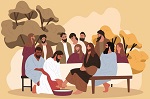
It is the last moment of apparent serenity, just before Jesus’ arrest. He and his disciples have just arrived in Jerusalem and gathered in the Upper Room to celebrate the Passover. It is a normal dinner among friends, but Jesus already warns that it will be the last chance for him to be with these men whom he loves more than anyone in the world. The end of his time among men is approaching inexorably and he knows that the chalice that God the Father has prepared for him is the most bitter that can be imagined. He also knows that one of his friends will betray him and that another will deny him, and he tells the Apostles, that unbelievers protest. They also protest when Jesus washes the feet of each of them, an act of great humility, but also immense love. The death of Christ still seems so far away, and yet here he takes the bread and takes the wine and sacrifices himself in the first Eucharist, only an anticipation of what will happen in a few days.

Jesus in Gethsemane

After supper, Jesus moves aside to pray in the Garden of Olives. He doesn’t want to be alone. The doubts are deepened in his mind, the fear of suffering that awaits him makes him tremble in his resolution. But the Apostles sleep and even God does not seem to want to hear his prayers. In the end, the choice is his and his alone: Jesus accepts that his destiny is fulfilled, he is ready to die.

The Denial of St. Peter

The moment of Jesus’ arrest comes. Roman soldiers led by Judas break into the slopes of the Mount of Olives. Some disciples try to react by drawing their weapons, but Jesus stops them and gives himself docilely to his executioners. Jesus is brought before the priests Anna and Caiaphas, and it is at this point that Peter’s threefold denial is placed (before the meeting with the priests according to Luke after according to Mark and Matthew). In the palace courtyard, Peter is accused by a woman of knowing Jesus and being one of his own. Peter denies, not once but three times, just as Jesus had predicted during the Last Supper. Then he abandons himself to cry. The denial of St. Peter was immortalised by many masters of art, one for all Caravaggio.

The trial at Pontius Pilate

The process of Jesus is also described in all the canonical Gospels. After being accused of blasphemy by the priests and the Sanhedrin, the Jewish tribunal, for having compared itself to God, Jesus is brought before the Roman governor of Judea, Pontius Pilate. A theological accusation is not enough to sentence him to death, a policy is needed. Pilate, though sceptical of the hatred that everyone manifests for a man whom he judges to be the most insane, condemns Jesus for sedition and injures majesty. The sentence is death by crucifixion.

The Passion and Crucifixion of Jesus

Thus begins the sequence of events known as the true Passion. The Way of the Cross, or Via Dolorosa, traces in fourteen stations the path of Jesus from the tribunal in which he was condemned to the hill of the Crucifixion until the deposition of Jesus from the cross and then in the tomb. Devotional practice par excellence of Easter was born to allow even those who could not afford a pilgrimage to the Holy Land to follow the moments of the Passion of Christ, evoking his suffering made eternal in these scenes carved in stone or painted.

After being beaten and humiliated in every way, Jesus is crowned with a crown of thorns and clothed with a purple robe, in contempt of his proclamation as King of the Jews. Dragged out of court, he is stripped, whipped, and then the Cross is loaded on his shoulders, which he must carry to his last destination: the hill of crucifixion. Jesus advances between two wings of an angry crowd, that same crowd that a few days before had welcomed him joyfully in Jerusalem, waving leaves and palm branches. Among them, hidden and frightened, the Apostles, His mother Mary and the women who, despite everything, still love Him and participate helplessly in His agony step by step. Jesus wavers under the weight of the Cross and falls the first time. His gaze clouded by suffering meets that of Mary. It is only a moment, but we can imagine the atrocious suffering of Our Lady who sees her only son bent and broken in that way. The prophecy of Simeon is fulfilled, a sword pierces her soul (Luke 2:35), and yet even at that moment Our Lady puts aside her immense pain, tries to transmit to her son only love, tenderness, the last that he will receive in this world that is condemning him to death.

 Simon of Cyrene is forced by the Roman soldiers to help Jesus to carry the Cross. Now they advance together, while Saint Veronica makes her way among the people to dry the face of Jesus, who again falls into the dust.
In front of the weeping of the women of Jerusalem Jesus comforts them, he who is suffering an unspeakable pain, and encourages them not to weep for him, but themselves and for their children. Then again he falls, for the third time, now exhausted.
Arriving at the top of Golgotha, Jesus is stripped of his clothes, stretched out on the wood of the Cross and nailed to his hands and feet, and then raised between two other crosses, those of two thieves. Even at this moment when His agony is about to reach its climax, Christ sets aside his pain and forgives Disma, the repentant thief, promising him paradise.
The death of Jesus is described with slight differences from the evangelists, as we have mentioned. After death, the body of Jesus is taken off the cross, claimed by Joseph of Arimathea, one of his disciples and a merciful man, and prepared by him to be laid in the tomb. From that tomb, Jesus will rise three days later, but at this point, we are beyond the Passion and in the fullness of his Glory.

Easter: 10 curiosities about the symbols of the Passion of Christ

Easter: 10 curiosities about the symbols of the Passion of Christ

Contents1 The crown of thorns2 Where is the Holy Shroud3 The tomb of Jesus4 The Cross of Christ5 What are the Holy Nails6 What does INRI mean on the Cross7 The last words of Jesus8 What is the Holy Staircase?9 Who were the two thieves10…

The washing of the feet, the symbol of God’s love

The washing of the feet, the symbol of God’s love

The washing of the feet is one of the greatest gestures of God’s love. Here is how it happened and how it is repeated every year between the rites of Holy Thursday There is one particular episode that is told only in one of the…

Palm Sunday: history and meaning of the celebration

Palm Sunday: history and meaning of the celebration

Palm Sunday is the last Sunday before Easter. With it begins Holy Week. Here is what is celebrated and how.

Anyone among us who grew up in a Catholic family will have happened as a child to be taken to church on Palm Sunday and receive an olive branch blessed by the priest. That branch, brought home, was then hung somewhere, and preserved, as a sign of peace and faith for the house and those who lived there. Of course, as children, we could not know how ancient was the origin of this custom, connected to an even more ancient Jewish tradition that coincided with the Sukkot, the “feast of huts”. It is a pilgrimage festival, one of the most important for Jews even today. It recalls the journey of the Jewish people in the desert to the Promised Land when they lived in huts (the Hebrew word sukah means “hut” and “sukoth” is the plural). To celebrate this feast, the Jews made a pilgrimage to the temple in Jerusalem, offering a bunch of four different plants: palm, cedar, three myrtle branches and two willow branches tied together with hemp.

Always as children, we could not even know that the Palm Mass recalls the triumphal entry of Jesus into Jerusalem, recounted in all four canonical Gospels. In particular, John (John 12,12-13) writes that the arrival of Jesus was greeted by a crowd waving palm branches, while Matthew and Mark speak more generally of branches of trees and branches taken from the fields and Luke mentions nothing in particular.

From this fundamental event, which took place five days before the death of Jesus, was born the celebration of Palm Sunday, on the occasion of which the priest blesses the palm branches, or the olive branches at our latitudes, and distributes them to the faithful to bring them home and keep them as a symbol of peace.

The dove in Christian iconography

Read more:

The dove in Christian iconography
Even before the birth of Jesus, the dove was considered an animal with a strong symbolic value. For the Greeks was a symbol of love…

The liturgy of Palm Sunday

Palm Sunday marks the beginning of Holy Week, which overlaps with Lent. Only with the celebration of the ninth hour of Holy Thursday will Lent be over and we will enter in all respects into the Easter Triduum, the memorial of the Passion, Death and Resurrection of Christ.

On the occasion of Palm Sunday at Mass, we read the passio, the story of the Passion of Christ drawn from the Gospels of Mark, Luke or Matthew, depending on the current liturgical year.  The reading is done by three different people, who impersonate Jesus, the chronicler and the people. Before arriving at the church the faithful gather in the square or in the churchyard, where the priest blesses and distributes the olive branches. Where possible there is also a procession.

In addition to the actual liturgy, there are many customs related to the olive twigs distributed on Palm Sunday, such as the one that provides that Easter day uses an olive branch dipped in holy water to bless the table.

Entrance of Jesus into Jerusalem

The entry of Jesus into Jerusalem that gives rise to the tradition of the Palm Sunday is described in all four canonical gospels: Matthew 21,1-11, Mark 11,1-11, Luke 19,28-44 and John 12,12-19. According to John, Jesus’ entry into Jerusalem took place on the fifth day before the Passover, the 10th day of the month of Nisan. This was the day given to take the lamb to be sacrificed at Easter, and it is emblematic that the evangelist chose that very day, considering how the theme of Jesus, the lamb of God, is used in his Gospel. The other Gospels do not indicate a precise date, simply saying that you were close to Easter.

How is Easter calculated

Read more:

How is Easter calculated?
Each year changes date but remains the most important holiday: in this article, you will find out how Easter is calculated in the Jewish…

Jesus enters the holy city of Jerusalem to celebrate Easter. He is riding a donkey, surrounded by disciples and escorted by a festive crowd waving palm branches. They cry out his name and acclaim him with festive exclamations: “Hosanna! Blessed is he who comes in the name of the Lord!” John (12:13). Hosanna is an expression of Jewish jubilation, but it also means help us, save us.

Even the choice of the mount of Jesus, the donkey, is not accidental. Zechariah’s prophecy concerning the coming of the Messiah recited: “Rejoice greatly, daughter of Zion, rejoice, daughter of Jerusalem! Behold, your king comes to you. He is just and victorious, humble, riding on a donkey, a foal son of a donkey” (Zc 9,9).

Even the cloaks that are placed on the donkey as a saddle for Jesus have a symbolic value: they were spread out on the steps to allow the sovereign to climb to the throne. So here they become a symbol of royalty and recognition.

The meaning of the blessed olive branches

The custom of going to Church on the occasion of Palm Sunday and bringing home the branches of blessed olive trees thus originates from the Gospel episode. But why was the olive tree chosen to replace the palm? The olive tree has always been considered a sacred plant, for all the peoples of antiquity. The Symbol of Athena for the Greeks was used to crown Olympic athletes. Closer to our ambit, the biblical account of Noah, and of the dove that brought him an olive branch made him understand that the Flood was over. Olive therefore as a symbol of rebirth and peace and deeply linked to the history of Jesus: the same name Christ means “anointed”, with reference to the oil obtained from olives and used in ceremonies. Let us also remember the last night that Jesus spent with his disciples in Gethsemane, the garden at the foot of the Mount of Olives.

The palm was also very important for ancient civilizations, from the Egyptians to the Romans. It was considered a symbol of immortality and rebirth. So high as to suggest a link between the earth and sky, it generated countless fruits and was often used as a model for temple columns.

It is important not to throw the olive branches, even when they dry out: they are sacramentals, and as such protected by canon law, therefore sacred. We can choose whether to burn them, bury them or take them back to church, where they will be burned to obtain the ashes for the following Ash Wednesday.

Blessed olive branches at Easter

Read more:

Blessed olive branches at Easter: should you keep them or throw them away?
When we go to Church on Palm Sunday, the last one before Easter…

Meta description: Palm Sunday marks the beginning of Holy Week. He remembers how Jesus entered Jerusalem welcomed by a crowd that waved branches and branches cheering him.

St. Disma, the good thief who went to heaven

St. Disma, the good thief who went to heaven

Contents1 Who were the two thieves on the cross with Jesus?2 Dysma, the penitent thief3 Prayer to St. Dismas Who was Saint Disma, the repentant thief crucified alongside Jesus on Golgotha? Let’s find out his story and how he became a saint From the Gospels…

The Mount of Olives, among the places dearest to Jesus

The Mount of Olives, among the places dearest to Jesus

Contents1 The biblical episodes that occurred on the Mount of Olives.2 Gethsemane or Garden of Olives.3 Jesus’ agony in Luke’s Gospel The Mount of Olives has since ancient times been a place of mysteries, the scene of great biblical events. This is where the Passion…

The lost years of Jesus’ life

The lost years of Jesus’ life

Let us investigate the lost years of Jesus’ life. What was he doing before he started preaching? Did he ever move away from Palestine?

Jesus’ life is known mostly through the canonical Gospels, but there are many gaps, periods during which we can only guess what He did. It is strange to talk about Jesus’ lost years, even more so to talk about dark years. What could be dark about Him, who was and is the bearer of a light that transcends darkness and death across the centuries? Indeed, this term is used to define only a period in Jesus’ life that is not particularly noteworthy, and as such not mentioned in the Gospels. Later texts have attempted to recount these years of Jesus’ silence, following the Nativity and preceding the beginning of His preaching. The Apocryphal Gospels have attempted to fill the narrative gaps from the New Testament, and many scholars over the centuries have tried to reconstruct the story of Jesus based on available legends and information. Even today they continue to investigate, studying historical sources and comparing them with medieval texts and accounts of all kinds.

The story of Jesus

Read more:

The story of Jesus: the most important events of His life
The story of Jesus, between the Gospel story, historical reality and devotional legend. In view of Easter, we reconstruct the human story that changed the fate of humanity.

Living in the Palestine of the time, and particularly in Nazareth, a small town populated mainly by Jews engaged in agriculture, it is likely that the childhood and youth of the historical Jesus was no different from that of any other child and boy of the time and place. At the age of five, children began their studies at the synagogue and were initiated into their father’s trade. Twelve was an important age because the family went to the Temple in Jerusalem to celebrate the bar mitzvah, the child’s religious initiation. From here on, the boy was part of the community and had to divide his time between work, religious ceremonies in the synagogue and Scripture study. On the occasion of the great Jewish festivals one would go to the Temple in Jerusalem. Jesus’ life, that unique and special life for which He is remembered, actually begins with His preaching, when He leaves Nazareth and begins to travel, and on it the Gospels come to our aid.

Jesus’ childhood and youth

In Luke’s Gospel we find two episodes that leave some clues about Jesus’ childhood. One is shortly after His birth, and it is the Presentation at the Temple in Jerusalem. The evangelist writes that after it the Holy Family returned to Nazareth, and that “the child grew and was strengthened; he was full of wisdom, and the grace of God was upon him.” (Luke 2:39-40). Again Luke briefly relates another episode, the loss and finding of Jesus in the Temple. Every year Joseph and Mary traveled to Jerusalem on the occasion of Passover. When Jesus is twelve years old, they take Him with them, for His bar mitzvah: “When He [Jesus] came to the age of twelve, they went up to Jerusalem, according to the custom of the feast; the days of the feast having passed, as they were returning, the child Jesus remained in Jerusalem without the knowledge of His parents” (Luke 2:42-43). Mary and Joseph will find Him in the temple, intent on talking with the teachers, and in the face of their distress Jesus will say only, “‘Why were you looking for me? Did you not know that I was to be found in my Father’s house?”” (Luke 2:49)

Presentation of Jesus at the temple

Read more:

Presentation of Jesus at the temple until the feast of Candlemas
The presentation of Jesus to the temple is celebrated on February 2. Also known as the Feast of the Purification of Mary, or Candlemas, it is a holiday that has taken on many different and important meanings…

It is presumable that, having returned to Nazareth, Jesus followed in his father’s footsteps and, like St. Joseph, became a carpenter or joiner, since carpenters of that time were also builders. Both Mark and Matthew in their Gospels refer to him as Téktôn, a Greek term that is still the subject of exegetical diatribe today, as it can mean carpenter, mason, joiner or even blacksmith.
The theory of Jesus at work with Joseph in the family workshop is borne out by one of the earliest episodes recounted in Mark’s Gospel, when Jesus, now in his thirties, begins preaching in Nazareth. The local people are initially annoyed by this young man who dares to set out to teach in the Synagogue on the Sabbath, as if he were a teacher: “‘Where do these things come to this man? What wisdom is this that is given to him? And how is it that such mighty works are done by his hand? Is not this the carpenter, the son of Mary, the brother of James, of Joses, of Judas, and of Simon? And are not his sisters here among us?” And they were scandalized because of him.” (Mark 6:3-4)

Novena to Saint Joseph for Labor Day

Read more:

Novena to Saint Joseph for Labor Day
Saint Joseph in an unmissable figure when we think about Jesus life and work. Even though he was probably already dead when Jesus began his mission, it is true that his role of Mary’s husband and foster father…

Regarding St. Joseph, it is presumable that he died before Jesus reached the age of 30 and began preaching, or it would not explain why in the Gospel accounts Mary is always alone. When the father died, the eldest son became the head of the family and assumed all duties and burdens upon himself.

Jesus in India

Over the centuries there has also been an attempt to investigate any travels of Jesus. Did he ever travel away from Palestine? In medieval times a literary current developed that told of Jesus’ travels to Britain, present-day Great Britain. These tales related to the figure of Joseph of Arimathea, an influential member of the Sanhedrin and disciple of Jesus, who, according to the Gospel of John, claimed His body from Pilate and prepared it for burial together with his friend Nicodemus. Joseph of Arimathea, revered by all churches and considered patron saint of gravediggers, funerals, and morticians, appears in the Arthurian cycle as the first custodian of the Holy Grail. He is said to have brought the cup of the Last Supper to Britain by a daring journey, according to the account of Rabanus Maurus (780-856), archbishop of Mainz, in which he was to be accompanied by Mary and Martha of Bethany, their brother Lazarus, who rose from the dead, and other eminent figures in early Christianity. They would have been the ones to lay the foundations of Christianity on the island. According to legends Joseph would only return to Britain, where he had already been to accompany Jesus while still a boy. There is even a chapel in the Glastonbury Abbey whose foundation is attributed precisely to Jesus and Joseph of Arimathea.

More recent studies have advanced the possibility that Jesus was in India. Some suggested that He was Bhagavan Krishna, one of the incarnations of the god Vishnu, there are many similarities between the story of the Jesuses and this character, and the name Jesus could be derived from Jezeus, “pure essence” in Sanskrit, by which Krishna’s disciples called Bhagavan Krishna. But there is no firm evidence for this. The American preacher Levi H. Dowling in the early 1900s told in his writings of a long journey of the young Jesus through India, Tibet, Persia, Assyria, Greece and Egypt, and later Dr. William S. Sadler expanded His travels to North Africa and Italy as well. But again, this is speculation without substantial documents to prove its veracity.