Author: Redazione

The main differences between Catholics and Protestants

The main differences between Catholics and Protestants

Contents1 The Sacred Scriptures2 Authority of the Pope3 Purgatory4 The Sacraments5 The Immaculate Conception and the Assumption of Mary6 The Saints The differences between Catholics and Protestants are fundamental to the history of the Christian religion and the birth of Europe as we know it.…

Nard oil from Jerusalem: we discover the benefits of this ancient ointment

Nard oil from Jerusalem: we discover the benefits of this ancient ointment

Contents1 History of the oil of nard2 Nard oil as it is used and benefits3 The nard in the Bible4 Perfumed oils in the liturgy5 Perfume of nard: the spirituality of the Order of the Holy Sepulchre What is the history of Jerusalem nard oil?…

Saint Thomas, the Doubting Apostle

Saint Thomas, the Doubting Apostle

Let’s talk about Saint Thomas, the doubting apostle, a devoted follower of Jesus and a great evangelist, often remembered more for his skepticism than his immense and solid faith.

Among the apostles who followed Jesus until His last days, there is one who is almost exclusively remembered for an episode that does not particularly honour him: Saint Thomas, the doubting apostle. In reality, Saint Thomas, whose name in Aramaic means “twin,” as does his Greek nickname Didymus, was an enthusiastic apostle full of great fervor. However, he was probably a bit pessimistic by nature and not very trusting. This is evident in nearly every passage of the Gospel where he is mentioned.

In John 11, for instance, the decision of Jesus to go to Bethany, where His friends Martha, Mary, and Lazarus live, is recounted. Lazarus is ill, and his desperate sisters have gone to seek Jesus’ help. Many in Judea hate Jesus, and His return to Bethany could be dangerous. Among the apostles’ various expressions of dissent, Thomas’s is certainly the most blunt. When Jesus urges the apostles to go because Lazarus has already died, Thomas responds, “Let us also go, that we may die with him” (John 11:16). It is a somewhat cynical reply, yet it does not prevent Thomas from following his Master and risking his life with Him.

12 apostoles 1

Read more:

Who were the 12 apostles and discover the difference between apostles and disciples
Who were the 12 apostles, companions of Jesus in the short span…

Thomas’s skepticism also emerges during the Last Supper, where he questions Jesus, despite being one of the least known apostles. In John 14, Jesus declares that He is going to prepare a place for everyone in the Father’s house. “You know the way to the place where I am going,” He says to the uncertain apostles. Here, Thomas voices what was probably everyone’s perplexity, though the others did not dare express it. “Lord, we don’t know where you are going, so how can we know the way?” It is almost amusing to imagine Saint Thomas as one of those friends present in every group, who participates in communal activities, never backs down, and is always ready to help, but who grumbles and objects to every proposal. This might have been his role among the 12 apostles.

The events of the Passion of Jesus from the Last Supper to His Crucifixion

Read more:

The events of the Passion of Jesus: from the Last Supper to His Crucifixion
The Passion of Jesus is the highest and most terrible moment of his…

“Unless I See, I Will Not Believe”

Having met Thomas in the previous Gospel episodes, his behavior during Christ’s Resurrection becomes more understandable. Faced with his excited companions who recount seeing the risen Jesus, Thomas’s usual skepticism resurfaces: “Unless I see the nail marks in His hands and put my finger where the nails were, and put my hand into His side, I will not believe” (John 20:25). Eight days later, Jesus appears to the gathered disciples. Among them is Thomas, and Christ addresses him: “Put your finger here; see my hands. Reach out your hand and put it into my side. Stop doubting and believe” (John 20:27). At this point, Thomas has no more doubts and responds to Jesus, “My Lord and my God!” Jesus’ response (“Because you have seen me, you have believed; blessed are those who have not seen and yet have believed!“) does not show any bitterness towards this stubborn, distrustful, and perhaps slightly pessimistic friend. On the contrary, Thomas appears as an extremely human figure, close to each of us, symbolizing the doubts that lead to greater awareness and the uncertainty that nurtures faith.

The life of Mary after the Resurrection of Jesus

Read more:

The life of Mary after the Resurrection of Jesus
What became of Our Lady after the Resurrection of Jesus? Let’s investigate Mary’s life through the Gospels…

The Doubt of Saint Thomas

The episode of Saint Thomas’s Doubt has been the subject of countless artistic representations. The iconography of this saint is quite varied. Traditionally, he was depicted with a book, a common attribute for all the Apostles, or with a sword or a lance, the weapon with which he was killed, and the palm, symbolizing martyrdom. However, in other depictions, he is seen with an architect’s square. Saint Thomas is, among other things, the patron saint of architects and surveyors, as well as of India and Pakistan. According to legend, the king of India gave him the architect’s square (or olive rod) after Thomas miraculously traced the plan of the royal palace. Since then, the square has become one of his iconographic attributes.

Another scene featuring Saint Thomas, recurrent in sacred art, comes from the apocryphal gospels. Thomas, ever skeptical, did not want to believe in the Assumption of Mary. To convince him, the Madonna appeared from heaven and threw her belt to him.

Returning to the scene of doubt, it was famously depicted by the Italian painter Caravaggio in an oil painting created between 1600 and 1601, displayed in the Bildergalerie in Potsdam. The painting, with Caravaggio’s sublime style and the play of light and shadow that distinguished his work, captures the exact moment when Thomas verifies the wounds on Jesus’s body.

Saint Thomas and His Evangelistic Work

Saint Thomas was also a great evangelist, traveling to Syria, Persia, India, and China. After being in Syria and evangelizing Edessa, he moved to Babylon in Mesopotamia, where he founded the first Christian community and stayed for seven years. He then went to India, where he interacted with Jewish communities and made converts, and from India, he traveled to China. It was upon his return to India that he met his martyrdom in 72 AD, killed by a lance (or sword) blow on the orders of King Misdaeu.

Gospel of Saint Thomas

An apocryphal Gospel of Saint Thomas has also come down to us. This Coptic text does not recount the life of Jesus as the canonical Gospels do, but rather collects His sayings. It is important to note that apocryphal gospels, often fragmentary, are later than the apostolic age and have not been recognized as canonical by the Church’s magisterium. Linked to the emergence of early Christian communities, they were written to delve into topics raised by the canonical Gospels and to provide additional information about the life of Jesus and those who knew Him. In the Gospel of Thomas, the Kingdom of God is already on Earth, visible only to those willing to be enlightened by the divine light present within each of them. For a chronic pessimist, that doesn’t seem like a bad premise!

The apocryphal gospels

Read more:

The apocryphal gospels: what differentiates them from the canonical ones
The apocryphal gospels are not part of the New Testament…
The Camino de Santiago: history and curiosities of one of the most famous religious itineraries

The Camino de Santiago: history and curiosities of one of the most famous religious itineraries

Contents1 Why walk the Camino de Santiago2 The Cathedral of Santiago de Compostela3 The pilgrim’s compostela4 The shell of Santiago For centuries, the Camino de Santiago has represented one of the most significant pilgrimages of faith that a person can undertake. Let’s see why embarking…

When Holiness Runs in the Family: Stories of Siblings Who Became Saints Together

When Holiness Runs in the Family: Stories of Siblings Who Became Saints Together

Contents1 Saints Donatian and Rogatian2 Saints Cyril and Methodius3 Saints Martha and Lazarus4 Saint Benedict and Saint Scholastica5 Saints Andrew and Peter6 Saints Marcellina and Ambrose7 Saints Cosmas and Damian Stories of Saintly Siblings: When Holiness Runs in the Family. From Saints Cyril and Methodius,…

The Fathers of the Church: Who They Were and What is Meant by Patristics

The Fathers of the Church: Who They Were and What is Meant by Patristics

The Fathers of the Church are the primary Christian writers, whose works form the foundations of the Church’s doctrine. Let’s get to know them.

We have previously discussed the Doctors of the Church, those men and women who, by virtue of their holiness and wisdom, have managed to magnify the Church and leave a testament of immortal theological knowledge and spiritual strength. Illustrious writers, therefore, who led a holy and devoted life, armed with knowledge of sacred matters, to the extent of being recognized as Doctors by decree of the Pope or ecumenical council. But four of them, in addition to being doctors, are also considered Fathers of the Church, and therefore, they have the dual title: we are talking about the four Fathers of the Western Church, St. Augustine of Hippo, St. Ambrose, St. Jerome, and St. Gregory the Great.

doctors of the church

Read more:

Doctors of the Church: who are they and what are the requirements for having this title
On 1 October we celebrate Saint Therese of Lisieux, one of the four…

It is they who elaborated what we know as Patristics, the Christian thought of the early centuries. Before that, Christian scholars and authors were engaged in Apologetics, the theological discipline through which they supported their religious and moral theses against criticisms and accusations from the outside. There are also the so-called Minor Patristics, promoted by those scholars who defended the Christian faith against Jews, pagans, and heretics. With the Edict of Milan (313 AD), Christians had obtained freedom of worship, so now they could focus on the study of sacred texts and the spread of religion.

It is not easy to summarize in a few words the revolutionary importance of Patristic thought, which developed from the 3rd century AD. The Fathers of the Church began their work of study and preaching, and since they were, first of all, scholars, they did not hesitate to embrace the philosophy and pagan culture, inherited from the Greeks and Romans, to create the new Christian philosophy. They sought to integrate pagan thought, reworking many concepts in a Christian key and attributing them to their faith. In this way, classical philosophy becomes a means to understand Christian truths. This approach is called Greek Patristics. On the contrary, Latin Patristics will have a completely opposite attitude, rejecting any contamination from pagan philosophy as an obstacle to religion and claiming the need to create a philosophy exclusively linked to Christianity, justifying many gaps as mysteries of faith.

Saint Gregory the Great, Pope and Doctor of the Church

Read more:

Saint Gregory the Great, Pope and Doctor of the Church
Saint Gregory the Great, “the consul of God”, venerated as a saint and doctor of the Church. But who was…

It would also be very difficult to do justice to the merits of the Fathers of the Church in a few lines. We will limit ourselves to briefly presenting them, referring you to various in-depth articles that we have already written on our blog, such as those on St. Augustine and his mother St. Monica, or St. Ambrose, the Patron Saint of Milan.

  1. St. Augustine of Hippo lived between 354 and 430 AD. Of North African origin, he was a philosopher, bishop, and theologian, Father, Doctor, and saint of the Church. His nickname was Doctor Gratiae, “Doctor of Grace”;
  2. St. Ambrose lived between 339 and 397. A theologian and writer, he was the bishop of Milan, of which he is also the patron, along with St. Charles Borromeo and St. Galdino, after attempting to peacefully end the strong contrasts between Arians and Catholics as the representative of Emperor Valentinian I;
  3. St. Jerome lived between 347 and 419 AD. A scholar of the Bible, his main work was the translation into Latin of part of the Greek Old Testament and then the entire Hebrew Scripture;
  4. St. Gregory the Great lived between 540 and 604 and was the bishop of Rome and Pope until his death. Venerated as a saint and doctor of the Church even by other Churches, he was frail and often sick, but animated by immense faith and moral strength.

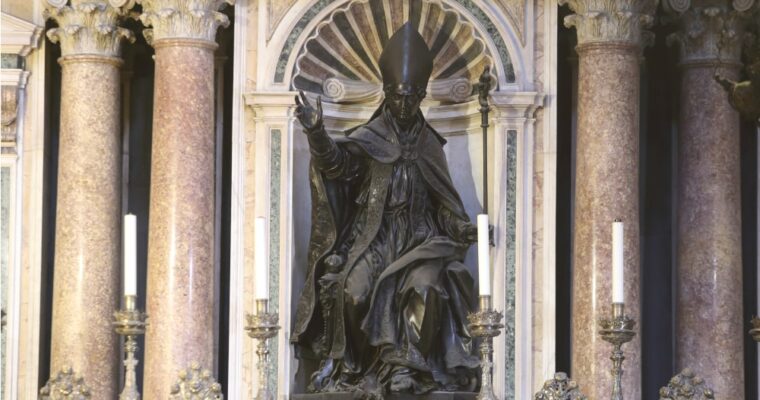
Painting in Sant Ambrogio church , Milan

Read more:

Saint Ambrose, who was the patron saint of Milan
Saint Ambrose is one of the patrons of Milan and is venerated by all Christian Churches. Let’s get to know him…

The Beloved Disciple: Who was the disciple “loved” by Jesus

The Beloved Disciple: Who was the disciple “loved” by Jesus

Giovanni, the beloved disciple of Jesus. A fisherman, like the brothers Simon Peter and Andrew, he had a special relationship with Christ. Here’s why We have seen on many occasions how much importance Jesus attributed to friendship and how much He valued His friends. This…

Priestly Ordination: Here’s How One Becomes a Priest

Priestly Ordination: Here’s How One Becomes a Priest

Contents1 The Sacrament of Holy Orders2 The Rite of Priestly Ordination3 Priestly Ordination Gift Ideas With Priestly Ordination, a man becomes a priest in every sense. Here’s how the rite unfolds, how his life changes, and how friends and family can show their support with…

The patron saint of marriages Saint Anthony of Padua

The patron saint of marriages Saint Anthony of Padua

Doctor of the Church, Hammer of Heretics, Protector of the Poor, Saint Anthony of Padua is also considered the patron saint of marriages. Let’s see why.

While Saint Rita of Cascia is regarded as the protector of marriages, particularly of unfortunate brides, there is also a patron saint of marriages. We are talking about Saint Anthony of Padua, one of the most beloved and revered saints among Catholics. A shining example of Christian wisdom, he authored fundamental and precious theological works that earned him the title of Doctor of the Church. He was personally appointed by Saint Francis to teach theology. Of Portuguese origin, Saint Anthony lived through the tumultuous years at the end of the Middle Ages when Europe was rocked by immense political and social changes. As the eldest son of a noble family, Anthony experienced all the comforts of a wealthy youth but soon showed a love for study and a desire to embrace a life dedicated to Christ. He chose the Franciscan Order and, upon arriving in Italy, met Saint Francis, whose ideology he fiercely supported, even against the heresies that plagued the Church at that time. For his work in evangelization and fighting heresies, he earned the nickname “malleus hereticorum,” the hammer of heretics. Besides being mentioned among the Doctors of the Church and his merits as a theologian and preacher, Saint Anthony is also remembered for his miracles, which made him the protector of the poor, the hungry, and lost objects.

Doctors of the Church

Read more:

Doctors of the Church: who are they and what are the requirements for having this title
On 1 October we celebrate Saint Therese of Lisieux, one of the four…

Proclaimed a saint by Pope Gregory IX, who summoned him to Rome to preach Lenten meditations to him and the cardinals, he also became famous as the saint who helped women find a husband. This belief remains deeply rooted in popular devotion to the extent that even today, there is a custom of reciting a special Prayer to Saint Anthony to find a boyfriend, as well as a Prayer for Marriage that young couples address to the Saint.

But let’s see why Saint Anthony of Padua became the protector of marriage and a valuable aid for those seeking a good engagement.

In the era when the Saint lived, it was not easy for a woman to find a good husband, especially if she did not have a substantial dowry. There is a legend about Saint Anthony that one day, while in Naples, he was visited by a desperate girl whose family could not provide her with an adequate dowry to get married. The Saint gave her a thin piece of paper and told her to take it to a merchant with the message to give her as many silver coins as it would take to equal the weight of that note. The merchant laughed, astonished by the oddity of the request, but his surprise was great when he realized that no matter how much silver he placed on the scale, he could not balance the message from Saint Anthony. Only when 400 silver coins were placed on the scale did the merchant remember that he had promised exactly that sum to Saint Anthony long ago but had never delivered it. The girl took the silver and made the best marriage she could hope for, and from then on, Saint Anthony became the protector of marriages.

Prayer to Saint Anthony to Find a Husband

We were talking about special prayers to Saint Anthony of Padua, the protector of marriages, to find a husband, as well as a prayer for engaged couples. Here it is:

My dear friend Saint Anthony,

you who are the protector of engaged couples,

look upon me, see my life,

my desires,

and intercede for me.

Defend me from dangers,

keep failures, disappointments, and disillusionment away from me.

Make me realistic,

confident, worthy, and joyful.

Help me find a partner

who I like, who is hardworking,

virtuous, and responsible.

May I walk towards the future

and towards a life together

with the disposition of one who receives from God

a sacred vocation and a social duty.

May my engagement be happy,

and my love boundless.

May all engaged couples

seek mutual understanding,

communion in life,

and growth in faith.

So be it.

Alternatively, if one wishes to address Saint Anthony with a prayer to heal a marriage and strengthen the union between spouses, one can recite this:

Glorious Saint Anthony, You wielded the divine power to find what was lost. Help me rediscover the Grace of God received in the sacrament of Marriage.

May my spouse and I regain the strength, courage, hope, and faith we once had. We once possessed all of these, but the wrong decisions we made in life weakened us.

Assist us in finding again the selfless love in which we give ourselves entirely to make the other person happy. May this charity burn again like an unquenchable flame, so that joy may fill both our hearts once more.

May we find moments to give ourselves to each other in the intimacy of our relationship, and may we make the other person feel how much we appreciate their presence and the time spent together.

Oh Saint Anthony, help us find again the desire to love each other without measure. May we find forgiveness for the painful situations we have experienced. May we heal all the wounds we have inflicted on each other in moments of immaturity and indifference.

Come and strengthen our spirit so that we may love God above all else, dedicate our time to Him, and find a way to reconcile with Him.

Dear Saint Anthony, bless and protect our family; keep it united in love, that love which sustains us in our daily needs, and keep it free from evil.

Bless my spouse (say their name) and me. Help us to live with dignity the fruits of our labor, so that we may have the opportunity to grow and educate the children that the Lord has given us and those that He will give us, if it is His will.

Bless our children, that they may remain healthy and with goodness in their hearts. Help them never to lose their way; but if they should, help them find the path of love again. Help them also to focus on their studies and prepare for the future. Do not allow them to lose faith and purity whenever evil attempts to compromise their spiritual and personal growth.

Help us understand our children and guide them—through our words and example—so that they may always aspire to the noblest ideals and be able to put into practice their human and Christian vocation.

Amen.

Let’s prepare for the Holy Year with the Jubilee prayer

Let’s prepare for the Holy Year with the Jubilee prayer

In anticipation of the Holy Year 2025, Christians around the world are preparing to be Pilgrims of Hope. Here are the tools provided by the Dicastery, the Intentions and prayers of the Pope, and the special Jubilee prayer. 2025 will be the year of the…

What to Bring on a Pilgrimage: Organizing Your Backpack!

What to Bring on a Pilgrimage: Organizing Your Backpack!

Contents1 Pilgrim’s Backpack2 Essential Items for a Pilgrim’s Backpack3 Items for Specific Destinations Preparing for a pilgrimage is an exciting and spiritually enriching experience. To ensure that your journey goes smoothly, it is essential to carefully plan what to bring and how to organize your…

Black Madonnas in Italy and around the world: origins and mystery of a cult

Black Madonnas in Italy and around the world: origins and mystery of a cult

For centuries, Black Madonnas have been at the heart of many devotional cults in Italy and beyond. Let’s explore the origins of this particular vision and get to know the Black Madonnas in Italy.

When we think of Madonna, if we visualize her in our minds, we will almost certainly imagine a beautiful woman, enveloped in long, light robes and surrounded by white and pure light. We’ll think of her ageless, timeless face, which in many works of art portrays her as a child even next to her Son. There is no place for darkness when it comes to the Virgin Mary, no room for shadows. Yet, it is surprising to note how much space the devotion to the so-called Black Madonnas occupies in our country and how many countries and cities are famous for a sanctuary of the Black Madonna.

After all, the iconography of the Black Madonna is ancient, with many examples existing in both painting and sculpture, spread throughout the world. These representations depict the Virgin with a dark, if not entirely black, face. Staying in Italy, just think of the Madonnina of Tindari, the Madonna of Loreto, or those of Oropa or Viggiano.

Marian Titles

Read more:

Marian Titles: what are they and how many are all the names dedicated to Mary
Marian Titles: all the appellations with which Mary, mother of Jesus, is…

But where does this particular cult originate? We have seen that the Madonna is venerated in different places with many titles, the so-called Marian titles, sometimes derived from dogmatic attributes, other times linked to popular devotion, sacred images, or the apparitions of the Madonna in specific locations. Likewise, Black Virgins can have different origins.

In some cases, the face of the Madonna appears dark because it is blackened by smoke or the effects of oxidation on the original colours. In some cases, especially for Marian cults originating in Africa or South America, such as that of Our Lady of Guadalupe, the Virgin has been depicted with somatic features close to those of the local populations. In Byzantine art, and particularly in icons, the oxidation of the silver leaf, used for the faces of the Madonna and the Saints, darkens the pigments, making them even black.

The apparitions of Our Lady of Guadaloupe

Read more:

The apparitions of Our Lady of Guadaloupe
By the Apparitions of Guadalupe, we refer to the four appearances of Our Lady to Juan Diego…

Furthermore, the assimilation of previous cults, such as that of the Earth Mother Goddess or Isis, led to the ‘conversion’ of statues depicting deities associated with the earth or the night into representations of Mary, without changing their original characteristics.

It also happened that statues arrived by sea from the East, carved in a dark wood entirely unknown in our country. They began to arrive already during the time of the Crusades, as spoils of war, but also to save them from persecutions or the iconoclastic fury that raged repeatedly in those lands. During the Crusades, many religious orders, especially the Carmelites and the Franciscans above all, contributed to bringing these representations of Black Madonnas to the West. The Templars, in particular, appreciated the Song of Songs, of which St. Bernard of Clairvaux, their founder, had written a commentary. Here, it spoke of the Sposa nigra sed formosa (Song of Solomon 1:5), “black but beautiful,” and this definition soon began to describe the Black Madonnas.

The most famous Black Madonnas in Italy and around the world

We mentioned the Madonna of Loreto or the Lauretana Virgin. But why is the Madonna of Loreto black? This devotion dates back to a 16th-century statue, which showed the face darkened by the smoke of oil lamps, as well as by the alteration of the original pigments. When in 1921 a terrible fire reduced the original statue to ashes, it was decided to create another one while maintaining the color. To do this, it was carved from the wood of a cedar from Lebanon taken from the Vatican Gardens.

In the Sanctuary of Oropa, near Biella, the Gothic statue of the Black Madonna has been venerated since the first half of the 14th century, and its origins are lost in the ancient pre-Christian cults of the Celts. The entire sanctuary is located near erratic boulders, which were once pagan worship sites linked to fertility. The statue of the Black Madonna shows no signs of wormholes or wear, and dust never settles on her face.

In the Sanctuary of the Black Madonna of Tindari, a Byzantine statue of the Madonna is venerated, having arrived from the sea to escape the iconoclastic persecution in the East. Made of Lebanese cedar, it depicts the Madonna as Basilissa, “Queen seated on a throne,” sitting on a seat engraved with the quote from the Song of Songs that we have already mentioned: Nigra Sum Sed Formosa, “I am black but beautiful.”

The Black Madonna of Czestochowa, or the Black Virgin of Częstochowa, is a medieval Byzantine icon representing the Madonna and Child. Like other images of Black Madonnas, it has been attributed to Saint Luke the Evangelist. Profaned with axe blows in the 15th century, it has become a symbol of the Poles’ resistance to invasions.

The Virgin of Candelaria is the patron saint of the Canary Islands. A miraculous statue was found on the seashore in 1392 by two indigenous fishermen, who initially thought it represented an evil spirit due to the black colour of the face, and then began to venerate it.

The Madonna of Tindari the Black Madonna and her sanctuary on the sea

Read more:

The Madonna of Tindari: the Black Madonna and her sanctuary on the sea
The Madonnina di Tindari ‘chose’ to stop in the small town of the same…

The Three Maries of the Sea

In Saintes-Maries-De-La-Mer, France, three Maries who arrived from the sea from Palestine are venerated, fleeing persecution after the crucifixion of Jesus. One of them was Mary Magdalene, or perhaps Mary of Bethany, the sister of Martha and Lazarus, friends of Jesus, and the others were Saint Mary of Cleophas and Mary Salome, two of the pious women who witnessed the death of Christ. The veneration for these women mixed with Gypsy folklore, assimilating the figure of Sara, the Kali, the Black, a Romani queen who commanded the tribes of the Rhone delta, who predicted the arrival of the Pious Women and saved them from the shipwreck of their raft. Sara also has a black face, and over time, she took the place of Mary Magdalene in popular imagination and devotion.

pious women

Read more:

Women at the Foot of the Cross: The Three Marys Present at Jesus’ Crucifixion
Virgin Mary, Mary of Cleophas, and Mary Magdalene: here are the pious…

How to furnish a children’s bedroom with religious items: our tips

How to furnish a children’s bedroom with religious items: our tips

Contents1 Azur loppiano products2 “Sopraculla” to hang on the cradle of the newborn baby3 Nativity scenes for children4 Figurines and guardian angels5 Decorative lights and accessories How to furnish a children’s bedroom with religious items. Not an easy task, but here are some valuable ideas…

World Parents’ Day

World Parents’ Day

Contents1 Parents in the Bible2 The Ten Commandments3 Parenting Phrases 1 June is World Parents’ Day, a time to remember the importance of parents as the first and fundamental educators of children. World Parents’ Day was established by the United Nations in 2012 with the…

St Augustine of Canterbury, evangelizer of England

St Augustine of Canterbury, evangelizer of England

St. Augustine of Canterbury, known as the Apostle of England, is adored as a saint by Catholics and Anglicans. His credited for having evangelized England.

The greatest merit of St. Augustine of Canterbury lies in his attempt to reunite the Breton Church with the Saxon one, reconfirming Christianity in Britain after the invasions of the German populations from Scandinavia had weakened it. He also attempted to bring the Celtic Christian churches back under Roman control. For these reasons, he deserves to be remembered among the saints who changed the history of the world. He received his commission and his mission from St. Gregory the Great, Pope and Doctor of the Church, who sent him to evangelize England.

saints

Read more:

The saints that changed the world
The history of Europe and of the Western world as we know them goes through many and constant political and social changes…

The mission of St Augustine of Canterbury

Although Christianity had already arrived in England through the Roman centuries, in the 5th century the massive invasions of Angles and Saxons had brought paganism back to much of the island. The bishop of Rome Gregory (Saint Gregory the Great) decided to counterattack and bring Christianity back to Britain. To do this, he asked for the support of King Ethelbert of Kent, who, despite being Juto, had married Princess Berta, a Christian. It was she who had the new church of San Martino built, dedicated to San Martino di Tours, patron saint of the Merovingian dynasty. Gregory decided that his work of re-evangelization would start from there.

saint gregory

Read more:

Saint Gregory the Great, Pope and Doctor of the Church
Saint Gregory the Great, “the consul of God”, venerated as a saint and doctor of the Church…

In June 596, forty Benedictine monks from the monastery of Sant’ Andrea sul Celio in Rome were sent to Britain. Leading them was Augustine, their prior.

At first, the latter was very frightened by the prospect of having to confront the Saxons and the Angles, and when he arrived in Provence he backtracked, returned to Rome and asked the Pope to entrust him with another assignment.

But then he let himself be persuaded, and after stopping in France for a while, he was persuaded to go to Britain, on the Isle of Thanet. He was welcomed by the King of Kent and with his help assumed his role as archbishop of Canterbury, where he had an old church rebuilt into a cathedral. From there he began his work of conversion. While the king and all his subjects asked for baptism, Augustine with the help of his monks created other bishoprics in the heart of the territories of the Jutes and Saxons: in Rochester, London and York.

Augustine also attempted to convert the German populations by leveraging their traditions, transforming pagan myths and rituals into Christian celebrations.

At the same time, he undertook to bring the Celtic Christian Churches, which had developed their own independent religious form, back under the aegis of the Church of Rome. Paradoxically, the Celtic Christians wanted to keep themselves detached from the new Catholic converts, the same Germans who had invaded them, and who were now allowing themselves to be progressively evangelized by Augustine.

Augustine’s tomb in Canterbury, in the church of Saints Peter and Paul, has long been a place of pilgrimage, as have many other places dear to devout Christians.

places of pilgrimage

Read more:

5 places of pilgrimage to go to at least once in a lifetime
God’s action on this Earth leaves a strong mark that attracts us: here are five pilgrimages of faith to be made…

St Augustine of Canterbury as St Paul

Augustine’s conversion from a fearful prior who shuddered at the mere account of the atrocities of which the Angles and Saxons were capable, to a proud apostle of the Church of Rome, capable of converting entire regions with his word alone, makes us think of other miraculous conversions. Let us think of Paul of Tarsus, considered the first great missionary of the Christian Church for his proselyte work and his contribution to spreading the evangelical message throughout the Mediterranean basin. But let us remember that before all this he was a fierce persecutor of Christians. There is a right time and place for everything to be accomplished, and this probably also applies to men, who are not always born invested with a mission, nor endowed with the courage and determination to carry it forward, but in some cases, with time, they can become better than they are and prove themselves capable of great things.

Saint Paul of Tarso

Read more:

Saint Paul of Tarso: story of a missionary
Saint Paul of Tarso can be considered the first great missionary of the Christian Church…

Saint Augustine of Canterbury evangelizer of England

For every country in the world, or almost, there is a patron saint. Saint Augustine of Canterbury is considered the evangelizer and protector of England, while Saint George is its patron, and like him, there are other saints whose patronage has been associated with a country or a nation. The term Patron derives from the Latin patronus, “protector”, a term with which in ancient Rome was indicated a citizen worthy of respect that guaranteed protection to clientes submitted to him. For the Christian Church, this definition was attributed to a saint who is entrusted with the protection of a certain category of the faithful, defined according to the city or the area in which they live, the profession they perform and so on.

Europe counts as patrons: Saint Benedict of Norcia, Saint Bridget of Sweden, Saint Catherine of Siena, Saints Cyril and Methodius, and Saint Teresa Benedetta of the Cross. As for the countries outside Europe, the patron saints are: Saint Josephine Bakhita, patron saint of Africa, Our Lady of Guadalupe, patron saint of the Americas (especially of the South), Saint Rose of Lima, patron saint of the Philippines, India and Peru and Saint Francis Solano, patron of Argentina, Chile, Bolivia, Paraguay and Peru.

Then for each nation, there are particular patron saints, as for Italy, which has Saint Francis of Assisi and Saint Catherine of Siena, and France which has Mary SS. Assunta, Saint Martin of Tours, Saint Joan of Arc and Saint Therese of Lisieux.

The pilgrim’s credential: how to organize for the Jubilee events

The pilgrim’s credential: how to organize for the Jubilee events

Contents1 What is the Pilgrim’s Credential2 Pilgrimages and pilgrim passport3 Pilgrim’s Card for Jubilee 2025 The Pilgrim’s Credential is a precious and indispensable document for anyone wishing to undertake a devotional pilgrimage. That’s why it’s essential to obtain it given the Jubilee 2025. With the…

The Seven Churches Tour: pilgrimage itineraries for the Jubilee

The Seven Churches Tour: pilgrimage itineraries for the Jubilee

Contents1 Seven Churches Pilgrimage2 The Seven Churches of Rome3 Basilicas of Rome The Seven Churches Tour is an ancient devotional itinerary still undertaken by believers today. A pilgrimage to plan ahead of the 2025 Jubilee The Seven Churches Tour is a fascinating route of devotion…

Saint Matthew: the apostle who took the place of Judas Iscariot

Saint Matthew: the apostle who took the place of Judas Iscariot

Saint Matthew the Apostle, the protector of engineers and butchers, was the only apostle not chosen by Jesus, but by the apostles. Let’s get to know him better.

St. Matthew, the twelfth apostle is celebrated on 14 May. An atypical apostle, because he was the only one not chosen by Jesus, but by the other apostles after the latter’s death. The betrayal and tragic suicide of Judas Iscariot had left a vacancy among the apostles, who had to be twelve, to symbolize the twelve tribes of Israel.

So in the days following the Ascension, the apostles and disciples of Jesus gathered to elect the new apostle. Saint Matthew was chosen from one hundred and twenty faithful Jesus, together with another man, Joseph, called Barsaba, and then drawn as a new apostle. His story is told in the book of the Acts of the Apostles 1,21-22.
Before this, he was a disciple, one of those who followed Jesus everywhere. In the case of Matthew, he was already at Jesus’ side when he was baptised by John the Baptist and never left him.

Moreover, Matthew seemed destined to remain at the side of the Son of God forever. His very name derives from Mattathias, which means “Gift of God”.

Saint John the Baptist

Read more:

24 June Saint John the Baptist
On 24 June we celebrate the birth of Saint John the Baptist, one of the most venerated Saints in the world…

The history of San Matthew

Paradoxically, almost nothing is known about the apostle Matthew after his appointment. Shortly after being drawn by Lot, he would leave, like the other apostles no longer welcome in Jerusalem, to go and preach the Word of Jesus. Vague and contradictory sources describe him travelling in the lands of Ethiopia, to the territories populated by cannibals.

His death occurred in Sevastopol, where he was buried at the Temple of the Sun, or according to other accounts, he suffered martyrdom in Jerusalem, where he was stoned and then beheaded with a halberd. This detail would justify why the Saint is often represented with this weapon in his hand. But there are no definite facts.

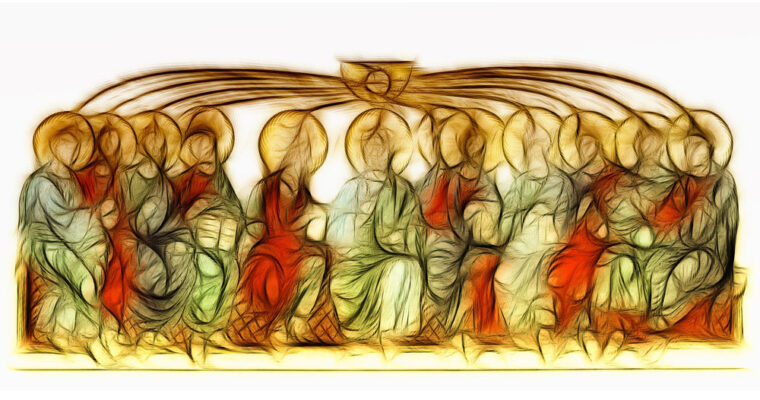
What is certain, however, is that Saint Matthew was present at Pentecost, the descent of the Holy Spirit on the Apostles. It is one of the highest moments in the history of the Church, indeed, in some ways, it is considered its true beginning. It was thanks to the outpouring of the Holy Spirit, sent by Jesus to his disciples in the form of tongues of flame, that they began to go and preach the Gospel.
Hebrew Pentecost fell on the fiftieth day from the day after the Passover Sabbath. It was a sacred, but also an agricultural feast, known as the feast of harvest and first fruits. He envisaged a pilgrimage to Jerusalem and the sacrificial offering of leavened bread to the priests of the Temple.
In the Acts of the Apostles (Acts 2:1-11), it is stated that on the feast of Pentecost all the disciples of Jesus were gathered together in Jerusalem, united in one place. Now when the day of Pentecost had come, they were all with one accord in one place. Suddenly there came from the sky a sound like the rushing of a mighty wind, and it filled all the house where they were sitting. Then there appeared to them tongues as of fire, which parted and came to rest on each one of them. And they were all filled with the Holy Spirit and began to speak in different tongues, as the Spirit enabled them to proclaim. (Acts 2,1-4)

pentecost

Read more:

On the occasion of Pentecost, pray Mary that unties the knots
50 days after Easter, she will untie the knots and celebrate Pentecost, which recalls the descent of the Holy Spirit among the disciples…

A great crowd was called by the noise and rushed to the place where the disciples were gathered. Hearing them speak in so many different languages they marvelled immensely. St. Peter and the Apostles came forward, reminding everyone of the ancient prophecies, and said that this miraculous event was the work of Jesus, “Lord and Messiah” sent by God and resurrected from the kingdom of the dead. Many people were instantly converted and asked to be baptised, as Peter urged them to do: “Repent, and let every one of you be baptised in the name of Jesus Christ for the remission of your sins; then you will receive the gift of the Holy Spirit. For the promise is made to you and to your children and all those far off, whomever the Lord our God will call.” (Acts 2,38-39).
So the apostles, and Saint Matthew among them, began to preach the Gospel. Many people came together to listen to them and learn from them how to turn to God and the miracle of sharing bread and praying. Thus the first seed of the Christian church was born.

As for many Saints, his cone relics are kept in different churches and cities. One part is in Trier, a German city of which he is the patron saint, and where there is a basilica dedicated to his worship. Even in the Basilica of Santa Giustina in Padua, there are some relics of San Matthew, contained in a marble ark in the transept. The same Basilica also houses the relics of St. Luke the Evangelist. Other relics of the Saint would be kept in Rome in the Basilica of Santa Maria Maggiore, brought here by St. Helena, mother of the emperor Constantine, but there is a suspicion that they could be those of St. Matthew, bishop of Jerusalem.

Saint Matthew was also attributed as an apocryphal gospel.

Saint Matthew

Read more:

Saint Matthew, apostle, evangelist and martyr
On 21 September, Saint Matthew is celebrated evangelist, apostle and martyr. Who was he and how did he become an apostle?…

Matthew, an apostle after the betrayal of Judas

So even if drawn after the death of Jesus we can certainly not consider Saint Matthew a less important apostle than all the others. His participation in the life of the Lord and his constant presence at his side, make his ‘promotion’ to the rank of Apostle only the confirmation of a life dedicated to the faith. Also being personally invested by the fire of the Holy Spirit in the feast of Pentecost. It is also probable that he was one of the seventy-two disciples sent by Jesus “as sheep among the wolves” (Matthew 10:16) so that they would prepare for his arrival in the villages and lands where he was headed.

But how does his figure fit in with Judas Iscariot?
Judas did not enjoy great popularity even before he betrayed Jesus. Reading the Gospels we often find very negative judgments about him, even accusations of being greedy, not very honest in his role as an economist of the apostles, and even a thief. It is difficult to understand how much of this negative view of Judas Iscariot is to be implied in what he has done, in his role in the arrest, Passion and death of Jesus. If he was so unpleasant and unpleasant, why would the Savior want him by his side? Perhaps Jesus in his infinite wisdom knew that it took just such a man as Judas for everything to be accomplished.
The fact remains that Judas did not survive his Master. After having him arrested he immediately repented and, destroyed by guilt, hung himself.
The fact that Saint Matthew has taken his place has in a certain sense healed an open wound, restoring integrity to the college of the Apostles and preparing the ground for the fate that awaited them.