Author: Redazione

Biblical male names: what they are and their meaning

Biblical male names: what they are and their meaning

Contents1 Biblical prophet names2 The meaning of the name Gioele3 Evangelist names4 Matthew/Matthias, name that means gift of God The names in the Bible have always provided an inspiration for parents to choose how they would like to call their unborn child. Here are the…

The blood of San Gennaro: how and when the miracle happens

The blood of San Gennaro: how and when the miracle happens

Contents1 The Blood of San Gennaro story2 The liquefaction of the blood of San Gennaro3 When the blood of San Gennaro dissolves Three times a year the blood of Saint Gennaro, martyr and patron of Naples, is miraculously melted. This is what makes this miraculous…

The Prayer for Good Humour: Pope Francis’s Favourite

The Prayer for Good Humour: Pope Francis’s Favourite

October is one of the months dedicated to the Holy Rosary, but there are other ways to address God every day. Here is the prayer for good humour.

The choice to identify October as one of the months dedicated to praying the rosary stems from a historical fact: on 7 October 1571, the Holy League won the Battle of Lepanto against the Ottoman Empire, marking the decline of Muslim dominance in Europe. Pope Pius V, who had blessed the Holy League’s banner, declared that it was the merciful intercession of the Virgin Mary that led the Christians to victory and consecrated 7 October to Our Lady of Victory. His successor, Pope Gregory XIII, changed the dedication to Our Lady of the Rosary. But what does the prayer for good humour have to do with this story and with October, the month of the rosary?

October the month of the Holy Rosary

Read more:

October: the month of the Holy Rosary
What is the connection between the fall month with what is probably the most important and popular devotional form in the world…
“Rejoice always, pray without ceasing, in everything give thanks” (1 Thessalonians 5:16-18). Saint Paul exhorts us in this way, reminding us that God is joy and that we are all invited to maintain good humour even in the most difficult moments, even when the worries, concerns, and vicissitudes of life become more pressing. And Pope Francis seems to be firmly convinced of this because, for many years, he has recited a daily prayer for good humour, which is not only an act of devotion and faith but also a sort of personal encouragement to not lose the smile and sense of humour in every circumstance.

Here is how we can pray during this special month: on one hand, remember that October is the month of the rosary and that we can turn to the Madonna and to God with this powerful and unique prayer, a true instrument of personal and communal salvation, perhaps inspired by Saint Dominic of Guzmán, founder of the Dominicans. On the other hand, let’s not lose our good humour and sense of humour, and let’s imitate Pope Francis and his prayer for good humour, written many centuries ago by Saint Thomas More, yet still so relevant every day.

The Madonna and Saint Dominic of Guzmán

Saint Dominic of Guzmán was animated by a fervent and deep devotion to the Virgin. It was precisely during an apparition of the Madonna that she handed him the Holy Rosary. The Saint had been kidnapped by pirates and was travelling on a ship caught in a storm when the Virgin presented him with the Holy Rosary as the only salvation from shipwreck and the death of all on board. The Saint informed his captors, who listened to him, and immediately the fury of the sea calmed down. The pirates were the first members of the Confraternity of the Rosary.

Thanks to Saint Dominic and the order of preachers he founded, the Rosary acquired the form that we still know and practise today, with the central role of the Virgin Mary and the circular movement that expresses the spiritual journey of the faithful, their gradual approach towards God. In this month and always, we should use it as an instrument of personal meditation and prayer.

Saint Dominic of Guzman

Read more:

Saint Dominic of Guzman and the delivery of the rosary
Saint Dominic of Guzman, the saint in love with Christ, lived his life dividing himself between preaching and prayer…

Pope Francis’s Prayer

Pope Francis has recounted on various occasions which prayers he prefers and that accompany him every day. The Pontiff begins each day with the Morning Office, one of the Canonical Hours that is part of the Liturgy of the Hours and was originally celebrated at dawn. The Office opens with the introductory verse from Psalm 69, “O God, come to my assistance,” followed by the Gloria and the acclamation Alleluia.
The Pope continues his day of prayer by reciting the Rosary, and in the evening, he spends an hour before the Blessed Sacrament for evening Eucharistic Adoration. He also speaks of a special prayer he recites in the evening before going to bed, which begins with the supplication “Lord, if you will, you can cleanse me!” followed by five Our Fathers, one for each wound of Jesus.

Finally, as mentioned at the beginning, the Pope recites the prayer for good humour by Thomas More, the famous English politician and humanist who lived at the turn of the 15th and 16th centuries and was proclaimed a saint after being executed for refusing to acknowledge the King of England’s Act of Supremacy over the Church and for not wanting to disown the Pope.

Prayer for Good Humour

Lord, grant me a good digestion and also something to digest.

Grant me the health of the body and the good humour necessary to maintain it.

Grant me, Lord, a simple soul that knows how to treasure all that is good and does not get frightened at the sight of evil, but rather finds a way to set things right.

Give me a soul that does not know boredom, grumblings, sighs, and laments, and do not allow me to be overly concerned about that troublesome thing called “I.”

Give me, Lord, a sense of good humour. Grant me the grace to be able to take a joke, to discover a bit of joy in life, and to be able to share it with others.

Amen.

The story of Saint Rosalia, patron saint of Palermo

The story of Saint Rosalia, patron saint of Palermo

Contents1 Story of the saint2 Feast of Saint Rosalia3 The meaning of the name Rosalia Saint Rosalia, patron saint of Palermo, is celebrated on 4 September. We know better this beloved saint who defeated the plague and saved her city. Even today in Palermo and…

What is the Difference Between Orthodox and Catholic

What is the Difference Between Orthodox and Catholic

Contents1 The Dogma of the Immaculate Conception for Catholics and Orthodox2 The Orthodox and the Pope3 Purgatory for the Orthodox4 Baptism in the Orthodox Church5 The Russian Orthodox Church The difference between Orthodox and Catholics traces through the very history of Christianity between the East…

The Confessions of Saint Augustine: How to Change Your Life

The Confessions of Saint Augustine: How to Change Your Life

The Confessions of Saint Augustine are a timeless testimony of a journey of faith and self-awareness.

The Confessions of Saint Augustine constitute the autobiography and the summation of the spiritual and human thought of Augustine of Hippo, Father and Doctor of the Church. They are also one of the most beautiful and moving theological texts ever written within the Catholic Church, characteristics that make it an essential masterpiece.

Written between 397 and 400, the Confessions of Saint Augustine are divided into 13 books, in which Augustine addresses God to recount his conversion, his transition from his old self, devoted to vice and sin, to the realization of his new “self.”

saint therese

Read more:

Doctors of the Church: who are they and what are the requirements for having this title
On 1 October we celebrate Saint Therese of Lisieux, one of the four…

Starting from this unique and immortal book, we remember how it is possible for anyone, at any moment, to decide to change their life, no matter what we have done and who we have been before.

What the Confessions of Saint Augustine are About

We have focused on the life of Saint Augustine by talking about his mother, Saint Monica of Tagaste, patron saint of all mothers and a symbol of virtue and unwavering tenacity for all women.

To understand the profound significance of the Confessions of Saint Augustine, we must consider that for the first part of his life, this exceptional man was a true scoundrel. Raised in Tagaste, in present-day Algeria, in a middle-class family, he had a Hellenistic-Roman education. His father, Patricius, was a pagan, his mother a Christian, and Augustine grew up between these two vastly different worldviews, although he was greatly influenced by his mother from an early age. “From my earliest childhood, I had sucked with my mother’s milk the name of my Savior, Your Son,” he would write in one of his Confessions. As he grew, although proving to be an excellent student, Augustine showed signs of increasing restlessness, which led him to indulge in a life of licentiousness and pleasures, which worsened further when he moved to Carthage at seventeen, a city that offered many more amusements and opportunities for sin.

Saint Monica

Read more:

Saint Monica: patron saint of mothers and example for women
Saint Monica of Tagaste was a woman endowed with extraordinary strength of mind and unwavering faith…

He also dedicated himself to the study of Hellenistic-Latin philosophy. Among other things, he read Hortensius by Marcus Tullius Cicero, which planted the seed of change that would come later, pushing him to open his eyes to his conduct.

He then turned to Manichaeism, fascinated by the concept of the struggle between good, represented by the spiritual world, and evil, represented by the material world, as well as by an approach to the world free from the constraints of faith, devoted to a scientific explanation of nature promoted by the Manicheans.

Augustine embraced this philosophy with great enthusiasm, studying and becoming its propagator, involving friends and acquaintances, and at the end of his studies, he returned to Tagaste to become a grammar teacher. His mother never stopped suffering for Augustine’s heretical choice and found no peace until he decided to distance himself from the Manicheans, disillusioned by the realization that even they could not answer all the questions about life and creation that tormented him.

At 29, Augustine moved to Italy and obtained a job as a professor in Milan, where the influence of Bishop Ambrose was predominant. The encounter with this excellent man would radically change him, along with the discovery of Neoplatonic philosophy. In all this, he continued to fight his personal battle against the temptations and passions that dominated him without being able to control them.

Over time, however, and always supported and encouraged by his mother, he returned to embrace Christianity, realizing that in it he could find the answer to all his doubts and inner conflicts. Gradually, Augustine integrated into Christian thought all the insights stimulated in him by Platonic philosophy and began to neglect vices and pleasures, dedicating his days solely to the search for truth. In 387, he returned to Milan to be baptized by Ambrose. Shortly after, his mother Monica died.

Painting in Sant Ambrogio church

Read more:

Saint Ambrose, who was the patron saint of Milan
Saint Ambrose is one of the patrons of Milan and is venerated by all Christian Churches…

What Prompted Him to Write These Confessions

At this point in his life, at the age of 44, Augustine wrote the Confessions, at the peak of an experience of study and, above all, a highly varied life, and of a spiritual crisis that had finally led him to find his path. He himself wrote, as the motivation for undertaking this work: “I want to remember my past wickedness and the carnal corruptions of my soul, not because I love them, but so that I may love You, my God.”

In the tenth book of the Confessions, he explicitly states the reasons that led him to write the work: it is not just about recognizing and admitting his sins, but about discovering, through confessing them, that only in God is there true joy and that only by reconciling with God through Christ can man find his way. It is precisely the awareness of what his life was like before that makes this assertion all the more significant.

The Confessions in Brief

Here are the Confessions summarized briefly.

Book I

Invocation to God, childhood memories, reflections on children and school, guilty of having led him away from God.

Book II

He then talks about his turbulent youth and recounts an emblematic theft of pears committed only for the thrill of the forbidden.

Book III

Augustine recalls the sins committed in Carthage, his love for the theater, amusements, but also his encounter with Cicero’s books and how his search for wisdom and truth began, leading to his adherence to Manichaeism.

Book IV

He talks further about the Manicheans, but also about the concubinage in which he lives with a woman, his work as a rhetoric teacher in Tagaste, the death of a friend, and the literary contests that make him proud and arrogant, distancing him even more from God.

Book V

From Carthage, Augustine moves to Rome, tired of his students’ subterfuge and torn by doubts about Manichean disciplines. Then he goes to Milan, where he hears Saint Ambrose speak for the first time. Christian faith begins to reinsert itself into his life.

Book VI

At 30, Augustine divides his time between study and conversations with friends, but passions and carnal weaknesses still haunt him. He decides to leave his concubine and get married, but is full of doubts.

Book VII

Seeking answers to clarify the origin of evil and why God allows it to exist, Augustine distances himself more and more from Manichean fables and embraces Neoplatonism. He begins to form the idea that evil is nothing more than a consequence of distancing oneself from God, and that man is what he loves, thus if man loves God, he should fear nothing.

Book VIII

The time for conversion is now ripe. Augustine speaks with Simplicianus and other scholars. One day, while in a garden, he hears a child shouting: “Tolle lege, tolle lege!” take and read, take and read, and he takes in hand the Letters of Saint Paul and reads a passage against lust. He then announces to his mother his decision to convert.

Book IX

Augustine renounces teaching, with all the satisfactions it brings him. He spends time with friends and his illegitimate son Adeodatus, then receives baptism from Saint Ambrose. The sudden death of his mother shortly after provides another pretext to talk about his mistakes and the profound influence she had on his life.

Book X

Augustine summarizes in this book the reasons that led him to write his work. His conclusion is that only God is true joy, and men must understand this, but are continually led astray by carnal desires and pride. Only through Christ can men reconcile with God.

Book XI

In the last three books, Augustine focuses on philosophical and theological questions, on God who created everything starting from the Word, on the fact that there are three times: the present of the past (memory), the present of the present (intuition), and the present of the future (expectation).

Book XII

Augustine comments on Genesis, the transition from darkness and formless matter, and debates the various interpretations of Scripture.

Book XIII

Augustine continues to comment on Creation.

Saint Bartholomew the Apostle: The Story of the Martyr Flayed Alive

Saint Bartholomew the Apostle: The Story of the Martyr Flayed Alive

On August 24, the commemoration of Saint Bartholomew the Apostle, one of Jesus’ closest disciples, is celebrated. He is the patron saint of butchers, shoemakers, and anyone who uses cutting tools. Saint Bartholomew the Apostle is primarily remembered for his martyrdom, one of the most…
Relics of the Saints: The List of the 10 Most Fascinating Ones

Relics of the Saints: The List of the 10 Most Fascinating Ones

Contents1 Tooth of Saint Apollonia2 Blood of Saint Januarius3 Incorrupt Body of Saint Catherine4 Holy House of Loreto of the Virgin Mary5 Staff of Saint Joseph6 Saint John the Baptist7 30 Pieces of Silver of Judas Iscariot8 Saint Anthony of Padua9 Saint Agatha10 The Veil…

Marian Apparitions Worldwide: The 10 Most Important Ones

Marian Apparitions Worldwide: The 10 Most Important Ones

The many names by which Christians address the Madonna largely derive from the numerous Marian apparitions around the world. Here are the most famous ones.

We dedicated a previous article to Marian titles, that is, the many names by which the Virgin Mary has been and is invoked by her devotees in Italy and worldwide. Some derive from the Holy Scriptures, others were attributed by theologians and Church Fathers, while others have developed over centuries through historical events, popular veneration, and even folklore. Still, others stem from attributes of Mary, such as the Immaculate Conception, which recalls the dogma stating her freedom from original sin even before her conception, or the Assumed Virgin, as she alone ascended to heaven body and soul to reunite with her Son. In addition to dogmatic, historical, and devotional Marian titles, there are also titles linked to images and sacred places, usually those where Marian apparitions occurred. Often, shrines and places of worship were built in these locations, and over time, the title given to the Madonna coincided with the name of the church or sanctuary. Think of the Madonna of Lourdes or that of Loreto, just to name two.

Many names, then, for one extraordinary woman, who, with a revolutionary act of faith, changed the fate of the entire world forever. By accepting to become the Mother of God, Mary agreed to be the Mother of all men, of every era, without distinctions, without borders, ready to offer relief to her afflicted children, to intercede for them with God the Father, with all the understanding and mercy that only a mother is capable of.

World Map of Marian Apparitions - Copia
World Map of Marian Apparitions – National Geographic


Let us then look at the ten appellations of Mary that arise from as many apparitions of the Madonna around the world, remembering that the Madonna is always one and only one and resides in every place, from the largest and most populous city to the most remote village, and even in lands where men rarely choose to tread. But she is there, everywhere, in the heart of those who need to turn to their Heavenly Mother. For our ‘journey’ through the places of Marian apparitions worldwide, we relied on the National Geographic World Map of Marian Apparitions, which collects the places where the Madonna has manifested herself through the centuries.

Madonna of Loreto in Italy

In Loreto, in the province of Ancona, since the 4th century AD, there has been the Basilica of the Holy House, one of the main Marian pilgrimage sites in our country. Here, devotion to the Madonna of Loreto, mother of Jesus, Virgin Lauretana, developed. This is not exactly a place where a Marian apparition occurred but something more particular. The basilica dedicated to the Madonna of Loreto contains what are universally considered the remains of the Holy House of Mary in Nazareth, where she was born and received the visit of the Archangel Gabriel. The translation of the Holy House is said to have occurred by the hands of Angels on May 10, 1291. First, it was brought to the Dalmatian mountains, then near Recanati, in a forest belonging to a woman named Loreta. There was also an apparition of the Madonna to a faithful follower, to whom she revealed that it was indeed her house, followed by many miracles confirming the sanctity of the place.

Madonna Loreto

Read more:

Our Lady of Loreto: the history and myth of the House that arrived in Loreto from Palestine
Since the Middle Ages, the Basilica of the Holy House has been the…

The Madonna of Loreto is celebrated particularly on December 10. She is the patron saint of the Marche region and several Italian municipalities, as well as the protector of aviators and aviation due to the fascinating legend of the Translation of the Holy House.

Madonna of Czestochowa in Poland

The Black Madonna of Czestochowa, or Black Virgin of Częstochowa, owes its name to a medieval Byzantine icon, part of the so-called Black Madonnas. These are representations of the Madonna with a dark or even black face, usually darkened by smoke or the effects of oxidation on the original colors. The Black Madonna of Czestochowa depicts a Madonna with the Child in her arms and, like many Black Madonnas, is attributed to St. Luke the Evangelist. In the 15th century, during the Hussite wars, it was severely damaged by axe blows, which allegedly caused it to bleed. A central figure in battles and legends, the icon of the Black Madonna is a reference point for all Poles who go to the Jasna Góra Sanctuary to pray to their dark-faced Mother in times of difficulty and dramatic decisions. She is celebrated on August 26.

Madonna of the Pillar in Spain

On October 12, the liturgical memory of Our Lady of the Pillar (Virgen del Pilar or Nuestra Señora del Pilar) is celebrated, venerated in Zaragoza in the sanctuary that bears her name and, consequently, throughout the world. Patroness of the Hispanic peoples, she owes her name to the ‘pilar,’ a miraculous pillar given by the Virgin Mary to the Apostle James, who had come to the Iberian Peninsula to preach the Word of God, to give him strength and support. The pillar is said to be the one atop which Mary appeared to the discouraged Apostle, ready to give up his mission. It is noteworthy that while James encountered the Virgin in the Iberian Peninsula, she was still alive in Palestine! Mary promised that if he built a sanctuary in her honor, she would guarantee healing and salvation for anyone seeking refuge there. The gigantic Sanctuary of the Virgen del Pilar in Zaragoza is the oldest in Spain, and the apparition of the Madonna to James is considered the first Marian apparition. It still houses the legendary pillar, in the same spot where Mary is said to have appeared to James. The pillar is actually an alabaster column later covered in bronze and silver.

Madonna of Lourdes in France

Catholics refer to Mary as the Madonna of Lourdes or Our Lady of Lourdes to recall the eighteen apparitions of the Virgin to Bernadette Soubirous, a fourteen-year-old peasant girl living in the French town of Lourdes. In 1858, the girl reported seeing a “beautiful Lady” dressed in white with a blue sash in a cave near Massabielle. The Sanctuary of the Madonna of Lourdes is now one of the most visited in the world, and the description of the Madonna provided by Bernadette has defined the most widespread and recurring iconography of Mary.

Madonna of Altötting in Germany

On May 27, the Madonna of Altötting, the Black Madonna symbolizing the Sanctuary of Altötting in Bavaria, is celebrated. Here, the hearts of all the kings of Bavaria are kept in precious silver urns. The Madonna appeared in Altötting twice in 1489. She is said to have brought back to life a three-year-old boy who had fallen into a river. For over 500 years, pilgrims have visited the sanctuary, obtaining graces and miraculous healings. Altötting, Lourdes, Fatima, Czestochowa, and Loreto are the five so-called European Sanctuaries.

Madonna of Fatima in Portugal

On May 13, the Madonna of Fatima is celebrated, who appeared six times in 1917 to three children tending a flock near Fatima. Beautiful, dressed in white, and shining like a star, the Virgin had blooming roses adorning her feet, a golden cord as a belt, and a gold-embroidered veil on her shoulders and head. She held a sparkling Rosary in her fingers. The Madonna of Fatima encouraged the children to return, and during the apparitions, she reminded them of the importance of the Rosary, penance, and prayer as instruments of salvation. She also entrusted them with three secret messages, instructing them not to reveal them. These are the three secrets of Fatima. Today, the Fatima sanctuary is one of the most visited Marian sanctuaries in the world. Built on the exact spot where the Madonna appeared to the three shepherd children, it houses their mortal remains.

Our Lady of Fatima Penance and prayer are salvation

Read more:

Our Lady of Fatima: Penance and prayer are salvation
On 13 May we celebrate the Madonna of Fatima. Her invitation to penance and prayer as instruments of salvation today…

Virgin of the Poor in Belgium

In Banneux, Belgium, near Liège, eight apparitions of the Madonna occurred in 1933. Mariette Beco, the eldest of eleven children in a poor family uninterested in religion, encountered the Virgin. One day, while at home looking after one of her younger brothers, she saw a woman dressed in white in the garden, emitting light and inviting her to follow. Stopped by her mother, she saw the same Lady a few days later, and this time she managed to follow her to a spring, which the mysterious Lady claimed as hers and for all nations, for the sick. The next day, the Lady appeared again to the girl, introducing herself as the Virgin of the Poor. There were other apparitions, accompanied by miraculous events, and finally, the Lady revealed herself to Mariette saying: “I am the Mother of the Savior, the Mother of God.” The Lady did not return, but the spring she showed the girl became a place of miraculous healings. Today, the Sanctuary of Our Lady of the Poor, built nearby, is visited by thousands of pilgrims seeking health and salvation.

Our Lady of Aparecida in Brazil

Patroness of Brazil, Our Lady Aparecida or Our Lady of Conception Aparecida is celebrated on October 12th. The sanctuary dedicated to her in Aparecida, in the state of São Paulo, is the largest in the world and one of the four most visited. Legend has it that three fishermen were tasked with procuring fish for a banquet in honor of the Count of Assumar, the governor of the Province of São Paulo, who was passing through the town where they lived. They cast their nets into the Paraíba River, and after several unsuccessful attempts, they first found a terracotta statue depicting the Madonna, and then its head. From that moment on, their nets began to fill beyond measure. After remaining in one of the fishermen’s homes for fifteen years, the statue became the object of ever-growing devotion. Eventually, a grand sanctuary was erected: the Sanctuary of Our Lady of Aparecida.

Our Lady of Guadalupe in Mexico

The cult of Our Lady of Guadalupe, or Virgin of Guadalupe, also derives from a series of apparitions that occurred between December 9th and 12th, 1531, on Tepeyac Hill near Mexico City. Here, Juan Diego Cuauhtlatoatzin, one of the first Aztecs converted to Christianity, encountered a young woman with features typical of women from his land: dark skin and black hair, surrounded by rays of sun and standing on a moon carried by an angel under her feet. We are familiar with her appearance because it miraculously remained impressed on the man’s cloak, the so-called tilma. The Madonna of Guadalupe is celebrated on December 12th throughout Mexico. The Sanctuary of Our Lady of Guadalupe was erected at the site of the apparitions, visited annually by over 20 million pilgrims, making it one of the most visited places of worship in the world and the first in America. Here, Juan Diego Cuauhtlatoatzin’s cloak with its miraculous image is still preserved today.

Basilica of Our Lady of Guadalupe in Mexico City

Read more:

Basilica of Our Lady of Guadalupe in Mexico City
The Basilica of Our Lady of Guadalupe is dedicated to Our Lady of Guadalupe, protector of all Spanish-speaking people and patron…

Mother of the Word in Rwanda

Even in the African village of Kibeho, Rwanda, the Madonna is said to have appeared, starting from November 28th, 1981. The protagonists of the apparitions were six girls and one boy who encountered a woman of extraordinary beauty in the school where they studied. The lady introduced herself as the Mother of the Word. During subsequent apparitions, in addition to urging the children to pray, the Madonna revealed the terrible massacres that would bloodshed Rwanda in the following years. To combat evil and seek peace, the only paths would be prayer, fasting, and love for one’s neighbour. A Sanctuary dedicated to Our Lady of Kibeho or Our Lady of Sorrows stands in Kibeho today.

Our lady of Guadalupe
Virgin Mary of Guadalupe statue resin 30 cm
Buy on Holyart
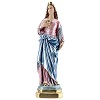
Our Lady of Loreto
Lady of Loreto statue, 30 cm hand painted plaster Barsanti
Buy on Holyart
Our Lady of Czestochowa
Statue of Our Lady of Czestochowa, 35 cm in plaster with mother of pearl
Buy on Holyart
Our Lady of Lourdes
Our Lady of Lourdes with crown in painted wood of Valgardena
Buy on Holyart
Saint Roch and the Dog: A Bond from the Middle Ages

Saint Roch and the Dog: A Bond from the Middle Ages

Contents1 Saint Roch of Montpellier2 The Story of Saint Roch and the Dog3 What Breed Was Saint Roch’s Dog? Why is Saint Roch depicted with a dog by his side? Read this article to discover the story of Saint Roch and the dog. A saint…

Orthodox icons: representations of Christ’s works on Earth

Orthodox icons: representations of Christ’s works on Earth

Contents1 The ancient orthodox icons2 Author, subject and interpretation of icons3 The icon of the Annunciation Orthodox icons have always been a meeting place between art and pure and solemn spirituality. In ancient icons, a tradition that goes beyond space and time remains alive. On…

Coronation of the Virgin: Queen of Heaven and Earth

Coronation of the Virgin: Queen of Heaven and Earth

On August 22, we celebrate the Coronation of the Virgin, Mother of Jesus. What is the origin of this feast, and why is Mary considered a “queen”?

The Feast of the Coronation of the Virgin, celebrated on August 22, is quite modern. This devotion was officially established only in the second half of the 20th century. However, the first Christians already considered the Madonna worthy of being called “Queen.” The first to refer to her as such was Ephrem the Syrian, a theologian, writer, and saint of Syriac origin who lived in the 4th century and is a Doctor of the Catholic Church. In one of the twenty hymns he dedicated to the Madonna, to whom he was very devoted, he addresses her: “August Virgin and Lady, Queen, Mistress, protect me under your wings, guard me, so that Satan, who sows ruins, does not exult over me, nor does the wicked adversary triumph against me.”

saint therese

Read more:

Doctors of the Church: who are they and what are the requirements for having this title
On 1 October we celebrate Saint Therese of Lisieux, one of the four…

The Council of Ephesus in the 5th century defined the Virgin Mary as Theotokos, “Mother of God.” From this, many forms of popular devotion arose over the centuries, culminating in the coronation of the Virgin Mary as Queen, often with precious crowns made of gold and jewels collected from the faithful as a penitential offering.

Why is Mary called a queen?

Where does Mary’s royal dignity come from? It is not just one of the many Marian titles attributed to the Virgin. The Madonna is Queen as the Mother of God because Jesus, both God and Man, is the Sovereign of all Creation, and His Mother must be part of His royalty. The Virgin is thus Queen due to her divine motherhood, but not only that. For her role in the New Covenant, for having consciously chosen to be the Mother of the Savior, and for suffering with Him the agony of the Passion, Mary became the new Eve, an instrument of redemption and salvation alongside her blessed Son. Mary is called Queen in the Fifth Glorious Mystery of the Holy Rosary, in several points of the Litany of Loreto, and in three of the most well-known Marian antiphons: Salve Regina, Regina Coeli, and Ave Regina Coelorum.

marian titles

Read more:

Marian Titles: what are they and how many are all the names dedicated to Mary
Marian Titles: all the appellations with which Mary, mother of Jesus…

Encyclical Letter Ad Caeli Reginam

The Encyclical Ad Caeli Reginam was issued on October 11, 1954, by Pope Pius XII, to institute the liturgical feast of the “Blessed Virgin Mary, Queen.” The same Pope also proclaimed the dogma of the Assumption of Mary into Heaven. Initially set for May 31, the feast of the Coronation of the Virgin was later moved to August 22 with the reform of Paul VI, to bring it closer to the Feast of the Assumption and to unite, in a sense, the corporeal and regal glorification of the Virgin. The decision to establish the feast was greatly supported by popular initiatives, such as the one promoted by Maria Desideri, who collected petitions worldwide to advocate for her project Pro regalitate Mariae and to request the proclamation of the feast.

The Assumption of Mary

Read more:

The Assumption of Mary and the most characteristic celebrations
15 August is not just an occasion for partying and outings…

Why August 22?

On August 15, we celebrate the Assumption of Mary into Heaven, resurrected to eternal life for being the Mother of Jesus and being preserved from sin. On the 22nd, her corporeal glorification is joined by her regal glorification, with her proclamation as Queen of Angels (Regina Angelorum) and Queen of Heaven (Regina Caeli or Regina Coeli).

How does Mary exercise this kingship of service and love?

We should not think of the Virgin Mary as a distant Queen indifferent to the fate of her children. In 2012, Pope Benedict XVI explained that the Madonna exercises her queenship by: “Watching over us, her children: the children who turn to her in prayer, to thank her or to ask for her maternal protection and her heavenly help, perhaps after losing their way, oppressed by pain or anguish due to the sad and troubled circumstances of life.”

A queenship characterized by love, therefore, and by continuous inclination towards us humans, who seek in her a Mother, before a Queen, an infinitely merciful reference that watches over us from Heaven and serves as an intermediary between our sufferings and God the Father.

The Inventions of Monks: Major Contributors to European Progress

The Inventions of Monks: Major Contributors to European Progress

Discover how the inventions of monks fostered technological and scientific development in medieval Europe and passed down ancient, valuable knowledge. We often hear the Middle Ages described as a dark era, during which technological progress and artistic development came to a halt, and widespread barbarism…

Resurrection of Lazarus: “Rise and Walk”

Resurrection of Lazarus: “Rise and Walk”

The resurrection of Lazarus represents a turning point for Jesus. From here begins His relentless journey towards the destiny that God has willed for Him. We have recounted the story of Martha, Mary, and Lazarus of Bethany in an article dedicated to friendship. Indeed, for…

The fisherman’s ring and the rite that marks the beginning of the pontificate

The fisherman’s ring and the rite that marks the beginning of the pontificate

The Fisherman’s ring is one of the oldest traditions related to the election of the pope. How is it made and what is it for?

Few objects related to the religion and rites of Catholicism express a symbolic value and a fullness of meaning and history as the Fisherman’s ring. This is because the very surface of the pope’s ring is engraved with the image of Saint Peter throwing fishing nets from the boat. The reference to the Gospel of Luke (5:1-11) arises immediately: on the shores of Lake Genesisaret, while he is intent on preaching the word of God, Jesus saw two boats moored and climbed on the one that belonged to a certain Simon, asking him to take to the sea and cast his nets. The fisherman complained that they had not caught anything all night, but he obeyed Jesus’ message and in a few moments the nets were filled with fish. To Simon’s astonishment, Jesus told him that from that moment on he would make him a fisher of men. So Simon, the future Saint Peter the Apostle, together with James and John, sons of Zebedee, pulled the boats to the ground, left everything and followed Him.

Although the first documentation regarding the Fisherman’s ring, as a seal for the pontiff’s private correspondence, dates back to 1265, in a letter written by Pope Clement IV to his nephew Pietro Grossi, that of the Fisherman’s ring is one of the oldest traditions related to the papal election. It is likely that as early as 1100 the new Pope received the fisherman’s ring at the time of ascension to the papal throne and wore it from that moment on to the ring finger of his right hand.

The papal ring is gold, with the pope’s name engraved along the edge of the effigy of the apostle Peter. During the solemn mass for the election of the pope, the cardinal camerlengo hands him over to the new pontiff. At the death of the pope, the same camerlengo destroys the Fisherman’s ring with a silver hammer in front of the other cardinals. The ring thus broken is preserved in the Vatican museums.

The tombs of the popes and all there is to know

Read more:

The tombs of the popes and all there is to know
Where are the tombs of the popes? Let’s find out where the popes have been buried for centuries and…

Uses of the ring in history

What is the Fisherman’s ring for? It’s not just a piece of jewellery or a sign, or at least it wasn’t in the past. The kiss of the ring was a widespread practice in secular environments, where kings and emperors demanded it as a sign of respect from vassals and subjects. It is presumed that this tradition also passed to the popes, considering how important their role in secular matters was in ancient times. Today, the Fisherman’s ring has an especially symbolic function, but in antiquity, it also had very specific and essential uses. The fact that it is destroyed at the death of the pope, for example, has an explanation that becomes immediately clear if we think that until 1842 the swimming ring was used by the pope as a seal for all his private correspondence and for minor documents of the Holy See, which however had been written by him or at least bore his signature (sub anulo piscatoris is a recurring formula in these documents and indicates precisely this practice). Unlike the most important and official documents that were sealed with molten lead (papal bubble), on the less important and more private documents the effigy of the Fisherman’s ring was imprinted on the hot wax. Destroying the ring after the pope’s death prevented anyone from appropriating it and using it improperly to legitimise later documents. Today the destruction of the ring indicates that the papal mandate is over and that the seat is vacant.

Saint peter in the Vatican church symbol of the christianity

Read more:

Saint Peter in the Vatican: Church symbol of the whole Christian world
Saint Peter in the Vatican is a basilica full of meanings, mysteries and…

Pope Francis’ Fisherman’s Ring

When on 19 March 2013 the then Dean of the College of Cardinals, Angelo Sodano, slipped the papal ring on Cardinal Bergoglio, thus elevating him to the papal throne as Pope Francis, he did not do so using a gold ring, but a silver one.

Anniversary of the election of Pope Francis

Read more:

Anniversary of the election of Pope Francis
Pope Francis’ pacific revolution. On the fifth anniversary of his election, recently celebrated…

Already before Pope Francis, other popes had wanted to change this secular tradition: John Paul II, for example, did not want his ring to be destroyed but sent it to the Archbishop of Krakow to put it in the church of the Discalced Carmelites in his hometown, Wadowice. Even Benedict XVI, when he renounced the pontificate, did not have the ring destroyed, but only had it engraved with a chisel so that it was no longer usable, according to a practice called rigatura.

The choice of Pope Bergoglio was a very significant sign of rupture, which immediately clarified his position regarding traditions and his willingness to renew many purely symbolic aspects of the Church in favour of greater attention to the weak, the needy, and the poor.

Martha, Mary, and Lazarus: Friends of Jesus

Martha, Mary, and Lazarus: Friends of Jesus

On July 29, the memory of Martha, Mary, and Lazarus of Bethany is celebrated. Here’s why these saints were among Jesus’ dearest friends. In 2011, the United Nations General Assembly declared July 30 as the International Day of Friendship. The goal of this observance is…

Marian Feasts: Here Are All the Annual Celebrations Dedicated to Mary

Marian Feasts: Here Are All the Annual Celebrations Dedicated to Mary

Marian Feasts, All the Faces of Devotion to Mary, Mother of Jesus It is not easy to list all the feasts dedicated to Mary, Mother of Jesus. The devotion shown to her by the faithful has always manifested in various ways within the Catholic Church.…

The apparitions of Maria Rosa Mystica and its Sanctuary in Fontanelle

The apparitions of Maria Rosa Mystica and its Sanctuary in Fontanelle

The apparitions of Maria Rosa Mystica to Pierina Gilli have given rise to a strong devotion at the Sanctuary of Rosa Mystica in Montichiari. Here is their story.

Among the many Marian apparitions recognized or not by the Catholic Church, those that occurred in Montichiari, in the province of Brescia, in 1947 and 1966, remain today shrouded in deep mystery. These are the apparitions of Maria Rosa Mystica, in which the visionary Pierina Gilli played a central role. Although the ecclesiastical authority has never recognized the apparitions, since December 2019, the place where they allegedly occurred, already a destination for devout pilgrims, has been declared by the Bishop of Brescia as the Diocesan Sanctuary of Rosa Mystica – Mother of the Church. Although the Church has not recognized the validity of the apparitions, the location is acknowledged as a Marian place of worship dedicated to Maria Rosa Mystica. It’s a place famous for the apparitions of Mary, but also for the cult that has developed over the years around the figure of the visionary, her messages, and Mary Mother of the Church.

Pierina Gilli, the visionary of Montichiari

Pierina was an unusual visionary figure, especially because, despite the great fame brought to her by the apparitions and the influx of devotees and the sick to her home in Fontanelle di Montichiari, she never gave up leading a simple, sheltered, anonymous life. She never married, never wanted a family of her own, and died elderly in her home in Montichiari, surrounded by the love and devotion of friends and believers.

Born to peasant parents, in frail health, she was born in 1911 and showed a deep calling from a young age. Unable due to various illnesses, including meningitis which plagued her for a long time, to enter the Handmaids of Charity of Brescia, she worked as a housekeeper and later as a nurse in a hospital.

The apparitions in which she played a central role are divided into two cycles, and their descriptions can be read in Pierina’s Diary.

First cycle of apparitions 1946-1947

In November 1946, while Pierina was still convalescing after a severe bout of meningitis, she was visited by Saint Mary Crucified of the Rose, founder of the Handmaids of Charity congregation, who would later be canonized in 1954. Saint Crucified indicated to Pierina a point in the room, where “… a beautiful Lady appeared as if transparent, dressed in purple with a white veil descending from her head to her feet, holding her arms open, and I saw three swords pierced in her chest over her heart.

It was always Saint Crucified who helped Pierina interpret the vision: the Lady was the Madonna, and the three swords tormenting her heart were caused by three categories of souls consecrated to God but inadequate to support their role and their faith, in particular:

  • religious souls who did not correspond to the grace of their vocation;
  • religious souls lingering in mortal sin;
  • priests who had become unworthy of their sacred ministry.

To help these souls, the Saint imposed prayer, sacrifice, and penance on Pierina.

In a subsequent apparition, in July 1947, the Madonna appeared again to Pierina, this time dressed all in white. The three swords lay at her feet and had been replaced on her chest by three roses, one white, one red, and one golden yellow. The meaning of the three flowers was respectively the spirit of prayer, the spirit of sacrifice, and the spirit of penance. The Madonna asked Pierina to have the 13th of every month consecrated as a Marian day, dedicated to prayer and penance: “I wish the day 13 of each month to be the Marian Day, preceded by special prayers of preparation for 12 days […] This day must be one of reparation for the offences committed against our Lord by consecrated souls who, with their sins, cause three piercing swords to enter into my heart and that of my Divine Son.

At the conclusion of the first cycle of apparitions, in November 1947, Maria Rosa Mystica warned Pierina that on December 8, the Feast of the Immaculate Conception, she would appear in the Cathedral of Montichiari. After an initial apparition on December 7, in which Pierina reported seeing the shepherds of Fatima, Francisco and Jacinta, on December 8, 1947, Pierina saw the Immaculate Heart of Mary in the Cathedral of Montichiari, which was filled with faithful gathered in prayer for the occasion. The Madonna, who wished to be invoked under the title of Rosa Mystica, asked Pierina to establish the Hour of Grace: “I wish that every year, on December 8, at noon, the Universal Hour of Grace be practiced; through this practice, many spiritual and corporal graces will be obtained… Be it reported as soon as possible to the Supreme Father of the Catholic Church, Pope Pius XII, that I desire this Hour of Grace to be known and extended throughout the world. Those who cannot go to their respective churches will obtain from me the graces even by praying in their homes.

Second cycle of apparitions 1966

The second cycle of apparitions took place in 1966 in Fontanelle, in the countryside of Montichiari. On April 17, 1966, the second Sunday of Easter (also known as Divine Mercy Sunday), the Madonna of the Rosa Mystica appeared in the fields, near a fountain, the source of San Giorgio. In that fountain, she invited all the sick and suffering to bathe for relief. On May 13, 1966, she requested that the fountain be named the Fountain of Grace, and that a basin be installed to facilitate ablutions.

On June 9, 1966, on the Feast of Corpus Christi, Pierina again saw Maria Rosa Mystica in the wheat fields ready for harvesting. The Madonna ordered that those ears of wheat become flour for the Eucharistic Bread: “How much I would desire that this wheat became Eucharistic Bread… in many reparative Communions.

On August 6, the Feast of the Transfiguration, the Virgin asked Pierina to have October 13 celebrated as the world day of Reparative Communion: “My Divine Son Jesus has sent me again to ask for the worldwide union of Reparative Communion, and this shall be on October 13 […] Let the news of this holy initiative that must begin this year for the first time and shall always be repeated every year be spread throughout the world.

Sanctuary of Maria Rosa Mystica in Fontanelle di Montichiari

In reality, the sanctuary of the Madonna of Montichiari is not a true sanctuary, in the sense that there is no building or church. There are only two small chapels located within a large amphitheater, which also includes the water source declared miraculous by Maria Rosa Mystica, where many immerse themselves, which is why the sanctuary has earned the nickname of small Lourdes. One peculiarity: the sanctuary of the Madonna della Rosa Mistica is particularly dear to the Romani and Sinti communities, as well as the sanctuary of the Gypsies and the Blessed Zeffirino located near the Sanctuary of Divine Love in Castel di Leva.

Our Lady of Lourdes

Read more:

Our Lady of Lourdes
With the Our Lady of Lourdes epithet, Catholic refer to Mary, mother of Jesus, who in 1858 appeared eighteen times to Bernadette Soubirous…

Maria Rosa Mystica: meaning of the three roses

In the apparition of July 13, 1947, Pierina saw the three roses on Mary’s white robe. The Madonna’s message regarding them is a true proposal of “Rosa Mystica” for all religious communities and groups scattered around the world: prayer, penance, suffering to repair and eliminate the infidelities of consecrated persons and of every Christian.

  • White Rose: spirit of prayer to repair the offenses against the Lord committed by consecrated persons who do not live their vocation with coherence;
  • Red Rose: spirit of sacrifice to repair the offenses against the Lord committed by the consecrated living in mortal sin;
  • Yellow-gold Rose: spirit of immolation to repair the offenses against the Lord committed by priests who betray their vocation and, in particular, to obtain their sanctification.

Only if these three roses are offered with love will the three swords fall from the Heart of the Madonna.

Prayer to Maria Rosa Mystica

Among the many prayers that can be addressed to the Madonna of Montichiari is the Novena to Maria Rosa Mystica, which is prayed for twelve days. The thirteenth day the requested Grace will be granted.

Immaculate Virgin, Mother of Grace, Rosa Mystica in honor of your Divine Son, we prostrate ourselves before You to implore mercy from God: not for our merits, but for the goodness of Your maternal heart, we ask for Help and Grace, certain that You will assist us.

(Hail Mary)

Mother of Jesus, Queen of the Holy Rosary and Mother of the Church, the mystical Body of Christ, we implore for the world, burned by discord, the gift of unity and peace and all those Graces that can convert us and the hearts of many children.

(Hail Mary)

Mystical Rose, Queen of the Apostles, make numerous religious and priestly vocations flourish around the Eucharistic Altars, so that with the holiness of life and fervent zeal for souls they may extend the Kingdom of Your Jesus throughout the world, also fill us with your heavenly favors.

(Hail Mary)

Mystical Rose, Mother of the Church, pray for us.