When speaking of the treasure of San Gennaro, the patron saint of Naples, we cannot fail to recall Dino Risi’s entertaining film starring Totò: Operation San Gennaro. A ragtag gang of thieves attempted to steal the Saint’s immense treasure, after San Gennaro himself had given them permission, or so they wanted to believe, but after a series of hair-raising adventures the crooks ended up being hailed by the whole of Naples as the very saviours of the treasure itself. Beyond the cinematic fiction and the irresistible Neapolitan flavour of Risi’s film, it remains true, today as it was then, that the treasure of San Gennaro is one of the richest and most precious in the world, and that countless stories and traditions have grown up around it over the centuries. In particular, the Mitre of San Gennaro is a unique and extraordinary object, a treasure within the treasure.
Certainly, the treasure of San Gennaro, preserved in the Museum of the Treasure, but also in the Treasury Chapel, where the precious ampoules containing the blood of San Gennaro are also kept, boasts a unique collection of more than 21,613 precious objects in gold, silver, bronze and precious stones, donated by kings, queens and emperors to the Saint and to the city. Experts have estimated that the treasure as a whole is worth considerably more than that of the Queen of England. In short, it is a treasure worthy of a king, yet it belongs to no Crown. It belongs to Naples, to its people, who have always been devoted to San Gennaro, who have always lived under his aegis and his benevolent protection.
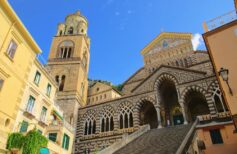
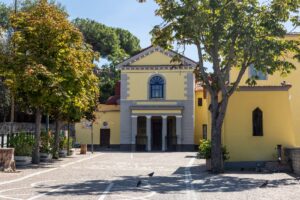
The Museum of the Treasure of San Gennaro opened in 2003, and its entrance is located beside Naples Cathedral and the Treasury Chapel. It houses most of the pieces that make up the Saint’s treasure: jewels, statues, textiles and silverware, donated by distinguished men and women, many of them crafted by the city’s finest artisans. The museum was financed by private companies, European funds and local institutions, and is under the patronage of the Deputation of the Royal Treasury Chapel. The treasure of San Gennaro also represented a fundamental turning point in Neapolitan craftsmanship. In fact, it was after the arrival in Naples of the bust of the Saint, created by Provençal goldsmiths on the orders of Charles of Anjou and donated to the city in the 14th century, that local goldsmiths also gained much greater recognition and began organising themselves into a guild which is still active today in the Borgo Orefici district.
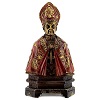
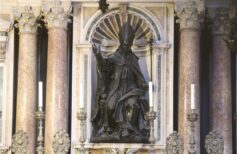
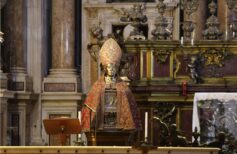
Bust of Saint Januarius with base displaying his name. The predominant colors are the red of the cloak and the gold of the face, chest and decorations…
The Treasury Chapel of San Gennaro
The Royal Treasury Chapel of San Gennaro was built within Naples Cathedral as an ex voto offered by the entire city of Naples, on the anniversary of the translation of the bones of San Gennaro from Montevergine to the city in 1601. The people of Naples implored their Saint to protect the city from famine, plague and war. It was on that occasion that the Elects of the city, the representatives of the administrative institutions of Naples from the 13th to the 19th century, established the Deputation of the Treasure of San Gennaro to safeguard the Treasury Chapel. The Elects met in the Church of San Lorenzo Maggiore, using special Sedili. The Deputation is composed of 12 members, in addition to the Mayor of the city. Ten members come from the ancient Sedili of the patrician families, while two come from the Sedili representing the people. For more than 500 years, the Deputation of San Gennaro has safeguarded the relics (the bust and the ampoules of the miraculous blood) and the treasure, while promoting devotion to the Saint.
The foundation stone of the Treasury Chapel was laid in 1608, and the works were completed in 1647. It is a splendid example of Neapolitan Baroque and one of the city’s greatest artistic achievements, to which outstanding artists contributed. The frescoes and painted decorations are the work of Domenichino and Lanfranco, the foremost exponents of Emilian Baroque painting in Naples.
By virtue of several papal bulls, the chapel does not belong to the Curia, but to the city of Naples, and is safeguarded on behalf of the Neapolitan people by the Deputation.
This tapestry is produced in Tuscany (Italy) with a modern Jacquard loom; the images are in high definition and use refined yarns such as lurex and are fully lined.
The Value of the Mitre of San Gennaro
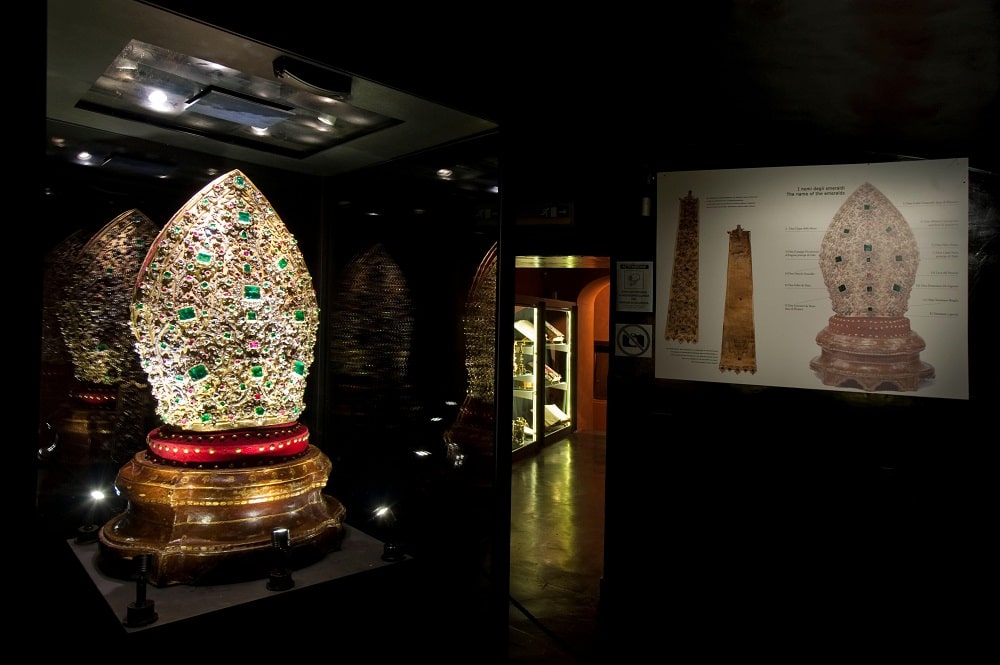
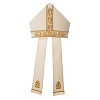
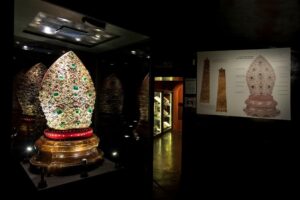
To grasp the immense value of the treasure of San Gennaro, it is enough to consider that the Mitre alone has been valued at around €7 million. It is undoubtedly one of the highlights of the treasure: entirely covered with precious stones and weighing 18 kilograms, it is a symbol of San Gennaro and one of the finest examples of Neapolitan goldsmithing.
It is worth remembering that the mitre is a characteristic headdress of the Catholic clergy dating back to the 5th century. Initially worn by the Pope during solemn processions, it was later replaced by the tiara, the symbol of papal authority, and from the 10th century onwards bishops began wearing it as a symbol of the holiness they embodied.
The Mitre of San Gennaro was created in 1713. The Neapolitan goldsmith Matteo Treglia used 3,964 diamonds, rubies and emeralds. He spent a year, assisted by 50 collaborators, completing this masterpiece. The choice of the precious stones adorning it was not accidental. Each type of gemstone carries a specific symbolic meaning: emeralds represent knowledge, diamonds represent Faith, and naturally the rubies symbolise the blood of San Gennaro.
Alongside the mitre, among the most famous pieces of the treasure are the priceless emerald cross donated by Napoleon; the magnificent silver statue of Saint Michael the Archangel, created in 1691 by Giovan Domenico Vinaccia to a design by Lorenzo Vaccaro, depicting the Archangel defeating a dragon; the necklace by the goldsmith Michele Dato which adorns the bust of San Gennaro, made of 13 gold links decorated with diamonds, emeralds, rubies and other precious stones; the cross donated by Charles of Bourbon in 1734, decorated with 13 brilliant-cut diamonds and 13 rubies; the chalice donated by Ferdinand IV of Bourbon, adorned with 586 brilliant-cut diamonds; and a monstrance presented by Joachim Murat.
The most precious pieces of the treasure of San Gennaro can never be displayed together, but are exhibited to the public on a rotating basis. Indeed, it would not be possible to insure them all at the same time, given their inestimable value.
The fragrances of Padre Pio represent just one of the most evocative aspects of the veneration surrounding this unique Saint....
26 August 2026
What’s the Future of Religion?
What’s the Future of Religion?
A Beginner’s Guide to Christianity
A Beginner’s Guide to Christianity
Mind-Blowing Statistics About Christianity You Need to Know
Mind-Blowing Statistics About Christianity You Need to Know
9462
Enter the Holyart world: $20 discount voucher valid on over 60,000 items
Come and discover Holyart, the largest e-commerce of religious articles in Europe and immediately receive a $20 voucher to use with your first purchase.
Check your mailbox: you will receive your discount within 5 minutes