Homepage | Religion | What is the IOR and how does the Institute for the Works of Religion work?
What is the IOR and how does the Institute for the Works of Religion work?
28 October 2026
Reading Time: 5minutes
The Vatican IOR is a financial institution established to safeguard and administer the movable and immovable assets of the Church intended for religious or charitable works. Its aim is to serve the Catholic Church in all its branches, including the Holy See
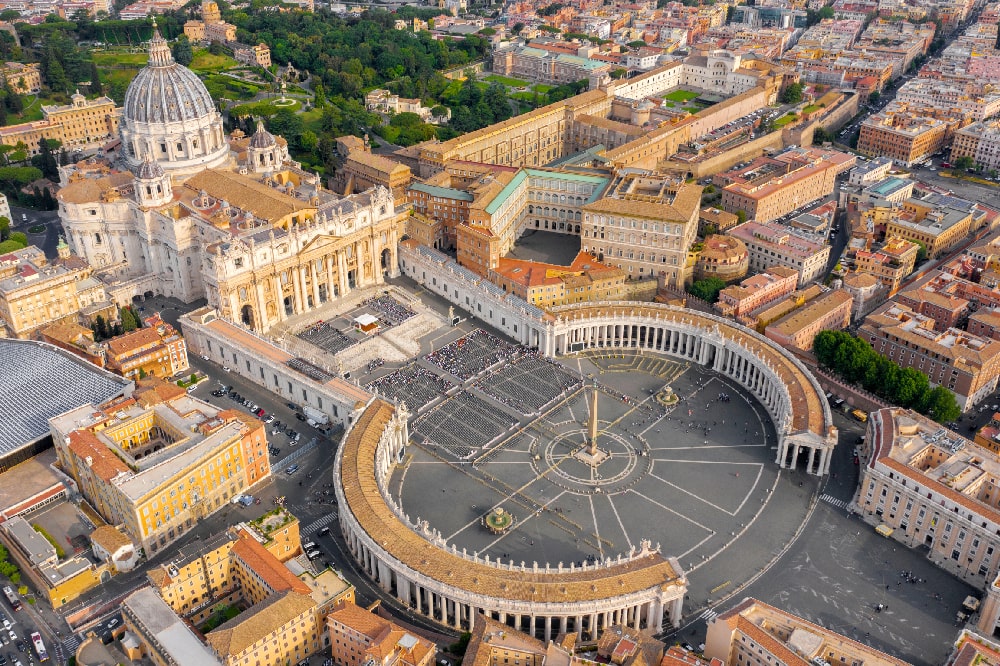
The Vatican IOR, or Institute for the Works of Religion, is a financial institution located within Vatican City. Founded in 1942 by Pope Pius XII, the Institute is often referred to as the Vatican Bank. Its main role is to manage funds intended for religious and charitable works, as well as to provide financial services to the Catholic Church throughout the world. It is not a commercial bank open to the public, but primarily serves religious entities, churches, dioceses, religious orders and other organisations connected to the Church.
As early as 11 February 1887, Pope Leo XIII had established the Commissione Cardinalizia ad pias causas, tasked with administering assets, bequests and charitable works that came to the Holy See. On 24 November 1904, Pope Pius X renamed the Commission the Cardinal Commission for the Works of Religion. On 10 February 1934, Pope Pius XI approved the Commission’s Statutes, and it became the Prelatial Commission for the Administration of the Works of Religion.
The Institute for the Works of Religion was officially established on 27 June 1942 by a chirograph of Pope Pius XII, that is, a document written directly by the Pontiff. Its foundation responded to the need to manage more efficiently the funds intended for the charitable and religious activities of the Catholic Church, especially during a period of major global turmoil such as the Second World War. Pope Pius XII incorporated the original Administration for the Works of Religion into the IOR.
On 24 January 1944, the same Pope issued a second Chirograph to establish new regulations, allowing the Institute to manage cash deposits and securities on behalf of third parties and to employ lay staff.
In 1990, Pope John Paul II restructured the Institute, entrusting its supervision to a dedicated Board of Superintendence, while leaving the purposes and functions of the IOR unchanged.
But what does the IOR finance? Although it is not a commercial bank, it plays a crucial role in supporting religious and charitable works throughout the world, carrying out its mission with integrity, transparency and dedication.
Who can open a current account with the IOR?
The Vatican IOR is not a traditional commercial bank and does not offer its services to the general public. Access to IOR services is reserved for a specific clientele, primarily connected to the Catholic Church and its activities.
Therefore, only religious entities, such as dioceses and parishes, religious orders and congregations, charitable and missionary institutions of the Catholic Church, may open an account with the IOR; Vatican institutions, such as the Dicasteriesand other bodies of the Roman Curia, embassies and representations of the Holy See; and finally, private individuals, provided that they are members of the Catholic clergy (bishops, priests, etc.), employees of the Vatican and the Holy See, or persons authorised by the IOR’s Cardinal Commission.
Access to an account with the IOR is strictly regulated and monitored to ensure that funds are used for religious and charitable purposes in accordance with the mission of the Catholic Church.
The current president of the Vatican IOR is Jean-Baptiste de Franssu. Jean-Baptiste de Franssu is a French banker and financial executive with a long career in the financial sector. He took on the role of president of the Institute for the Works of Religion on 9 July 2014, succeeding Ernst von Freyberg.
Who controls the IOR?
The Institute is supervised and regulated by the Financial Information Authority (ASIF). ASIF is the central body of the Holy See and the Vatican City State responsible for preventing and combating money laundering, terrorist financing and the proliferation of weapons of mass destruction.
It supervises and regulates financial activities, applying specific regulations to obliged entities, such as the IOR, and to reporting entities, such as legal persons with their registered office in the Vatican City State and the Curial Institutions. These entities must report suspicious activities.
It is also the central authority for financial intelligence, which acquires and analyses data on entities and financial flows suspected of money laundering and terrorist financing.
What does the IOR do?
The Vatican IOR differs from any other financial services provider, as it specifically serves the Catholic Church in all its components, including the Holy See, affiliated entities, religious orders, Catholic institutions, clergy, accredited diplomatic corps and employees of the Holy See. The IOR safeguards and manages the assets entrusted to it and provides dedicated payment services worldwide.
The Institute is one of the expressions of the new financial and administrative architecture of the Holy See and the Vatican City State, to which it contributes by ensuring high quality in the products and services it offers and full compliance with internal and international regulations, with particular attention to the prevention of money laundering and terrorist financing.
Subject to authorisation by ASIF, the Institute offers various financial services to its clients, including taking deposits, asset management, custody of securities and valuables, international money transfers through correspondent banks, and the payment of salaries and pensions for employees of the Holy See and the Vatican City State.
The IOR’s lending activities are carried out in compliance with the restrictions established by the Board of Superintendence. The Institute does not raise funds on the interbank market, does not issue debt securities and does not participate in underwriting syndicates.
All relationships with authorised clients comply with the regulations in force concerning the prevention and combating of money laundering and terrorist financing in the Vatican City State. Clients can access the Institute’s services only at its sole branch located within the Vatican.
How does the IOR work?
The IOR is governed by a Cardinal Commission and a Board of Superintendence, as well as by a Director General who oversees day-to-day operations. The Cardinal Commission is responsible for approving the Institute’s general strategies and policies, while the Board of Superintendence ensures the supervision and control of its financial activities.
In recent years, the Vatican IOR has been subject to numerous reforms aimed at improving its transparency and combating money laundering. These reforms were particularly evident during the pontificate of Pope Francis, who promoted a series of measures to make the Institute more transparent and aligned with international standards. On 30 January 2023, with a new Chirograph, Pope Francisconfirmed the purpose of the Institute, which is to “safeguard and administer movable and immovable assets transferred or entrusted by individuals or legal entities, intended for works of religion or charity.”
An ancient and virtuous custom, the collection still constitutes a concrete gesture towards the Church today, as well as a...
14 October 2026
What’s the Future of Religion?
What’s the Future of Religion?
A Beginner’s Guide to Christianity
A Beginner’s Guide to Christianity
Mind-Blowing Statistics About Christianity You Need to Know
Mind-Blowing Statistics About Christianity You Need to Know
9583
Enter the Holyart world: $20 discount voucher valid on over 60,000 items
Come and discover Holyart, the largest e-commerce of religious articles in Europe and immediately receive a $20 voucher to use with your first purchase.
Check your mailbox: you will receive your discount within 5 minutes