Homepage | Religion | Festival of the Lilies: the city of Nola’s devotion to Saint Paolino
Festival of the Lilies: the city of Nola’s devotion to Saint Paolino
10 June 2026
Reading Time: 5minutes
With the towering lily-shaped structures carried on the shoulders of devotees, the Festival of the Lilies in Nola is a thrilling explosion of tradition and devotion.
What is the Festival of the Lilies and when is it celebrated?
Every year, on 22 June if it falls on a Sunday, or on the following Sunday, Nola celebrates its patron saint, Saint Paolino, with this magnificent event, which has been included since December 2013 in UNESCO’s Intangible Cultural Heritage of Humanity.
The Festival of the Lilies in Nola is an explosion of tradition, devotion, and popular joy that takes place each year in the picturesque town in Campania. This celebration, with its towering lily-shaped structures carried on the shoulders of the faithful, is a true display of faith and community pride.
It is not the only patronal festival offered by Southern Italy, especially in the summer months. Among the five most famous patronal festivals are the Feast of San Gennaro in Naples, San Nicola in Bari, Sant’Agata in Catania, San Giovanni in Salerno, and San Biagio in Ragusa.
However, it is particularly in the Sicilian summer that a wide selection of patronal festivals takes place, with ten major celebrations lighting up towns with processions, fireworks, and moments of great joy. These include the festival of Santa Rosalia, patron saint of Palermo, of San Giuseppe in Cefalù, of San Vito in Mazara del Vallo, and many others that fully represent the festive and colourful spirit of the Sicilian summer. These festivals enchant visitors, offering them the opportunity to immerse themselves in local traditions and to experience the hospitality and joy that permeate the South of our country.
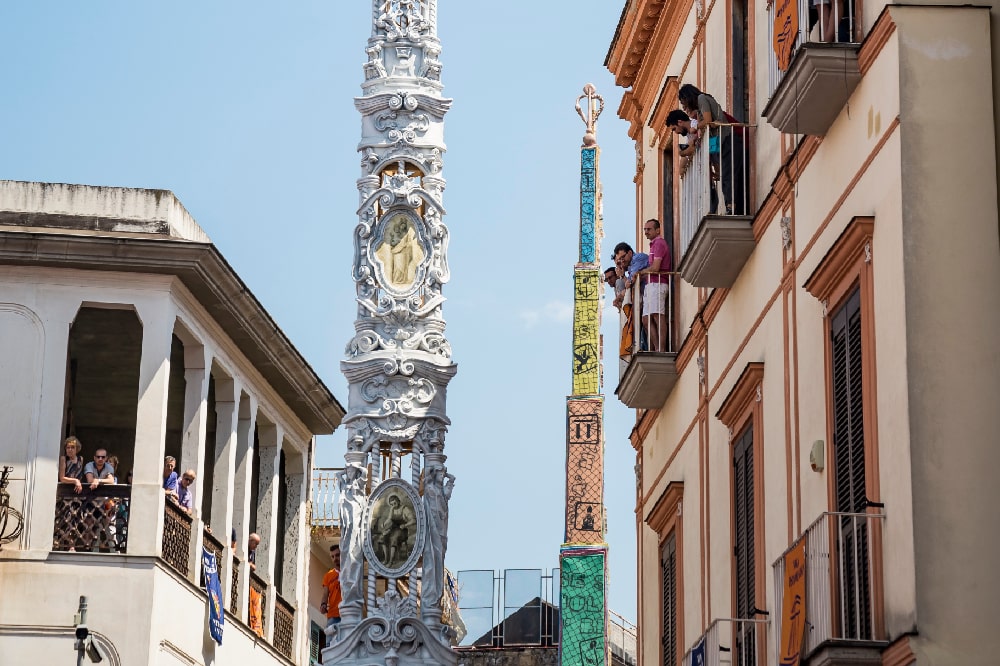
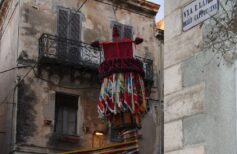
Returning to Nola and the Festival of the Lilies, the event takes its name from the “Gigli” – the processionalstructures – a testament to an ancient and extraordinary art, known precisely as the Lilies of Nola. These are imposing, dancing obelisks made of wood, clay, and brightly coloured papier-mâché, towering over twenty metres high, and carried by groups of bearers.
These bearers, with surprising strength and skill, transport the obelisks through the streets of the town, giving life to a truly unique spectacle.
A selection of processional canopies in different styles and models.
The Festival of the Lilies in Nola is a manifestation of religious devotion that has its roots in the city’s ancient history. The Lilies of Nola represent a symbol of faith and unity for the local community, which participates with enthusiasm in the construction of the structures and the organisation of the event. This unique and fascinating tradition continues to attract visitors from around the world, captivated by its beauty and deep spirituality.
When did the Festival of the Lilies in Nola begin?
The Festival of the Lilies in Nola is a traditional celebration that has ancient origins. It is believed that the Lilies originate from the “majo” tree – a large tree symbolising fertility used in ancient pagan rites before the advent of Christianity.
The Festival of the Lilies, as we know it today, is deeply felt and firmly rooted in the culture of the city of Nola. Its origins date back to 410 AD, when Nola was invaded by the Vandals. The city was plundered and many of its inhabitants were captured and deported as slaves. Among them was the then bishop of Nola, Pontius Meropius Anicius Paolino.
With the Festival of the Lilies, Nola commemorates its liberation, honouring the saint and parading the Lilies created in his memory. This is how the Festival of the Lily – or of the Lilies – was born.
What are the Lilies of Nola?
The Lilies of Nola are enormous wooden structures representing towers in the shape of lilies. They are carefully and skilfully built by local craftsmen, who dedicate several months to their construction.
Each Lily is approximately 25 metres tall and weighs several tonnes. Made of papier-mâché and clay, they are constructed around the “borda”, a central beam that supports all structural elements and ensures maximum stability. The structure consists of a robust wooden frame, and the papier-mâché is painted and decorated with flowers, ribbons, and religious symbols.
There are eight Lilies of Nola, named after the ancient guilds of arts and crafts: Greengrocer, Delicatessen Seller, Wine Vendor, Baker, Boat, Butcher, Shoemaker, Blacksmith, and Tailor.
The construction of the Lilies of Nola involves the entire community. Each neighbourhood in the town has its own Lily, and residents come together to work on its preparation. It is a time of great unity and sharing, where artistic and manual skills are passed down from generation to generation.
The Festival of the Lilies begins with a solemn procession through the streets of Nola, led by the principal Lily, dedicated to Saint Paolino.
The wooden tower is carried on the shoulders of the bearers, called “cullatori” – a name derived from the rocking motion they make as they move, similar to cradling. The collective of cullatori who take turns bearing the tower throughout the route is called a “paranza”, each made up of 128 “paranzari”, who must demonstrate great strength and skill in carrying the Lily.
The cullatori lift and manoeuvre the Lilies using special wooden beams known as “varre” and “varretielli”.
Fiberglass statues. Religious statues entirely made in Italy and hand-painted with oil colours
The procession is accompanied by a brass band and traditional songs. The streets of Nola fill with spectators and worshippers who witness the grandeur of the Lilies and take part in the religious devotion.
The festival continues throughout the day, with prayers, celebrations, and communal moments.
In addition to the eight Lilies, the “Boat” is also carried in procession – another magnificent scenic structure that commemorates Saint Paolino’s return to Nola by sea.
The story of Saint Paolino of Nola
Saint Paolino of Nola, born Meropius, came into the world in Bordeaux, France, in the 4th century. He was a bishop and Christian saint, known for his great generosity and dedication to the most needy.
He not only gave away all his possessions to ransom the inhabitants of Nola who had been taken prisoner by the barbarians and to support families fallen into hardship, but he also offered himself as a prisoner to free the son of a widow who had been sent to Africa as a slave to the king’s court.
There, Paolino pretended to be a gardener and managed to win everyone’s favour – even the king’s – thanks to his kind heart and prophetic abilities.
When the king discovered that his gardener was in fact a bishop, he immediately released him – along with all the prisoners from Nola.
The townspeople welcomed the bishop and the freed captives with joy and gave Paolino a lily as a symbol of their happiness. For this reason, every year the city of Nola renews its devotion to Saint Paolino through the Festival of the Lilies, bearing witness to the deep faith and unbreakable bond between the people of Nola and their patron saint.
For five hundred years, the Swiss Guards have protected the Pope's security and watched over the Vatican. Here is who...
23 September 2026
What’s the Future of Religion?
What’s the Future of Religion?
A Beginner’s Guide to Christianity
A Beginner’s Guide to Christianity
Mind-Blowing Statistics About Christianity You Need to Know
Mind-Blowing Statistics About Christianity You Need to Know
9213
Enter the Holyart world: $20 discount voucher valid on over 60,000 items
Come and discover Holyart, the largest e-commerce of religious articles in Europe and immediately receive a $20 voucher to use with your first purchase.
Check your mailbox: you will receive your discount within 5 minutes