When speaking of Eucharistic Adoration, we are touching on an extremely delicate and important subject. In a previous article, we attempted to understand how it might be explained to children, but at times even adults need a bit of clarity.
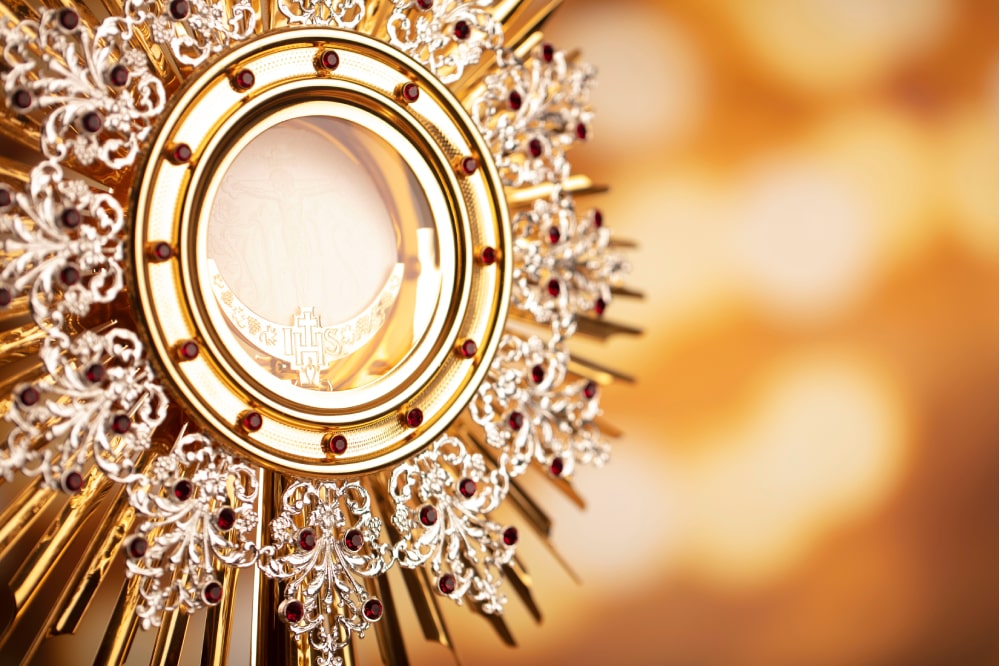
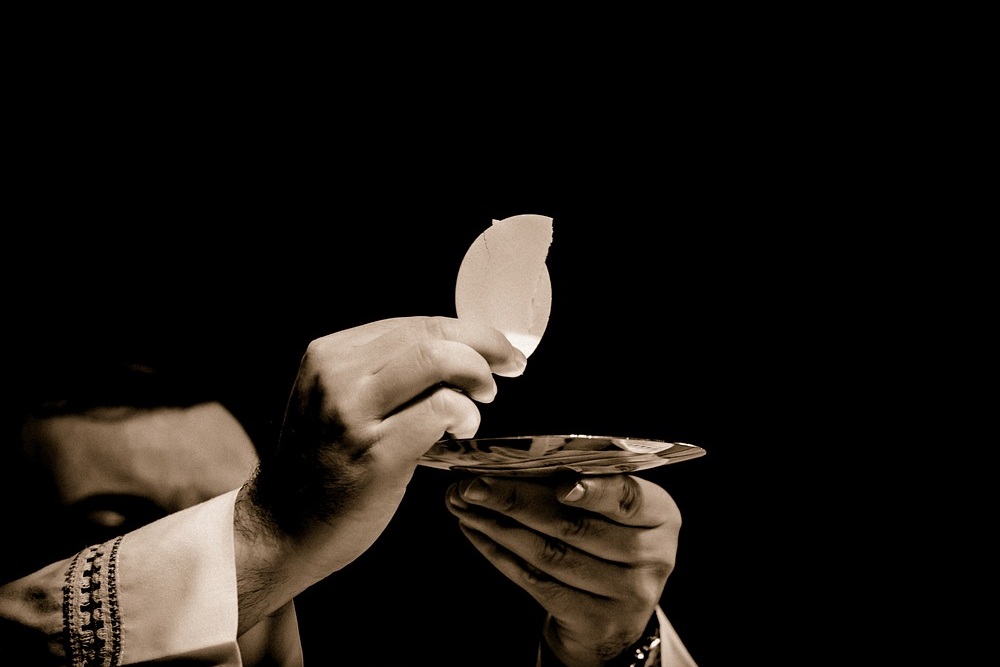
First of all, let us say that Eucharistic Adoration is an act of devotion and veneration towards the Blessed Sacrament, which represents the body and blood of Jesus Christ. We are, of course, referring to the Eucharist—the bread and wine offered to the faithful during the celebration of Mass and then kept in the Tabernacle. Eucharistic Adoration consists in paying homage to Jesus through the Eucharist, by praying and meditating before the monstrance, where the consecrated host is exposed.
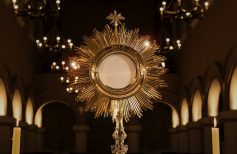
Monstrances, chapel monstrance, reliquaries and thabors of different manufacture
But how do we adore the Eucharist? What does it mean to adore? Adoration refers to the act of praying, exalting, praising, and honouring God. In the desert, Satan asked Jesus to adore him as He adored God, offering Him all the kingdoms and power of the world in return. But adoration belongs to God alone; it is the only form of worship that may be directed exclusively to Him, unlike veneration, which is also directed towards saints and sacred images.
Adoration lies at the heart of religion itself, the core of each believer’s relationship with their Father and Creator, the origin and ultimate goal of our existence. To adore is to enter into a deep relationship with God. In Heaven, adoring is what the angels, saints, and the blessed do constantly, their gaze always turned towards Him. This is why we must think that each time we practise Eucharistic Adoration, we bring a little piece of Heaven to earth—we unite spiritually with Heaven.
Read more:
Eucharistic adoration for children
Eucharistic adoration for children is a delicate and important matter. Let’s see how we should introduce them to…
The exposition of the Eucharist during Eucharistic Adoration carries profound meaning. By recognising the real presence of Christ in the consecrated Host, the faithful gather to adore and honour the Saviour. The solemn exposition of the Eucharist allows believers to contemplate the mystery of the Incarnation and to direct their prayers to the Sacramental Jesus.
The practice of Eucharistic Adoration originated in monasteries, particularly those of a cloistered nature. Its official beginning dates back to 11 September 1226 in Avignon, France. On that occasion, it was decided to give thanks to God for victories achieved against the Cathars, considered heretics and a dangerous threat. It was King Louis VII of France who proposed that the Eucharist be exposed in the Cathedral of the Holy Cross in Orléans, as a sign of gratitude and devotion. This event marked the beginning of a practice that spread rapidly throughout various parts of the Catholic world. In the following years, the practice became widespread, although monasteries continued to be the privileged places for Eucharistic Adoration, with monks and nuns dedicating themselves to prolonged hours of silent worship.
Eucharistic Adoration can be practised in various contexts and at different times. One of the most significant events during which Eucharistic Adoration is celebrated is the feast of Corpus Christi, which is held in June. During this feast, the Catholic Church celebrates the real presence of Jesus Christ in the Eucharist and His sacrifice for the salvation of humanity.
Another special form of Eucharistic Adoration is the Forty Hours’ Devotion. This religious practice usually takes place during the Lentenperiod and involves adoring the Blessed Sacramentfor forty consecutive hours, in a continuous act of love and reverence towards Christ’s presence in the Eucharist.
In some places, Eucharistic Adoration is practised continuously and perpetually. This form of adoration, called Perpetual Eucharistic Adoration, takes place in churches or dedicated sanctuaries, where the faithful take turns in Eucharistic prayer to ensure that adoration continues day and night.
During Eucharistic Adoration, the faithful may recite specific prayers addressed to the Sacramental Jesus. Moreover, Eucharistic Adoration can be dedicated to specific intentions or themes, such as Eucharistic Adoration for peace or Marian Eucharistic Adoration.
In conclusion, Eucharistic Adoration represents a privileged moment for Catholic believers to venerate and adore Jesus present in the Eucharist. It is a profound spiritual experience that offers a more intimate connection with the divine and nurtures the faith and devotion of the faithful.
Eucharistic Adoration During Corpus Christi
The solemnity of Corpus Christi, also known as the Feast of the Body of Christ, is a Catholic liturgical celebration that honours the real presence of Jesus Christ in the Eucharist. This feast, which falls on the Thursday of the second week after Pentecost—that is, the Thursday after the solemnity of the Most Holy Trinity—is a special occasion on which the Catholic Church exalts and adores the Blessed Sacrament.
During Corpus Christi, Eucharistic Adoration plays a central role. The faithful gather in church to pay homage and adore the body and blood of Christ present in the Eucharist. The monstrance, which contains the consecrated host, is solemnly exposed for the adoration of the faithful. This symbolic gesture represents the recognition of the real presence of Jesus in the Eucharistic form, the invitation to contemplate His infinite love for humanity, and the opportunity to enter into an intimate dialogue with the Sacramental Jesus, offering Him their praises, petitions, and intentions. It is a moment when believers can express their gratitude for the gift of the Eucharist and renew their faith and commitment to Christ.
Monstrance in two-tone brass 70 cm baroque.Catholic monstrance, 70 cm in brass, made by skilled Italian craftsmen
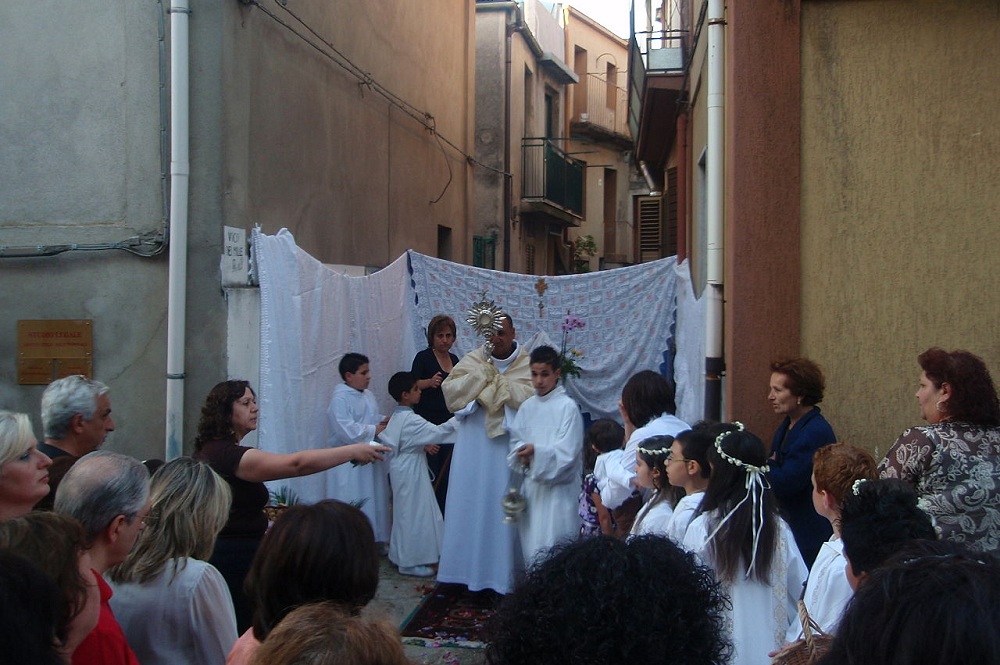
During Eucharistic Adoration on Corpus Christi, specific prayers linked to the Eucharist are recited. Eucharistic prayers also recall the communal dimension of the celebration, emphasising the importance of communion among the faithful and their union with Christ. Hymns and sacred chants are also sung. In many cities, Corpus Christi is marked by solemn processionsduring which the Blessed Sacrament is carried through the streets.
Forty Hours’ Devotion
The Forty Hours’ Devotion is an ancient religious practice that offers Catholic believers a prolonged period of adoration of the Blessed Sacrament. Over forty consecutive hours—recalling the time between Christ’s death (Good Friday) and His resurrection (Easter Sunday)—the faithful take turns praying before the exposed Eucharist, thereby creating an uninterrupted flow of devotion and worship. The Blessed Sacrament remains visible throughout the entire period in the monstrance solemnly displayed on the altar.
This lamp has a cable with a European plug for 220V current.
This particular form of adoration is usually carried out during Lent, which represents a time of spiritual preparation and reflection in view of Easter. During the Forty Hours’ Devotion, the faithful may engage in various acts of prayer. These may include the recitation of the Holy Rosary, reading of Scripture, silent meditation, personal prayer, and the offering of praise and thanksgiving to God.
Perpetual Eucharistic Adoration
Perpetual Eucharistic Adoration also provides a place of spiritual refuge for those seeking a moment of silence and communion with God in His Eucharistic presence. It is a special form of adoration of the Blessed Sacrament that takes place continuously and without interruption. In a dedicated church or sanctuary, the faithful organise themselves in shifts of prayer to ensure that Eucharistic Adoration continues day and night, without pause.
The history of the Church records numerous episodes in which the Blessed Sacrament has been, or still is, perpetually exposed. A significant example is found in Latin America, where the community of the Missionaries of Our Lady of the Blessed Sacrament embraced an initiative proposed years ago by Pope John Paul II: to establish a space dedicated to the Perpetual Adoration of the Blessed Sacrament, allowing uninterrupted visits day and night. Currently, there are already 950 such spaces for Perpetual Adoration in various locations across Latin America, and many people bear witness to the effectiveness of this mode of prayer.
In France, we find another example of Perpetual Adoration in the Benedictine Church of Mother Mectilde of the Blessed Sacrament, founded with the specific aim of promoting this form of continuous adoration.
In the United States, the Franciscan Sisters of Perpetual Adoration have prayed in this manner for over 128 years, starting at 11:00 a.m. on 1 August 1878. This religious community has dedicated itself to the perpetual adoration of the Blessed Sacrament, thus bearing witness to their profound faith and devotion to the real presence of Christ in the Eucharist.
A Classic glass globe for the Sanctuary Light made of precious hand-blown ruby glass-colored paste.
Prayers for Eucharistic Adoration
Eucharistic Adoration is a privileged moment to draw near to the Sacramental Jesus, to offer our prayers to Him, and to establish an intimate dialogue with the Saviour. Prayers for Eucharistic Adoration can be varied and personal, but there are some traditional and commonly recited prayers during this time of spiritual intimacy. Here is one:
Prayer to the Sacramental Jesus
My Jesus Christ, Son of the living God, here I am in the company of the Blessed Virgin, of the Angels, of the Saints in Heaven, and of the righteous on Earth, to visit and adore You in this Consecrated Host. I firmly believe that You are present, powerful, and glorious just as You are in Heaven, and through Your merits I hope to attain eternal glory, following always Your divine inspirations. As a sign of gratitude for Your divine love, I wish to love You with all my heart and soul, with all my faculties and senses. I beg You, Saviour of my soul, by the precious Blood You shed at Your circumcision and during Your Most Holy Passion, to exercise upon me Your office as Saviour, granting me, through the intercession of Your Most Holy Mother, the gifts of prayer along with perseverance, so that when I leave this life, You may guide me to the eternal glory which You enjoy in Heaven. Amen.
For five hundred years, the Swiss Guards have protected the Pope's security and watched over the Vatican. Here is who...
23 September 2026
What’s the Future of Religion?
What’s the Future of Religion?
A Beginner’s Guide to Christianity
A Beginner’s Guide to Christianity
Mind-Blowing Statistics About Christianity You Need to Know
Mind-Blowing Statistics About Christianity You Need to Know
9219
Enter the Holyart world: $20 discount voucher valid on over 60,000 items
Come and discover Holyart, the largest e-commerce of religious articles in Europe and immediately receive a $20 voucher to use with your first purchase.
Check your mailbox: you will receive your discount within 5 minutes