Homepage | Religion | The Franciscan Rosary: a prayer full of joy
The Franciscan Rosary: a prayer full of joy
17 June 2026
Reading Time: 5minutes
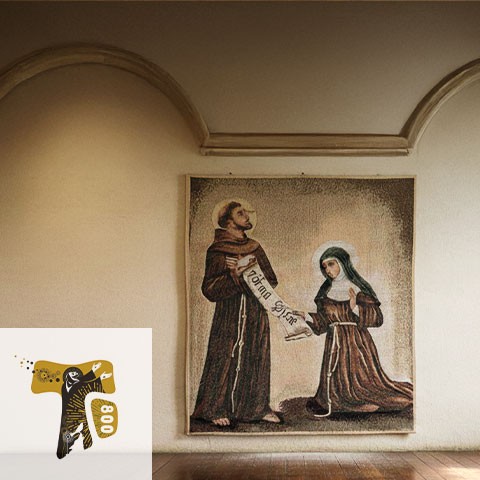
As in every aspect of existence, Saint Francis preached joy and gladness even in prayer. Here is the Franciscan Rosary, the meditation on the Seven Joys of the Virgin Mary.
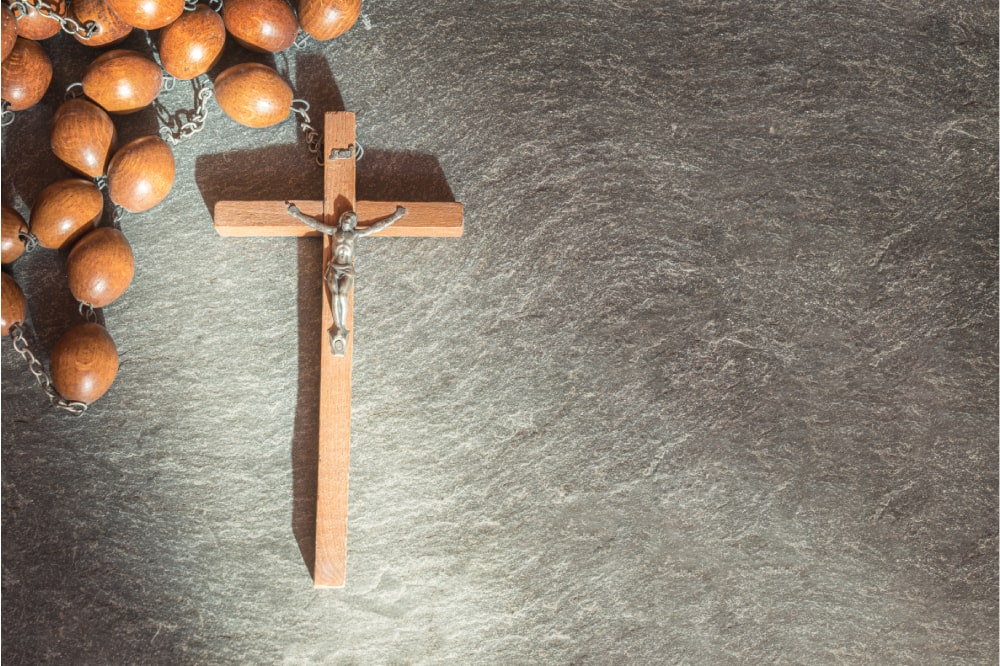
The Franciscan Rosary is a form of Catholic prayer imbued with deep Franciscan spirituality, which fully expresses the most intimate connection with the life of Jesus Christ and the desire to follow in His footsteps. In this it perfectly embodies the spirit of Saint Francis, who made following the model of Christ his life’s mission, as well as the starting point for his reform of the Church and the heart of the Franciscan Order he founded. This chaplet began to be used by the Franciscans in the fifteenth century. Composed of 70 beads, it contains seven Mysteries, each linked to an important and joyful moment in the history of Jesus and the Virgin Mary. Hence the names Rosary of the Seven Joys of the Virgin Mary and Franciscan Crown of the Seven Joys.
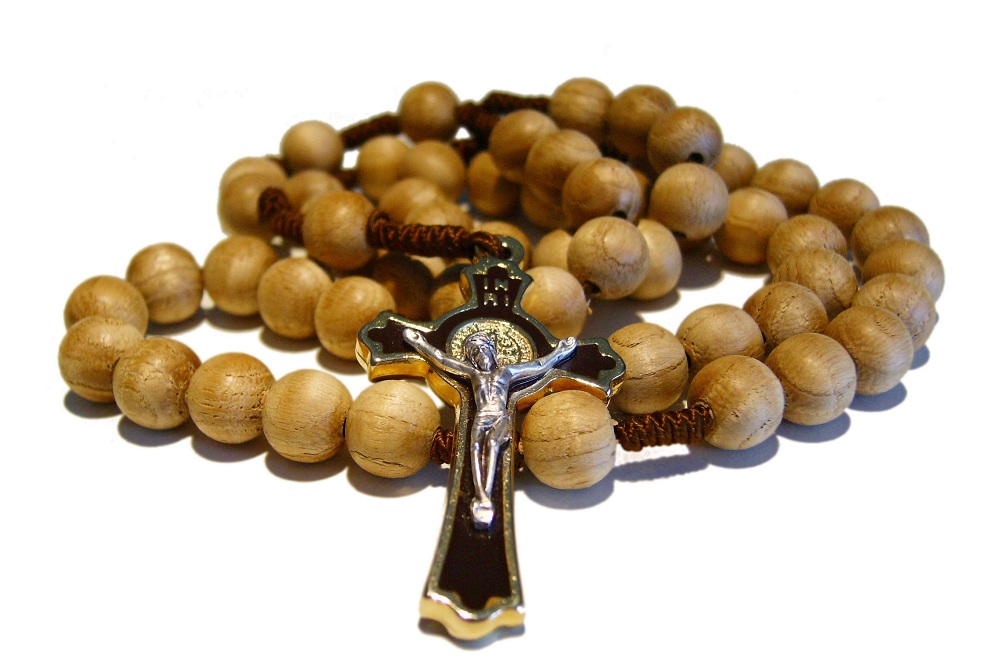
The Franciscan Rosary is often made with simple materials, such as untreated wood and cord. This choice of materials is in keeping with Franciscan humility and simplicity, also symbolised by the Franciscan cross, the TAU, characterised by arms of equal length that embrace every creature with universal love.
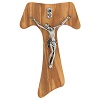
Olive wood tau and body of Christ in silvery metal. This Tau cross is made in Italy and it is suitable for wall hanging.
How the devotion of the Franciscan Rosary originated
The origin of the Franciscan Rosary is, as often happens, a story halfway between legend and devotion. The Virgin Mary is said to have appeared to a young Franciscan novice, James. The boy, devoted to Our Lady since childhood, was saddened because the commitments linked to his new life in the Order prevented him from honouring her every day with a crown of roses, as was his custom. The Virgin appeared to him, consoling him and recommending that he offer her a new crown each day, but of a different kind. She was referring to the Franciscan Rosary, namely seven decades dedicated to the great joys in Mary’s life. The boy accepted that request, shared it with his companions, and soon the practice of the Franciscan Rosary spread throughout the Order.
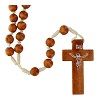
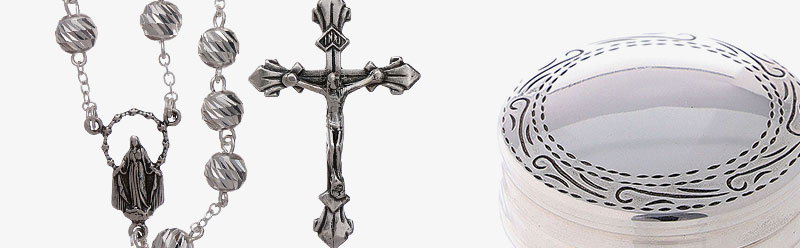
Franciscan rosary mounted on as tring, round-shaped beads of 9mm.
The Rosary of the Seven Joys of the Virgin Mary
One of the most fascinating aspects of this Franciscan chaplet is precisely that its seven decades call for meditation on seven joyful events in the life of Our Lady, rather than, as more often happened previously in such devotional forms, on her Seven Sorrows. Moreover, joy and gladness were qualities that Saint Francis recommended to his companions, even in the face of the most terrible adversities and tribulations. The Saint of Assisi maintained, in fact, that joy, “perfect joy”, was one of the most powerful weapons against the Devil, who would more easily enter hearts oppressed by sadness and would flee from those who show joy and cheerfulness. However, this does not mean ignoring pain and suffering—quite the opposite. Perfect joy arises precisely from the inner joy and deep peace that can be attained only by those who have experienced and profoundly understood suffering and human hardship, learning to reinterpret them in the light of divine love. “Perfect joy” lies precisely in the ability to endure difficulties and injustices with patience and cheerfulness. Franciscan friars have always been great supporters of this “perfect joy”, and for this reason their Rosary, instead of retracing Mary’s Sorrows, encourages the faithful to meditate on the seven joyful mysteries.
Read more:
The cult of Our Lady of Sorrows
Our Lady of Sorrows is a name attributed to Mary, mother of Jesus. This is how secular devotion to Mater Dolorosa was born…
The mysteries of the Franciscan Rosary, linked to the most joyful moments in Mary’s life, are:
The Annunciation: This mystery celebrates the announcement of the Archangel Gabriel to Mary, informing her of the birth of Jesus.
Here is how to recite the Franciscan Rosary. It begins with the sign of the cross and the invocation of the Father, the Son and the Holy Spirit. Then the faithful announce the First Joy, followed by one Our Father, ten Hail Marys and one Glory Be. The same sequence is repeated for each joy, seven times in total, one decade of beads for each joy of Mary.
At the end of the Crown, a special prayer dedicated to Our Lady is recited:
O Holy Lady, Most Holy Queen, Mother of God and Mother of Mercy, Queen of Peace and our Advocate, we have offered you this Crown in memory of your seven joys, as a sign of our desire to belong to you as you belonged to the Lord. Therefore, with Saint Bonaventure we say to you: “I am all yours, and all that I have is yours, O Virgin blessed above all things.” Intercede that we may be granted the grace to serve God and our neighbour, and in fidelity to the promises of our Baptism, to renounce evil in all its forms, so that we may be like you, O Immaculate One, children of the heavenly Father, brothers of our Lord Jesus Christ and dwelling places of the Holy Spirit. Help us to live by committing our lives to the Gospel, obeying the Church, always ready to bear witness to our faith before others, so that, protected by you, especially at the hour of our death, we may come with you into the glory of heaven. Amen.
Two additional Hail Marys recall the 72 years of Mary’s life before ascending into Heaven.
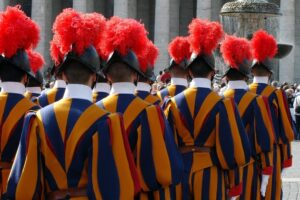
For five hundred years, the Swiss Guards have protected the Pope's security and watched over the Vatican. Here is who...
23 September 2026
What’s the Future of Religion?
What’s the Future of Religion?
A Beginner’s Guide to Christianity
A Beginner’s Guide to Christianity
Mind-Blowing Statistics About Christianity You Need to Know
Mind-Blowing Statistics About Christianity You Need to Know
9226
Enter the Holyart world: $20 discount voucher valid on over 60,000 items
Come and discover Holyart, the largest e-commerce of religious articles in Europe and immediately receive a $20 voucher to use with your first purchase.
Check your mailbox: you will receive your discount within 5 minutes