Homepage | Religion | Ascension of the Lord: the meaning of the feast
Ascension of the Lord: the meaning of the feast
8 June 2026
Reading Time: 6minutes
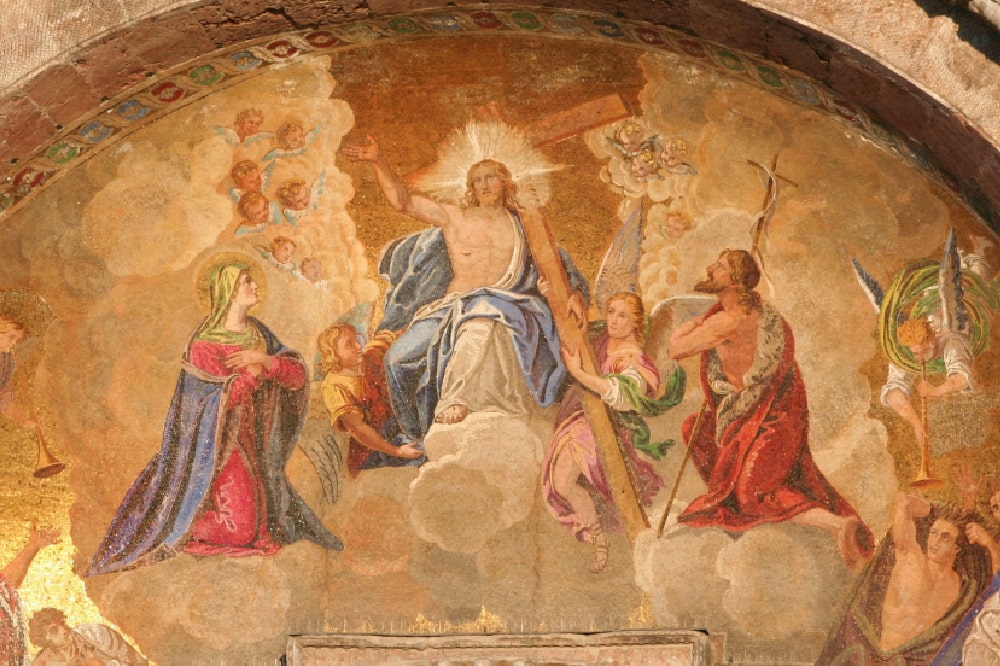
The Ascension of the Lord represents the moment when Jesus departs from the Earth and from His disciples, leaving His human form to ascend to Heaven. This is why it is so important.
Forty days after Easter, the Catholic Church celebrates the Ascension of Jesus into Heaven, which commemorates Christ’s ascent to Heaven and the end of His time in the world. It is one of the Catholic holy days of obligation, that is, one of the days on which, according to Canon Law, “the faithful are obliged to participate in the Mass; moreover, they are to abstain from those works and affairs which hinder the worship to be rendered to God and the joy proper to the Lord’s Day, or the due relaxation of mind and body.” (Code of Canon Law, can. 1247)
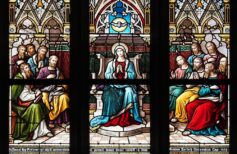
You can find many Pentecost products on Holyart.it.
This feast, which is also the penultimate one of the Easter season (the last being Pentecost, celebrated fifty days after Easter), is properly called the Ascension of the Lord, *Ascensio Domini nostri Jesu Christi*. Although the Ascension is liturgically set on the Thursday after the fifth Sunday after Easter, the Catholic Church allows the celebration to be postponed to the following Sunday, also because until 1977 in Italy it was a public holiday.
Throughout its long liturgical history, the Ascension of Christ has seen many popular devotional traditions intertwined with its solemnity and profound religious meaning. The Ascension is recalled in the Via Lucis, the Catholic liturgical–devotional rite that remembers and celebrates the events of the life of Christ and of the early Church from the Resurrection of Jesus to Pentecost, of which the Ascension represents the twelfth station, and in the glorious mysteries of the Holy Rosary.
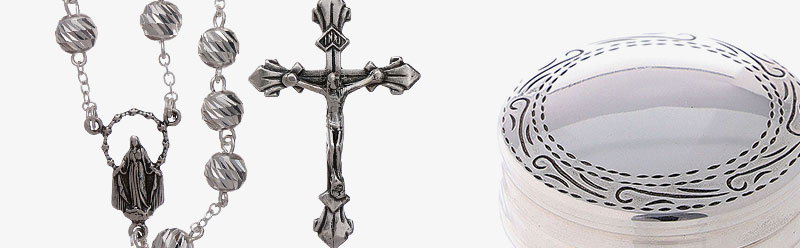
Rosary beads and rosary cases: here you will find a wide selection of rosary beads.
The liturgy of the solemnity of the Ascension of the Lord opens with the introit *Viri Galilaei*, which recurs several times during the celebration. It is composed in the seventh mode, the *tetrardus authenticus* (Gregorian chant is based on a tonal system consisting of eight tones, or ecclesiastical modes), defined as angelic and used to describe flights and outbursts of joy.
“Viri Galilæi,
quid admirámini aspiciéntes in cælum?
Quemádmodum vidístis eum
ascendéntem in cælum, ita véniet,
alléluia.”
“Men of Galilee,
why do you stand looking up into heaven?
As you saw Him ascend into heaven,
so the Lord will return.”
Alleluia
(Acts 1:11)
The Orthodox Church also celebrates the Ascension, which is one of the twelve Great Feasts, while for the Lutheran Church it is one of the principal feasts of the calendar of saints.
What does the Ascension of the Lord mean?
The Ascensionrepresents a fundamental moment for the Christian religion and for the figure of Jesus Christ in particular. It is the moment when He ceases to be Jesus the Man—preacher, worker of miracles, friend of the Apostles and their companion in life. At the moment when He rises and ascends to Heaven, to take the place that is rightfully His at the right hand of the Father, He continues to remain close to His disciples and to all people, but in a completely new way. Jesus is no longer on Earth, no longer part of human affairs, but He will return for the Final Judgement, His Second Coming: the Parousia.
This bas-relief is hand made by the nuns of the Atelier d’Art de Bethléem, in France.
With the Ascension, the appearances of Jesus after the Resurrection also cease, and the ultimate meaning of the Resurrection itself is proclaimed, which is not only of the flesh: whoever is saved, at the end of time, will ascend to Heaven.
The origins of the feast of the Ascension
The origins of this feast are ancient. It is described in the Gospels of Mark and Luke and in the Acts of the Apostles:
19 So then the Lord Jesus, after He had spoken to them, was taken up into heaven and sat at the right hand of God. 20 And they went out and preached everywhere, while the Lord worked with them and confirmed the word by the signs that accompanied it. (Mark 16:19–20)
At that time, Jesus said to His disciples: “Thus it is written, that the Christ should suffer and rise from the dead on the third day, and that repentance and forgiveness of sins should be preached in His name to all nations, beginning from Jerusalem. You are witnesses of these things. And behold, I am sending upon you what My Father promised; but stay in the city until you are clothed with power from on high.” Then He led them out as far as Bethany, and lifting up His hands He blessed them. While He blessed them, He parted from them and was carried up into heaven. And they worshipped Him and returned to Jerusalem with great joy, and were continually in the temple blessing God. (Luke 24:46–53)
6 So when they had come together, they asked Him, “Lord, will You at this time restore the kingdom to Israel?” 7 He said to them, “It is not for you to know times or seasons that the Father has fixed by His own authority. 8 But you will receive power when the Holy Spirit has come upon you; and you will be My witnesses in Jerusalem and in all Judea and Samaria, and to the ends of the earth.” 9 And when He had said these things, as they were looking on, He was lifted up, and a cloud took Him out of their sight. 10 And while they were gazing into heaven as He went, behold, two men stood by them in white robes, 11 and said, “Men of Galilee, why do you stand looking into heaven? This Jesus, who has been taken up from you into heaven, will come in the same way as you saw Him go into heaven.” (Acts 1:6–11)
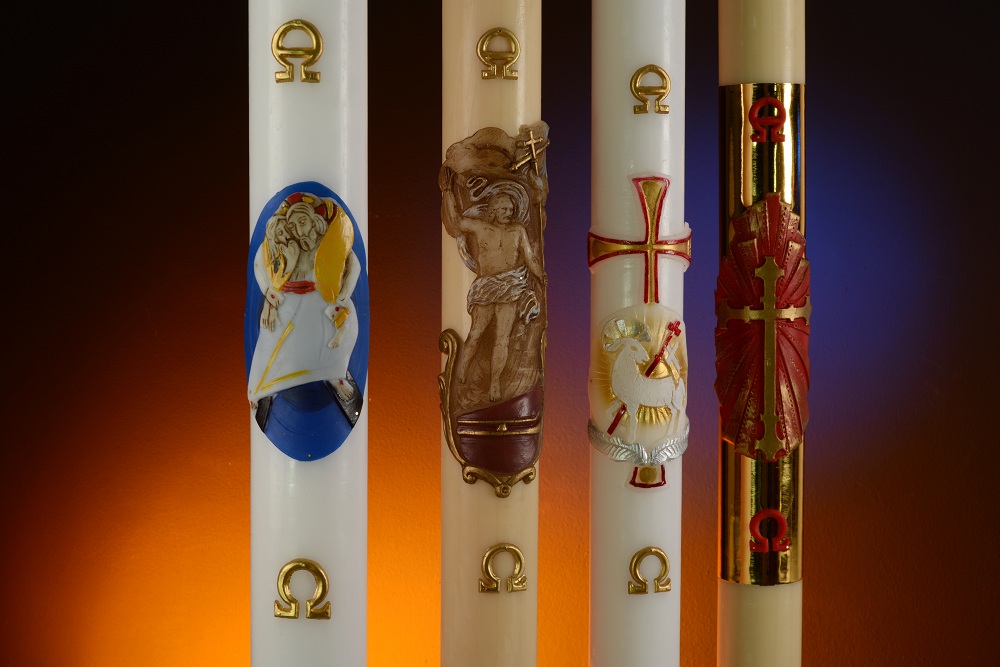
Saint Augustine spoke of the *Ascensio Domini in coelum* as a practice established by the Apostles themselves or shortly thereafter, and in his time already widespread “toto terrarum orbe”, throughout the known world. It is likely that in the past this feast coincided with that of Pentecost, and that the two events were commemorated together. The first evidence of the celebration of the Ascension in Rome forty days after Easter dates back to Pope Leo the Great (440–461 AD). It was Pius V (1566), however, who established on this occasion the removal of the Paschal candle lit at the beginning of the solemn Easter Vigil, which in the past was extinguished on Low Sunday, the Sunday that closes the Octave of Easter. Today, instead, the Paschal candle remains lit near the ambo until Pentecost.
The Ascension and Pentecost therefore represent the end of the Easter season, both on a temporal-chronological level and on a symbolic one. For the disciples of Jesus, they represent a continuum of preparation: from the Ascension onwards they begin to prepare for the mission that Christ will entrust to them through the Holy Spirit at Pentecost.
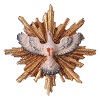
Holy Spirit with halo and pouch 5,5 cm in wood Valgardena
We have seen how the Ascension has been celebrated everywhere since the fourth century, forty days after Easter. Pentecost, on the other hand, celebrates the descent of the Holy Spirit, the third person of the Holy Trinity, which took place after the Resurrection of Jesus and in a certain sense represents the very birth of the Church. At first, it was a solemn Eastern feast in honour of the Holy Spirit and included the period of fifty days after Easter. It lasted eight days, during which Baptism was administered. Only between the eighth and ninth centuries did it begin to be celebrated in the West as well. Until 1969, Pentecost continued to be celebrated for eight days, although the feast days were gradually reduced. Monday was abolished at the beginning of the twentieth century.
The fragrances of Padre Pio represent just one of the most evocative aspects of the veneration surrounding this unique Saint....
26 August 2026
What’s the Future of Religion?
What’s the Future of Religion?
A Beginner’s Guide to Christianity
A Beginner’s Guide to Christianity
Mind-Blowing Statistics About Christianity You Need to Know
Mind-Blowing Statistics About Christianity You Need to Know
9206
Enter the Holyart world: $20 discount voucher valid on over 60,000 items
Come and discover Holyart, the largest e-commerce of religious articles in Europe and immediately receive a $20 voucher to use with your first purchase.
Check your mailbox: you will receive your discount within 5 minutes