Author: Redazione

What Saint Malachy’s Prophecy Says About the Popes

What Saint Malachy’s Prophecy Says About the Popes

Contents1 Who Was Saint Malachy2 Malachy’s Prophecy3 Prophecy About the Last Pope Saint Malachy’s Prophecy on the End of the Papacy: Between Vision and Deception, Faith and Unease In an age where the world seems to be rushing ever faster towards an uncertain future, ancient…
How a Pope is Elected: The Role of the Conclave and the Secrets of the Rite

How a Pope is Elected: The Role of the Conclave and the Secrets of the Rite

Contents1 Who Elects the Pope2 The Rules of the Conclave3 Black Smoke or White4 Habemus Papam How a Pope is Elected. History, Tradition and Mystery of an Ancient Rite: the Conclave When the papal throne becomes vacant, the Catholic Church prepares to experience one of…

What Happens When a Pope Dies: All the Stages from Death to the Election of His Successor

What Happens When a Pope Dies: All the Stages from Death to the Election of His Successor

The Death of a Pope: What Really Happens Between His Passing and the Election of the Next Pontiff

The death of a Pope is never a common event. It never has been, in the two thousand years of the Church’s history.
When a Pontiff dies, it’s not just the end of a man—it marks the close of an entire spiritual, pastoral, political, and human era. A voice that has guided millions of faithful, that has prayed, spoken, suffered, and forgiven, falls silent. One door closes, but another opens—a suspended, sacred, and solemn time known as the Sede Vacante (“Vacant See”). The bells toll not only in mourning; they also ring to remind the world that the Church is now orphaned. But it is not lost. Every gesture, every step, every word is already written in a millennia-old liturgy that guides the transition from one pontificate to the next. Everything has its order, its timing, its meaning. Even silence.
Time stands still for a moment, but the millennial engine of the Church does not stop. It sets into motion a sequence of ancient gestures, solemn symbols, and crucial decisions.
Behind the Vatican walls, a ritual machine begins to move—full of secrets and symbols, intertwining spirituality with history, grief with responsibility. From the first moment the Pope’s death is confirmed until the announcement of the new pontiff with the famous Habemus Papam, the Church embarks on a journey that blends the human and the divine, mourning and hope.

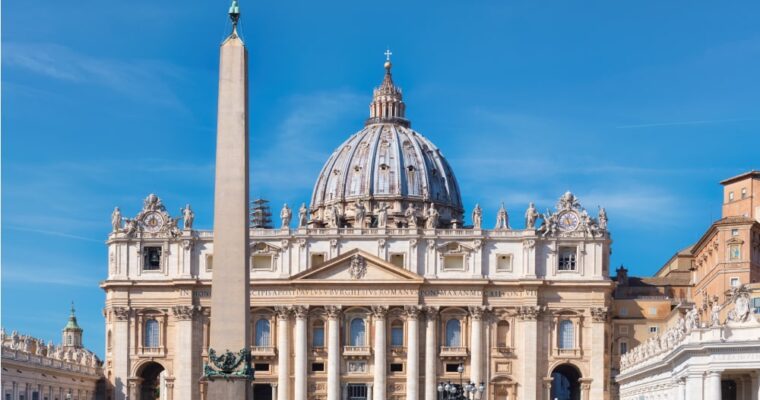
Saint Peter in the Vatican: Church symbol of the whole Christian world

Read more:

How Pope Francis transformed the Church during his pontificate
What did Pope Francis do that was important? His pontificate was…

But what exactly happens between the death of a Pope and the election of his successor? Who holds power? Who guards the silence? And who decides when it’s time to turn the page?

Here are all the phases, step by step—each marked by a ritual that combines faith, mourning, and responsibility.


The Role of the Camerlengo

In the heart of the Vatican, the moment the Pope closes his eyes to the world, one man approaches his bedside: the Camerlengo, custodian of the transition between one pontificate and the next.
An ancient title that sounds like it came from a medieval novel, yet it still carries one of the most delicate and symbolic responsibilities in the Catholic Church.

The Camerlengo—currently Cardinal Kevin Joseph Farrell—is the guardian of the “in-between time”, when the Church is without a leader, but not without order.
His duty begins with a gesture full of meaning: officially certifying the Pope’s death. In the past, this was done by calling the Pope’s name three times and solemnly declaring in Latin “Vere Papa mortuus est.” Today, confirmation is entrusted to a physician, but the solemnity remains unchanged.

Once the death is confirmed, the Camerlengo symbolically enters the sphere of power. He seals the papal apartments, halts all official Vatican communications, and assumes control of the vacant Apostolic See. But his authority is most visibly expressed through one specific object: the Fisherman’s Ring (Anulus Piscatoris), the Pope’s personal seal, worn on the ring finger of his right hand. It bears the Pope’s name and an image of Saint Peter fishing—symbol of his mission as a “fisher of men.”

The fisherman’s ring and the rite that marks the beginning of the pontificate

Read more:

The fisherman’s ring and the rite that marks the beginning of the pontificate
The Fisherman’s ring is one of the oldest traditions related to…

Upon the Pope’s death, the ring must be destroyed or rendered unusable. The Camerlengo, in the presence of cardinals, carries out this ritual—either by breaking it or engraving two crossed lines upon it—ensuring no one can forge documents or claim authority in the late pontiff’s name.
A simple yet powerful act. It says: “This pontificate is over. No one can speak in his name anymore.”

But what breaks is not just an object. It is the tangible end of an era—etched in metal. A closure that opens the way for a new beginning. From that moment, the world knows the Church is preparing to turn the page, while the Camerlengo, silent and watchful, guards the waiting.

Following the Pope’s death and the Camerlengo’s formal assumption of his role, he is not left alone. Through the wisdom of centuries, the Church has ensured that every stage is monitored by multiple eyes, hearts, and consciences.
Thus, among the cardinals already gathered in the Vatican for the upcoming Conclave, three assistants are chosen by lot: one bishop, one priest, and one deacon—one for each ecclesiastical order. Together with the Camerlengo, they form the so-called Particular Congregation, a small committee tasked with helping him in day-to-day decisions and overseeing the Church’s routine administration during the Sede Vacante. This ensures balance and transparency during the time when the Chair of Peter is empty and the entire Church is waiting.

Consistory of Cardinals: What It Is and How It Works

Read more:

Consistory of Cardinals: What It Is and How It Works
The Consistory is a gathering of cardinals around the Pope to make important decisions. But how…


The Pope’s Funeral

When a Pope dies, it is not only the Church’s voice that speaks—its gestures and ritual silences also speak volumes. One of the most eloquent moments unfolds before millions of eyes, yet in a deeply intimate atmosphere.
In the heart of St. Peter’s Square, the large bronze door leading to the Vatican Curia offices is half-closed. One side open, the other shut. Not a mistake—but a sign. The Church is alive, but wounded. Moving forward, but without its shepherd.

Simultaneously, the bells of the Basilica toll mournfully—a solemn, heavy rhythm, not the joyful peals of celebration. The sound spreads through Rome, and then the world. Whoever hears it understands: the Pope is dead.
This simple but powerful gesture marks the visible beginning of the Sede Vacante. From that moment, everything changes—but everything already follows an order. Church time becomes memory, prayer, and waiting.

Saint Peter in the Vatican: Church symbol of the whole Christian world

Read more:

Saint Peter in the Vatican: Church symbol of the whole Christian world
Saint Peter in the Vatican is a basilica full of meanings, mysteries and…

Thus begins the time of mourning. But the Church is never empty—it is expectant.
The Pope’s body is prepared, dressed in sacred vestments—a white miter, a red chasuble—and placed in a wooden and zinc coffin, with his face visible, so the faithful can pay their final respects. Traditionally, the body was exposed without a coffin, but Pope Francis opted for a simpler ritual: dignity without grandeur. Less pomp, more essence. He revised the liturgical texts, shortened the ceremonies, and restored to the Pope’s death a more human and spiritual dimension.

The mourning lasts nine days—the Novendiales—during which cardinals celebrate daily Masses in suffrage. There are three solemn milestones in this period: the confirmation of death, public viewing, and burial. The latter typically takes place in the Vatican Grottoes, beneath St. Peter’s Basilica, beside the pontiff’s predecessors—where the silent soil holds the history of the Church.

The meaning of the Mitre

Read more:

The meaning of the Mitre
What does the Mitre represent, the strange headdress worn by the bishops at different moments in the Liturgy? We discover…


Francis’ Exception: Choosing Santa Maria Maggiore

Pope Francis did not wish to rest among the solemn marble tombs of the Vatican Grottoes.
He chose the earth.
He chose simplicity.
And, as he so often did during his pontificate, he broke with tradition in a gesture of powerful coherence.

In his 2022 testament, Jorge Mario Bergoglio laid out his wishes clearly: no monuments, no grand inscriptions. Just a simple burial niche in the Basilica of Santa Maria Maggiore, with a single word engraved: Franciscus. Nothing more. A tomb in the earth, without embellishment. A final message more powerful than a thousand homilies.
But this was not just a stylistic choice—it was profoundly spiritual.

Santa Maria Maggiore is the Marian heart of Rome, the home of the Salus Populi Romani—the icon to which Francis entrusted every step of his pontificate. He visited it in silence before and after every apostolic journey—without announcements or fanfare. It was his sacred place.
It also connects to his Jesuit roots: it was in this very basilica that Saint Ignatius of Loyola, founder of the Society of Jesus, celebrated his first Mass in 1538 after receiving papal approval. Francis, the first Jesuit Pope in history, chose to return there.

And then there is his trademark sobriety. Even in death, Francis wished to strip away power and remain a man among men. His tomb is that of a shepherd. No statues, no golden crypt—just earth.

This decision also had practical consequences for the funeral protocol.
Francis requested that his body be placed directly in the coffin inside the Sistine Chapel, without the traditional raised catafalque, and that a simplified liturgy with revised texts be used—to restore the centrality of silence and prayer.

The burial expenses were not covered by the Vatican, but by an anonymous benefactor, as Francis himself had requested. One final act of humility that speaks to the hearts of the humble.


The Conclave and the Election of the New Pope

Meanwhile, behind closed doors, the cardinals prepare to choose Peter’s successor. The Conclave begins between the 15th and 20th day after the death, barring exceptions.
It is held in the Sistine Chapel, a place infused with art and the Holy Spirit, where only the cardinal electors may enter. They vote in secret ballots. Each vote is burned in a stove with added chemicals.

A black smoke rising signals to the world that no decision has yet been reached. But when white smoke billows from the chimney, it is as if heaven itself responds: a new Pope has been chosen.

The tomb of Saint Peter and his incredible discovery

Read more:

The tomb of Saint Peter and his incredible discovery
The tomb of St. Peter in Rome has always been considered one of the sacred places…

The name of the newly elected is announced to the waiting crowd with the historic formula:
“Annuntio vobis gaudium magnum: Habemus Papam”.
It is the moment when a man, dressed in white, steps out onto the balcony of St. Peter’s Basilica—and the entire world holds its breath. A new pontificate begins. And with it, a new chapter in the history of the Church.


Jubilee of Youth 2025: Dates and Full Programme

Jubilee of Youth 2025: Dates and Full Programme

Contents1 The Dates of the Jubilee of Youth 20252 World Youth Day3 Jubilee of Youth Programme Jubilee of Youth 2025: A Week Dedicated to the Pilgrims of Hope Who Will Change the World As summer takes hold, making our days increasingly sweltering, Rome is preparing…

Via Francigena: Among the Oldest Pilgrimage Routes

Via Francigena: Among the Oldest Pilgrimage Routes

Contents1 What is the Via Francigena2 Sigeric’s Itinerary3 Via Francigena: the stops in Italy4 Pilgrim Passport From Canterbury to Puglia stretches a road travelled for centuries by people in search of God and of themselves. This is the Via Francigena. Most of us have probably…

The Functions of the Dicastery for the Causes of Saints

The Functions of the Dicastery for the Causes of Saints

What is the Dicastery for the Causes of Saints, and what does it do? This is the department of the Roman Curia responsible for overseeing the processes of beatification and canonisation.

The world is changing at an increasingly rapid pace, and the Church, too, adapts in response, reshaping its internal structures to meet the ever-evolving and urgent demands of modernity. The pontificate of Pope Francis has, for instance, led to the creation of 16 Dicasteries that manage various bureaucratic as well as religious aspects of the Roman Curia. Until recently, the term Dicastery referred generally to all bodies within the Curia. However, with the apostolic constitution Praedicate Evangelium, issued on 19 March 2022, the various Dicasteries became clearly defined institutions which, although part of the Curia, now follow different regulations. One such institution is the Dicastery for the Causes of Saints (Latin: Dicasterium de Causis Sanctorum).

The Congregation for the Causes of Saints

In fact, a congregation for the causes of saints has existed for centuries, albeit under different names. Its evolution runs parallel to the promulgation of apostolic constitutions – the formal decrees issued by the Popes throughout history.

Pope Sixtus V, in 1588, with the constitution Immensa Aeterni Dei, established the Congregation of Rites (Congregatio pro Sacri Ritibus et Caeremoniis), which was responsible within the Curia for overseeing all aspects of liturgical worship, as well as the causes of canonisation in the Catholic Church and the organisation of solemn ceremonies.

In 1969, Pope Paul VI restructured the longstanding institution with the constitution Sacra Rituum Congregatio, dividing the old Congregation of Rites into two distinct bodies: the Congregation for the Causes of Saints and the Congregation for Divine Worship and the Discipline of the Sacraments.

The 1988 constitution Pastor Bonus, under Pope John Paul II, gave the Congregation for the Causes of Saints its modern form, while the 2022 apostolic constitution Praedicate Evangelium, promulgated by Pope Francis, retained the same structure but changed its name to the Dicastery for the Causes of Saints.

Process of Sanctification

Read more:

How Does One Become a Saint? Explaining the Process of Sanctification
The process of sanctification consists of various stages and unfolds over…

What Does the Dicastery for the Causes of Saints Do?

In simple terms, it handles all matters related to the process of beatification and canonisation for individuals who are recognised for their holiness of life. These persons may be given the title Servant of God after their death, and later possibly Venerable, Blessed, and Saint.

The Dicastery is also responsible for awarding the title Doctor of the Church to those saints whose lives and works have been particularly distinguished by theological insight, the dissemination of Christian teachings, and spiritual enlightenment. The Dicastery evaluates whether a saint should receive this title, after consulting the Dicastery for the Doctrine of the Faith, which must confirm the eminence of the saint’s doctrine (Art. 102).

In addition, the Dicastery must verify the authenticity of relics, bodily remains, and personal effects believed to belong to a saint. It establishes the canonical procedure to verify and declare the authenticity of sacred relics, and ensures their preservation (Art. 101).

The Difference Between Venerable, Blessed, and Saint

As mentioned, the title Servant of God is the first step in the canonisation process. A person may later be declared Venerable if the Dicastery determines they demonstrated exceptional heroism in the practice of Christian virtues or suffered martyrdom for their faith.

Saints Moderns

Read more:

Modern Saints: The Canonizations by Pope Francis in Recent Years
Blessed saints are key figures in the history of the Catholic Church…

What is the difference between Venerable, Blessed, and Saint?

Once declared Venerable, the investigation continues, involving careful examination of documents and, where possible, testimonies from those who knew the person. If a miracle is attributed to the Venerable’s intercession – an event considered to be of divine origin – they may then be beatified and given the title Blessed.

The title Saint is reserved for those Blessed individuals to whom a second miracle is attributed.

The Process of Beatification and Canonisation

Through Beatification, the Church formally acknowledges that a deceased person has entered Heaven. This recognition, based on their earthly virtues, confers upon them the ability to intercede with God on behalf of the faithful. The beatification process may take varying lengths of time: for example, Pope John Paul II (Wojtyła) was beatified in just six years, while Pope John XXIII’s cause took thirty-seven years. A Blessed person may be venerated only in specific regions or by certain groups of devoted followers.

However, not all the Blessed are canonised Saints. Canonisation is the more rigorous process by which the Church not only confirms that the individual is in Heaven, but also allows for universal veneration as a Saint. This process can take many years and, as mentioned, requires the recognition of two miracles.

Over the centuries, the Dicastery for the Causes of Saints – in all its various forms – has always had to evaluate alleged miracles not only from a spiritual but also from a medical-scientific perspective. Even in the Middle Ages, specially appointed Medical Experts were tasked with this responsibility. In the 18th century, a formal register was created for them.

In 1948, Pope Pius XII established a Commission of Doctors and a Medical Council. In 1959, Pope John XXIII merged these into the Medical Board, which remains active to this day.

The official proclamation of a new Saint is ultimately the responsibility of the Pope, who issues it with a formal papal decree.

Recognized Miracles by the Church

Read more:

Recognized Miracles by the Church: All the Healings and Extraordinary Events
What are the miracles recognized by the Church, and…

Jubilee of Priests 2025: Information and Event Programme

Jubilee of Priests 2025: Information and Event Programme

Jubilee of Priests 2025: When the Church Rediscovers Itself and Begins to Walk Again There comes a moment in the life of a believing man when the heart feels the need to return to the source. When the voice becomes prayer, silence becomes listening, and…

The 7 Gifts of the Holy Spirit: What They Are and Their Meaning

The 7 Gifts of the Holy Spirit: What They Are and Their Meaning

Contents1 What are the seven gifts of the Holy Spirit?2 Why are there seven gifts of the Holy Spirit?3 When are the gifts of the Holy Spirit received? The gifts of the Holy Spirit make a person receptive to divine inspiration and define their relationship…

Consistory of Cardinals: What It Is and How It Works

Consistory of Cardinals: What It Is and How It Works

The Consistory is a gathering of cardinals around the Pope to make important decisions. But how has it evolved throughout history, and how does one become a cardinal?

The word Consistory derives from the Latin consistorium, already used in ancient Rome to denote the emperor’s private council, made up of his closest advisers, and known as the sacrum consistorium – the “sacred college”. The Catholic Church adopted the concept of the Consistory to define a formal assembly of the College of Cardinals, that is, all cardinals of the Catholic Church, including both electors and non-electors. The Consistory is a key moment for the Church: it is the occasion for making major decisions, most notably the appointment of new cardinals, but also for dialogue and debate on issues of global significance. Causes for canonisation are also discussed during the Consistory. The cardinals who must elect a new Pope, however, gather in what is called the Conclave.

Modern Saints

Read more:

Modern Saints: The Canonizations by Pope Francis in Recent Years
Blessed saints are key figures in the history of the Catholic Church…

In the medieval period, Consistories were held frequently. The Pope would summon them whenever an important decision had to be made, in order to discuss the matter with the cardinals—just as the emperor did with his sacred college. We must remember that at that time, the Pope held both spiritual and temporal power. Innocent III, who was Pope from 1198 to 1216, is said to have called a Consistory at least three times a week!

Later, around the 16th century, the Roman Congregations were established under Pope Sixtus V as part of a broader plan to restructure the Curia. These were divisions of cardinals into specific departments (or dicasteries) to assist the Pope in various aspects of governance and spiritual administration. The Church was experiencing a turbulent era. The Western Schism and later the Protestant Reformation had both undermined its authority and questioned its power. In an effort to consolidate his role, the Pope created these dicasteries to handle administrative matters, drawing on the College of Cardinals for their membership. Initially intended as temporary bodies, the Congregations later became permanent institutions, always directly overseen by the Pope.

It was with Pope Paul VI’s reform in 1969 that the Consistory became the occasion for the appointment of new cardinals, investing the meeting with a new sacred character and transforming it from a ‘political’ event into a liturgical rite. Until the Second Vatican Council, the election of new cardinals required three different consistories: the secret consistory, during which the Pope listed the names of the new cardinals; the public consistory, when they were given the red biretta as a sign of their cardinalatial dignity; and finally the imposition of the galero, the cardinal’s hat.

Benedict XVI shared his Pontificate with the cardinals, calling a Consistory each time an important decision had to be made, including his historic resignation from the Papal throne.

What Does Consistory Mean?

The word Consistory means assembly or council. In Latin, consistĕre means “to stand”, which is exactly what the members of the sacred college would do in the emperor’s presence, while he remained seated on his throne.

Ordinary and Extraordinary Consistories

Depending on whether the consistory involves only cardinals residing in Rome or all cardinals worldwide, it is classified as either ordinary or extraordinary. This distinction has existed since 1983, established by the new Code of Canon Law. Previously, consistories could be secret, public, or semi-public.

The Pope convenes the Extraordinary Consistory, involving all cardinals, only on special occasions, whereas the Ordinary Consistory—which is also public and open to other clergy and even laypeople—is more frequent and is used by the Pontiff to address more routine matters or to proclaim solemn acts such as a confirmed canonisation.

Who Can Be Appointed Cardinal?

The Consistory is composed of cardinals, the highest-ranking members of the Catholic hierarchy, second only to the Pope, who alone has the authority to appoint them. In turn, it is the cardinals who elect the new Pope after the death of his predecessor. The position is governed by Canon Law and is not considered to be of divine origin. Cardinals also hold the most important roles within the Roman Curia.

In the past, becoming a cardinal was tied to the level of ordination. There were thus cardinal deacons, cardinal priests, and cardinal bishops. In the Middle Ages and up to 1903, tradition required that cardinals be of noble or bourgeois social origin. Pope Leo XIII decreed that anyone could aspire to the role, regardless of social class.

It was Pope John XXIII in 1962 who decided that, in order to be appointed a cardinal, one must first be consecrated as a bishop. In practice, to be elected cardinal, one must have already been a bishop and served in lower roles for at least 10 years. There may also be Cardinal Deacons—officials of the Roman Curia or priests created cardinals at a very advanced age—or Cardinal Priests, who were historically assigned to the care of Rome’s oldest churches.

Thanks to special dispensations, John Paul II, Benedict XVI, and Pope Francis have all appointed some priests as cardinals without first consecrating them as bishops. Also under John XXIII, cardinals were stripped of any governing power over the church or diocese to which they were assigned, both in terms of property administration and discipline. These duties are entrusted to parish priests and diocesan bishops.

But what is the difference between a bishop and a cardinal? As we have seen, a cardinal must first have been a bishop, whereas not all bishops become cardinals. Bishops wear purple and are addressed as “Monsignor”, while cardinals wear scarlet red and are addressed as “Eminence”. Even today, a cardinal functions as an ecclesiastical official, an adviser to the Pope, while the bishop is focused on pastoral life and the diocese entrusted to him.

How Does One Become a Saint? Explaining the Process of Sanctification

How Does One Become a Saint? Explaining the Process of Sanctification

Contents1 What Is the Difference Between Sanctification and Beatification?2 Who Decides Sanctification?3 The Process of Sanctification The process of sanctification consists of various stages and unfolds over a long period. Here’s how one becomes a Saint. How does one become a Saint? It may seem…

The Most Famous Religious Proverbs: Between Faith and Wisdom

The Most Famous Religious Proverbs: Between Faith and Wisdom

God sees and provides: just one of the most famous religious proverbs. Let’s discover the others. Don’t look in the mouth of a horse that was a gift. A word to the wise is enough. Strike while the iron is hot. The old hen makes…

What is the Angelus Prayer?

What is the Angelus Prayer?

From a Marian prayer to a papal blessing, the Angelus is a moment of devotion and dialogue between the Pontiff and the faithful, renewed every Sunday.

We often hear about the Sunday Angelus recited by the Pope, a kind of apostolic blessing that the Pontiff imparts from the balcony every Sunday at noon to the faithful gathered in the square in front of St Peter’s Basilica. In reality, the Angelus is much more than that. It is an important prayer for Catholic Christians, who should recite it three times a day: at dawn, at noon, and at sunset. Each of these moments is marked by the ringing of church bells.

The Angelus is, in particular, a prayer of thanksgiving dedicated to the Virgin Mary, Mother of Jesus, for having accepted within herself the mystery of the Incarnation.

Basilique Saint Peter

Read more:

Saint Peter in the Vatican: Church symbol of the whole Christian world
Saint Peter in the Vatican is a basilica full of meanings, mysteries and sacred works of art famous all over the world.

To fully understand the importance of the Angelus prayer, we must retrace the history of Revelation, focusing on the figure of Mary of Nazareth and the account of the Annunciation.

In the sixth month, the angel Gabriel was sent by God to a town in Galilee called Nazareth, to a virgin betrothed to a man of the house of David, named Joseph. The virgin’s name was Mary. (Luke 1:26-27)

This passage refers, of course, to the moment when Mary accepted to conceive Jesus, the Son of God—a mystery that Christians call the Incarnation, when Jesus took on human nature while remaining fully divine. This is known as the Hypostatic Union, meaning that Jesus assumed human nature without ever ceasing to be God. It is as if, at that moment, human nature was added to His divine nature, making Jesus Christ fully God and fully man at the same time. In this interpretation of the Annunciation and the Incarnation, the Virgin Mary is, in every sense, Theotókos, the Mother of God.

The Angelus Prayer

The Angelus prayer itself consists of three verses and their respective responses. The first verse is also the one that gives the prayer its name:

. Angelus Domini nuntiavit Mariae. 

. Et concepit de Spiritu Sancto. 

. Ecce ancilla Domini. 

. Fiat mihi secundum verbum tuum. 

. Et Verbum caro factum est. 

. Et habitavit in nobis. 

After each verse, a Hail Mary is recited, and at the end, the prayer is usually concluded with three Glorias, followed by an Eternal Rest and, if desired, an Angel of God prayer.

During the Easter Season, up to the feast of Pentecost, the Angelus is replaced by the Regina Coeli (Queen of Heaven) prayer, dedicated to the Madonna in celebration of the Resurrection of Her Son, Jesus Christ. The Regina Coeli is also recited three times a day.

It is likely that the practice of the Angelus began to spread during the medieval period, within the Liturgy of the Hours. Monks would chant psalms and antiphons at various times of the day, also for the benefit of those who could not read or write and would simply listen and pray.

The official establishment of the Angelus is attributed to Pope Urban II, who, in 1095 at the Council of Clermont, promoted its diffusion after the victory of the Crusader army against the Turks. Pope Callixtus III also contributed to the consecration of this special Marian prayer in 1456, again as an invocation of the Virgin Mary’s intercession in wars against the Turks. It was later King Louis XI of France who, in 1472, decreed that the Angelus should be recited three times a day.

The Pope’s Angelus in St Peter’s Square

As for the Angelus recited by the Pope every Sunday at noon in St Peter’s Square, it is usually preceded by a short address from the Pontiff, in which he reflects on contemporary issues and global concerns. This address is broadcast worldwide by various television networks.

Peace

Read more:

The Most Beautiful Quotes on Peace by Pope Francis
In this particular and dramatic historical moment, Pope Francis’ quotes on peace represent a beacon of hope for all of Christianity.

Since 1954, the recitation of the Angelus has been transmitted via radio and later on television. The first Pope to embrace this initiative was Pius XII, following the insistence of Luigi Gedda, publisher and president of Catholic Action.

Anyone can attend the Angelus by going to St Peter’s Square at the appointed time every Sunday.

The Angelus with Pope Francis

Like his predecessors, Pope Francis places great importance on the Angelus, seeing it as an opportunity for encounter and dialogue with the faithful.

During the pandemic, when lockdowns brought eerie and unsettling images of an empty St Peter’s Square, and now in the face of the war in Ukraine, Pope Francis’s Angelus has become more than just a papal blessing. It is not only a moment of prayer but also a heartfelt appeal from the Pontiff to the goodness and justice within humanity—a call to make one’s existence a tool of faith and mercy, just as Mary did in that most sacred moment of the Annunciation.

Mother of the Church: the feast instituted by Pope Francis

Mother of the Church: the feast instituted by Pope Francis

Contents1 How the feast of the Blessed Virgin Mary, Mother of the Church, came about2 Why it falls on the Monday after Pentecost3 Prayer to Mary, Mother of the Church The Roman rite celebrates Mary, Mother of the Church, on the Monday after Pentecost. Here’s…

31 May: Feast of the Visitation of the Blessed Virgin Mary

31 May: Feast of the Visitation of the Blessed Virgin Mary

Contents1 Elizabeth and Mary2 When is the Visitation of the Blessed Virgin Mary celebrated?3 Prayer for the Visitation of the Blessed Virgin Mary The Feast of the Visitation of the Blessed Virgin Mary commemorates a key moment in the history of Salvation. In the encounter…

Saint Rita of Cascia, Patron Saint of Marriages and Impossible Causes

Saint Rita of Cascia, Patron Saint of Marriages and Impossible Causes

Among the few married saints that Christian history can enumerate, Saint Rita of Cascia is perhaps the most beloved. Invoked as the protector of marriages and lost causes, she was a wife and mother before taking religious vows.

Not all saints are born with a vocation. Or rather, not all dedicate their lives to God and the Church from a young age. Take Saint Rita of Cascia, who, before taking the veil and entering the Augustinian convent of Saint Mary Magdalene in Cascia, was a wife and mother of two sons. Indeed, it may be precisely this life experience as an ordinary woman that has fuelled the people’s devotion to her, as they felt her to be closer and more relatable than other religious figures who became saints.

The fragrance of the saints

Read more:

The fragrance of the saints: for every saint, a flower!
The rose is the flower par excellence dear to Our Lady, but also other saints have a flower that represents them…

The story of Saint Rita of Cascia was full of tragedy, plagued by many thorns—like the roses she loved dearly and which became one of the symbols of her devotion. She lived in a time marked by continuous wars and bloody feuds between families that spanned generations. Although little is known about Saint Rita’s life before becoming a nun, we do know she was born around 1371, and her parents, Antonio Lotti and Amata Ferri, were landowners who had been appointed by the town of Roccaporena, near Cascia in the province of Perugia, as Peacemakers of Christ. Their role was to maintain peace between Ghibelline families (Cascia was largely under their influence) and Guelf families.

The Guelfs and the Ghibellines were two historically opposing factions, dating back to 1125 when, upon the death of Holy Roman Emperor Henry V, the Bavarian and Saxon houses opposed the Swabian line in claiming the crown. The Guelfs (Welfen) supported the Bavarians and Saxons, sided with the Pope, built castles with square battlements, and bore the cross of Saint George. The Ghibellines (Waiblingen) supported the Hohenstaufen Swabians, were more loyal to the Emperor than the Pope, built castles with swallow-tailed battlements, and fought under the banner of the cross of Saint John the Baptist.

Rita was married to Paolo di Ferdinando di Mancino, a Ghibelline officer, by the will of her parents. He was a proud and violent man who, for her sake, managed to abandon his belligerence and devote himself to his family, working as a miller. They had two children, possibly twins, and for a time lived in happiness and peace. But the ghosts of Paolo’s turbulent past came back to claim their due, and one night, while returning home, he was brutally murdered—perhaps by his former comrades.

Rita, a pious and gentle woman, did not seek revenge. On the contrary, she immediately forgave her husband’s killers in her heart and prayed to God that her sons would never sully their hands seeking vengeance. Her prayers were answered, albeit in the most painful way: both sons fell ill and died.

Left alone and abandoned even by her husband’s relatives—whom she had persuaded not to pursue any vengeance—she was eventually granted permission to enter the convent of Saint Mary Magdalene in Cascia as an Augustinian nun. According to hagiographic legend, her three patron saints—Saint Augustine, Saint John the Baptist, and Saint Nicholas of Tolentino—carried her in flight over the convent walls by night.

Saint Rita of Cascia lived for another forty years in contemplation, penance, and prayer. Moved by an infinite love for Christ, she wished to share in His Passion: she regularly mortified her flesh, wore a hairshirt, and underwent long periods of fasting and solitude. Her prayers were answered again, and on Good Friday evening, 18 April 1432, Saint Rita was struck on the forehead by one of the thorns from the crown Jesus wore on the cross. This stigmata never disappeared and remained with her until her death, earning her the title Saint of the Thorn.

Speaking of thorns, we mentioned Saint Rita’s love of roses. She is also known as the Saint of the Rose. As she lay dying, she asked a cousin to bring her a rose and some figs from the garden of her childhood home in Roccaporena. It was deep winter, snow blanketed everything, but the cousin went to the garden and found a freshly blossomed red rose and two ripe, juicy figs. The rose thus became one of the symbols of Saint Rita. Staying within the natural theme, bees were also particularly dear to this saint: it is said that when she was a baby, white bees flew around her cradle, and when she lay dying, black bees kept her company.

Saint Rita is also remembered as the Saint of the Impossible, or Saint of Lost Causes. From the day of her death, miraculous healings and wonders began to occur, stirring amazement and deep devotion among those who already loved and regarded her as a living saint.

The convent where Saint Rita lived for over forty years is still home to Augustinian nuns, who, like her, live in seclusion, dedicated to prayer, silence, and service to others.

Saint Rita, Protector of Marriages

Due to her personal story and tragic widowhood, Saint Rita of Cascia is also considered the patron saint of marriages, particularly those facing difficulties. Couples in crisis or going through hard times pray to her, especially women suffering in painful or oppressive marriages.

Here is a prayer to Saint Rita of Cascia for grace, especially for brides or couples in distress:

O glorious Saint Rita,
Obtain for us from the Lord the strength we need
to remain faithful to God and to each other.

Take care of us,

bless our path,
so that everything may serve to glorify God
and for our mutual benefit.

May nothing ever disturb our harmony.

May our home be prosperous,
O Saint Rita; may it be assisted by the angels of peace,
may all evil discord depart,
may charity reign supreme,
and may the love that unites two hearts,
that binds two souls redeemed by the most pure Blood of Jesus,
never fail.

Amen

Donating a Wedding Dress to Saint Rita

For over sixty years, a unique and commendable practice has developed around the Monastery of Saint Rita of Cascia. Brides who no longer need their wedding dress may choose to donate it to the monastery. The cloistered nuns, expert seamstresses, restore the gowns and offer them to girls who cannot afford a new wedding dress. By contacting the monastery, one can obtain information about dress sizes and the donation process. And if the bride prefers a civil wedding, the nuns will not disapprove—they are ready to help even those who choose not to marry in church!

The Devotion of the Fifteen Thursdays of Saint Rita

The devotion of the Fifteen Thursdays of Saint Rita of Cascia was established to commemorate the fifteen years during which the saint bore the stigma of the thorn on her forehead, with which Jesus marked her as His faithful and beloved servant. The devotion involves dedicating the fifteen Thursdays preceding the celebration of her liturgical feast on 22 May to particular acts of piety. Devotees wishing to express their love and invoke the saint’s help should approach Confession and Communion and devote a moment of the day to meditating on an episode from Saint Rita’s life or an aspect of her faith. Since 1919, those who practise the devotion of the Fifteen Thursdays of Saint Rita of Cascia have been granted a plenary or partial indulgence, to be applied to the souls in Purgatory.

Saint Julia, Martyr and Patron Saint of Corsica

Saint Julia, Martyr and Patron Saint of Corsica

On 22 May, Saint Julia is celebrated as the patron saint of both Corsica and Livorno. Born into nobility, she lived as a slave and died a martyr by crucifixion. The story of Saint Julia the Martyr is not widely known, as it appears in…

Saint Paschal Baylon, the Patron Saint of Cooks and Pastry Chefs

Saint Paschal Baylon, the Patron Saint of Cooks and Pastry Chefs

Protector of unmarried women, Saint Paschal Baylon was a shepherd before becoming a friar. Though illiterate, he became a theologian of the Eucharist and gifted the world with an unrivalled dessert: zabaglione. Saint Paschal Baylon was a religious figure of Spanish origin who lived during…

The 10 Most Famous Marian Shrines in Italy 

The 10 Most Famous Marian Shrines in Italy 

Marian Shrines have always been places where devotion to the Virgin, Mother of Jesus, is concentrated. Between history and traditions, miracles and legends, this is a journey through places of faith and eternal love.

May is the month of Our Lady. It is the perfect time to visit one of the countless Marian shrines scattered across our country—and beyond. This year, more than ever, many will feel the need to turn to the Mother of Jesus, to ask for graces and invoke her merciful intervention to bring peace and love among men. After all, since the Middle Ages, this month has been marked by an increase in floral tributes to the Virgin, devotions, and promises made to her, as well as the practice of the Holy Rosary—the ultimate devotional prayer—which Mary herself “gifted” to mankind through Saint Dominic, founder of the Order of Preachers.

Looking at the long list of Marian Shrines built over the centuries in Italy, the first thing that stands out is how each of them expresses a different way of venerating Mary, deeply linked to the history of the shrine itself but also infused with the atmosphere and local traditions of the place where devotion originated and developed. It is as if Marian shrines in Italy reflect the characteristics of the different locations, becoming an integral part of them, like elements of the landscape—like mountains, which sometimes guard them like precious treasures, or like the sea, over whose vastness some of them stand, as if ready to take flight.

Let us now explore ten famous shrines in Italy dedicated to Our Lady, each associated with one of the many Marian titles under which she is known and venerated.

May is the month of Our Lady

Read more:

May is the month of Our Lady: how to celebrate the Marian month
May is the month consecrated to the Virgin Mary…

Sanctuary of Our Lady of Divine Love

Located in the countryside just outside Rome, in Castel di Leva, the Sanctuary of Our Lady of Divine Love stands out not only as a place of miracles and constant pilgrimages—making it more frequented than many of the capital’s more illustrious churches—but also as a favourite destination for Romans’ countryside outings. The sanctuary originated around an ancient depiction of the Madonna enthroned, holding the Infant Jesus in her arms, with a dove—the symbol of the Holy Spirit—hovering above her head. This dual devotion, to both the Virgin and the Holy Spirit, has made the Sanctuary of Divine Love famous and has ensured a steady stream of worshippers, who also take advantage of the frequent and evocative night pilgrimages to visit this sacred place and bring their ex-votos to the Madonna.

Our Lady of Divine Love and Her Sanctuary 

Read more:

Our Lady of Divine Love and Her Sanctuary 
A place of miracles and a destination for pilgrims, the Sanctuary of Our Lady of Divine Love is one of the most cherished day trips for Romans.

Sanctuary of Our Lady of Sorrows in Pietralba

In Trentino-Alto Adige, another renowned Marian shrine stands in the locality of Nova Ponente: the Sanctuary of Pietralba. It is perched on a hill in a magnificent setting, surrounded by meadows and woods, harmoniously blending with the stunning Baroque church. As is often the case, devotion here developed around an image of the Virgin—this time, a small alabaster Pietà, only 20 centimetres tall, which has been kept here since 1547. Initially housed in a chapel and later in the splendid white church built by devotees, their fervour was such that the original statue had to be replaced with a copy, as it was being worn down by constant kissing. In 1988, Pope John Paul II visited the Sanctuary and granted a plenary indulgence to those who visited the site dedicated to Our Lady of Sorrows.

Sanctuary of Our Lady of the Guard in Genoa

On Mount Figogna, in Ceranesi, overlooking the city of Genoa like a silent guardian, stands “La Guardia,” as the locals call it—the Sanctuary of Our Lady of the Guard. Built at the end of the 15th century, it is an imposing structure, so much so that it has been elevated to the rank of a minor basilica. It houses a statue of the Virgin placed behind the high altar, and pilgrims are welcomed in the Chapel of the Apparition. The Marian title “Our Lady of the Guard” originated here, in this sanctuary built to commemorate the Virgin’s apparition to Benedetto Pareto in 1490. The Virgin asked the humble farmer to build a sanctuary in her honour, but he was discouraged by his wife and by those who called him a visionary. After a near-fatal fall, he invoked Our Lady’s grace, promising to fulfil his vow, and was miraculously saved. This is why, in traditional iconography, Our Lady of the Guard is always depicted with Benedetto kneeling before her.

Sanctuary of the Blessed Virgin of the Rosary in Pompeii

We have previously discussed the Sanctuary of the Blessed Virgin Mary of the Holy Rosary of Pompeii in an article dedicated to Saint Pio of Pietrelcina, who was a great devotee of the Virgin in general and of this particular title in particular. Padre Pio made several pilgrimages to this shrine, where the miracle of the rose also took place. As he approached the end of his life, the saint asked one of his devotees to take a red rose he had received as a gift and place it before the painting of the Madonna housed here. That same rose remained fresh and even closed into a fragrant bud after the saint’s death.

The sanctuary is one of the most important in the region and one of the most visited in Italy, attracting millions of pilgrim  s and tourists every year. A special devotional practice takes place in honour of the painting of Our Lady of the Rosary of Pompeii—especially on 8 May—when the faithful, wherever they may be, recite together a special supplication to Our Lady of the Rosary, written by Blessed Bartolo Longo.

How to recite the supplication to Our Lady of Pompeii

Read more:

Our Lady of Divine Love and Her Sanctuary 
The Virgin of the Rosary is celebrated on 8 May. Today, we shall dwell upon the foundation of the Shrine of Pompeii and how…

Sanctuary of Our Lady of Saint Luke

Technically a basilica, the Sanctuary of the Blessed Virgin of Saint Luke stands atop the wooded Colle della Guardia, just outside Bologna. Its construction and consecration are linked to an icon depicting the Madonna and Child, which is attributed to Saint Luke himself. A Greek pilgrim is said to have brought it here from the Basilica of Hagia Sophia, where it had been entrusted to him by the priests with the instruction to take it to the Mount of the Guard.

The construction of the sanctuary is attributed to Angelica Bonfantini, a noblewoman who chose to live as a hermit, giving up all her possessions and building the Church of Santa Maria della Guardia—the first nucleus of the sanctuary. Over the centuries, the icon of Our Lady of Saint Luke has often been taken from the sanctuary and carried in processions through the city, with many miracles and graces attributed to it. The image of the Virgin belongs to the Hodigitria type—”She who shows the Way”—also known as the “Madonna of Travellers.”

Basilica of the Holy House in Loreto

Often referred to as the “Italian Lourdes,” the Basilica of the Holy House in Loreto, in the province of Ancona, is one of the most visited Marian shrines. According to legend, it was built in the 4th century, but in reality, it is believed to house the authentic Holy House of Mary—the place where she received the angel’s announcement of Jesus’ birth. The house is said to have been transported from Nazareth to this location by angels to protect it from the Turkish invasion.

The devotion to Our Lady of Loreto is particularly associated with the human and familial dimension of the Virgin, as well as with Jesus, who became man. A pilgrimage site for countless worshippers, it has witnessed miraculous healings and has been a place of refuge and comfort for those burdened by physical and mental suffering. The famous Lauretan Litanies, the supplications recited or sung at the end of the Rosary, originated here. Interestingly, the legend of the house’s angelic flight led to Our Lady of Loreto becoming the Patroness of Aviation and of all those who travel by air.

Our Lady of Loreto

Read more:

Our Lady of Loreto: the history and myth of the House that arrived in Loreto from Palestine
Since the Middle Ages, the Basilica of the Holy House has been the…

Sanctuary of Our Lady of Tindari

On a magnificent promontory overlooking the Tyrrhenian Sea, the Sanctuary of Our Lady of Tindari has become one of Italy’s most famous pilgrimage sites. The shrine developed around the veneration of a Black Madonna, which sailors aboard a ship travelling from Byzantium were forced to abandon on the shore to escape a storm.
The Black Madonna of Tindari is a Byzantine Madonna, sculpted from Lebanese cedar wood and bearing the features of an empress. The current Basilica-Sanctuary of Our Lady of Tindari stands on the remains of an ancient church destroyed by Arab pirates, near the Marinello Lakes, in a stunning natural reserve.

The Madonna of Tindari

Read more:

The Madonna of Tindari: the Black Madonna and her sanctuary on the sea
The Madonnina di Tindari ‘chose’ to stop in the small town of…

Sanctuary of Our Lady of Sorrows in Castelpetroso

In the province of Isernia, in the town of Castelpetroso, stands the Basilica-Sanctuary of Our Lady of Sorrows. This shrine became the site of Marian apparitions in March 1888. Initially entrusted to the Franciscans and the Franciscan Sisters of the Immaculate, it is now managed by the Servants of the Lord and the Virgin of Matará, who welcome the many pilgrims.
The church is notable for its architectural beauty, featuring a central plan built around an octagonal hall.

Basilica of Saint Mary of the Angels in Assisi

The Basilica of Saint Mary of the Angels was built to enclose the Porziuncola, the small chapel where Saint Francis of Assisi used to pray. This chapel was consecrated to Saint Mary of the Angels, one of the Marian titles under which Catholics honour the Virgin. To commemorate this devotion, which Saint Francis held deeply, a golden bronze statue of the Madonna was placed on the facade of the basilica.
Built to protect the Porziuncola, as well as the Chapel of the Transitus—the old infirmary where Saint Francis died after composing the *Canticle of the Creatures*—and the Chapel of the Rose Garden, where one of Saint Francis’ most famous miracles took place, the basilica has a simple and elegant design. Beyond being a well-loved Marian shrine, it represents the very heart of Franciscan spirituality.

Sanctuary of Our Lady of the Crown

The last Marian shrine we examine is perhaps the most awe-inspiring in terms of location. The Sanctuary of Our Lady of the Crown is built into a recess carved into the side of Mount Baldo, on the border between Caprino Veronese and Ferrara di Monte Baldo, in the province of Verona. At an altitude of 774 metres, it overlooks a sheer drop, making it one of the world’s most famous pilgrimage destinations. With a 600-metre elevation difference and 1,500 steps, it has drawn devoted pilgrims for centuries.
The Sanctuary of Our Lady of the Crown was founded in the 15th century to honour the apparition of the statue of Our Lady of Sorrows, a small painted stone Pietà. This statue was originally in Rhodes, which was under siege by the Turks in 1522, yet it miraculously appeared here. Initially a hermitage, the sanctuary was later expanded thanks to the Knights of Malta.
Although today it is possible to reach the sanctuary by car via an asphalt road, many pilgrims choose to walk at least part of the long staircase, designed to imitate the Holy Stairs of Saint John Lateran Basilica in Rome, kneeling on each of the twenty-eight steps to reflect on the Passion of Christ.

The sanctuary of Our Lady of the Crown

Read more:

The sanctuary of Our Lady of the Crown: a charming pilgrimage destination
The Sanctuary of Our Lady of the Crown is one of the most famous…