Author: Redazione

Day night crib control unit: everything you need to know

Day night crib control unit: everything you need to know

Contents1 Control units for cribs2 Day/night effect for the nativity scene3 Nativity scene lights and accessories A nativity scene control unit can make your Christmas truly special. Here’s how to make your nativity scene unique and original with the right devices. At Christmas, the nativity…

Nativity Pumps: how to choose the right one

Nativity Pumps: how to choose the right one

Contents1 What are they?2 Why is water so important for the Nativity scene?3 How to choose the Nativity scene pumps?4 Water pump maintenance Pumps for nativity scenes, essential accessories to create suggestive effects of moving water for our nativity scene. Let’s find out how to…

Holy Martyrs: sacrificing one’s life in the name of God

Holy Martyrs: sacrificing one’s life in the name of God

The Holy Martyrs are men and women, often very young, who sacrificed their lives for the love of God, and for this reason, they deserved beatification. So let’s get to know them better.

Dying for love. You hear it often, in old songs, in novels, in immortal stories of unhappy loves. Certainly, when we talk about the Holy Martyrs who have suffered unimaginable torments and have been killed by those who have not been able to bend their will or their faith, we are not talking about a romantic concept. The lovers who in the great love stories died with broken hearts suffered the impossibility of being next to the beloved, or the unbearable pain of loss. The Holy Martyrs, on the other hand, were tortured and killed for having claimed their faith and their deep devotion to God with too much passion, too much conviction and too much love.
So we can say that this form of death for love does not derive from a lack, but from a fullness of love, totality, a fatal fulfilment.

Martyrdom is a kind of witness of love for God. It is not for nothing that the word martyr comes from the Greek martys, witness. In the Catechism of the Catholic Church, we read: “Martyrdom is the supreme witness given to the truth of the faith; the martyr is a witness who goes as far as death. He bears witness to Christ, who died and rose again, to whom he is united by charity. He bears witness to the truth of faith and Christian doctrine. Face death with an act of fortitude. Let it become food for the beasts. Only in this way will I be allowed to reach God”(CCC, n. 2473).

The martyr symbolises and attests the victory of life over death, reliving on his skin, in his flesh, the Passion of Jesus, enduring unspeakable suffering in the full awareness that the consolation of God’s love will make every torment light. With blind trust and poignant love, the Holy Martyrs entrusted themselves to the hands of their executioners, in many cases coming to forgive them at the very moment in which they inflicted extreme torture on them. As dramatic as the death of a martyr may seem, we must not think of it as a painful sacrifice. There is joy in wanting to immolate oneself in the name of God and of one’s faith, there is an unstoppable, unstoppable impetus, a longing for love that no man, however cruel, can stop, no torment can dampen. And this is what makes the Holy Martyrs so special, emblems of religious fervour, of an inner awareness projected solely towards God. Examples to be inspired, when we face the vicissitudes of life, so as not to give in to pain, fear,

But who are the Holy Martyrs?

The first to be called Holy Martyrs were the Apostles, witnesses to the life and works of Jesus, persecuted and killed for having brought His Word into the world. Subsequently, all the men and women who, having lived by demonstrating faith and devotion, were persecuted and killed for not wanting to abjure their creed were defined in this way.

The Catholic Church recognises three types of Christian martyrdom, all worthy of Paradise. Therefore, it is not necessary to die to demonstrate one’s love for God. It is enough to live one’s faith in Him with courage and self-sacrifice, shaping one’s life in the name of devotion.

Here are the three recognised types of martyrdom:

  • White martyrdom: proper to those who are persecuted for their faith and must live their lives with courage and suffering, in the name of Jesus, but without necessarily being killed;
  • Green martyrdom: precisely of those who manifest their love for God by submitting to fasting and deprivation, choosing solitude, heritage, tearing themselves from the human context to immolate themselves solely to faith;
  • Red martyrdom: that of the true and holy martyrs, who after living in the love of God accepted with joy to be tortured and die for their faith in Him, without ever betraying Him.

Martyrdom of Saint John the Baptist

29 August commemorates the martyrdom of Saint John the Baptist, one of the most venerated Saints in the world, considered the last prophet of the Old Testament and the first Apostle of Jesus. Tradition has it that he was holy even before he was born, for when the Virgin Mary presented herself to her six-month pregnant mother to announce the coming birth of Jesus, he leapt with joy in her womb.
His conception of the rest had been announced by the Archangel Gabriel, who had also told his parents, Elizabeth and Zechariah, that he would be “filled with the Holy Spirit”, that he would be “great before the Lord” and his forerunner.

John the Baptist

Read more:

24 June Saint John the Baptist
On 24 June we celebrate the birth of Saint John the Baptist


Saint John, after having dedicated his life to preparing the way for the coming of Jesus, first living like a hermit in the desert, then preaching the coming of the Messiah and baptising men and women in the Jordan, knew his end by the whim of a girl. He had been imprisoned by King Herod Antipas because of his preaching that had instilled subversive ideas in the people. Salomè, the princess of Judea and the king’s stepdaughter asked for her head on a silver platter as a gift. In return, she agreed to dance for the pleasure of her stepfather and guests during a banquet.

Saint Stephen

Stephen, deacon of Jerusalem, was the first Christian to be martyred and as such is considered the protomartyr of the Church.

But what do we mean by protomartyr?
The title of protomartyr indicates the first member of a profession of Christian faith or the first member of a Christian community to have undergone martyrdom in the name of their faith.
For example, Saint James Major was the first apostle martyr and is therefore considered the protomartyr of the Apostles; Saint Thecla, a disciple of Peter, was the protomartyr of women, and so on.

Stephen was originally from Greece and was the first deacon of the Christian community in Jerusalem. His task was to attend to the needs of the apostles so that they could devote themselves entirely to prayer and the preaching of the Good News.
It is celebrated on 26 December, the day after Christmas, the day on which he was stoned in 36 AD. It is said that one of his accusers was Saul, the one who would later become Paul of Tarsus, the apostle of the Gentiles and the first great missionary of the Christian Church.

Saint Agnese

It is celebrated instead on 21 January Saint Agnese, protector of virgins, girlfriends and girls in the age of husband. Agnes was one of the very young saints, such as Luigi Gonzaga. It was a very young girl of noble birth belonging to the gens Clodia who as soon as twelve years old underwent martyrdom under Diocletian. Her beauty and innocence had attracted the sights of the son of the Prefect of Rome, but the girl had already decided to dedicate her chastity to Jesus.

The suitor complained about it to his father, who first tried to bend his stubbornness forcing her to become Vestal, then closed her in an aftertaste, where however no man could violate her, since an angel was watching over her. In the end, Agnes was dragged into the square and stripped naked, but her hair grew to the point of completely wrapping her. Then the Prefect ordered her to be burned alive, but the flames refused to lick her. She was slaughtered with a sharp sword, like the lambs with which she is often depicted, and it is said that when she fell to the ground her executioners cried for her.

Saint Sebastian

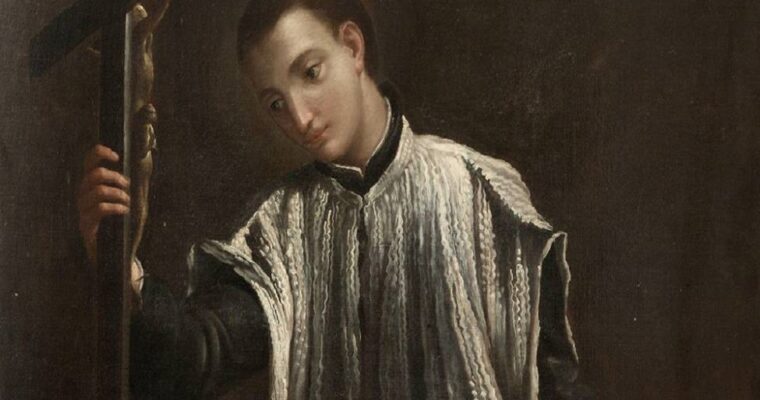
A senior officer in the Roman army, Saint Sebastian is said to have been an intimate friend of Emperor Diocletian. Perhaps it was precisely for this reason that when the latter discovered that the young man, of Christian faith, took advantage of this friendship to help his fellow believers condemned to death, he became so angry. Not only did Sebastian use his influence and position to save Christians and bury those who were killed, but he also worked to spread Christianity among the other soldiers and even the members of the imperial court.
When Diocletian discovered the ‘betrayal’ of his protégé, he went on a rampage.
Sebastian was therefore condemned to death by him. He ordered Sebastiano to be stripped, tied to a pole on Palatine Hill, and pierced by countless arrows. Believing him dead, the executioners abandoned him, but the man survived and was saved by Saint Irene, who hid him and cured him. Back in health, Sebastian appeared before Diocletian facing him and condemning him for the persecutions against Christians. The emperor, therefore, ordered that the young man be scourged to death and that his body be thrown into the Maxima Cloaca. It is remembered on 20 January.

Saint Lawrence

Saint Lawrence, celebrated on 10 August, and which we all know well by the tradition of falling stars that rain on the earth that night, was a young deacon. He obtained martyrdom under Emperor Valerian. Originally from Spain, he was a friend and disciple of the future Pope Sixtus II who, once he became pontiff, entrusted him with the office of archdeacon. In practice, Lawrence had to manage the charitable activities in the diocese of Rome.

Emperor Valerian ordered that all the bishops, priests and deacons be executed, and so it was also for Sixtus II. Arrested in turn, Lawrence was burned on a grate, or according to another tradition, beheaded. The legend of the grid would fuel the link between the young saint and the falling stars, which would be the lapilli that had escaped his torture.

Saint Barbara

Saint Barbara celebrated on 4 December is a saint famous for the many patronages that have been attributed to her, even if not much is known about her historically. Other patrons include: bombers, gunners, mathematicians, firefighters, bells, miners, gunners, architects, stone cutters, masons, sailors and undertakers.

The daughter of a pagan, she was locked up by her father in a tower because of her beauty. Here she was educated by philosophers and poets but, as soon as she left the tower, she discovered the Christian faith. Her father threatened to kill her if she didn’t abjure herself, and dragged her before the Prefect. Her refusal to deny her faith was first wrapped in garments that tore her flesh, then burned, but she miraculously saved herself. Then her executioners cut off her breasts, forcing her to parade naked through the streets. Her own father beheaded her at the top of a mountain.

Cosmas and Damian

The Holy Martyrs Cosmas and Damian were brothers. Both were doctors and are still considered today among the saints to be invoked to heal from all diseases.

Celebrated on 26 September, they were born in Arabia, and they used their influence as doctors and healers to convert as many people as possible to Christianity. Arrested by order of Emperor Diocletian, they were martyrs several times, according to various traditions: they were stoned, then flogged, crucified and struck with darts and spears, thrown into the sea with a boulder hanging around their necks, burned in a burning furnace. In the end, they were beheaded, and with them were the younger brothers Antimo, Leontius and Euprepius.

Saint Lucia

Lucia of Syracuse is one of the seven virgins listed in the Roman Canon. She is remembered on 13 December, the day of her martyrdom, and is invoked as the protector of sight. She lived in the early fourth century and died during the great persecution willed by Emperor Diocletian. She belonged to a noble Christian family in Syracuse and was denounced by her fiancé when she refused to marry him to consecrate her chastity to God and to give all her enormous patrimony to the poor. Because she refused to abjure, she was sprinkled with oil and tortured with fire, but because the flames did not touch her she was beheaded, or her throat was cut. She was only 21. There is no historical evidence that her eyes have even been ripped out, but the cult born around her figure often represents her with a saucer in her hand and her eyes resting on it, probably because of her name, which means Light.

Holyart hardstone rosaries: technical characteristics

Holyart hardstone rosaries: technical characteristics

Contents1 Hardstones2 Amethyst3 Hematite4 Pumice5 Fossil stone6 Angelite7 Agate8 Coral Semi-precious stones have always been used to imitate semi-precious stones. Let’s discover together the suggestion of semi-precious stone rosaries, sacred jewels of great beauty and value. Hardstone rosaries have always been a less expensive, but…

The history of the lights: from Southern Italy to the United States

The history of the lights: from Southern Italy to the United States

Christmas lights are a suggestive and essential tradition during the holidays, and not only in our country. This is how they were born. The custom of lighting the house on the occasion of Christmas has ancient origins and that sink in the profound religious sense of Christian…

Sacred statues in plaster, the excellence of Italian craftsmanship

Sacred statues in plaster, the excellence of Italian craftsmanship

Plaster sacred statues have belonged to the Italian artisan tradition since antiquity. Let’s discover this ancient and always current art.

Sacred statues and figurines of the crib in plaster: an ancient art that has characterised our country over the centuries. For those who, like us at Holyart, deal with sacred art, following and knowing the evolution of this particular artistic production is as necessary as it is appropriate. Aware of the value of sacred chalk statues in the history of art in our country, and wanting to offer in our online store only products that respect its excellence, we want to rely on suppliers who carry out their work in a handcrafted way with great professionalism and attention to detail. In a market saturated with objects made in series, without personality, especially without accuracy, Holyart prefers to stay in the opposite trend.

Plaster statues
The ancient one founded in 1900, from which the plaster statues present in our catalog are born!

We like to get to know our suppliers in person and look among them for the most interesting stories, which often involve entire families, generations of men and women who have believed in their work to the point of investing their entire existence in it. Secrets and tricks of the trade handed down from father to son, the pride of an illustrious legacy, an authentic passion that emerges from the speeches, from the looks that light up when the products are shown. This is the craftsmanship we like, that is made by people we can talk to, to whom we can smile, while they proudly show us their company, explaining to us step by step how their products are made.

5 sacred plaster statue for your church

Read more:

5 sacred plaster statues for your church
Why aren’t the sacred plaster statues that we find in the church considered as objects of idolatry, but as an integral part of every Christian’s profession of faith?…

The tradition of plaster statues

Returning to the sacred plaster statues, even in the Classical era, the Roman sculptors used plaster to reproduce Greek masterpieces. This exceptionally ductile material was used to create casts, thanks to which copies could then be made.

Preparation of the cast

But it is during the Renaissance that the desire of many collectors to own copies of ancient works of art pushes artists to deepen the work of plaster, to the point of transforming it into real art. Ancient Greek and Roman statuary thus become an inexhaustible mine of models to which countless master craftsmen draw, who make plaster casts then used to create bronze replicas. The interest in antiquity leads to excavations and research, especially in Rome, and the fabulous finds that are made in the Eternal City contribute to feeding more and more the market of statuary copies, as well as the processing of plaster aimed at it.

In a short time, we pass from the production of plaster casts to actual statues made with this material, kept in special museums even today, gipsoteques  (from ancient Greek gypsos, “plaster”), or calcoteques. Plaster statues of immortal artists, such as Antonio Canova, are kept here just to name one.

This product cannot help but convert itself over time to sacred art. The Christian cult of images, while condemning idolatry, has always encouraged the use of religious images and statues as an aid to prayer and devotion. The sacred statues in plaster and other materials housed in the churches have for centuries helped the faithful to find a more intimate and personal dimension of conversation with God, Our Lady, the Saints, making the object of their adoration visible and tangible in some way.

In Tuscany, in particular, plaster becomes the material that represents the historical tradition not only of sacred statues but also of nativity scene art. It is here, in particular in the surroundings of Bagni di Lucca, that in 1500 the Figurinai was born, artisans who once specialised in the production of stuccoes intended to embellish the noble palaces, which at a certain point began to reproduce sacred and profane statues with plaster. It was they who discovered that using plaster, a low-cost material, they could produce statues accessible to all. In a short time, driven by the scarcity of money, they also began to move and travel to sell their statues and in the 19th century, their movements led them to make their art known all over the world.

The production of sacred plaster statues and statues destined for the artisanal crib is so rooted in the territory that still today there are artisan companies that preserve and use for much of their production original moulds of 100 years ago, perpetuating a Tuscan tradition.

To companies like these, we turn to Holyart, to guarantee our customers sacred plaster statues that express all the value and excellence of a handmade product, the result of research and love for tradition, care and passion for every aspect of production, for every detail.

Although over time new processing techniques have been developed for nativity scenes and sacred plaster statues, we continue to rely on those who have been able to combine the new systems with the secrets of traditional plaster processing. Yes to mass production, but only if made with quality moulds and with greater attention to detail.

Let’s take a detailed look at the various stages of processing sacred plaster statues.

The production phases

The methods for working chalk for sacred art are handed down from generation to generation. The figure makers, the authentic ones, jealously keep their secrets, entrusting them only to those who prove to deserve to carry on this special art. They do not use modern machinery or equipment: everything is done strictly by hand, as in the past. At most, an air compressor can be used to remove dust, which is unavoidable when working chalk.

Casting

First proceed to the mixing the powdered alabaster chalk with water. The liquid chalk is poured into special moulds, which in the past were made of rubber or glue, while today they are made of silicone or latex. Since chalk when it dries creates a chemical reaction that pulls and warms, the old glue moulds lasted a maximum of seven, eight castings.

creation of the mixture
Phase: creation of the mixture

The casting phase is performed differently depending on the size of the statues. In the processing of medium and large statues, over 40 cm, which are hollow, the plaster is placed inside the mould, which is then turned and emptied. This creates a veil on the edge of the mould. To give the statue the proper thickness the casting process is repeated four or five times. Between one phase and the next, the excess chalk is eliminated. This type of processing makes it possible to produce a maximum of four large statues with a casting. Statues of one metre or more are printed one at a time.

As for the smaller statuettes, up to 30 cm, such as those plentiful ones from the nativity scene, the procedure is slightly different. The mould is filled, then it is ‘beaten’ to remove the excess chalk drops and then the statue is removed from the mould after twenty minutes, or half an hour. Up to twenty small statues can be produced with a single casting.

The large statues are reinforced with an iron core, which serves to support and make them less fragile, especially the smaller and protruding parts. Statues that exceed one metre in height are filled with jute to be more robust and impact resistant.

The molds of the statues laid out on shelves

Drying

During the summer, if there is no urgency, the plaster statues are left to dry on the shelves, in the air. It takes fifteen, twenty days. Otherwise, during the winter or if there is urgency, after being ‘shelled’ from the mould, the small and large statues are put in the oven for the drying process. It is necessary to remove the excess water from the inside of the moulded plaster. The oven is different from the one used for example for terracotta, which is plainly ‘baked’. It is only used to dry, so it must maintain a low temperature, between 50°-60°.
It is also necessary to be careful to change the position of the statue because if left in the same position it risks being ruined.

With the necessary differences, and depending on whether they are full or hollow, the statues are in the oven for about two days.

Cleaning up

After being dried, the statues are finished with spatulas and glass paper. This process is very important, because being handmade, without the aid of machinery, the statues have many imperfections, they are raw. Operators also check that the product does not show the small holes left by any air bubbles. In this case, they fill the imperfections with another cast and then they take care of polishing the statue.

phase de nettoyage
Smoothing phase to carefully clean the statue from imperfections

Refinishing

Some small details, or very protruding parts of the statue, cannot be made directly with the mould, because they would be too fragile and would break easily. In this case, a second step is taken on the statue, once it has been printed, dried and finished, with the process called “Rammontatura (Refinishing)”. In practice, the pieces are ‘mounted’ on the main structure.

Refinishing

Dyeing

The colours used to decorate the plaster statues are solvent enamels, diluted in acetone. In the past cementite colours were used, which were prepared at the time, diluting the powder of the desired colour. The colours are mixed and spread all by hand, by brush.
Since the chalk is porous, if the colours were spread directly on its surface they would not flow. Initially, a layer of primer is applied, which forms a film that makes the bottom uniform and smooth. In the past, we used the vinavil with the same purpose.

Staining phase
Coloring phase

Then we move on to the colours, which are spread one at a time, starting with the light colours and gradually going with the darker ones.

Once coloured, the statue is first polished with a satin primer and then a patina is sprayed with an airbrush, which is then removed with a cloth to give the effect of ageing.

The choice of chalk

Why choose to make a sacred plaster statue rather than with another material?
If we compare alabaster chalk and resin, both used in the production of sacred statues, we will see that there are some substantial differences between the two materials. Alabaster chalk is produced in Roccastrada, in the province of Grosseto, while marble powder, or calcium carbonate, is produced in Aversa, near Massa Carrara. The main difference between a sacred resin statue and a gypsum one is that the resin can stand outside, while the gypsum if exposed to direct rain or snow, corrodes and crumbles. So if you are looking for an outdoor statue you will have to take this difference into account. The resin is then catalysed, that is, it is processed with a chemical process with the addition of a catalyst that makes it harden, while the chalk is made only of water and dust, absolutely natural. Alabaster chalk is in no way harmful to health. It does not cause allergies or particular reactions, and also the processing process to which it is subjected is entirely handmade and ecological, from the first stages until disposal.

Other materials used as an alternative to plaster to produce sacred statues and statues for nativity scenes, in addition to resin, are papier-mâché, pressed paper and, in modern times, plastic.

Sacred Heart of Jesus statue in pearlized plaster 80 cm
Sacred Heart of Jesus 80 cm Plaster Statue with mother of pearl. Jesus wears white and red clothing with gold borders.
Buy Now
Mary Rosa Mystica statue in pearlized plaster 70 cm
Statue of St. Rosa Mystica 70 cm, in plaster with mother of pearl. The saint statue wears long white clothing and has her hands in prayer.
Buy Now
Our Lady of Lourdes statue in pearlized plaster 80 cm
Madonna of Lourdes 80 cm, in plaster with mother of pearl. The Our Lady of Lourdes statue is made out of plaster and has a mother of pearl effect.
Buy Now
Divine Mercy statue in pearlized plaster 90 cm
Divine Mercy of Jesus Statue, 90 cm. The Jesus statue wears a long robe with rays of red and blue coming from his chest.
Buy Now
St. Michael statue in plaster 100 cm
St Michael the Archangel 100 cm statue in plaster depicted about to crush the devil. The Saint Michael figure wears red and blue robes and wields a sword.
Buy Now
Cosma and Damian: the medical saints who treated for free

Cosma and Damian: the medical saints who treated for free

Contents1 Martyrdom of Cosmas and Damian2 Three dates for two saints3 Worship Diffusion4 Basilica of Saints Cosmas and Damian in Rome5 The first limb transplant in history (and other miracles) Doctors, twins, martyrs. Saints Cosmas and Damian shared an extraordinary life, an unwavering faith and…

Saint Matthew, apostle, evangelist and martyr

Saint Matthew, apostle, evangelist and martyr

Contents1 Saint Matthew the Apostle2 Martyrdom of Saint Matthew3 Saint Matthew the Evangelist On 21 September, Saint Matthew is celebrated evangelist, apostle and martyr. Who was he and how did he become an apostle? Saint Matthew the Evangelist is considered the author of one of…

The cult of Our Lady of Sorrows

The cult of Our Lady of Sorrows

Our Lady of Sorrows is a name attributed to Mary, mother of Jesus. This is how secular devotion to Mater Dolorosa was born.

A beautiful and sad woman, dressed in the mourning colours of black and purple. The face turned to the sky, often scratched with tears, and in the eyes anguish that has no voice, has no words. This is how Our Lady of Sorrows appears in most of her depictions. And this is exactly what we are talking about, a mother who suffered immensely for the love of her only Son, who participated in his pain, in his Passion, accompanying him to the Cross and pouring all her tears at the feet of the latter.

But when and how was the cult of Our Lady of Sorrows born?

The origins of worship

The devotion to Our Lady of Sorrows is celebrated every year on 15 September, the day after the celebration of the Exaltation of the Cross. It was Pope Pius X (1904-1914) who established this date, but the cult of Our Lady of Sorrows and her Seven Pains already existed at the end of the eleventh century. Initially, the pains were 5, as were the Gaudi 5. These are moments of Mary’s life recounted in the Gospels, or handed down by popular devotion, linked to the Passion and death of Jesus, but not only. Mary’s pains were already represented at that time through five swords stuck in her heart.

It was especially Saint Anselm and Saint Bernard who contributed to the spread of this devotional form that exalted the figure of Mary as a mother and venerated her heartfelt crying at the foot of the Cross. The Liber de passione Christi et dolor et planctu Matris eius, a text written by an anonymous man, was only one of the first compositions dedicated to the Weeping of Our Lady, which would find so much space in the popular Lauds and Mysteries of the time.

In the 12th century, Jacopone da Todi (but the attribution is not certain) composed the Stabat Mater, a liturgical musical poetic composition that was recited or sung during the Eucharistic celebration before the proclamation of the Gospel. It is a poignant meditation on Mary’s pain at the foot of the Cross. The prayer begins with the words:

Stabat Materdolorósaiuxta
 crucem lacrimósa,
 dum pendébat Fílius.

 Cuius animam geméntem,
 contistátam et
 doléntempertransívit gládius.

The sorrowful Mother was
in tears at the Cross where her Son hung.

And her soul
groaned, saddened and

sorrowful pierced by a sword.

In 1233, seven Florentine nobles of the company of the Laudesi, a confraternity of Florence particularly devoted to Our Lady, witnessed a miracle: they saw the image of the Virgin depicted on the wall of a city street come to life. Our Lady appeared afflicted with great pain, and she was wearing the colours of mourning. The young people interpreted that vision as a sign of the pain that the mother of Jesus felt because of the hatred that divided the families of Florence. So they decided to wear in turn mourning clothes, threw down their weapons, retired to penance and prayer on Mount Sanario and established a new fraternity: the company of Our Lady of Sorrows, or the Servites.

Many other confraternities were established later, while devotion to Our Lady of Sorrows and the Seven Sorrows of the Blessed Virgin spread to all strata of the population. This incredible spread is still visible today, thanks to the countless popular festivals in honour of Our Lady of Sorrows that take place everywhere in our country. But even European nobles and even sovereigns were devoted to Our Lady of Sorrows and encouraged her worship. We think of Charles V, Emperor of the Holy Roman Empire, who commissioned paintings depicting the Pains of Mary to educate the illiterate people, or the Spanish royals. The Servites and the Franciscans contributed greatly to this diffusion.
First, the rites in honour of the Sorrowful Mother were concentrated in Holy Week, then new dates and celebrations were instituted, until the decision of Pius X.

The Seven Pains Suffered by Mary

We have already mentioned the Seven Sorrows of Mary. But what is it a sculpture of? There are many events recounted in the Gospels that show episodes of the life of Mary characterised by great affliction. In popular iconography, swords have been depicted embedded in the heart of the Madonna.

Here are the Seven Sorrows of Sorrowful Mary:

  1. Prophecy of Elder Simeon on the Child Jesus: “Simeon blessed them and spoke to Mary, his mother: He is here for the ruin and resurrection of many in Israel, a sign of contradiction so that the thoughts of many hearts may be revealed. And you yourself a sword will pierce your soul.” (Luke 2:34-35)
  2. The flight into Egypt of the Holy Family: “They had just departed, when an angel of the Lord appeared in a dream to Joseph and said to him: ‘Arise, take the child and his mother with you and flee to Egypt, and stay there until I warn you because Herod is looking for the child to kill him‘. And Joseph arose, and took the child and his mother in the night, and fled into Egypt, and remained there until the death of Herod.” (Matthew 2:13-15).
  3. The Loss of the Child Jesus in the Temple: “His parents went to Jerusalem every year for the Passover feast. And when he was twelve years old, they went up again according to their custom: but when the days of the feast were ended, as they were returning, the child Jesus abode in Jerusalem, and his parents knew it not. And they believed him in the caravan, and went a day’s journey, and sought him among their kinsmen and acquaintances: and they found him not, and returned to Jerusalem to seek him. After three days they found Him in the temple, sitting in the midst of the teachers, listening to them and asking them questions. All who heard him were amazed at his understanding and his answers. And when they saw him they were astonished; and his mother said to him, Your father and I have been looking for you with great anxiety.” And he said, Why seek ye me? Did you not know that I must be in my Father’s house? But it has not all been joyful. He went down with them and came to Nazareth, and was obedient to them; and his mother kept all these things in her heart. And his mother kept all these things in her heart. (Luke 2:41-51)
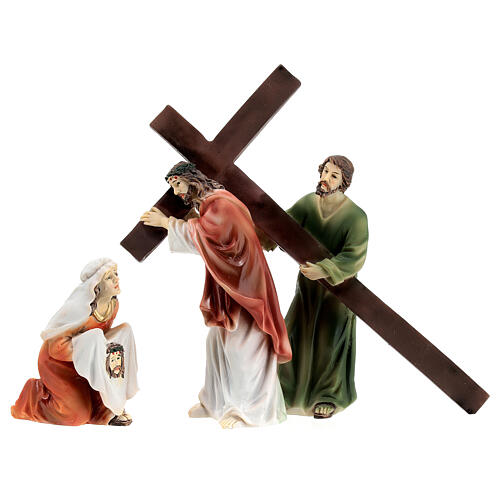
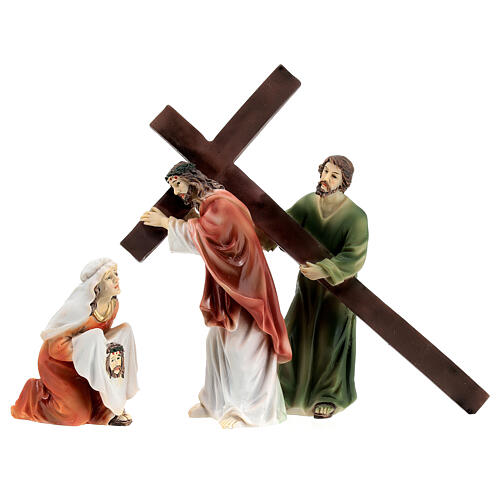
  4. The encounter of Mary and Jesus along the Way of the Cross (This episode is not narrated in the Gospels, but derives from popular tradition. Jesus ascending to Calvary meets his mother).
  5. Mary at the foot of the Cross: “At the cross of Jesus stood his mother, his mother’s sister, Mary of Cléofa and Mary of Magdalene. Jesus therefore, seeing his mother, and the disciple standing by, whom he loved, says to his mother, Woman, behold thy son. Then he says unto the disciple, “Behold thy mother. And from that hour the disciple took her to his own home. (John 19:25-27)
  6. Mary welcomes the dead Jesus into her arms (This episode is also not narrated in the Gospels, but has been the subject of countless sacred representations, such as Michelangelo’s Pietà, just to mention one of the most famous. Mary cradles in her arms the body of Jesus deposed by the cross before he is buried.)
  7. Mary attends the burial of Jesus (an unbiblical episode, handed down by tradition).

The Seven Pains constitute a kind of path of suffering in which Our Lady was the protagonist. It is no coincidence that popular tradition has established in some places the ‘Via Matris’, a Marian version of the Way of the Cross, establishing true paths of penance and meditation in the footsteps of the Seven Sorrows of Mary.

In the context of some popular festivals, the statues of Mary in mourning clothes and that of Jesus are placed side by side, in a kind of loving and infinitely painful dialogue between Mother and son.

Mary, all the suffering of a mother

We have talked in many other articles about the figure of Our Lady Mother of Jesus, of Our Lady Mother of God. In the figure of Our Lady of Sorrows, this maternal identity of Mary of Nazareth meets its highest and most dramatic fulfilment. Just as Jesus, his son, placed side by side in his life on that cold night in Bethlehem, so Mary followed him one step from death, cradling his battered body for the last time, before entrusting him to the tomb. His tears washed the blood from the wounds of the crown of thorns, of the nails of the Cross. His sighs that have touched the now-cold skin of the Lamb killed to wash humanity from all sins. But that Lamb for her was also a son, carried in his womb for long months, cared for in the nights of weeping, protected and guarded as the most precious treasure, and finally let go in the world, to follow his destiny, but always with the attentive and caring eye of his mother to follow him, to watch over him, to pray for him. We cannot understand the importance of the figure of Our Lady of Sorrows if we do not dwell on this aspect of Mary as a mother.  

mother Picasso

Read more:

From Eve to Mary: the figure of the Mother in the Bible
The mother, pillar of every family, beating heart and source of life for those who gravitate around her.

The depictions of Our Lady of Sorrows

At the beginning of the article, we have already mentioned the classic iconography of Our Lady of Sorrows. The sad, pale face of those who no longer have any other nourishment for their pain, another relief from the thirst for their crying. The clothes are in mourning, black or purple, and he often holds a handkerchief in his hand, never satiated with tears. In many representations, the chest is torn by the cruel blades of the Swords of the Seven Pains. A mourning mother who mourns for eternity the death of her only Son.

But other images are recurring in sacred art, which immortalises further moments of that Via Matris studded with suffering. The Pietà, for example, represents the penultimate of the Seven Pains, that moment not reported in any Gospel, but indelibly imprinted in the popular tradition, in the collective emotionality of humanity always sensitive to great tragedies: Mary holds in her arms the lifeless body of Jesus. 

The body of Christ is abandoned, in a painful and, at the same time, relaxed pose, as if all the pain had already left him, as if, at last, he could find relief in his mother’s embrace. And it is on her that all the suffering is poured out, as if it were she, Mary, who absorbed the evil inflicted on the blessed limbs born from her womb, to allow him to die in peace. Mary is composed, in her agony, she appears serene as if she were only cradling her sleeping son, as if she knew that, shortly thereafter, He will open his eyes and smile at her. At the same time, in this iconographic composition, one perceives all the intimacy that only two creatures who have shared the same body for months can know, that mysterious alchemy that makes mothers and children inseparable, inseparable regardless of what life reserves for them.

Spanish sacred art, especially in the Baroque era, preferred the Weeping Madonnas, richly dressed, with lavish, princely clothes, which also preserve the colours of mourning. Madonnas were made to move the people, to arouse feelings of piety and participation, and for this reason, they often had a very realistic aspect.

In Spain, but also in many popular Italian traditions, the burial ceremony, the burial of Jesus, brought to Spain in all probability by the Franciscans or the Servites, was very famous and practised. The body of Christ is deposed from the Cross, entrusted to the weeping of the mother and then buried. This type of sacred representation involved representatives of all social classes and mobilised the entire community, as happened for example in Casale Monferrato and in several countries of lower Piedmont, where there are still documents and testimonies of the spread of this rite.

Italy is home to many shrines dedicated to the Addolorata, from North to South. And from North to South there are still popular festivals that on 15 September, but also during Holy Week, celebrate Mary’s sorrow for the loss of the Son. As in Agrigento, where on Good Friday the statue of Mary goes in search of that of Jesus deposed in the streets of the city, carried on the shoulder by the members of a confraternity, or in Belluno, where the feast in honour of Our Lady of Sorrows coincides with the ancient Sagra de i fisciot (festival of whistles), or in Comiso where the celebrations last for days, between dinners and processions, and culminate with the “Triumph of Mary of Sorrows”.

our lady of sorrows statue in fiberglass by landi
Our Lady of Sorrows statue in fiberglass, measuring 170cm (66,93 in) FOR OUTDOOR. Statue representing Our Lady of Sorrows made of fiberglass, hand-crafted and hand-painted by Italian artist Martino Landi with water resistant colours. This statue is suitable to be kept outside.
Buy Now
This angel statue is hand sculpted on wood with traditional methods by the artisans of the Val Gardena. Available in 4 different sizes: - 10 cm, - 12 cm, - 14 cm, - 28 cm. You can choose the measurement you prefer in the menu under the picture. It is possible to order this guardian angel in a different finish. If you need further information about this article do not hesitate to contact us: we will be happy to help you.
Buy Now
our mother of sorrows statue fibreglass
Madonna of Sorrows statue, 110 cm colored fiberglass WITH CRYSTAL EYES. Our Lady of Sorrows statue, 110 cm made of fiberglass and hand painted. The Catholic statue is finely worked with care and attention. This Mary statue is not heavy and can be easily transported during processions, however, it is recommended to not leave it permanently outside. It is 100% hand crafted and finished in Italy by a company with years of experience in making sacred works.
Buy Now
deposition from the cross by angela tripi
The Pieta: Scene of the deposition of crucified Christ, interpreted by artist Angela Tripi. The figure is adapted for a 30 cm nativity set, not actual size. The scene depicts the deposition of the body of Jesus from the cross, in the arms of the Mother who mourns his death.As in the famous work, La Pietà, Mary, seated on a rock of Mount Calvary, holds her Son in her arms.
Buy Now
pieta statue of michelangelo
Pieta Michelangelo white composite marble statue 16 inches tall.This is a high quality statue, very resistant and suitable for both indoor and outdoor use.The structure of this item is entirely hand made in Italy, in a company with a long history in the manufacturing of religious statues.
Buy Now
The Nativity of Mary, when and why is it celebrated?

The Nativity of Mary, when and why is it celebrated?

Contents1 8 September Feast of Our Lady2 History of Mary’s Birth3 Devotion to Mary the Child 8 September is the birthday of Mary, the mother par excellence, the woman who changed the history of the Church and humanity. Let’s find out more about her birth…

Religious jewellery: the new Holyart product line

Religious jewellery: the new Holyart product line

Contents1 Prototypes and moulds2 Casting, moulding and grinding3 Galvanic treatment4 Decoration and colouring with the enamel5 Other products Religious jewellery? Yes, but only high quality, made with artisan methods by Italian companies of proven excellence. Because beauty, professionalism and faith can go together. We at…

Saint Monica: patron saint of mothers and example for women

Saint Monica: patron saint of mothers and example for women

Saint Monica of Tagaste was a woman endowed with extraordinary strength of mind and unwavering faith. Let’s find out why she’s become a symbol for all mothers.

Saint Monica is the patron saint of married women, mothers and widows. In an era when the woman was always relegated to a subordinate role, forced to live in the shadow of her husband, and condemned to oblivion, without consideration for her actual gifts or abilities, this exceptional woman was able to sublimate the role that history and society had assigned her, becoming a point of reference and a symbol for women and mothers of every era.

Let’s imagine a son who, instead of thinking about his future, finding a serious job, cultivating constructive relationships with his neighbour, wastes his life among futile amusements, lingering in vice, corruption, in wrong and harmful companies.
Imagine a mother, a Christian woman, widowed early, with three children to look after and all the weight of responsibility on her shoulders.
It seems like a story similar to many others, one that we can hear told every day, or that perhaps we have even lived up close, in our family.

In the latter case, we can surely realise how much courage, how much strength it takes for a mother to immolate her own life, to spend every single moment of her existence solely and exclusively on the care and well-being of a child. And we think not only of the well-being of the body but also and above all of that of the spirit, of the soul, which especially in the youngest is constantly disturbed by thoughts and solicitations not always comprehensible to themselves.

mother Picasso

Read more:

From Eve to Mary: the figure of the Mother in the Bible
The mother, pillar of every family, beating heart and source of life for those who gravitate around her.

We have focused in the past on how the mother is often the pillar of the family, her beating heart, and the source of life for those who gravitate around her. Yet too often we take it for granted. In ancient culture, in almost all societies, being a wife and mother represented the highest aspiration and full realisation for a woman. Just as in many cases, it was inevitable to be submissive to one’s husband. In fact, even in the Sacred Scriptures, there is no lack of examples of women and mothers who knew how to oppose their husbands and society as a whole for the good of their children. Mary, the mother par excellence, collects within herself the sum of all the characteristics that should characterize a mother: tenderness, sacrifice, ability to cancel out of love, to endure every pain to stay close to her children. But she wasn’t the only one.

Saint Monica was an ethnic Berber woman, who belonged to a wealthy family and was devoted to the Christian faith. After marrying according to the will of the family, she had three children, who grew in the fervour of her faith. Faith was so ardent and unshakable that even her husband, a pagan, was infected with it, so much so that he converted to Christianity.

In a previous article, we talked about the ten Christian women who changed the church and the world. Here, among philosophers and thinkers, mystics and warriors, we also like to include a mother, like Saint Monica, who was able to imprint her entire earthly life only on the care of her children, and of one in particular: Saint Augustine of Hippo.

Monica Mother of Saint Augustine

Yes, Saint Monica was the mother of Saint Augustine of Hippo, one of the greatest men of faith of all time. A philosopher and theologian, bishop and doctor of the Church, Saint Augustine wrote some of the most beautiful and intense pages in ecclesiastical literature and beyond. Some of those pages were inspired by his mother, Santa Monica. Unbelievable to say, it is him we were talking about just now, mentioning the unruly son and the mother who worked hard to lead him on the right path! In fact, this exceptional man of God came to the Faith after a long internal labour and a youth dedicated to excesses, licentiousness, vice and even crime.

Yet, from his own words we learn how: “From my tenderest childhood, I had sucked with my mother’s milk the name of my Savior, Your Son; I kept it in the recesses of my heart; and all who came to me without that Divine Name, though it might be elegant, well-written, and even full of truth, did not take me away.” (Confessions, I, IV).

Saint Monica never prevented her son Augustine from living his own life. Although she was opposed to some of his choices, the saint could leave him free to choose and to make mistakes. Moreover, God himself wanted to benefit his most complex creature, man, from free will, that is, the possibility of independently evaluating his own action, without any external force or superior entity holding the rows of his destiny. How could Saint Monica have acted differently with her eldest son?

free will

Read more:

Free will: what it is, what it means
What is free will? What implications does it have for a man’s life in general, and for the Christian’s in particular?

But she followed him, in his wanderings in the Mediterranean basin, without letting herself be discouraged by his discrepancies or lies. He went to great lengths to get rid of this loving and wise presence, even abandoning it at the port of Carthage to embark for Italy.
Santa Monica didn’t let it beat her. He followed his rebellious son to Milan and finally, thanks to his advice and love, Augustine converted and received catechesis from St.Ambrose.

To understand how much Saint Augustine was aware of his mother’s influence in this conversion, it suffices to think that after his conversion, Augustine often wanted her by his side while discussing rhetoric and philosophy with other scholars. Not only did Saint Monica take part in the learned conversations, but Saint Augustine brought back in his writings many thoughts and words of his mother.

These spiritual dialogues between mother and son characterised the last part of Santa Monica’s life. From that period of intense spiritual exchange we have the words of Saint Augustine, in the ninth chapter of the Confessions: “My son, as far as I am concerned, there is nothing that attracts me in this life. I don’t even know what he’s doing down here, and why he’s still here. There was only one thing that made me want to live a little longer: to see you as a Christian before I died. God has granted me more and better: to see you despise earthly joys and serve him alone. What am I still doing here?”
Prophetic words, those of Santa Monica: as she was about to embark to return to Africa, the woman contracted malaria and died, just fifty-six years old, on 27 August 387 AD.

Among the many things written about his mother, to whom he remained indebted for his entire life, Saint Augustine said: “I owe her all that I am” (La feltà, 1,6) and again, in the Confessions: “She begot me both with her flesh so that I might come to the light of time, and with her heart so that I might be born in the light of eternity.”

Prayer to Santa Monica

Prayer to Santa Monica

There is a prayer dedicated to Saint Monica, which can be considered the prayer of all mothers who put the good of their children before everything else and live for them.

Lord, who takes care of each one of you
 as if he were the only one and of all as of each one, I
 am here
 before Tecol, a heart full of trepidation and

hope. That
in the eternity of Your mercy you
accept to indebted
yourself with the debt of forgiveness,
turn Your gaze of indulgent attention
towards my son who struggles on his journey of Faith.

One day you led to Faith and holiness
a man who had wandered far from You,
that son of so many tears who was Augustine,
won by the tenacious and confident prayer
of his mother Monica.

It is to her, Lord, to Saint Monica
and to her intercession,
that I now entrust my sorrow and my prayer,
that his tears of faith also
obtain for my son the
return to a living and active faith,
so that the ideal Christian man may be
realised in him who with effort,
but with all the commitment of my poor testimony,
I have tried to build the
years of his education.

The Assumption of Mary and the most characteristic celebrations

The Assumption of Mary and the most characteristic celebrations

15 August is not just an occasion for partying and outings. We remember the Assumption of Mary into heaven. Let’s discover the most evocative celebrations that this anniversary is celebrated with. In an article of some time ago we had already spoken extensively about the…
Saint Dominic of Guzman and the delivery of the rosary

Saint Dominic of Guzman and the delivery of the rosary

Contents1 The history of the saint2 The delivery of the Rosary by the Virgin Mary3 The origins of the Dominican order Saint Dominic of Guzman, the saint in love with Christ, lived his life dividing himself between preaching and prayer. A proud opponent of heresy,…
Bible stories for young and old

Bible stories for young and old

The stories of the Bible are so many, and so compelling that over the centuries they have inspired countless artists and writers, up to modern directors who have made films and television series. Let’s find out the reasons for so much influence.

The stories of the Bible have been a constant in human history since immemorial time. It is not difficult to imagine why. The Holy Bible is the most widely read book in the world. It was the first book printed in Europe, after Johannes Gutenberg invented the movable type technique in 1455. But even before this happened, the stories of the Bible circulated throughout the known world, initially in the form of oral tales, transmitted from narrator to narrator, then in scrolls and manuscripts written by scribes and chroniclers of every country and nationality.

For this reason it is still difficult to identify an exact dating of the Bible. Certainly between the Old and New Testaments we speak in terms of thousands of years.

It is also difficult to determine exactly how many copies have been printed and sold, especially in view of the fact that there are different versions, coming from translations, and codes of different origin. An indicative estimate speaks of more than five billion Bibles sold, but it is a figure to be taken summarily.

Another information that gives us the measure of the success, and spread of the Bible in the world is the fact that it has been translated, in whole or in part, into more than 2,400 languages. This means that the stories of the Bible are accessible in part or in full to more than 90 percent of the planet’s inhabitants.

These data are sufficient to understand how great the influence of Bible stories may have been in art, literature, music, and once in the modern world, also in cinema and television. In fact, there are many films about the Bible.

It should be added that many of the stories in the Bible are truly compelling, sometimes even more so than many adventure novels or fantasy sagas that are trendy today. There is an abundance of violent and bloody events, murders, massacres, revenges, and wars, but even these dramatic events are important because on the one hand they demonstrate the truthfulness and historical accuracy with which the biblical writers wanted to write their testimonies; on the other hand they remind us how the Bible speaks of true men and women, and as such fallible, constantly exposed to temptation and sin. This means that we can appreciate even more those among them who have been able to stand up as examples of righteousness, wisdom, goodness.

Let’s see some of the stories of the Bible and their extraordinary protagonists.

Jacob

Of Jacob, Third Patriarch of Judaism after Abraham and Isaac, we read the story in Genesis. He was the son of Isaac and of Rebekah, twin brother of Esau, who was born before him, but from whom Jacob took the birthright, because at the moment of childbirth he held his heel with his hand. For this reason he was given this name, which derives from aqeb, “heel”. Then, Jacob also took from his brother the blessing of his father Isaac by deception. Esau sold it to him in exchange for a plate of lentils. In those days that meant getting full powers from the father over men, animals and everything that belonged to the tribe. It is not a case that the name Jacob also means “the supplanter”.
Jacob is also known by the name “Israel”, from the root shr, “to fight,” and El, “Lord.” “You will no longer call yourself Jacob, but Israel, because you fought with God and with men, and you won” (Genesis 32,29).

The differences between Judaism and Christianity

Read more:

The differences between Judaism and Christianity
What are the differences between Judaism and Christianity? Is the God of the Jews the same as the Christians?

The verse and the nickname derive from an emblematic episode of the life of Jacob, who one night engaged in a merciless fight against an unknown man, probably an Angel of the Lord. As dawn approached, and after he had almost crippled him by hitting him on the sciatic nerve, the stranger begged Jacob to let him go. He consented, but sensing the supernatural origin in his adversary, he wanted his blessing in return, and it was then that man gave him the name Israel. The name is prophetic, for the twelve sons which Jacob had from his lawful wives, and from two slaves, gave birth to the twelve tribes of Israel.

Jacob’s characteristics were therefore cunning and strength, considered by the people of Israel precious and enviable gifts. Accustomed to fighting against men, his brother first, to get what he wants, Jacob does not hesitate to use cunning and deception to pursue the goals he sets for himself, and refuses to be bent by the events.  Even his struggle against God is actually a sign of greatness: realizing against who he is fighting, Jacob lays down his pride and invokes the blessing of his adversary, who in return chooses him as the head of the people of Israel.

Jacob is venerated by the Catholic Church on December 24, along with the other patriarchs of the Old Testament.

Jacob had many children, among whom Joseph was his favorite.

St Joseph with Infant Christ in his Arms, by Guido Reni

Read more:

St. Joseph: the supposed father of Jesus
St. Joseph is a very beloved figure venerated by Christians and with affection and incomparable devotion.

Joseph and his brothers

The story of Joseph, who became Pharaoh’s minister and vice-king of Egypt after being sold to slave traders by his brothers, who were envious of the favor that his father Jacob granted him, has always inspired many writers and artists. There are films dedicated to him, including one of animation, Joseph the King of Dreams, made by Dreamworks, which has had a planetary success and is highly appreciated by children as well. The coat with many colors that Jacob wanted to give to his favorite son also inspired a musical, Joseph and the amazing technicolor dreamcoat, created by Andrew Lloyd Webber and Tim Rice.

Beyond his recent fame, Joseph is also an Old Testament patriarch, and from his sons Manasseh and Ephraim descend two of the tribes of Israel. After being sold by the envious brothers, he used his ability to interpret dreams to become minister and advisor to the pharaoh. He interpreted for the latter the famous dream of fat cows and thin cows, and thus managed to save all of Egypt, and also his father Jacob and the tribes of Israel from a terrible famine that lasted for seven years.

Samson and Delilah

The story of Samson and Delilah, in addition to paintings, literary and musical works, has also been the inspiration for many films, thanks mainly to the amorous and tragic component that it provides.
Samson was a judge who had received  supernatural powers as a gift from God. His name derives from Shimshon, “little sun”, and this made him think for some time that he himself could be a sort of demigod. His birth had been announced by an angel who had revealed to his mother that once he grew up, her child would free Israel from the invading Philistines, and had advised her never to cut his hair. 

Way of the Cross for children

Read more:

Way of the Cross for children: how to tell your child about the 14 stations
It is not easy to explain certain things to a child. Not even for modern children, used to witnessing impressive scenes on television every day

In the Latin Christian tradition Samson took on traits in common with Hercules, although in him physical strength always joined the spiritual gifts, creating an archetype of the Christian hero who sacrifices himself. In fact, even the adventures that Samson faces during his life, are a bit reminiscent of the labors of Hercules. He often clashes with the Philistines, becoming a real thorn in their side.
When Samson falls in love with Delilah, the Philistines offer her much gold in exchange for her help in capturing Samson. The woman goes to great lengths to discover the secret of his prodigious strength, and after many failed attempts, eventually manages to get the hero to confess that it resides in his hair. She makes him shave, and hands him over to the Philistines, who chain him up and imprison him, after blinding him. Later, they pick him up from the prison for a solemn ceremony, but his hair has grown back, and though blind, Samson manages to bring the building down by pushing the load-bearing columns, shouting “Death to Samson and all the Philistines!”

Queen Esther

His name in Hebrew means “I will hide”. Esther, who was actually called Hadasah, “myrtle”, takes this name to hide her Jewish origin when she enters the harem of King Ahasuerus as his wife.
Only later she will reveal her true identity to save the Jews from the massacre ordered by Prime Minister Aman. Upon hearing the minister’s plan, she fasted for three days, then presented herself to the king and asked him to go to dinner with Aman. In front of everyone, she revealed her Jewish origin, and said that Aman wanted the death of all Jews.
With her courage she convinced the king to intercede for her people. Thus the holiday of Purimwas was born, celebrated even today on March 14 and 15.

Bile Stories for children

Even children can appreciate many of the stories of the Bible. Obviously, we need to approach them in the right way, adapting stories, and characters to their age and sensitivity. There are many books written specifically to bring children closer to Christianity through the telling of stories from the Bible.

If we want to offer children the stories of the Bible for children, we can begin with stories that are easy to tell even the youngest, such as the three parables of mercy. The story of the lost sheep (Luke 15:1-7) or of the lost coin (Luke 15:1-10), or the prodigal son (Luke 15:11-32) are suitable to be told even to very young children, and teach them the importance of repentance, and especially the immense love of God, willing to welcome us back, and love us despite our mistakes.

Remaining within the context of the parables, the parable of the Good Samaritan (Luke 10,25-37) can also help children to understand the message of Jesus, to love our neighbor as ourselves. The parable of the vine and the branches (John 15,1-11) will teach them that alone we are nothing, like a vine shoot detached from the plant, and not cared for by the farmer (God), destined to dry and be burned. Only by remaining with God can we bear fruit. The parable of the talents (Matthew 25,14-30) shows children how God grants us all spiritual gifts, that each of us must put to good use, otherwise they are useless.
Also, the parable of the sower (Matthew 13:3-8;19-23) shows how everyone can receive the Word of God, telling what happens to different seeds that fall on the road, among the stones, among the thorns, and finally in the good soil, where they can bear much more fruit.
The parable of the Pharisee and the tax collector (Luke 18,9-14) finally teaches the value of humility.

World Day of Friendship

World Day of Friendship

July 30 is the World Day of Friendship, a celebration born to celebrate one of the most wonderful aspects of coexistence between men. On the occasion of the World Day of Friendship we wanted to verify what is the exact definition of this form of…

The story of Saint Anne Mother of Mary

The story of Saint Anne Mother of Mary

Contents1 History of Sant’Anna2 The meaning of the name Anna3 4 Gifts for the grandparents On July 26, St. Anne and St. Joachim, the parents of the Virgin Mary, are celebrated. Let’s find out why. Although the Day of the Grandparents was established as a…

Saint Benedict: the saint who inspired Italian craftsmanship

Saint Benedict: the saint who inspired Italian craftsmanship

Saint Benedict of Norcia, Patron Saint of Europe, throughout his life he fought against the devil he cast out in the name of the Cross. This is how the Saint Benedict medal inspired an Italian craftsman.

Saint Benedict of Norcia is not only famous for the so-called medal of Saint Benedict, the subject of this article. Patron of Europe,He was first of all a hermit, having chosen to live the first part of his life in Subiaco in an inaccessible cave. He then moved to Vicovaro, where he became a spiritual guide for some monks, and finally to Cassino, where he remained for thirty years to preach the Word of God and where he gathered many proselytes. At Cassino Saint Benedict also founded a monastery destined to become famous in the history of Christianity, and laid down his famous rule, which we can summarize in the motto ‘Ora et labora‘.

This rule based on prayer and work, has become the most widespread among monks around the world. This rule was revolutionary for its time. Before Saint Benedict, being a monk meant leading one’s life in almost total isolation, practicing the mortification of the flesh, undergoing fasting and privation. An admirable intent, but that according to the Holy Umbrian did not bring great benefit to God and much less to the Church.

For this reason, St Benedict proposed a new way of praying, alongside the solitary prayer of the community, shared with the Brothers, and associating it with singing. He also encouraged the monks to alternate their work with prayer, making it just another way to honor God and celebrate his greatness. This rule included the most noble works, such as that of scribes, and scribes who took care of the great libraries, to safeguard the ancient manuscripts. But every work done within the community was elevated to the rank of a valuable contribution to the spiritual practical life of all.

Precisely this new model of monastic life led to the proclamation of Saint Benedict as Patron of Europe. It was in fact largely thanks to the monks that the Europe of the Middle Ages, despite the barbarian invasions and the decadence of the Roman Empire, survived carrying out models and laws of life and civilization.

Another essential element of the cult of this Saint is the Medal-Cross of Saint Benedict. Several times during his life Saint Benedict found himself having to fight against the devil, his temptations and the evil influences. This history of fighting evil makes him the first exorcist in history, and that legacy survives in the medal that bears his name. Even today, the Saint Benedict medal is one of the most widespread sacred symbols and loved by the faithful, and is considered a precious and indispensable tool to protect themselves from evil thanks to the help of Jesus.

Just the cross-medal brings us to the topic of today’s article: the sacred creations of the company Germoglio.

The cross-medal of Saint Benedict

The cross-medal of Saint Benedict shows on one side a cross on which is engraved the motto of the Benedictine order: “Pax” (Peace).  Around the cross there is a circle of letters, or the initials of the words that make up one of the prayers of protection and exorcism from evil considered among the most powerful and effective.

On the other side there is Saint Benedict in monastic clothes, holding in his right hand the Cross and in his left an open book: the Benedictine Rule. Around him are engraved other words of protection, linked to the episodes of his life in which he faced and defeated the Devil.

The Saint benedict’s medal was approved in 1742 by Pope Benedict XIV, to meet the increasing devotion to the Saint and this powerful symbol. The Pope granted the medal and the crucifix in which it was set (the “Crucifix of the Good Death”) a plenary indulgence.

Even today the Medal of Saint Benedict is one of the most powerful sacred objects of the Church, especially at the point of death.

In the past, the medal of Saint Benedict could only be blessed by the bishop or his delegate priest, or by the Benedictine abbot or his delegate Benedictine monk. In the ancient Roman Benediction it is indicated that this blessing can only be done by a bishop. The same type of blessing is reserved for the Miraculous Medal of Rue du Bac.

The cross-medal of San Benedetto made by the company Germoglio di Conegliano (TV) was born from the passion and desire to create a unique object, which was at the same time a symbol of faith and an example of Italian craftsmanship of excellence.

The Germoglio was the first Italian company to produce and market the famous Cross-Medal of Saint Benedict. Germoglio was the first to insert the medal of Saint Benedict inside a crucifix. 

In 1990 Father Pellegrino Ernetti, Benedictine monk of the monastery of San Giorgio in Venice, as well as official exorcist of Venice and the area, asked Giovanni, the future founder of the company, to create a crucifix that also contained the medal of Saint Benedict.

John had recently changed his life. A pilgrimage to Medjugorje had led him to conversion and to embrace the path of Christian life. He had to consider this request as a sign in his journey of faith.

After some attempts, Giovanni decided to create a real company to fulfill the request of Father Pellegrino. In 1994 he opened the VAT number and in 1998 he began to produce the cross-medal of Saint Benedict.

The first crosses were made entirely of brass.  Then over time other sizes, models and materials were developed.

The Germoglio crosses-medals differ from the others in a series of details and details that express clearly and unequivocally their artisanal origin.

An important detail is that the medal is not trivially glued, but set at the intersection of the arms of the cross, behind the head of the Savior, instead of the plate INRI.

In addition the mold of the medal with the various original symbols is on both sides and not only on the visible side. This allows, if desired, to extract the medal from the crucifix and use it as a real medal.

The choice to coin the medal separately from the cross stems from the fact that in the original blessing of the medal of Saint Benedict we speak of “numismata”, that is, of a medal, not of other objects. So for the blessing to be “valid” there must be a minted medal, not printed on the cross or other.

Another characteristic that gives more prestige to this product is that the body of Christ is not glued or welded to the cross, but literally crucified.  In fact, the nails that secure your hands and feet to the frame are small loops.

Germoglio is also supplier of the abbey of Sacro Sepolcro, a very famous sanctuary, built over the cave where Saint Benedict had lived as a hermit. Hence the name given to the place of worship, since the cave was called precisely “Sacro Sepolcro”.

Germoglio also makes watches with the medal of Saint benedict, although they are very difficult to achieve. But this makes them so precious and special, a true source of pride for these artisans so proud of their work.

But let’s see in detail the products of this artisan company of excellence.

Material and workmanship

The crosses-medals of San Benedetto of the company Germoglio are made of wood and metal. In particular it is used solid wood, such as cherry, olive, beech, combined with other types of wood.

The wood is worked, shaped in the shape of a crucifix outside the company, while the final processing takes place inside Germoglio frieze, painting, sanding.

The painting is in three phases: first painting, sanding, second painting

As we have already written, the crucifix is pierced, the body of Christ and the medal nailed.

As for the metals used, the first crosses produced were made of brass. Today brass is still used, together with zamak, a zinc alloy combined with small percentages of aluminum, magnesium and copper. Brass and zamak are die-cast with large machinery and arrive in the company rough. They are partly processed in the company, partly outside, polished and galvanized. As for the for wood, all parts of the final processing take place in the company.

Aluminium is also processed in rods 6 meters long, which arrive at the company cut, processed and polished, sent to galvanize, then its processing is completed in the company.

As for the most precious models, in gold and silver, an external company realizes the crosses on the indication and design by Germoglio.

Some more modern models are also made of steel, with silver or brass details.

To work wood and metals need sophisticated machinery and special processes that must be carried out by experienced people and skilled craftsmen, able to translate ideas into products.


The lines

Currently the production of Germoglio is divided into three lines:

  • CLASSIC: simple and cheaper;
  • PRECIOUS:with precious cross-medals, in gold, silver, steel;
  • PRESTIGE:larger crosses.
saint-benedict-olive-wood-cross-pendant (1)
Saint Benedict cross in olive wood. The body of Christ is pinned to the cross (it is glued in the smaller size) and Saint Benedict medal is in silver plated brass. This cross pendant is entirely hand-made using excellent materials and manufacturing techniques. Saint Benedict cross is guaranteed forever. The two smaller sizes come complete with string. Choose the desired size.
Buy on Holyart
Saint Benedict cross 18K gold and diamond (2)
Precious Saint Benedict cross in genuine gold 750 18K and diamond. The crucifix and the Saint Benedict medal are in pure gold and the medal is not fused to the cross but manually inserted. This object is very precious and refined, a special gift for any occasion. Choose the desired size: - 3x1.8cm (1.2x0.7in), weight 4.10 gr (0.145 once); - 4x2cm (1.6x0.8in), weight 6.36 gr ( 0.224 once).
Buy on Holyart
Saint Benedict cross with wood inlays and base (2)
Saint Benedict cross in satin aluminum with a precious wood inlay. The standing cross is mounted on a satin aluminium base complete with a small drawer that is a rosary-case. The crucifix and the medal are in silver-plated brass. The crucifix is nailed to the cross and it is not fused to the medal but is introduced manually. This Saint Benedict standing cross is entirely hand-crafted, very precious and guaranteed.
Buy on Holyart