Author: Redazione

The tombs of the popes and all there is to know

The tombs of the popes and all there is to know

Where are the tombs of the popes? Let’s find out where the popes have been buried for centuries and how their burial takes place Where are the popes buried? A trivial question, perhaps, but that contains a deep meaning, closely connected to the very nature…

The patron saints of Europe: the patron saint for country

The patron saints of Europe: the patron saint for country

Each country has its patron saint: in this article, you will discover all the patron saints of Europe! Each unto its own, even for saints and countries. Knowing the history of Europe and the countries that make it up, one realises that many of the…

Saint Louis Gonzaga, patron saint of youths

Saint Louis Gonzaga, patron saint of youths

Saint Louis Gonzaga is one of those young people who, in the history of the Church, have dedicated their short lives to cultivating the virtues and caring for others. Young saints who live in eternity and are models of life and faith for today’s youths.

Today we are talking about Saint Louis Gonzaga, one of the so-called “young saints”. And in his case, this definition is truer than ever, since St. Louis of the Young is the patron saint. Canonised in 1726 by Pope Benedict XIII, he was later declared by the latter protector of the students, while Pius XI appointed him in 1926 as patron of Catholic youth.

Again, in 1991 John Paul II attributed to him the patronage of AIDS patients.

We have said that St. Louis Gonzaga is a young saint. As we will see, he died at just twenty-three years of age. The death of a child or a very young person is always tragic. It affects the whole community, conveying a sense of profound helplessness and disbelief. It is as if the premature end of a young life takes away a little future and confidence from everyone. This is because to the gravity of death in and of itself is added the awareness of a life broken at birth, of the annulment of all that could have been and never will be. The greatest merit of these young boys and girls is precisely that they have been able to cultivate their spirit in such a short time, carrying out actions that merit beatification.

What do these young saints show us, these flowers too soon cut, perhaps because they are destined to adorn a heavenly Garden, to which only the most worthy can aspire? Their lesson is precious and twofold: on the one hand, they teach us that holiness has no age, that it is not necessary to have lived many years and to have gained a long experience of life to be able to perform actions worthy of being sanctified. On the other hand, they show us how true immortality lies precisely in being remembered over the years and centuries by virtue of the good deeds that have been accomplished in a short life.

This dual value makes them role models for their peers of every era, examples to follow and imitate, to be inspired to find courage and strength in difficult times. Never as in our time, when young people seem to have lost their reference values, when it is so easy to abandon oneself to discouragement, often for futile reasons, does one feel the need for such examples.

On 21 June, one of these young saints is celebrated, the very emblem of youth, the patron saint of boys and girls of all times: St. Louis Gonzaga.

The History of the Saint

Before discovering the history of St. Louis, we want to dwell on a somewhat neglected aspect of his person. If we look at the saints and the images that depict him as a delicate young man wearing the black and white robe of the Jesuits, with a lily in his thin hands and his gaze languishingly lost in the contemplation of a crucifix, the perception we can have of him is perhaps a little limited. Because St. Louis was certainly a gentle-looking boy, but he was also so stubborn and determined to oppose with all his strength the life that others had decided for him, to pursue his dream and dedicate his life to God. We can therefore speak of a rebellious young man, and for young people, it is perhaps easier to identify with a rebellious man, rather than with one of their peers with an air that is too mild and submissive.

Saint Louis was born on 9 March 1568 in Castiglione delle Stiviere, in the province of Mantua, the eldest son of Marquis Ferrante Gonzaga, Lord of Castiglione, and Marta Tana di Chieri, the favourite lady-in-waiting of Philip II of Spain’s third wife, Elizabeth of Valois. He belonged to one of the most powerful families of the Italian Renaissance and, as the eldest son, his father appointed him as his heir and invested all his hopes in him. From an early age, therefore, Louis had to follow his father when he engaged in military exercises and reviewed his troops. He did so wearing a child’s armour that Ferrante had made especially for him. The environment of the soldiers was certainly not the most suitable for such a small child, but Louis obeyed the wishes of his father, who wanted to introduce him to the craft of weapons as soon as possible.

However, already at the age of seven, the child began to show a certain impatience for that kind of life dedicated to violence and abuse. He began to pray more and more often, feeling an early call to God. His desire to escape from the mundane and often turbulent life of the nobles of his time increased when sent with his brother Rodolfo to Florence, he came into contact with the corrupt court of the Grand Duke of Tuscany Francesco de’ Medici. He was so disgusted by that environment dedicated to intrigue and decadence that he closed himself more and more in himself, until he pronounced, at only ten years old, the vow never to offend God with sin again. He began to undergo fasting and often extreme religious practices, praying on the stone floor of his own icy room, and striving strenuously to maintain his chastity and modesty. His constant yearning for holiness led him to excesses that he later acknowledged. After all, having no one to guide him and advise him on his spiritual path, he had to try to find his own way.

“I am a piece of twisted iron, and I entered religious life to be straightened out,” he said of himself, once he became a Jesuit.

In the meantime, he devoted himself to the study of literature, sciences, philosophy and theology. His father did not easily resign himself to his change, sending him to many Italian and European courts, hoping to divert him from his religious obsession. In Brescia in 1580, Louis received First Communion from Cardinal Carlo Borromeo on a visit.

His father came to send him as a page to Spain, following Mary of Habsburg, the widow of Emperor Maximilian II.

But Louis was more determined than ever to follow his own path. In fact, in Madrid, he had a Jesuit confessor and decided to join the Society of Jesus. However, Ferrante’s permission was needed, and he threatened to whip him if he did not cease his religious fanaticism. But in the end, it was he who had to give in.

Louis renounced the title of Marquis, in favour of his younger brother, and Ferrante sent him to Rome, with a letter to the superior general of the Jesuits, in which he had written: “I simply mean that I am delivering into the hands of His Most Reverend Excellency the most precious thing he possesses in the world.”

On 25 November 1585, at the age of seventeen, Luigi Gonzaga entered the Society of Jesus as a novice. Paradoxically, the lifestyle as a novice was much less rigid and austere than what he had imposed himself at home. His superiors ordered him to eat more and pray less, and reduce penances.

He lived and studied in Rome, which he left only for short periods. Here, amid the epidemics that were mowing down the population, he dedicated his young life to the care of those suffering from plague and typhus. And this despite having confessed to his spiritual contact that he felt a terrible disgust at the sight and smell of the sick. Healthy, tried by that very hard lifestyle, in 1591 he became ill after attending a hospice of the Hospital of the Consolation, sick with the plague. She died at the age of twenty-three, with the name of Jesus on her lips, as Joan of Arc.

Joan of Arc

Read more:

Symbol of faith and courage: Joan of Arc, holy warrior
Joan of Arc, also known as the Flea of Orléans is a French national heroine. Her figure inspired…

“When two Jesuits came to him, they noticed that his face had changed and they understood that their young Louis was about to die. His eyes were fixed on the crucifix he held in his hand; he died while trying to pronounce the name of Jesus”. (Joseph Tylenda SJ, Jesuit Saints and Martyrs).

Patron Saint of Students

As we have already mentioned, Pope Benedict XIII declared St. Louis protector of the students in 1729. This title inspired many religious congregations throughout the centuries that dedicated themselves to the education of young Catholics: the Brothers of St. Louis Gonzaga, born in the Netherlands in 1840; the Oblate Sisters of St. Louis Gonzaga, founded in 1815; the Maestre Luigine of Parma.

Pope John Paul II, who in 1991 went on a pilgrimage to Castiglione, said of Louis: “I am here in this historic shrine to celebrate with you St. Louis Gonzaga, a young model of youth, who lived so long ago, but is still very current because he is dedicated to the values that never set in. He was a heroic apostle of charity. He separated himself from everything to embrace the Whole… He did not despise the world, but rather consecrated himself to God to love him more and better.”

Other young saints

We mentioned in the opening article that St. Louis was only one of the young Saints and Blessed ones who have shown over the centuries how holiness knows no age limits.

We want to mention just a few.

San Domenico Savio was a pupil of San Giovanni Bosco and died at just fourteen years of age. Profoundly devoted to the Immaculate Conception, assiduous to the sacraments of Penance and the Eucharist, Don Bosco helped forty-four of his boys in 1856 during the terrible cholera epidemic, from which all of them miraculously escaped unharmed. Later, however, he fell ill with tuberculosis and died before his fifteenth birthday. He was proclaimed a saint in 1954 by Pope Pius XII.

Saint Agatha, the patroness of Catania, lived in the 3rd century. The proconsul Quintianus became infatuated with her and persecuted her, first trying to get her to be corrupted by a courtesan and her daughters, then imprisoning her and causing her to be tortured horribly. Agatha was whipped and her breasts were torn with pliers, and then she suffered the torment of burning coals. She is one of the seven virgins and martyrs remembered in the canon of the Mass.

To Saint Joan of Arc, we have recently dedicated a long in-depth study. Patroness of France, during the Hundred Years’ War she led the army of Charles, Dauphin of France and later king, against the British and their Burgundian allies. Betrayed by her captains and abandoned by her King, she was burned at the stake by the British at just nineteen, after a sham trial in which she was accused of witchcraft and heresy.

The fragrance of the saints: for every saint, a flower!

The fragrance of the saints: for every saint, a flower!

Contents1 The month of May month of Our Lady2 The lily, the flower of Santa Caterina3 Spikenard, the flower of St. Joseph4 The lily, the flower of Saint Anthony5 The Hypericum, the Flower of St. John6 All the flowers of Saint Teresa7 The Rose of…

The flower of Saint Joseph is the nard: let’s find out together the reason why

The flower of Saint Joseph is the nard: let’s find out together the reason why

Saint Joseph, symbol of all the fathers. Pope Francis dedicated 2021 to him. But today we talk about an unusual aspect that concerns him: the flower of Saint Joseph Many words have been spent in order to express the importance of Saint Joseph, the putative…

Gift Ideas for Father’s Day

Gift Ideas for Father’s Day

Here are some gift ideas for Father’s Day. Special thoughts for those who have a very difficult ‘job’…

“Dear dads, best wishes on your day! Be for your children like Saint Joseph: guardians of their growth in age, wisdom and grace.” This message was tweeted by Pope Francis on the occasion of Father’s Day on 19 March 2018. The attention reserved by our Holy Father for this anniversary is known to all. Pope Francis has always been very attached to St. Joseph, the putative father of Jesus, who on 19 March is celebrated and remembered together with all the other fathers in the world. It is no coincidence that the Pope chose 19 March to be consecrated to the papal throne, and also decreed that 2021 was entirely dedicated to Saint Joseph. Also note his habit of carrying with him, since the days of the seminary, a statuette of a sleeping Saint Joseph, to which the Pope has confessed to often asking for advice.

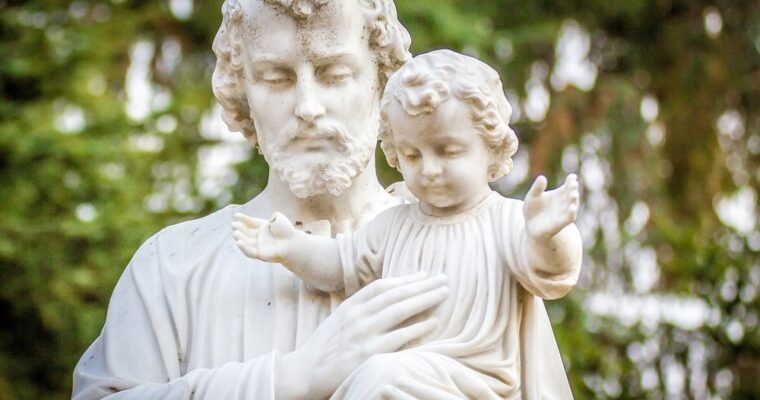
St Joseph with Infant Christ in his Arms

Read more:

St. Joseph: the supposed father of Jesus
St. Joseph is a very beloved figure venerated by Christians and with affection and incomparable devotion In his being considered the supposed father of Jesus…

Wanting today to suggest some gift ideas for Father’s Day, it seemed nice to open our article with this quote which in its simplicity perhaps contains the deepest meaning of being a father today.

The father is really a keeper, for his children, the one who has the task of protecting them as long as they are not able to walk on their own legs (and in many cases even after), helping them to grow in the best way. Too often this doesn’t happen. The modern world, with its frenetic pace, sometimes makes fathers forget their duty, makes them believe that they will have all the time to be close to their children, to have a role in their life, but that’s not the case. Children grow up fast, and it happens more and more often parents fall behind, lose any chance to exert some influence over them. Thus St. Joseph was the protector of Jesus, he was close to him in the years of his childhood, taught him his profession and transmitted his thoughts about the world and things to him.saint joseph putative father

We recall that in the Jewish world much importance was given to the relationship between fathers and sons.
In Proverbs 1,8-9 we read: Hear, my son, the instruction of your father and do not refuse the teaching of your mother; for they will be a crown of grace on your head, and bindings around your neck; or in Ephesians 6: 1-3: Children, obey your parents in the Lord, for this is right. Honour your father and mother: this is the first commandment associated with a promise: that you may be happy and enjoy long life on earth.

Gift Ideas for Father’s Day

So what would it be nice to give to someone as important as a dad on the occasion of his festival? We at Holyart have some ideas.

onyx bracelet with 4mm beads
Onyx bracelet with 4mm beads 925 silver AMEN
Buy Now
saint joseph statue
Saint joseph statue
Buy Now
St. Benedict's white dial watch
St. Benedict's white dial watch in sterling silver
Buy Now
St. Benedict cross medal
St. Benedict medal
Buy Now
camaldoli frequent wash shampoo
Men's care products
Buy Now

We talked about St. Joseph, the putative father of Jesus, whose feast coincides with that of all fathers. So why not give our dad a statue of St. Joseph, to make him understand how important we consider him? Maybe just a sleeping Saint Joseph, like the one that Pope Francis likes so much, who protects him and gives him advice.

Also to let him know that we are thinking of him, we could give him a watch or a Saint Benedict medal to protect him, perhaps one produced by a company of Italian artisans. Even today, the medal of St. Benedict is one of the most widespread and loved sacred symbols by the faithful.

Alternatively, a nice bottle of wine, perhaps bottled in an abbey, or, if our dad cares about his appearance, a bottle of cologne or aftershave produced in the Camaldoli pharmacy. If, on the other hand, we have a greedy dad, he might appreciate a good confectionery product made in the monastery. There are delicious ones, such as jams, candies, honey.

Saint Joseph’s zeppole recipe

If we manage in the kitchen, we could prepare the zeppole for him, a typical dessert of St. Joseph’s day, perhaps in the cocoa version with custard.
Put 250 ml of water on the heat, with a pinch of salt and 70 g of butter inside; when it boils, throw in 130 g flour and 30 g unsweetened cocoa powder and stir until the dough comes off the bottom of the pan. When the dough has cooled, add 4 eggs, one at a time, continuing to mix well. At this point, put the dough in a pastry bag and form the zeppole on a baking sheet covered with parchment paper, which will be cooked for 20 minutes in a ventilated oven at 200°. Open the oven for the last 5 minutes and then turn it off and let the zeppole cool inside. Meanwhile, prepare the cream by mixing 75 g flour, 75 g sugar and 4 egg yolks in a saucepan. Add vanillin and orange flavouring and 500 ml milk, slowly, stirring to avoid lumps. When the cream has thickened, remove it from the heat, let it cool and then use it to fill the zeppole di San Giuseppe. Don’t forget to garnish them with black cherries!

cocoa zeppole
Source: Pinterest


On the occasion of Pentecost, pray Mary that unties the knots

On the occasion of Pentecost, pray Mary that unties the knots

Contents1 The Origins and Meaning of Pentecost2 The Holy Spirit: What It Is and What It Represents3 Prayer to Mary who unties the knots while waiting for Pentecost4 What Mary’s knots symbolise 50 days after Easter, she will untie the knots and celebrate Pentecost, which…

Symbol of faith and courage: Joan of Arc, holy warrior

Symbol of faith and courage: Joan of Arc, holy warrior

Contents1 The story of Joan of Arc2 Trial and death at the stake3 Review of the judgment4 Saint Joan of Arc like Saint Catherine of Siena Joan of Arc, also known as the Flea of Orléans is a French national heroine. Her figure inspired the…

Pope Paul VI, his memory celebrated on May 29

Pope Paul VI, his memory celebrated on May 29

Pope Paul VI was a reserved and courteous man, with a refined intellect and great spiritual depth. He led the Catholic Church in a period of great change and knew how to combine tradition and renewal admirably.

It is difficult to think about how the Catholic Church could adapt to the modern world without losing its fundamental values and principles.

Pope Paul VI offers us an illuminating example of how this was possible, he was Supreme Pontiff between 1963 and 1978, and already joined his predecessors by playing roles of primary importance in the Italian and world religious scene.

Between the 60s and the 80s the world’s social and political reality changed radically, moving away in many cases not only from the legacy of values and social conventions that had been established in previous centuries but also separating itself from religion, from spiritualities. Think of the youth protest, which culminated in the 1968 uprisings, and led to the birth of alternative and secular cultures. But we cannot forget also the Cold War and the imposition of the communist ideology of a Marxist, secularist and anticlerical Soviet matrix, and terrorism, which in Italy manifested itself in the bloody actions carried out by groups of the extreme left and extreme right, such as the Red Brigades and the New Order.

The Church was still immersed in the events of the world, and yet her role required a change, to still allow her to intervene and make a difference. The famous phrase pronounced by Paul VI in 1968, when the wind of contestation threatened to completely overwhelm doctrines and dogmas: “We waited for spring, and the storm came”.

Even John XXIII, who preceded him on the papal threshold, tried to mediate the frictions between the Church and the new realities that opposed it, instituting the Second Vatican Council in 1962. The same Council was then carried forward by Paul VI himself, who reiterated the importance of faith and humanity as instruments of collaboration between church and world, and the church emerged reformed both internally and in its approach to modernity and other religious professions.

But in addition to external pressures that endangered the millennial integrity of the church, Paul VI also had to deal with internal problems, which made his authority falter. On the one hand, the ultra-radicals expressed their disagreement with any attempt at openness and modernisation, on the other the representatives of the clergy close to the socialist circles claimed the need for greater innovations, calling the Pope immobile. This led to continuous tensions between the Pontiff and the episcopal college, for the duration of his mandate.

If his predecessor John XXIII, to whom Paul was deeply bound by a relationship of mutual esteem and friendship, was a man open to the world, extroverted and close to the people, Paul VI was much more reserved and austere.

This did not prevent him from demonstrating great diplomatic and political skills, also thanks to the experience gained first as a senior official of the Secretariat of State, then as Archbishop of Milan and finally as Cardinal.

He was a courteous man, deeply humane, cultured and belonged to that Italian high bourgeoisie that had made the political and cultural history of the country at the turn of two centuries. A man apparently not suited to face the profound social and cultural revolutions of that time, yet, precisely thanks to his balance, able to hold the Church with a firm and sure hand through the storms of those turbulent years.

Life before becoming a Pontiff

Paul VI was born on 26 September 1897 in Concesio, north of Brescia, into the Montini family, which belonged to the upper bourgeoisie. He was baptised with the name of Giovanni Battista. His father Giorgio was a lawyer who ran the Catholic newspaper Il Cittadino di Brescia, and later he was a deputy in the Italian Popular Party of Don Luigi Sturzo. His mother Giuditta Alghisi belonged to the small local rural nobility.

He attended schools as an external student due to poor health at the college “Cesare Arici” of Brescia, run by the Jesuits. After obtaining his Classical diploma in 1916, he entered the seminary of Brescia as an external student.

In 1919 he became a member of the ICUF, Italian Catholic University Federation, of which in 1925 he would become a national ecclesiastical assistant.

He was ordained a priest on 29 May 1920, in the cathedral of Brescia.

He attended the university in Milan obtaining his doctorate in canon law, then in Rome to follow the courses of Civil Law, Canon Law, Letters and Philosophy. He also followed the courses of the Pontifical Ecclesiastical Academy and thus began to collaborate during the pontificate of Pius XI with the Vatican Secretariat of State, the body in charge of coordinating the various offices of the Holy See and relations with States and international organizations.

In 1923, he was sent for a year as an attendant to the apostolic nunciature in Warsaw, Poland, where he found himself facing the effects of local nationalism, which viewed foreigners with malice.

Returning to Italy, he obtained the three degrees and assumed the role of national ecclesiastical assistant of the ICUF, which he would leave eight years later, impatient with the continuous resistance opposed by the Jesuits and other representatives of the church regarding the difficult coexistence of the Church with fascism and the cultural and social changes underway.

In 1937, Montini was appointed substitute of the Secretariat of State and with this office he wrote the radio message read on 24 August 1939 by Pope Pius XII, meanwhile elected, to prevent the outbreak of the War.

During the war, he worked in the Vatican Information Office. He also participated in covert operations to hide and rescue thousands of Roman Jews. When at the end of the conflict the Pope was overwhelmed by the accusations of the Church’s behaviour towards Nazism he was not touched by them.

In 1944 he assumed the post of Pro-Secretary of State and continued to collaborate with Pope Pius XII, especially in defending the Catholic world from the spread of Marxist ideas.

On 1 November 1954, he was appointed Archbishop of Milan. As archbishop, he showed interest and closeness to the conditions of the workers and collaborated with unions and associations to improve them. He also started building dozens of new churches. He showed himself liberal and willing to dialogue even with schismatics, Protestants, Anglicans, Muslims and atheists, earning himself the reputation of a progressive.

On 28 October 1958, Angelo Giuseppe Roncalli, Pope John XXIII, a great friend of the future Paul VI, who was appointed Cardinal by him, ascended to the papal throne. With this new role, he travelled around the world as a representative of the Pope and was a member of the preparatory commission for the Second Vatican Council.

Pope from 1963 to 1978

After the death of Pope John XXIII, John the Baptist Montini was elected Pope on 21 June 1963, under the name of Paul VI.

Paul VI was able to support the modernisation of the Church without ever losing sight of the protection of the faith and the primacy of human rights, above all the defence of life.

He was the first pope to travel by plane, and this allowed him to travel to distant lands and have relations with statesmen and religious leaders. In particular, on the occasion of his first trip to the Holy Land in January 1964, he joined in a symbolic embrace with the Orthodox Patriarch of Constantinople Athenagoras I, and this gesture led to the rapprochement between the two churches and to the drafting of the Common Catholic-Orthodox Declaration of 1965.

He was also the first pope in history to set foot in the UN headquarters, where he issued a heartfelt appeal for peace on 4 October 1965, broadcast worldwide. We are in the middle of the Cold War, the world is split in half by the Atlantic Pact (USA and pro-American countries) and the Warsaw Pact (satellite states of the Soviet Union).

Thus the Pope said to the representatives of the state present and the whole world: “You sanction the great principle that relations between peoples must be governed by reason, justice, law, negotiation, not by force, not by violence, not by war, nor by fear, nor by deception.”

In 1967 he also established the World Day of Peace, which was first celebrated on 1 January 1968.

As we mentioned earlier, Paul VI continued the work of his successor John XXIII by carrying forward the work of the Second Vatican Council, which ended in 1965. The highlights of this Council were:

  • a better understanding of the Catholic Church;
  • reforms of the Church;
  • advancement in the unity of Christendom;
  • dialogue with the world

In particular, the reform of the liturgy already begun by Pius XII (1939-1958) was implemented with further innovations. Already with Pius XII the use of the vernacular was allowed for baptisms, funerals and other events. After the Vatican Council, in 1969, although the Missal had not undergone any particular changes, the “new Mass” in the national language was approved by Paul VI. The Tridentine continued to be celebrated in Latin.

In addition, the Sacrosanctum Concilium required the priest to administer the Mass to the faithful (versus populum) and no longer to the east (ad Deum).

The introduction of folk and modern music into liturgical celebrations was allowed until then fiercely rejected.

Still, in 1966, Paul VI abolished the index of forbidden books, maintained for over four hundred years and supported by the most conservative clergy.

He also revolutionised the papal elections, establishing the maximum age of 80 years for participation in the Conclave and limiting the ostentatious pomp on the occasion. Paul VI eliminated many ornaments that had distinguished the Papacy for centuries, going so far as to substantially modify the ceremony of the papal coronation.

On the other hand, however, he reiterated what was established by the Council of Trent regarding priestly celibacy, with the encyclical Sacerdotalis Caelibatus of 24 June 1967, and supported the traditionalist position regarding contraception, reiterating in the encyclical Humanae Vitae of 25 July 1968, what was already declared by Pope Pius XI, that it was illegal for Catholic spouses to use contraceptives of a chemical or artificial nature.

Paul VI also had the merit of attributing the title of Doctor of the Church to Saint Teresa of Avila on 27 September 1970, with the Apostolic Letter Multiformis sapientia Dei, and to Saint Catherine of Siena, on 4 October 1970 with the Apostolic Letter Mirabilis in Ecclesia Deus. They were the first women to obtain this qualification.

When St. Paul VI is celebrated

Pope John Paul II opened the diocesan process for the beatification of Paul VI. In fact, the Pope had been attributed two miracles, one linked to the healing of a child who should have been born with physical problems, the other always to a child born with a difficult and apparently desperate birth.

Paul VI was beatified on 19 October 2014 by Pope Francis. Again by Pope Francis on 25 January 2019, he established the liturgical memory of St. Paul VI on 29 May, the day of his priestly ordination.

The Papal Encyclicals

Among the various encyclicals written by Paul VI, in addition to those we have already mentioned, two are dedicated to Our Lady. This is the encyclical Mense Maio of 29 April 1965, which invites the Virgin to pray for the happy outcome of the Vatican Council and peace in the world, and the encyclical Christi Matri of 15 September 1966, a new invitation to the faithful to address their prayers to Our Lady to guarantee peace in the world. The devotion and imitation of the Mother of Christ were fundamental for Paul VI, who went so far as to affirm that the Mary-Church relationship was an integral and indispensable part of the divine Plan.

The Apostolic Exhortation Signum Magnum of 13 May 1967 deepens this relationship and underlines Mary’s role as Mother not only of Jesus but of Christians of all times.

From Eve to Mary

Read more:

From Eve to Mary: the figure of the Mother in the Bible
The mother, pillar of every family, beating heart and source of life for those who gravitate around her….

Here are all the encyclicals published by Pope Paul VI:

Ecclesiam Suam (His Church) – 6 August 1964.

Pope Paul VI’s pontifical manifesto focused on the Catholic Church and how he intended to carry out his mandate.

Mense Maio – 29 April 1965.

An invite to devotion to Mary in May for the successful outcome of the Vatican Council and peace in the world.

Spirituality and religion, Hands folded in prayer on a Holy Bibl

Read more:

How to pray for grace in the Marian Month
May, the month of love has always been dedicated to the Virgin Mary. Let’s find out how to pray for grace in this special month…

Mysterium fidei – 3 September 1965.

Focused on the doctrine and worship of the Eucharist.

Christi Matri – 15 September 1966.

I invite Christians to invoke Mary in October for peace in the world.

Populorum Progressio (The Development of Peoples) – 26 March 1967.

Dedicated to cooperation among peoples and the problem of developing countries. The Pope denounced the worsening imbalance between rich and poor countries, neo-colonialism, capitalism and Marxist collectivism. On the other hand, he proposed the creation of a world fund for aid to developing countries.

Prierdotalis Caelibatus (Priestly Celibacy) – 24 June 1967

In this encyclical, Pope Paul VI defends the tradition of the Latin Church regarding celibacy to priests.

Humanae Vitae – 25 July 1968

The last encyclical written by Pope Paul VI defines the doctrine of marriage and reaffirms the procreative purpose of the conjugal act, refusing contraception between spouses.

How to recite the supplication to Our Lady of Pompeii

How to recite the supplication to Our Lady of Pompeii

Contents1 What is the supplication to Our Lady of Pompeii?2 Prayer to Our Lady of Pompeii: the text3 Padre Pio and the Rose at Our Lady of Pompeii4 The Sanctuary of Our Lady of Pompeii The Virgin of the Rosary is celebrated on 8 May.…

Padre Pio’s devotion to Our Lady of Pompeii and the gift of the rose

Padre Pio’s devotion to Our Lady of Pompeii and the gift of the rose

Contents1 Padre Pio and the Sanctuary of the Blessed Virgin Mary of the Holy Rosary of Pompeii2 The correlation between the Madonna and the rose3 The Scent of rose of Padre Pio May 5 is the feast day of the Saint of Pietrelcina. Discover the…

The Madonna del Roseto represented by various artists

The Madonna del Roseto represented by various artists

The theme of the rose symbol of Mary is recurrent in art. Here are the most famous works depicting the Madonna del Roseto and the meaning of this flower associated with Mary.

The arrival of summer is a time of rebirth and fertility. May, the spring month par excellence, is dedicated to Our Lady and is the month in which Mother’s Day is celebrated, in Italy and other countries. Flowers are the great protagonists of the spring season: their scent and beauty have always been interpreted, in art and culture, with meanings and used as attributes for people or concepts.

How to make a sacrifice to the Madonna

Read more:

How to make a sacrifice to the Madonna
A sacrifice to Our Lady, a small sign of devotion to show great love…

In particular, the rose is often associated with love, for its intense colours and scents, purity and beauty. The rose is the flower of Mary, appeared and defined as “Mystical Rose“: Mary is the Queen of Saints as the rose is the “queen” of flowers.

The roses: symbol of Mary

The link between the Madonna and the roses, in art, has been present since ancient times. In several works, Mary is depicted in a rose garden or with a rose in her hand. The rosary itself, the prayer par excellence dedicated to Mary, takes up the image of the rose. Every Hail Mary recited in the rosary is like a rose offered to the Mother of God, and the complete rosary is like a beautiful rose garden. Sometimes, to emphasize this similarity, rosaries are flavoured with the scent of a rose or other flowers.

flowers
Check out all the spring products on our site!
Buy Now
Medjugorje rosary with lilac roses, Murano glass
Buy Now
Statue of Mary of the Mystic Rose in painted resin 30 cm
Rosa Mystica statue, 30 cm painted resin
Buy Now
Bracelet with 4 mm spheres in 925 sterling silver with resin rose pendants, a cross and a medalet
Buy Now
Our Lady of Loreto leather key ring, flower
Buy Now
Rosary in plastic with 5x5 mm flower-shaped grains, multicolour
Plastic rosary flower shaped multicolored beads 5 mm
Buy Now
Flower painting with angels plaque for girl
Little girl angel plaque floral frame
Buy Now

The Madonna del Roseto: the most famous works

The Madonna portrayed inside a rose garden is the subject of works by different artists. The two most famous are the Madonna of the Rose Garden of Stephan Lochner and that of Martin Schongauer, well known in the countries of Nordic tradition.

The first is a tempera and gold paint on the panel dated 1440-42. It is also called Madonna del Pergolato di Rose. In the painting we see Mary, who carries Jesus in her arms, sitting in a lush garden, surrounded by angels. Behind it is a pergola on which grow a large number of white roses (representing innocence and purity) and red (reminiscent of the colour of the blood of passion), along with lilies, daisies, strawberries, and acanthus.

Madonna of the Rose Garden
Font: Pinterest

The Madonna del Roseto by Martin Schongauer is an altarpiece, preserved in Colmar in the church of San Martino, dated 1473. It is considered the most important work of the artist and is recognizable for the incredibly detailed flowers and birds, the red robe of Mary and the absorbed gaze of the Virgin. The Madonna holds Jesus in her arms and is also in this case immersed in a garden of roses and lush plants. The pergola is dotted with birds that make the image lively, while two flying angels hold a crown on Mary’s head.Madonna of the Rose Garden Martin Schongauer

Other representations of Madonna del Roseto

There are many other artists who have taken up the theme of roses and flowers in their works dedicated to Mary. In The Virgin at the Fountain by Van Eyck, a famous Flemish painter, Mary stands near a fountain: behind her, the angels hold a tapestry and in the background, there is a hedge of roses.The Virgin at the Fountain de Van Eyck

In the composition of the Madonna del Roseto by Stefano da Verona, Mary and the Child are surrounded by the flowers and leaves of a flower garden. A rose is portrayed as if it had fallen on the blue mantle of the Madonna, light and fragrant. Around the angels and nature rejoice in the presence of the Virgin.The Virgin in the Rose Garden

The oil painting of the Madonna del Roseto by Bernardino Luini instead offers a gentle and delicate scene: Mary is half-portrayed and the Child has his gaze turned to the viewer. Behind them, the leaves of the rose garden are dark and create a uniform background that enhances the effect of the shading and the soft light on the subjects. Three white roses come off the bottom around the figure of Mary.Madonna del Roseto by Bernardino Luini

Finally, the great Sandro Botticelli also made a painting of the Madonna del Roseto. Mary, with a thoughtful attitude, holds the Child in her arms, lively and attentive; the figures are highlighted by the technique of chiaroscuro. Behind the Virgin, there is a garden of flowering roses.madonna by Sandro Botticelli

The tomb of Saint Peter and his incredible discovery

The tomb of Saint Peter and his incredible discovery

The tomb of St. Peter in Rome has always been considered one of the sacred places par excellence of Christianity. Simon, called Peter, was the head of the twelve apostles by the will of Jesus himself, designated by him as the head and founder of…

The story of St George who killed a dragon

The story of St George who killed a dragon

Contents1 History of San Giorgio2 Martyrdom of Saint George3 The dragon4 St. George’s Day The legend of Saint George and the dragon has become over time a parable of the struggle between good and evil. But who really was Saint George, the holy warrior? Saint…
The Last Supper by Leonardo da Vinci

The Last Supper by Leonardo da Vinci

The Last Supper by Leonardo da Vinci, in Santa Maria delle Grazie, is one of the most famous works in the world, full of religious and artistic meanings.

Leonardo da Vinci’s Last Supper is one of the most famous works of art – Christian and non-Christian – in the world. Also known as the Last Supper, it was painted by Leonardo between 1495 and 1499, in the refectory of the convent of Santa Maria delle Grazie in Milan, commissioned by Ludovico il Moro. The subject represented is the Supper that we remember on Holy Thursday, with Jesus in the centre surrounded by the twelve apostles. The moment of the Institution of the Eucharist is not represented, nor the Washing of the Feet, but the moment following the words of Jesus “one of you will betray me”.

The work marks a great change in the history of art, thanks to the expressive style that Leonardo chooses for the subject: the sacredness of the moment is expressed in the most human dimension, through the shocked expressions of each apostle. There are many copies and paintings of the Last Supper, a much-loved subject. Many artists have reinterpreted the work or taken inspiration from it: Leonardo’s Last Supper has entered the imagination and homes of many with paintings and prints.

angels of Raffaello

Read more:

5 must-have sacred images and pictures
Since the origins of Christianity, people felt the need to reproduce the object of their devotion, or something that recalled it…

The technique chosen by Leonardo was an example of his experimentation, even if it proved to be unsuccessful: not having followed the traditional fresco techniques, the painting began to degrade after a few decades. Many artists, not all experts, took care of retouching parts of the painting. For this reason, the Last Supper is one of the most restored works ever and has different levels of modifications.

In addition to the restoration work, the Last Supper was subject to numerous interpretations of meaning, some even controversial and unfounded. An example is the idea that gave birth to the novel “The Da Vinci Code” by writer Dan Brown. This interpretation held that the disciple next to Jesus was actually Mary Magdalene and that the message passed through this work that Magdalene had been Christ’s lover.

Where is the Last Supper?

Leonardo’s Last Supper is located in the refectory of the convent of Santa Maria delle Grazie in Milan. The church of the convent had been chosen as the place for the celebration of Mass by the Sforza family. Leonardo, as was his custom, made numerous studies before making the work – for example, the preparatory drawing for the Head of Christ is preserved in the Brera Art Gallery. The restoration and modification interventions were not the only rescue operations of the work: during the Second World War, the work was protected with sandbags mounted on scaffolding to make it survive as much as possible unscathed from the bombings. Now the refectory is the exhibition site of the Last Supper.

last supper scene
The last supper of Jesus and his apostles
Buy Now
Last supper in resin
The Last Supper scene in resin 9 cm
Buy Now
last supper setting for easter creche
Last Supper Easter nativity scene 9 cm 30x40x20 cm
Buy Now
hanging lamp
Nativity accessory, plastic lamp with white light, 2.5cm
Buy Now

Last Supper Leonardo analysis

The numerous analyses carried out over the years have produced different interpretations of the characters and their features. One of the first things to underline is the human dimension of representation. Jesus is represented without a halo and differs from the apostles only in the central and isolated position. The expression on Jesus’ face is full of meaning: the eyes are lowered, the lips half-open, to testify the suffering for the announcement just made to his friends. The positions of the apostles express the agitation and upheaval of the moment. The structure of the work is framed by the horizontal line of the table, on which you can see detailed dishes and crockery, and by the architecture in the background. The apostles are distributed in groups of three and each of them is characterised differently in the position.

The apostles at the Last Supper

The group on the far left of the work is made up of Bartolomeo, Giacomo and Andrea. The first two lean out towards Jesus with enthusiasm while the third raises his hands. Emotions are conveyed by the poses, thanks to Leonardo’s studies on the human body and the expressiveness of gestures.

In the second group from the left are Judas, Peter and John. Judas is recognised because he carries a bag of coins in his hand and in the agitation he is portrayed while he drops a salt shaker and withdraws. Peter has a knife in his hand, a symbol of his fiery character and an omen of the episode in which he will cut off the ear of the high priest’s servant in Gethsemane. He is bent forward towards John, and touches him with one hand, to ask him to ask Jesus who the traitor is. John, portrayed with delicate and youthful features, listens to Peter’s words with his head bent towards him.

In the first group on the right next to Jesus are Thomas, James the Greater and Philip. The figure of Thomas is completely in the background and some hypotheses say that it was added later than the original project. James the Greater is portrayed with a strong expression and his position gives the idea of a sudden movement. Filippo puts his hands to his chest with a heartfelt gesture.

The last three apostles, Matthew, Judas Thaddeus and Simon, are represented as they are animatedly confronted with each other, struck by the news just received.

Easter Nativity

Read more:

The Easter Nativity scene, an ancient tradition to be rediscovered
Easter Nativity? Of course! In our country, it is an ancient and much-loved tradition. But when should it be set up?…

The washing of the feet

Leonardo’s work is also significant for the choice of the moment of the Supper to represent. The moment of dinner is interrupted by an event even more important than the revelation of the traitor: that of the washing of the feet. Leonardo’s Last Supper is the image we recall when we think of Holy Thursday, but it is the washing of the feet that we see being enacted during the celebrations of Holy Thursday – although not this year.

last supper golden tablecloth
Last Supper statue with golden tablecloth, in resin 15x30x10 cm
Buy Now
painting in coloured laminboard
The Last Supper painting in coloured laminboard with refined wooden back 7,5X15 cm
Buy Now
Tapestry last supper
Tapestry inspired by Leonardo's Last Supper 65x110cm
Buy Now
Greek print icon with Last Supper
Greek print icon with Last Supper, hand finished
Buy Now
Bas-relief Last Supper
Bas-relief, Last Supper in multi-patinated Valgardena wood
Buy Now
Easter Monday or Angel Monday? Let’s find out why they are called so

Easter Monday or Angel Monday? Let’s find out why they are called so

Contents1 Easter Monday, Angel Monday, Little Easter2 The Catholic Feasts of Obligation3 How is celebrated Easter Monday Why is the Monday after Easter called Easter Monday? How is Angel Monday celebrated? You will find out in this article. Perhaps not everyone knows that Easter lasts…

The animal symbols of Christian Easter

The animal symbols of Christian Easter

Contents1 The lamb in Easter2 Easter Bunnies3 Lion (Lion of Judah)4 European Goldfinch5 Dove6 Easter Chick Doves, rabbits, lambs: as animals and other elements of the natural world become symbols of Easter Men have always reflected themselves in the world around them. How can it…

The mystery of the Veil of Veronica, the cloth with the imprint of the face of Jesus

The mystery of the Veil of Veronica, the cloth with the imprint of the face of Jesus

The Veil of Veronica is one of the most mysterious and fascinating relics in the history of Christianity. Where does the legend of the veil with the face of Christ come from?

Although the name Veronica is not mentioned in any of the canonical Gospels it is mentioned in several apocryphal Gospels and historical and devotional documents from the 7th century A.D. onwards. Tradition indicates her as a young woman who followed the painful ascent of Jesus with the Cross on Golgotha and who, mercilessly, wiped his face smeared with sweat, tears and blood. The face of Christ was impressed on that linen cloth. The sixth station of the Way of the Cross is dedicated to this episode. Thus was born the Veil of Veronica, one of the most enigmatic relics in the history of Christianity, the basis of many forms of devotion and the origin of countless legends.

The Veil of Veronica: to whom did it belong?

There are many theories more or less likely about what was of the Veil, or Cloth of Veronica, or even Shroud of Veronica, after the Crucifixion of Jesus. The last definition is however wrong and inevitably refers to the Holy Shroud, but the reference is wrong, since the Shroud shows the whole figure of Jesus, while the Veil would only show the Holy Face. In some ways the story of the Veil of Veronica refers a lot to the mandylion acheropita, the sacred image “not made by human hands”. Abgar V Ukama, king of Edessa, seriously ill, asked his messenger to go and make a portrait of Jesus so that he could heal him, but Jesus, met the emissary, asked him for a cloth, with which he wiped his face, leaving his features impressed. So the mandylion was born.

In another version of the story, the cloth belonged to a woman named Veronica, a follower of Jesus. She wished to have a portrait of the Lord, and for this purpose, she had purchased a white cloth to deliver to a painter who would make it for her. But she met Jesus along the way, and He asked her for that cloth, rubbed it on her face, and gave her the much-desired portrait. That same effigy was then delivered by Veronica to the Volusian messenger, who arrived in Jerusalem by order of Emperor Tiberius, who was ill. Since Jesus had already been crucified on his arrival, the poor man was about to return to Rome empty-handed, but Veronica wanted to accompany him, carrying her veil, and as soon as the Emperor saw the precious relic he healed instantly. An inscription on the remains of a casket preserved in the Pantheon still bears witness to Veronica’s journey and the arrival in Rome of what is called here the “shroud of Jesus Christ”.

Later the relic was inserted by Pope Urban VIII in one of the four chapels in the pillars that support the dome of Saint Peter’s Basilica.

The healing of the bleeding woman

Veronica is often confused with another female figure mentioned in the Gospels. It is Berenice, better known as the bleeding woman, a woman whom Christ healed from endless bleeding. The episode is mentioned in the synoptic Gospels (Matthew 9,20-22; Mark 5,25-34; Luke 8,43-48). The confusion would arise from the fact that the names of the two women have the same etymology. In fact, Veronica is nothing more than the Latin translation of the Greek name Pherenike or Berenike, whose meaning is fere nike, “that brings victory”. The name Veronica derives from the Latin form of this name, namely Bernice, which retains the meaning of “bearer of victory” or “she who leads to victory”. However, in time Bernice was altered in Veronica, to adapt it to the ecclesiastical form true icon, “true image”. The reference is to the Veil of Veronica.

The Gospel episode tells of a woman suffering from an endless haemorrhage that touched Jesus, while Jesus went to the home of Jairus to heal her sick daughter. The woman, aware that her evil made her unclean in the eyes of God and men, tried to touch Jesus without being noticed, touching his cloak, but He turned, asked who had touched him, and the trembling woman stepped forward, explaining her gesture and announcing that she was healed. Then Jesus said to her: “Your faith has saved you, go in peace”.

Saint Veronica

Veronica would therefore have been one of the disciples of Jesus, one of the many women who followed him and the Apostles, to listen to the Word and embrace its message of salvation. But there is no reliable information about it, and it really could have been just one woman among many, moved to compassion in the face of the suffering of an innocent man who was dragged to death, to the point of making his way among his tormentors to give him a last moment of tenderness and mercy. Veronica’s gesture of approaching Jesus to wipe his face, as she could have done to a brother, a relative, is an example of mercy for all of us.

Read more:

Women in the Bible: Jesus and the relationship with his disciples
What was the role of women in the history of Salvation?

According to legend, Veronica, after witnessing the Passion of Christ and His Crucifixion, decided to dedicate her life to spreading His Word. She joined the Apostles and then travelled across Europe and stayed for a long time in France, of which she is today the patron saint, to convert the Gauls. His liturgical memorial falls on July 12.

Easter in art

Read more:

Easter in art: the most beautiful artworks representing the passion of Christ
Easter is the most important celebration for Catholics.

The Holy Face of Manoppello

Another tradition related to the Veil of Veronica says that the “Holy Face” was brought to Manoppello in the province of Pescara. Examinations carried out on the relic representing the face of Christ kept here since 1506 show that on the fabric there are neither colours nor pigments, and therefore it is not explained how the image was imprinted on it. Moreover, the dimensions of Manoppello’s face coincide with those of the Holy Shroud. It was a mysterious pilgrim who brought the heirloom to Manoppello, and nothing is known about him.