The Litany of Loreto occupies a fundamental role in Marian devotion. In general, a litany is a form of prayer that involves a series of invocations or supplications, often recited in procession or in other liturgical contexts, as part of Marian worship in Catholic traditions. The Litany of Loreto, like other Marian litanies, serves to honour the Madonna and to invokeher intercession and protection. So called because they gained particular importance and diffusion in the Shrine of the Holy House of Loreto, the Litany of Loreto has been used extensively since the sixteenth century, but even earlier litanies dedicated to the Madonna were documented, dating back to the twelfth century or even before. These litanies were known as the Litany of the Blessed Virgin Mary.
The practice of the Rosary and Marian litanies developed significantly after the victory of the Christian Fleet at Lepanto on 7 October 1571. Pope Pius V, who attributed the victory to the Virgin of the Rosary, decided to add to the prayer of the Rosary the recitation of the Litany of the Madonna, which at the time consisted of around seventy invocations and was extended with the addition of the invocation Auxilium christianorum (Help of Christians).
In 1587 Pope Sixtus V officially approved the Litany of Loreto, but over the following centuries other Pontiffs made further changes and additions to reflect developments in Marian devotion and Catholic theology, such as Benedict XV, who during the First World War added the invocation Regina pacis (Queen of Peace) for peace in the world, or more recently John Paul II, who in 1995 introduced the invocation Regina Familiae (Queen of the Family).
Initially, the invocations to the Madonna were 73; in the sixteenth century, 44 supplications were counted in the Holy House of Loreto; today the Madonna is addressed with 51 titles.
What are litanies and why “Lauretan”?
Litanies represent an ancient and universal form of ritual supplication that spans different eras and religious traditions. These prayers are a means through which believers express their humility and seek a deeper connection with the divine, asking for favours, protection, or spiritual guidance. Often composed of a sequence of invocations, they represent a fundamental element in the religious practice of many cultures and traditions.
The term “litany” has its roots in the Greek word λιτή, which means prayer or supplication. In Greek mythology, the litaí were supplications personified as deities, who followed Ate, the goddess of delusion, in order to mitigate or correct its tragic consequences. This mythological image offers a fascinating link between the act of supplication and the desire to avoid the negative consequences of human actions. However, litanies are not a concept limited to Greek mythology. They are present in various forms in numerous ancient and modern religious and spiritual traditions.
In Christianity, the Litany of Loreto is particularly well known, also referred to as the Litany of the Rosary, composed of a series of invocations to the Blessed Virgin Mary with the intention of receiving her intercession.
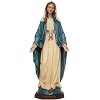
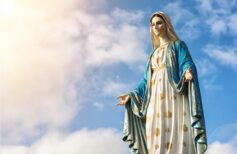
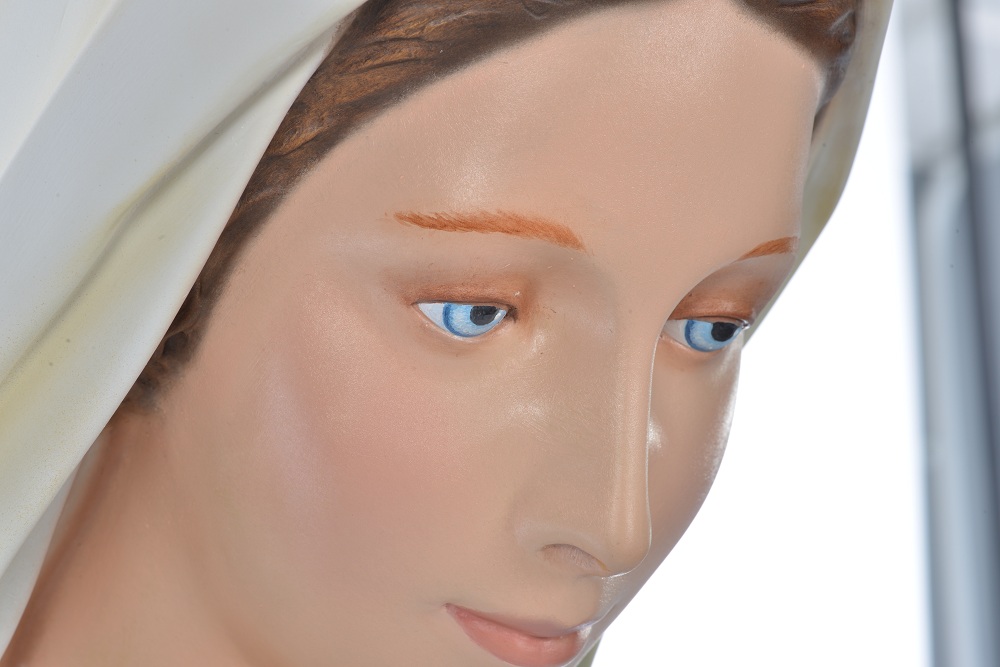
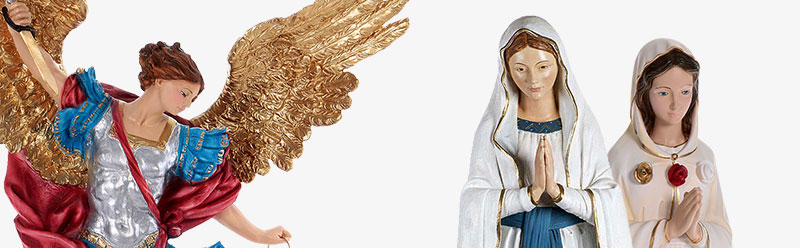
Handicraft carved with pantograph, hand finished and hand-painted. Statue blue and white with fine golden decorations.
In Islam, the ritual prayer known as Salat al-Layl, the night prayer, may be considered a form of litany, while in Hinduism there is the practice of reciting mantras, another form of litany, repeating sacred words or phrases to focus the mind and establish a spiritual connection with the deities. In Buddhism as well, litanies are used as part of prayer and meditation practices. These invocations may vary depending on the specific Buddhist tradition.
Marian litanies are a special form of prayer that honours and invokes the Madonna and her virtues. Each invocation in the Litany of Loreto is an acknowledgement of the qualities and holiness of the Madonna, defined in turn as Holy Mother of God, Mother of the Saviour, Most Prudent Virgin, and many others. These prayers emphasise Mary’s unique positionin the history of salvation and are linked to Marian titles and the symbolic meanings associated with the Madonna, described as Mirror of Divine Holiness, Spiritual Vessel, Mystical Rose, and so on.
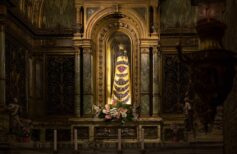
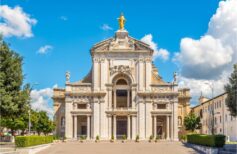
The Litany of Loreto is closely linked to Loreto, where the Basilica of the Holy House stands, one of the most important pilgrimage sites in the world. For this reason, the Litany of Loreto is also known as the Litany of the Blessed Virgin Mary of Loreto. The history of Loreto, in the Marche region, is connected to the legendary translation of the Holy House of Our Lady of Loreto, the House of Nazareth where the Madonna received the Annunciation. Catholic tradition recounts that the Holy House was miraculously transported by angels to preserve it from destruction during the Crusades. Tradition also holds that this is the house in which the Holy Family lived and Jesus grew up, and its preservation is considered a divine miracle. Today, the Basilica of Saint Mary of Loreto, which contains the Holy House, attracts millions of pilgrims from all over the world each year, and Our Lady of Loreto is loved and invoked everywhere.
The Litany of Loreto is usually recited at the end of the Rosary, but also as an independent Marian devotional practice, during celebrations dedicated to the Virgin, processions, and so on.
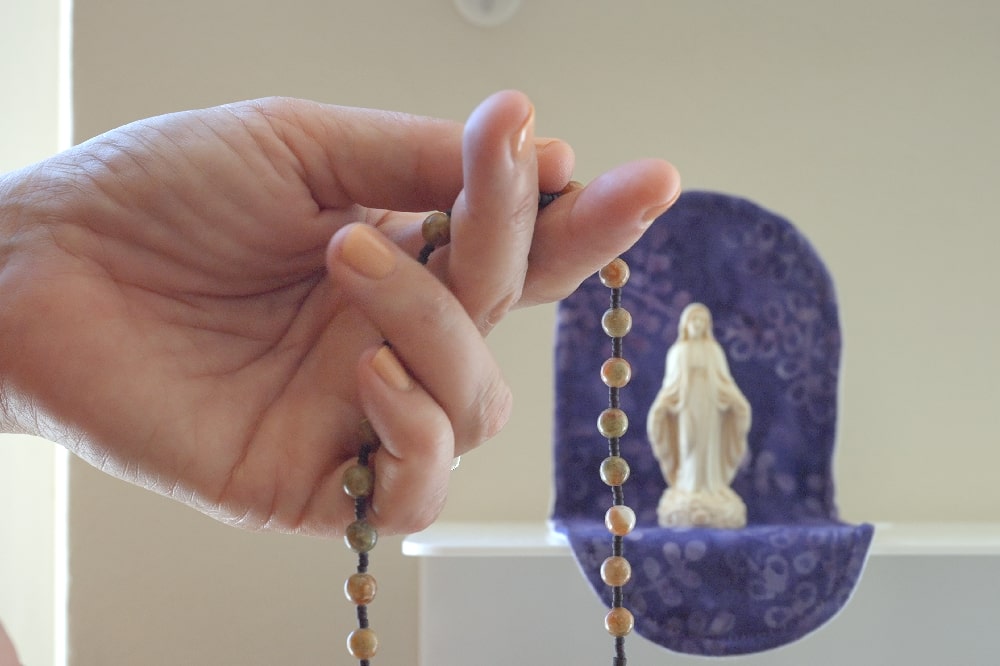
Here you will find a wide selection of rosary beads.
The structure of the litanies
The Litany of Loreto follows a particular ritual structure. These litanies are designed to be recited in alternating choirs, meaning that they involve two groups of people who respond in turn. The person leading the prayer proclaims the title or attribute associated with the Virgin Mary, while all present respond together by saying “Pray for us.”
This pattern of prayer makes the Litany of Loreto a form of collective invocation of the Madonna, in which the community actively participates. The formula “Pray for us” emphasises the request for intercession and protection from the Blessed Virgin Mary for the faithful taking part in the prayer.
The structure of the Litany of Loreto is deeply symbolic. It always begins with several invocations addressed to Our Lord Jesus Christ and the Most Holy Trinity, to emphasise the role of the Virgin as mediator between humanity and God.
In the subsequent invocations, one turns directly to the Madonna, who is called Holy Mary, Mother of God, and Virgin of Virgins. This structure helps to create a sense of unity and devotion among participants, emphasising the importance of the Madonna as intercessor and spiritual guide in the Christian faith.
The official text of the Litaniæ Lauretanae currently in use provides for the first three invocations to be addressed to Christ the Lord:
Invocation: Lord,have mercy.
Response: Lord, have mercy.
Invocation: Christ,have mercy.
Response: Christ, have mercy.
Invocation: Lord, have mercy.
Response: Lord, have mercy.
Two or more invocations addressed to the Most Holy Trinity:
Invocation: Father in Heaven, i,
Response: have mercy on us.
Invocation: Son,Redeemer of the world, who art God,
Response: have mercy on us.
Invocation: Holy Spirit, who art God,
Response: have mercy on us.
Invocation: Holy Trinity, one God,
Response: have mercy on us.
Finally, the invocations to the Madonna, to which the response is: ora pro nobis, pray for us.
The fragrances of Padre Pio represent just one of the most evocative aspects of the veneration surrounding this unique Saint....
26 August 2026
What’s the Future of Religion?
What’s the Future of Religion?
A Beginner’s Guide to Christianity
A Beginner’s Guide to Christianity
Mind-Blowing Statistics About Christianity You Need to Know
Mind-Blowing Statistics About Christianity You Need to Know
9066
Enter the Holyart world: $20 discount voucher valid on over 60,000 items
Come and discover Holyart, the largest e-commerce of religious articles in Europe and immediately receive a $20 voucher to use with your first purchase.
Check your mailbox: you will receive your discount within 5 minutes