Homepage | Religion | Solemnity of Christ the King: here is the meaning of the feast
Solemnity of Christ the King: here is the meaning of the feast
4 November 2026
Reading Time: 6minutes
Christ the King Sunday celebrates the triumph of Christ the King of the universe, His dominion over the world, over time and over our lives. Here is how this feast came about
Every year on the last Sunday of November the Catholic Church celebrates the Solemnity of Christ the King. This feast, introduced by Pope Pius XI in 1925 with the encyclical Quas Primas, is an important moment in the liturgical calendar, because it invites us to reflect on the meaning of Christ’s dominion in our lives and in the world.
The Solemnity of Christ the King was instituted during a critical historical period for the Church and the entire world. The 20th century saw the emergence of many secular and totalitarian ideologies, which sought to suppress religious faith and replace it with the worship of the state or of political leaders. In this context, Pope Pius XI wanted to reaffirm the supremacy ofChrist as King of the entire universe, emphasising that the Church and the Christian faith could not be set aside or supplanted by any human power. The Solemnity of Christ the King first of all invites us to recognise Christ as the Universal Sovereign, in a world that often idolises power, wealth and personal success. This feast reminds us that true greatness lies in humility and obedience to God. Christ is not an earthly king, but the King of Heaven and Earth, and His kingdom is not based on military force or political control, but on love, justice and truth.
These articles and statues are made respecting one of the most ancient and valuable raw materials: wood.
Furthermore, the Solemnity of Christ the King invites us to reflect on our personal relationship with Christ. It is a time to ask ourselves whether we truly recognise the Lord as King of our lives and whether we give Him His rightful place. This means putting God at the centre of our decisions, our actions and our priorities. It also means accepting His guidance and His teaching as the compass for our lives.
Among the readings prescribed for the Solemnity of Christ the King is Jesus’ final discourse, before the beginning of the Passion, from the Gospel of Matthew (Mt 25:31-46), in which Jesus speaks of the Final Judgement:31 When the Son of Man comes in his glory with all his angels, he will sit on the throne of his glory. 32 All the nations will be gathered before him, and he will separate them from one another, as the shepherd separates the sheep from the goats, 33 and he will place the sheep on his right and the goats on the left. In this passage, Jesus states that at the end of time, everyone will be judged according to the way in which they have treated others, especially those most in need. Christ teaches us that the sign of his kingdom is concrete love and compassion for others. Therefore, celebrating Christ the King also means committing ourselves to living a life of charity and service towards others.
Today, the Solemnity of Christ the King is more relevant than ever. In a world marked by divisions, social injustices and humanitarian crises, we need more than ever a kingdom based on love, justice and solidarity. This feast invites us to work towards a world in which the kingdom of Christ is a reality, in which people are treated with dignity and respect, and in which peace and justice prevail.
The fact that the feast of Christ the King coincides with the last Sunday of the liturgical year makes its value even more evident, namely that of identifying Christ as King of history and time, the beginning and the end, the Alpha and the Omega, of the entire existence of creation.
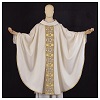
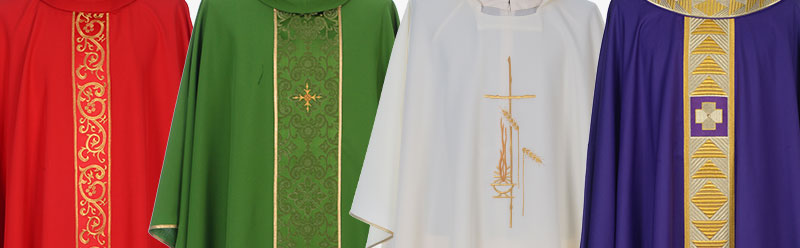
Elegant and solemn chasuble made of a very light woolen fabric enriched by lurex threads and by a separate pallium as collar and orphrey.
How the feast came about
We have mentioned the introduction of the Solemnity of Christ the King by Pope Pius XI, in 1925. In reality, the need to recognise Christ as King of the world and of time arose much earlier. Pope Leo XIII had already instituted in May 1899 the Universal Consecration of Mankind to the Heart of Jesus, with the Encyclical Letter Annum Sacrum, proclaiming the importance of devotion to the Sacred Heart of Jesus, a symbol of divine love and mercy, and as such worthy of profound veneration. The Heart of the Son of God, who died on the cross, becomes an everlasting source of eternal life and hope for every person, for the new humanity more than ever in need of building a world made of love and respect.
At the same time as Pope Leo XIII’s encyclical, the Sardinian Jesuit Sanna Solaro, together with other scholars, theologians and men of faith, undertook a series of initiatives to promote the institution of a liturgical feast dedicated to Christ the King. In particular, Solaro wrote to all the Italian bishops, imploring them to champion this cause, and forty-nine bishops agreed to support him.
After the International Eucharistic Congress of Rome in 1922, sixty-nine prelates signed a further petition to institute a liturgical feast dedicated to Christ the King and sent it to Pope Pius XI, who in 1925 received a third, this time signed by three hundred and forty cardinals, archbishops, bishops and superiors general, and also supported by religious orders and congregations, Catholic universities and hundreds of thousands of faithful throughout the world. The Pope, at the close of the Jubilee of that year, consented to the request and instituted, with the aforementioned encyclical Quas Primas, the Solemnity of Christ the King, an occasion for common celebration and reflection to recognise the supremacy of Christ as King of Heaven and Earth and to commit ourselves to living according to his teachings in order to create a world based on love and compassion. In the Pope’s intentions and words, the Feast of Christ the King was to be a response and a remedy to the secularism of the modern world, atheist and secularised, guilty of having deprived the Christian religion of all value, making it equal to all other false religions, subject to civil power and to the arbitrariness of the powerful.
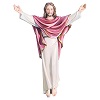
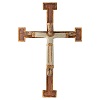
Majestic crucifix representing Jesus Christ, Priest and King, this statue is made of pyrenean stone and it is hand-painted by the nuns of the monastery of Bethleem.
The feast of Christ the King
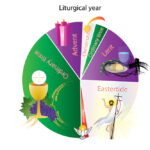
Established by Pope Pius XI on the last Sunday of October, after the Second Vatican Council the Solemnity of Christ the King was moved to the last Sunday of the liturgical year, before the Sundays of Advent.
Since 2021 at diocesan level, together with the Feast of Christ the King, the World Youth Day has been celebrated, previously celebrated on Palm Sunday. On Sunday 20 November 2022, the Solemnity of Christ the King, Pope Francis, after presiding over the Eucharist and the Angelus prayer, presented the 2023 World Youth Day in Lisbon, proposing its theme – Mary arose and went with haste (Lk 1:39) – and inviting young people to take part.
More and more often, cremation is being chosen for deceased loved ones. But what happens afterwards? Here is what you...
21 October 2026
What’s the Future of Religion?
What’s the Future of Religion?
A Beginner’s Guide to Christianity
A Beginner’s Guide to Christianity
Mind-Blowing Statistics About Christianity You Need to Know
Mind-Blowing Statistics About Christianity You Need to Know
9603
Enter the Holyart world: $20 discount voucher valid on over 60,000 items
Come and discover Holyart, the largest e-commerce of religious articles in Europe and immediately receive a $20 voucher to use with your first purchase.
Check your mailbox: you will receive your discount within 5 minutes