For the Catholic Church, marriageis not only the crowning of a love story, the human choice of two individuals, a man and a woman, who decide to unite their destinies and create a family. Marriage is one of the seven sacraments, a bond that Jesus elevated to sacredness, and which unites not only two people in life, but also two Christians in their journey of faith, in a profound and irreversible way. This is why attending a pre-marriage course is of great importance, and not only from a strictly religious point of view. Perhaps not everyone knows that the marriage course is an indispensable condition for getting married in church and that certain parish priests only allow wedding invitations to be sent once the attendance certificate of the said course has been obtained. This is because, for many young couples, the pre-marriage course can represent a moment of truth, an opportunity to question themselves in the face of issues and topics that they may not yet have considered during their engagement, but which could prove fundamental in determining the success or otherwise of their imminent union.
Thus, this series of meetings—usually 6, maximum 10, each lasting 1 or 2 hours—helps on one hand to organise the church wedding in the best possible way by providing all the necessary information, and on the other to lay the first foundations for living together and planning married life.
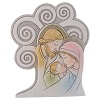
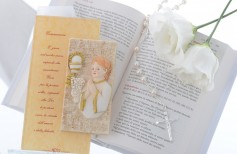
Stylized small bed headpiece depicting the Holy Family
How does a pre-marriage course work?
When organising a Christian wedding, there are many steps that need to be taken into account. We have tried to summarise them in a previous article dedicated precisely to how to organise a Catholic wedding and, among the various appointments, ranging from booking the church to planning the wedding banquet, we have indicated attending the pre-marriage course.
For details it is advisable to contact your parish priest directly, or your partner’s parish priest. Usually, the meetings are led by a priest, but there are also parishes in which married couples take on this very delicate role. If you do not have time to attend a regular pre-marriage course with weekly meetings, there is the possibility of attending ‘intensive’ courses lasting one or more weekends, during which the couple is hosted in a religious facility and experiences a true full immersion! Usually these courses require a fee, unlike parish courses which are free of charge.
At the end of the course, a certificate of attendance is issued, which represents one of the documents required for marriage in church.
For couples living in different cities and who, for work reasons, cannot attend the pre-marriage course together, the parish priest may allow only the future spouse who is able to be present to attend, while the other person may write a kind of pledge to show their intention to take a tailored course as soon as possible. Alternatively, a particularly accommodating parish priest may grant the couple an accelerated and personalised course just for them in the days immediately preceding the ceremony.
In the case of marriage between a believer and a non-believer, or between people of different religious denominations, it will be appropriate for the Christian in the couple to attend the pre-marriage course anyway, and for their partner to fully respect this choice, just as they will have to respect their religious choices in the future.
The pre-marriage course will also help us, among other things, to navigate through the maze of documents required for marriage in church. In addition to the documents needed for civil marriage, namely:
birth certificates;
certificates of residence;
certificates of citizenship;
for a religious marriage you will also need:
the Baptism certificate (issued by the parish where one was baptised);
the Confirmation certificate (often the date of Confirmation is included in the Baptism certificate, in which case the first certificate is sufficient);
the ecclesiastical certificate of freedom, which states that the applicant has not contracted a previous religious marriage;
the certificate of attendance at the pre-marriage course;
the ecclesiastical Nulla Osta: required only if the couple wishes to marry in a parish other than their own or outside their municipality of residence.
With what spirit should one approach a pre-marriage course?
What a future bride or groom is about to undertake is the adventure of a lifetime, a fundamental step. For this reason, the pre-marriage course should not be regarded as a nuisance or a waste of time, but as an opportunity for dialogue, first and foremost with the person with whom we intend to spend the rest of our life, but also with other couples, like us, about to embark on this journey. Men and women with whom we can share thoughts and concerns that make this occasion both unique and wonderful, but also very stressful, and with whom we can compare ourselves on a whole series of topics and issues—sometimes sensitive—that we have never had to, or wanted to, deal with with our partner.
In a word, we can therefore say that the main requirement for approaching a pre-marriage course is openness: openness to change, openness towards the person we love, and openness towards others, together with the willingness to question ourselves. Because what is at stake is truly great and important, and it is worth doing things to the very best of our ability.
The fragrances of Padre Pio represent just one of the most evocative aspects of the veneration surrounding this unique Saint....
26 August 2026
What’s the Future of Religion?
What’s the Future of Religion?
A Beginner’s Guide to Christianity
A Beginner’s Guide to Christianity
Mind-Blowing Statistics About Christianity You Need to Know
Mind-Blowing Statistics About Christianity You Need to Know
9377
Enter the Holyart world: $20 discount voucher valid on over 60,000 items
Come and discover Holyart, the largest e-commerce of religious articles in Europe and immediately receive a $20 voucher to use with your first purchase.
Check your mailbox: you will receive your discount within 5 minutes