The Sermon on the Mount, reported in the Gospel according to Matthew (Matthew 5:1-12), is undoubtedly Jesus’ most famous sermon and, perhaps, of all history. Delivered on a mountain in Galilee, before a large crowd of disciples and onlookers, this sermon represents a milestone in Christianity, as it summarises the ethical and spiritual principles that underlie the Christian faith.
What makes the teaching expressed by the Sermon on the Mount particularly revolutionary is its absolutely innovative content, for the historical moment in which it was pronounced. Jesus’ words are extraordinary for their time, and it is not difficult to understand how they continue to inspire believers and nonbelievers today. Jesus overturns the expectations and conventions of the time, preaching a message of love, forgiveness, justice and compassion that challenges the hierarchies and hypocrisies of society.
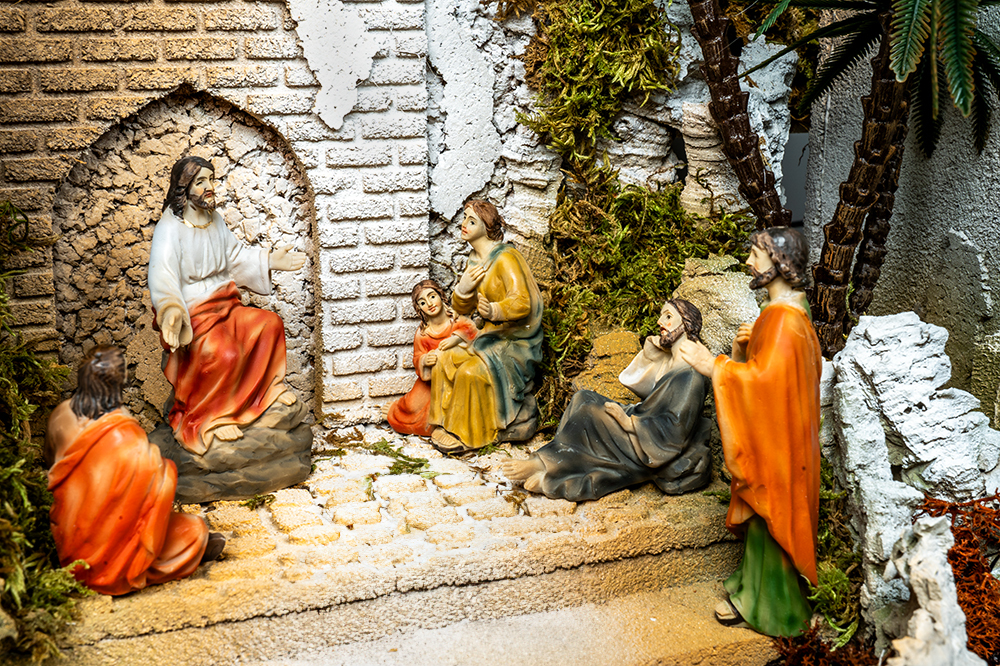
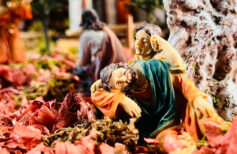
Statuette representing a specific moment in the life of Jesus when he climbed a mountain and sat down to teach a group of people.
Through the Sermon on the Mount, Jesus offers a transformative vision of divine law, delving into the fundamental principles of the Ten Commandments and inviting his listeners to understand the heart of morality and spirituality. His words are not mere legal norms, but principles that embrace love, compassion, justice, and mercy.
In this sense, the Sermon on the Mount offers a model of ethical and spiritual life that goes beyond mere formal observance of the Commandments to embrace a challenging call to inner transformation and life according to the values of the Kingdom of God.
The Beatitudes in Jesus’ Sermon on the Mount
At the centre of the Sermon on the Mount, we find the Beatitudes, proclamations of happiness that turn their attention to the least, to the marginalised, to those who suffer. Jesus proclaims blessed the poor in spirit, the afflicted, the meek, the persecuted for justice, teaching that true happiness is found in the search for God and in love for one’s neighbour.
The Beatitudes represent the beating heart of the Gospel. They reveal to us a God who cares about our joy and who tells us how to obtain it and how to embrace authentic life and true fulfilment. They are not just a list of abstract precepts, but the joyful proclamation of the life given by God to those who love, of a new world characterised by peace, sincerity, and justice.
With the Beatitudes, Jesus offers us a new concept of Holiness, incarnate and tangible, and reveals to us who the blessed truly are.
The evangelical beatitudes are present both in Jesus’ Sermon on the Mount and in the Sermon on the Plain in the Gospel according to Luke (Lk 6:20-38). They constitute an essential component of Christ’s teachingsand offer a profound and universal spiritual guide to all who seek the way of beatitude and divine benevolence.
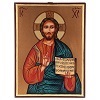
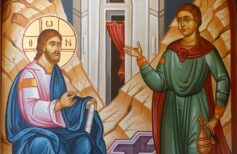
This icon was painted by hand in Romania using the traditional iconographic technique.
Their importance is such that a reduced version of the beatitudes is also found in verses 54 and 69 of the Gospel of Thomas, an apocryphal gospel that does not narrate the life of Jesus, but collects his sayings.
Jesus offered a precious gift to humanity through the Beatitudes. These teachings not only describe the path to true happiness, but also provide a pattern of living based on the spiritual values He has embodied. Those who embrace this model of life, living according to the teachings of Jesus, are already on the way to salvation.
The Beatitudes, with their unique perspective on happiness and virtue, represent a fundamental starting point for those who seek the most profound meaning of their existence. Following the teachings of Jesus and living according to the Beatitudes orients one toward authentic joy and spiritual fulfilment.
The Sermon on the Mount from Matthew 5:1-12 contains nine of them:
Blessed are the poor in spirit, for theirs is the kingdom of heaven. Blessed are the afflicted, for they will be comforted. Blessed are the meek, for they will inherit the earth. Blessed are those who hunger and thirst for righteousness, for they will be satisfied. Blessed are the merciful, for they will find mercy. Blessed are the pure in heart, for they will see God. Blessed are the peacemakers, for they will be called children of God. Blessed are those who are persecuted because of righteousness, for theirs is the kingdom of heaven. Blessed are you when they insult you, persecute you and, lying, they will say all kinds of evil against you because of me. Rejoice and rejoice, for great is your reward in heaven.
The Gospel of Luke contains four beatitudes combined with four woes.
The four beatitudes (Lk 6:20-23) are:
Blessed are you poor, for yours is the kingdom of God. Blessed are you who hunger now, for you will be satisfied. Blessed are you who weep now, for you will laugh. Blessed are you when men hate you and when they banish you and insult you and reject your name as wicked because of the Son of Man. Rejoice in that day and leap for joy, for behold, your reward is great in heaven. For that is how their ancestors treated the prophets.
The four woes (Lk 6:24 -26) are:
But woe to you, rich people, because you already have your consolation. Woe to you who are now satiated, because you will be hungry. Woe to you who are now laughing, because you will be afflicted and you will weep. Woe to you when all men speak well of you.
Lastly, in the Gospel of Thomas, we read:
«Jesus said, ‘Blessed are the poor, for theirs is the kingdom of heaven.’» (Gospel of Thomas, 54)
«Jesus said, ‘Blessed are you, when you are hated and persecuted; and there will be no place left where you will be persecuted.” Jesus said, “Blessed are those who have been persecuted in hearts: it is they who have truly come to know the Father. Blessed are those who endure hunger, so that the stomach of the needy may be filled.”» (Gospel of Thomas, 68-69)
Sermon on the Mount: meaning
Jesus’ Sermon on the Mount also offers teachings on thecorrect way to live and pray, stressing the importance of an authentic inner life and sincere religiosity, far from hypocrisy and ostentation. Jesus defines his disciples as the salt of the earth and the light of the world, urging them to shine their light before men, as a model of virtue and demonstration of the existence of God the Father.
Read more:
How to pray for grace in the Marian Month
May, the month of love has always been dedicated to the Virgin Mary. Let’s find out how to pray for grace in this special month.
The First section of the Sermon on the Mount (5:17-48) deals with the complete fulfilment of the Law and the Prophets, but with new presuppositions, derived from the Ten Commandments, which go beyond the simple written rule, invoking mercy, piety and love for one’s neighbour.
Fundamental is the reassurance that Jesus provides, regarding His will to fulfil what is written in the Law and announced by the Prophets, not to abolish or renege on everything that was written and said before His coming (17 Do not think that I have come to abolish the Law or the Prophets; I have not come to abolish, but to fulfil). This statement is important because it reaffirms the continuity between the Jewish tradition and Jesus.
The sermon continues with a new definition of Justice by Jesus. Authentic justice, according to God’s will, goes beyond the legalistic rigorism of the scribes and Pharisees, who cling to the letter of the law without understanding its true spirit (20 For I tell you, unless your righteousness exceeds that of the scribes and Pharisees, you will not enter the kingdom of heaven). This divine justice is permeated by love, capable of forgiving and embracing the authentic joy that comes from the living Word that resonates within us. Instead of being imprisoned in the rigidities of external legality, unnecessarily severe and deaf to God’s Mercy, God’s true justice is expressed in forgiveness, mercy and love towards others. It is a justice that frees hearts from hypocrisy and pride, allowing them to live according to the principles of compassion and humility taught by Jesus.
A deepening of the Ten Commandments follows, with examples and explanations: do not kill, live in concord with your brothers, agree with your adversaries, do not commit adultery, not even with thought (28 but I tell you: whoever looks at a woman to desire her, has already committed adultery with her in his heart), do not perjure yourself.
The crucifix is a represantation of Moses’ staff, while the centrepiece represents the tables of the 10 Commandments, written in english.
Again, Jesus recommends that you do not react to offenses with violence (39 but I tell you not to oppose the evil one; indeed, if one strikes your right cheek, you also turn the otherto him) and invites you to love your enemies: “44 But I tell you: love your enemies and pray for your persecutors, 45 so that you may be children of your heavenly Father, who makes his sun rise on the evil and on the good, and makes it rain on the just and on the unjust. 46 For if you love those who love you, what merit have you?” This exhortation adds to and completes the commandment to love one’s neighbour, adding to it love for the enemy and for the stranger, as we also see, for example, in the Parable of the Good Samaritan.
The Second section of the Sermon (6:1-18) instead focuses on the fulfilment of justice before God, against human pride, ostentation and self-referentiality.
All the rules of conduct and coexistence listed in the first part must not be followed only to gain the admiration of others. In the same way, good works, charity, mercy, do not need an audience that approves them: “2 Therefore, when you give alms, do not blow the trumpet before you, as the hypocrites do in the synagogues and in the streets to be praised by men. Amen, I say to you, they have received their reward. 3 But when you give alms, let not your left hand know what your right hand is doing, 4 so that your alms may remain secret; and your Father, who sees in secret, will reward you.”
In equal measure, prayer should not necessarily be practised in public, to be seen by men. It is only to God that we must turn, in an intimate and secret conversation: “6 But you, when you pray, enter your room and, closing the door, pray to your Father in secret; and your Father, who sees in secret, will reward you.”
The Lord’s Prayer
The Sermon on the Mount also includes the Lord’s Prayer, the prayer with which Jesus teaches the disciples to address God the Father correctly.
Within the Sermon on the Mount, the Lord’s Prayer assumes a central role, because it presents a simple but meaningful model of prayer, an instrument that is not only a formula to be recited, but a teaching of deep intimacy with God, with the trust and confidence that could be reserved for a loving Father.
Our Father prayer ring in English. Stainless steel, polished and brilliant ring with engraved Our Father prayer in English.
The Lord’s Prayer is articulated in three statements that express our commitment to witnessing the holiness of God’s name, promoting the coming of his kingdom, and accepting and fully adhering to his will.
After the declarations, there are three fundamental requests in the Lord’s Prayer: the plea for daily support from God, represented in the bread that we need every day; the request for forgiveness for our sins, symbolised by the act of asking for the remission of our spiritual debts; finally, the prayer for salvation and protection from any evil and temptation that may divert our path.
This prayer thus becomes a complete model of communication with God and commitment to others, reflecting the essence of the Christian faith in the relationship with the Divine and with one’s neighbour.
The fragrances of Padre Pio represent just one of the most evocative aspects of the veneration surrounding this unique Saint....
26 August 2026
What’s the Future of Religion?
What’s the Future of Religion?
A Beginner’s Guide to Christianity
A Beginner’s Guide to Christianity
Mind-Blowing Statistics About Christianity You Need to Know
Mind-Blowing Statistics About Christianity You Need to Know
8888
Enter the Holyart world: $20 discount voucher valid on over 60,000 items
Come and discover Holyart, the largest e-commerce of religious articles in Europe and immediately receive a $20 voucher to use with your first purchase.
Check your mailbox: you will receive your discount within 5 minutes