Much of the deep symbolism that permeates sacred icons comes from the colours with which they are painted. Each colour in Christian iconography has a precise meaning, codified over the centuries and handed down for generations by the artists of ancient sacred icons. It remains valid today for the authors of hand-painted icons. Thus, white is the expression of Divine Light; overseas blue symbolises God; dark red symbolises humanity; bright red symbolises beauty; black symbolises death and evil. How were these colours spread? And how are they still used today, for sacred handmade icons? The secret of religious icons is in the egg tempera.
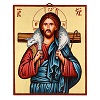
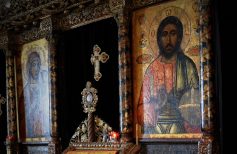
Icon of Christ, the Good Sheperd, depicted in his glory and with his cross. He is the sheperd who saves the sinners with his immense love.
What is egg tempera
It is in the Byzantine world, the cradle of the cult of icons, that the egg tempera technique was born. This system of colour mixing then spread throughout the Mediterranean and reached its peak in the Renaissance, where all the great masters used it until the emergence of oil painting. Some 19th-century painters will then take it up.
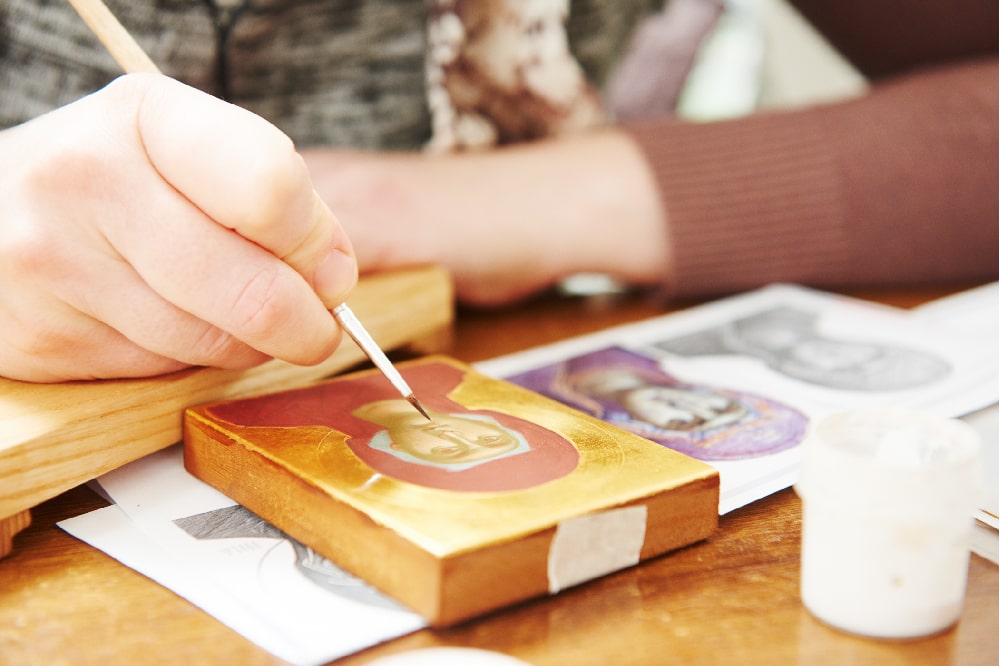
There were several methods for producing colour in tempera painting: the most classic, still in use today, involves mixing egg red with colours, usually pigment powders of mineral, vegetable, or animal origin, in equal parts of powder and water, with one part of egg. But there were more imaginative systems, such as beating the yolk with cut fig branches, from which the characteristic “milk” emerged, which reacted chemically with the egg, delaying the drying of the colours during the laying phase and favouring coagulation. Egg-red tempera is denser and more malleable than other temperas, making it suitable for very accurate work.
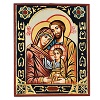
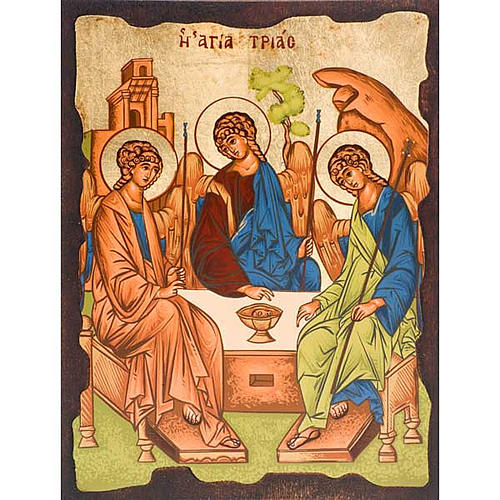
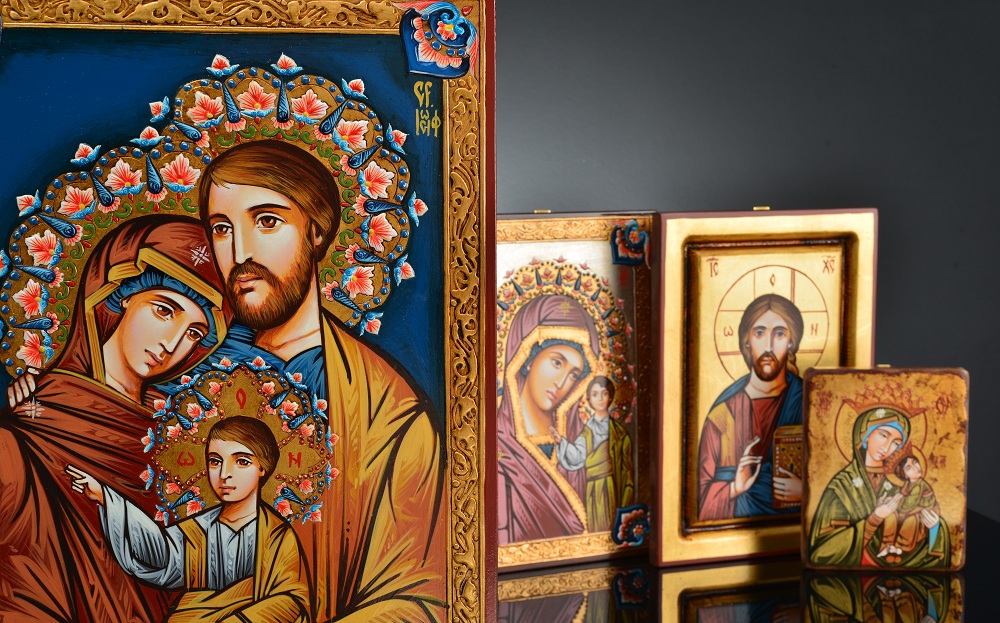
A hand-painted icon depicting the Holy Family from Rumenia. The three people form a triangle, the symbol of perfection.
The pictorial technique of egg tempera in sacred icons
Among the pictorial techniques, the egg tempera is very ancient, and already contains symbolic and spiritual elements. Moreover, the Russian and Greek sacred icons convey symbolic meaning in every aspect, from the support to the colour to the techniques used, right down to the final result. In the case of painting with egg tempera, we see the egg yolk, which symbolises the hidden life ready to be born. Still, also Christ who rises from the dead, mixed with white wine, which in the Eucharistic celebration becomes a manifestation of Christ and the Covenant. This emulsion is then used to dissolve the powder pigments, which make up the colours, each with its own symbolism, as we have mentioned, sometimes with the addition of a fragrant essence, to hide the unpleasant smell of the mixture. Even in the fragrance, there is a symbolic value, which refers to the anointing of Jesus.
Read more:
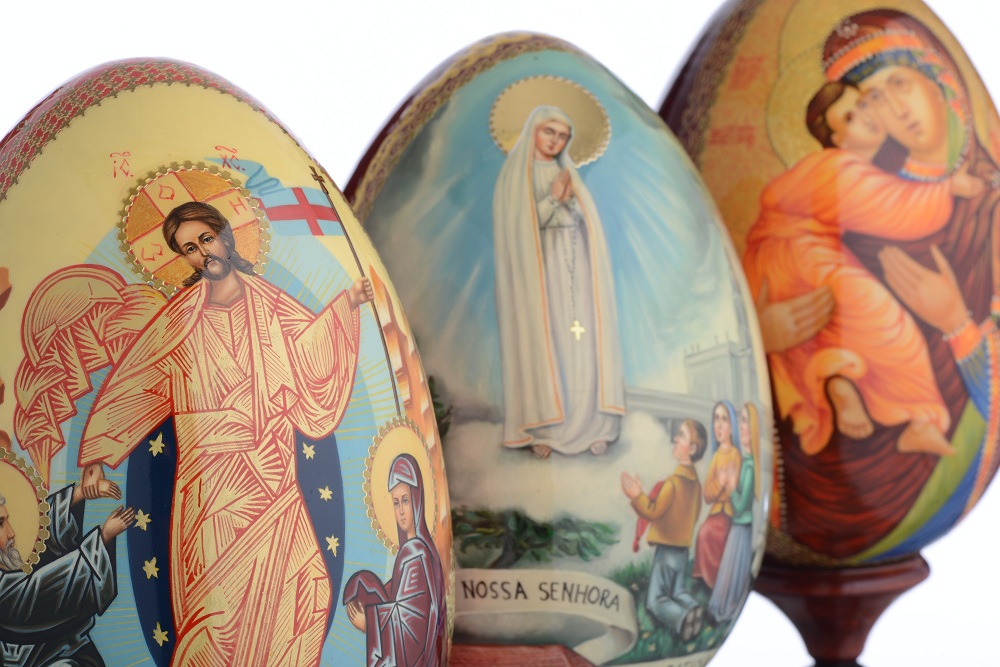
The Egg as a symbol of Easter
Whenever we think of Easter, apart from the religious significance of this festival for Christians…
A symbolism that transcends matter, therefore, every detail is aimed at expressing a superior concept, a meaning. It is no coincidence that we have defined the creator of icons as a writer rather than a painter, capable of intertwining all his work with hidden spiritual messages, and a sacred icon as a theological mission, rather than an artistic one. Thanks to painting with egg tempera, life enters colour, and with it the Word of God.
The iconography of the saints, each represented with their attributes, symbols, clothes and colours, is also indebted to this pictorial technique.
In the painting of the icons, the colours obtained from natural pigments, mixed with egg red, were then combined with white or soot to create shades. The volume of the shapes was defined using darker shades first and gradually lighter. The painting was finally passed with a transparent paint that protected it and emphasised the colours.
Sacred Icons: the ultimate guide
Only mentioning them evokes exotic and charming suggestions, a way to live religion that is far from the modern concept only at first glance.
Egg tempera: recipe
Do you want to try preparing egg tempera at home? Get yourself an egg, wine vinegar and some water.
First, separate the yolk from the egg white, making sure not a bit of it remains. You can help yourself with paper towels for this. Drop the yolk into a container, gently removing the skin that encloses it. Add the same volume of water and a few drops of wine vinegar. Stir until a uniform emulsion is obtained. The vinegar will keep the mixture flowing for longer.
At this point, take the dulling pigments and let your creativity run wild!
The fragrances of Padre Pio represent just one of the most evocative aspects of the veneration surrounding this unique Saint....
26 August 2026
What’s the Future of Religion?
What’s the Future of Religion?
A Beginner’s Guide to Christianity
A Beginner’s Guide to Christianity
Mind-Blowing Statistics About Christianity You Need to Know
Mind-Blowing Statistics About Christianity You Need to Know
8761
Enter the Holyart world: $20 discount voucher valid on over 60,000 items
Come and discover Holyart, the largest e-commerce of religious articles in Europe and immediately receive a $20 voucher to use with your first purchase.
Check your mailbox: you will receive your discount within 5 minutes