Homepage | Religion | Saint Andrew the apostle: the story of the saint and his connection to the city of Amalfi
Saint Andrew the apostle: the story of the saint and his connection to the city of Amalfi
8 July 2026
Reading Time: 6minutes
Saint Andrew was one of Jesus’s apostles. The brother of Peter, he spread the Word of God to distant lands and died a martyr in Patras. Today he is venerated and loved all over the world.
On 30 November, Saint Andrew is celebrated in many parts of the world. One of the twelve apostles of Jesus Christ, Andrew – also known as Protocletos, or the First Called, according to Orthodox tradition – was born in Bethsaida, Galilee, and was the brother of Peter. His life and work have been the object of veneration in both the Catholic and Orthodox Churches, and he is considered a myroblyte saint – one whose body emits a sweet fragrance, like Saint Padre Pio of Pietrelcina.
Andrew is associated with numerous miracles and legends. He is said to have performed many wonders, including healing the sick with the manna that flows from his tomb, and played a key role in the miracle of the loaves and fishes. It was Andrew who brought to Jesus the boy who had five loaves and two fishes, which enabled the miracle to take place.
Read more:
The miracles of Jesus in the four Gospels
The miracles of Jesus mentioned in the Canonical Gospels are considered historical events, although told from a theological perspective. Here are …
Thanks to his devotion to Jesus and his contribution to the spread of Christianity, Saint Andrew has become a model of faith and commitment for believers through the ages. His figure is still revered in both the Catholic and Orthodox Churches as an example of fidelity to Jesus and service to the Kingdom of God.
The Story of Saint Andrew
Born in Bethsaida, Galilee, Andrew was first a disciple of John the Baptist before following Jesus – it was in fact John who pointed out Jesus to him, saying, “Behold the Lamb of God.” Like his brother Simon Peter, Andrew was a fisherman, and like him, was called by Jesus to become a “fisher of men” – or souls. Indeed, Andrew was the first to recognise Jesus as the Messiah and introduced Him to his brother. He is mentioned often in the Gospels, though less frequently in the Acts of the Apostles, and was present at many significant moments of Jesus’s earthly life, as one of the disciples closest to Him.
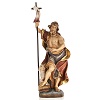
Statue in maple wood completely handmade and painted by Italian craftsmen.
After the death of his Master, Andrew set off on a mission, devoting himself to preaching the Gospel and guiding people towards salvation. He is especially venerated in Greece and Russia, where he is regarded as the national patron saint. Tradition holds that he travelled widely on missions throughout Asia Minor and the regions along the Black Sea, including Scythia, and as far as the Volga and Dnieper rivers. According to one academic tradition, he spent about 20 years among the Daco-Roman peoples, living in a cave near the village of Ion Corvin, in present-day Romania. Yet Saint Andrew is celebrated in many other places around the world – in Scotland, for example, he is the national patron saint.
According to tradition, Saint Andrew is also considered the founder of the episcopal see of Byzantium, where he served as bishop.
Saint Andrew died by crucifixion in Patras, Achaea (Greece), under the reign of Nero, probably around AD 60. Out of humility, he requested to be crucified on an X-shaped cross, not wishing to imitate Christ even in death. This particular cross has since become known as Saint Andrew’s Cross. He became the patron saint of Patras, where parts of his relics are still kept to this day.
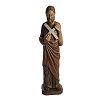
Saint Andrew in stone, in Pyrenees stone and resin measuring 72cm.
The Miracle of the Manna
Among the many miracles attributed to Saint Andrew, one of the most well-known is the Miracle of the Manna, which is said to flow from his relics and tomb in Amalfi. This extraordinary phenomenon is somewhat reminiscent of the liquefaction of Saint Januarius’s blood in Naples. From the tomb where Saint Andrew’s body is kept, in the crypt of Amalfi Cathedral, a miraculous, oily substance emerges – recalling the manna sent by God to feed the Israelites in the desert during the Exodus.
The miracle first occurred on 29 November 1304, a century after Saint Andrew’s body was brought to Amalfi. While Mass was being celebrated in the crypt, an elderly pilgrim approached the grate beneath the altar and alerted the celebrant that something unusual was happening. A mysterious liquid was discovered seeping from the stone that had once sealed the silver urn containing the saint’s relics. The manna was distributed to those present, and a man who had been blind for seven years recovered his sight after it was applied to his eyes. Many other miracles have since been attributed to the manna, and it is even said that the great poet Torquato Tasso was cured of a serious illness thanks to it.
The manna is collected seven times a year on various occasions: 28 January, 26 June, 1, 21 and 29 November, and 7 and 24 December. Its presence is seen as a sign of joy and favour from Saint Andrew; its absence, as an omen of misfortune.
The Feast of Saint Andrew in Amalfi
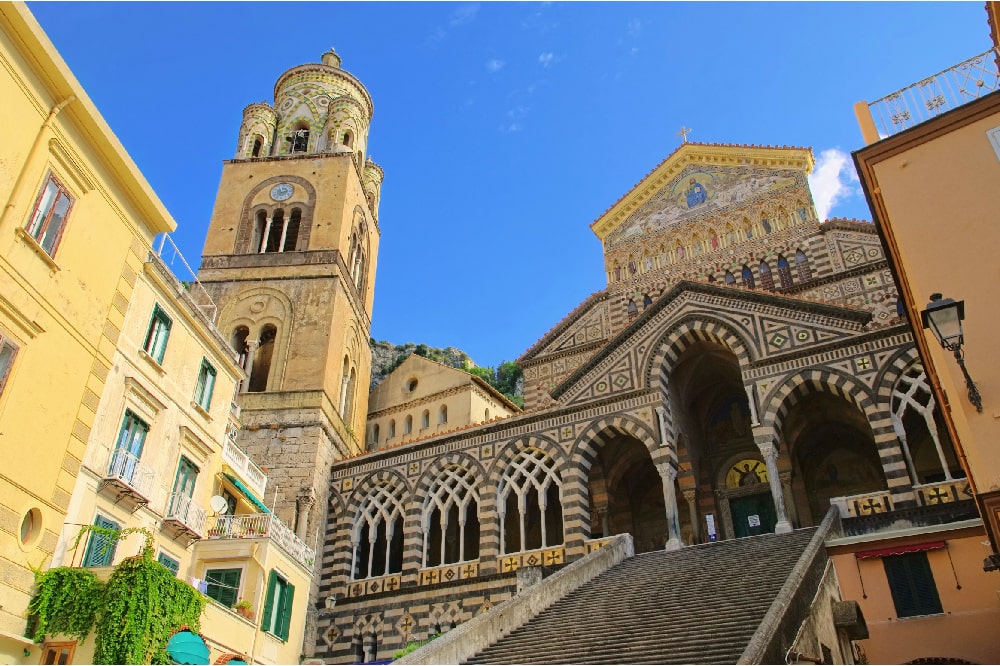
Although Saint Andrew is celebrated on 30 November in both the Eastern and Western Churches, the city of Amalfi honours him as its patron saint on 27 June. In this picturesque coastal town stands the Cathedral of Saint Andrew, also known as Amalfi Cathedral or the Duomo di Sant’Andrea – a majestic church that is one of the main centres of veneration dedicated to the apostle. The cathedral is famous for its grand staircase and striking bell tower that rises into the sky.
The summer feast of Saint Andrew in Amalfi blends deep devotion with local traditions and the city’s own history, having been saved by a miracle attributed to the saint. In June 1544, when the city was under siege by the Saracen pirate Kair-Ad-Din, the apostle Saint Andrew is said to have summoned a storm that completely destroyed the Moorish fleet.
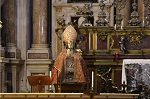
Each year on 27 June, the silver statue of Saint Andrew is carried in through the streets of the city, followed by crowds of the faithful praying and singing. One of the most iconic moments is the traditional race up the steps of the cathedral: the red-robed bearers rush up the steep staircase with the statue, urged on by the cheering crowd.
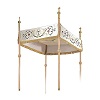
Made in Italy, this canopy features figures on all four sides embellished with a cannetille fringe that guarantees a smooth fabric drape.
The feast of Saint Andrew is a moment of great joy and spirituality for the people of Amalfi – an opportunity to renew their devotion to the saint. However, the cult of Saint Andrew is also deeply rooted in other parts of Italy. In Pescara, for instance, the saint is celebrated on the last Sunday of July with a solemn Mass in the parish dedicated to him. The statue of the saint is then carried in procession to the harbour, loaded onto a flagship boat selected for the occasion, and taken along the coastline as far as Montesilvano.
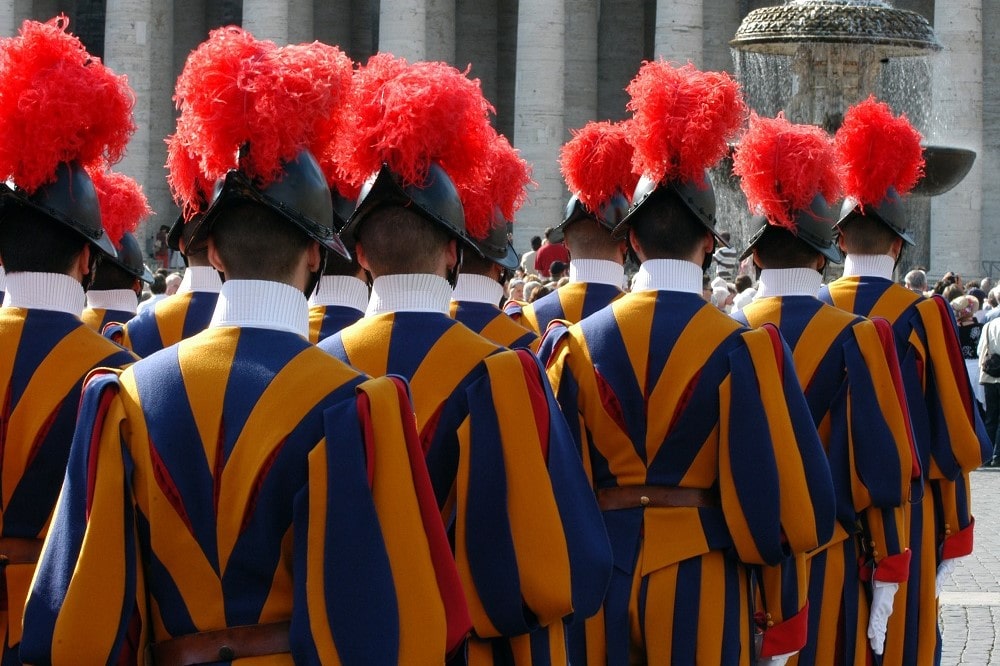
For five hundred years, the Swiss Guards have protected the Pope's security and watched over the Vatican. Here is who...
What’s the Future of Religion?
What’s the Future of Religion?
A Beginner’s Guide to Christianity
A Beginner’s Guide to Christianity
Mind-Blowing Statistics About Christianity You Need to Know
Mind-Blowing Statistics About Christianity You Need to Know
8422
Enter the Holyart world: $20 discount voucher valid on over 60,000 items
Come and discover Holyart, the largest e-commerce of religious articles in Europe and immediately receive a $20 voucher to use with your first purchase.
Check your mailbox: you will receive your discount within 5 minutes






 7 October 2026