Author: Redazione

How to Decorate the Inside of Transparent Christmas Baubles

How to Decorate the Inside of Transparent Christmas Baubles

Contents1 DIY Transparent Christmas Baubles2 Materials Needed3 Decorating and Ideas for the Christmas Tree Transparent Christmas baubles are an original and creative way to decorate your Holiday Tree. Here’s how to make them in just a few simple steps How lovely are transparent glass baubles…

Nativity Scene Modelling: Miniature Items and Where to Find Them

Nativity Scene Modelling: Miniature Items and Where to Find Them

Nativity Scene Modelling: Miniature items to make your DIY Nativity Scene even more realistic – and where to find them Can we really speak of “Nativity Scene Modelling”? Absolutely! For those who love and appreciate the wonderful tradition of Nativity Scenes, creating a homemade Nativity…

Snow Globe: How It Became a Magical Christmas Tradition

Snow Globe: How It Became a Magical Christmas Tradition

The snow globe is one of the most loved and famous Christmas decorations, an object found all around the world. But how did it come about?

Who hasn’t received a snow globe as a gift at least once in their life? It’s a glass or crystal sphere (though plastic is now also widely used) filled with water, containing inside a small figurine or miniature scene. Besides the water, there are white particles inside the globe that float and swirl when shaken, creating the illusion of falling snow. It’s an extraordinarily popular object, offered as a souvenir in countless situations and found in virtually every gift shop in every city around the world.

What is perhaps less known is that the tradition of glass spheres containing snow — also known as snowballs or snow globes — has ancient origins, dating back at least to the 19th century. The first snow globe was created almost by accident, but soon these decorative objects became popular and have continually reinvented themselves over time, never losing their vintage charm.

Today, snow globes are often transformed into music boxes, with a mechanism that makes the figurines inside rotate to the sound of a sweet melody and stirs the snow without the need to turn the globe upside down. Especially Christmas snow globes, associated with the winter holidays, have become much-loved decorations and timeless gift ideas.


How the Tradition of Snow Globes Began

The most widely accepted sources claim that the tradition of glass spheres containing snow originated in Austria in the 19th century. The first example of a snow globe is said to have been invented by chance by a German inventor named Erwin Perzy I, who specialised in surgical instruments. While attempting to create a lamp that would properly illuminate operating rooms, he tried placing glass and metal powder inside a water-filled glass globe lit from behind by a bulb, hoping to increase the brightness.

He noticed that the effect resembled swirling snow, and he even tried adding a bit of semolina, which enhanced the effect. Inspired by this discovery, he placed a small model of the Mariazell Shrine, near Vienna, inside the globe. He had created the first snow globe — and immediately realised it could become very popular.
To this day, his descendants continue his work in the famous Perzy workshop in Vienna-Hernals, known as the Original Wiener Schneekugelmanufaktur (Original Viennese Snow Globe Factory).

In the 1940s, the Perzy family began adding Christmas-themed elements to their snow globes. They did so to support young American soldiers far from home, who could appreciate familiar miniature scenes. Thus, Perzy II started producing new snow globe models featuring Christmas trees, small Father Christmas figures, and snowmen inside. The Original Wiener Schneekugelmanufaktur began selling its products in the United States, and the snow globe trend soon crossed the ocean.

There is also a tradition claiming that the first snow globe was invented in France, where, as early as the 19th century, similar objects known as boule de neige already existed. It is difficult to confirm who had the idea first.

Regardless of their exact origins, snow globes became popular as decorations — particularly Christmas ones — all over the world. Today, they are available in a wide variety of styles and designs, from traditional Christmas scenes to customised versions featuring images, characters, and different themes. They are often considered ornamental and collectible items that bring a touch of winter magic to the festive season.


How to Make a Snow Globe

But what if we wanted to make our own snow globe? It’s not difficult at all — all you need is a bit of creativity, some simple craft materials, and a touch of manual skill.
First, choose the container. If you don’t have a glass sphere, you can use a jar — preferably a rounded one — but make sure it can be sealed tightly.
Next, select the object to place inside. It could be a resin figurine or a small statue, but remember it must be water-resistant. The figurine should be glued to the inside of the lid using waterproof glue, before filling the jar with distilled water, thickened slightly with a few drops of glycerine.
Finally, choose the particles that will recreate the snow: glitter, sequins, and so on. The Perzy family stopped using semolina long ago, replacing it first with hard wax and magnesium powder. Today, the mixture they use to make their artificial snow is top secret!
All that’s left is to close the jar tightly and seal the edge with hot glue — and there you have your personalised snow globe, ready to brighten your home or serve as a delightful gift for someone special!

Solidarity gift ideas

Read more:

Solidarity gift ideas, for a Christmas of solidarity
Solidarity gift ideas for a better Christmas for everyone, near and far. Our selection…


Christmas Snow Globes on Holyart

The charm of the snow globe has captivated us at Holyart too. In our online store, you’ll find various models of Christmas-themed snow globes — original gifts for your friends as well as festive decorations for your home.

The Glass Snow Globe with Father Christmas is made of glass and resin and stands 15 cm tall. It also functions as a music box: by winding the mechanism at the base, the globe rotates and plays We Wish You a Merry Christmas.

In the Music Box with Christmas Tree, the glass sphere encloses a Christmas tree made of polystone, decorated with traditional ornaments: Father Christmas, presents, teddy bears, and snow. The music box sits on a base that, when wound up, plays a Christmas melody.

The charming family of snowmen inside a glass lantern is an original reinterpretation of the classic globe. Thanks to three AA batteries, the lantern lights up and the snow inside begins to move.

In the Glass Fireplace with Snow and Elves, the snow movement is battery-operated. The glass fireplace is decorated with Christmas motifs, and inside the glass are elves gathered around the Christmas tree.

Charming and festive, the Christmas Locomotive is a delightful snow scene on a red carriage with candy-shaped wheels. Inside, Santa and his cheerful elves fill the gift sack, surrounded by swirling snow, lights, and a joyful Christmas melody.

Santa Claus snow globe with decorated base 15x10 cm
Santa Claus snow globe decorated base 15x10 cm
Buy on Holyart
Christmas tree music box 20x10x10 cm
Christmas tree snow globe with music box 20x10x10 cm
Buy on Holyart
Snow globe lantern with snowmen 25x10 cm
Snow globe with snowman in lantern 25x10 cm
Buy on Holyart
Snow globe fireplace with elves 25x20x10 cm
Fireplace snow globe with snow with elves 25x20x10 cm
Buy on Holyart
christmas-candy-cane-train-snow-globe-30x10x15-cm
Christmas candy cane train snow globe 30x10x15 cm
Buy on Holyart
A priest’s life: answers to the most curious questions

A priest’s life: answers to the most curious questions

Contents1 How much does a priest earn?2 Do priests have holidays?3 Where does a priest sleep?4 What does a priest do during the day?5 How does a priest go to confession?6 How long must one study before becoming a priest? What is life as a…

Cremation and the Catholic Religion: Is It Permitted?

Cremation and the Catholic Religion: Is It Permitted?

Contents1 Meaning of the Cross Before Christianity2 Cremation and Catholicism3 How to Keep the Ashes of the Deceased4 Burial or Cremation: What Does the Bible Say? The relationship between cremation and the Catholic religion has long been a subject of misunderstanding and confusion. Here’s what…

How Cloistered Nuns Live: A Glimpse into Their Fascinating Lives

How Cloistered Nuns Live: A Glimpse into Their Fascinating Lives

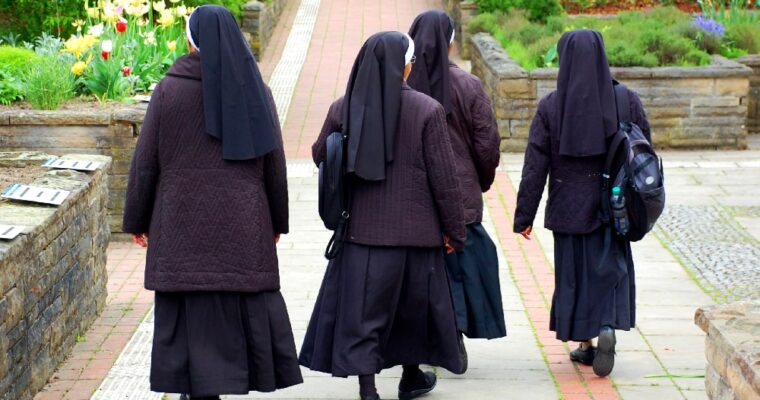
Cloistered nuns, the hidden heart of the Catholic Church, play a fundamental role in the spiritual lives of the faithful through their commitment to prayer and contemplation.

Most people, when hearing about cloistered nuns—and religious cloistering in general—are inclined to feel a sense of bewilderment. In our fast-paced world, which changes at a dizzying speed, often leaving little time to process information or absorb events and their consequences, it is difficult to imagine the life of someone who deliberately chooses to withdraw from it all, to step away from the world and let it flow past from a place of silence and isolation. But is that really how life unfolds in cloistered convents? Perhaps once it was so, but today, things are different.

While it is true that cloistered nuns—often also called contemplative nuns or cloistered sisters—still fulfil a very particular role within the Catholic Church, living in communities separated from the outside world and devoting themselves to praying for the salvation of all, it is also true that their responsibilities and contributions to the modern world have changed compared to the past. There is now greater openness, including encounters with people who come from that very world in search of help.

This form of religious life is based on separation from the material world in favour of a closer union with God. It is also characterised by an ascetic simplicity, a renunciation of worldly pleasures and comforts, and vows of poverty and obedience. The monasteries where these nuns live are generally enclosed, but today, in some cases, it is possible for outsiders to meet with them in the parlour, seeking spiritual comfort and advice. In addition to communal and personal prayer, contemplation, and adoration of God, cloistered nuns also carry out necessary tasks for the common good of the community, such as gardening, sewing, and in some cases, producing goods that are sold outside the monastery.

monks’ inventions

Read more:

The Inventions of Monks: Major Contributors to European Progress
Discover how the inventions of monks fostered technological and scientific development in medieval Europe and passed …

Great importance is also given to silence, which plays a fundamental role in the spirituality of cloistered life. It is the atmosphere in which they live and the medium through which they open themselves to God’s presence. This is a deep, interior silence—not merely the absence of noise, but a state of tranquillity essential for encountering the Divine Presence.

What Do Cloistered Nuns Do?

But what is life really like for cloistered nuns? Their lives are based on a delicate balance between prayer and work, following a carefully structured daily rhythm. A cloistered nun’s day begins early, at 5:00 a.m., with personal prayer, meditation, and in certain orders, chanting praise to God. At 8:00 a.m. there is a common Mass, followed by breakfast at 8:30 a.m. After breakfast, each nun attends to her assigned duties until lunch around noon.

After lunch, one of the nuns reads a spiritual text while the others listen in silence, creating a space for reflection and deepening their faith. This is followed by a recreation period, where the nuns gather to spend time together. At 6:00 p.m., they recite the Rosary. At 10:00 p.m., they prepare for bed and enter into nightly silence.

In addition to prayer, cloistered nuns engage in manual work, both necessary for communal living and for producing liturgical items, religious icons, sweets, and other products that are later sold outside the monastery to support the community.

Cloistered nuns renounce family ties and romantic relationships in order to embrace the religious life, but they are not entirely detached from the outside world. They receive visitors in the cloister for spiritual reasons or practical ones—such as receiving material support or selling their products. These encounters with the outside world offer them the opportunity to share their faith and to inspire those seeking a deeper spiritual life.

Silence shields monastic life from outside influences that might distract the nuns from their vocation. It helps them concentrate, immerse themselves in prayer, listen to God’s voice attentively, and remain open to His guidance. Through silence, they learn to discern God’s will and follow the spiritual path He has laid out for them.

But silence is also an opportunity for fraternal charity within the monastic community. It fosters mutual understanding, the sharing of thoughts and feelings, and growth in relationships with their fellow sisters. In silence, a space for respect and mutual listening is created, allowing for a true communion of hearts.

Despite their cloistered life, the nuns are able to stay informed about the outside world. They may read newspapers—especially Catholic ones—and listen to the radio to keep up with events and important news. They watch little television, and only religious programmes or papal appearances.

How Does One Become a Cloistered Nun?

Anyone might wonder how to become a cloistered nun. The journey is one that requires time, discernment, and a deep spiritual commitment. First and foremost, it is important to feel a strong attraction to the contemplative life. This desire may arise at a young age or develop gradually over time.

Any woman can become a cloistered nun. It is not necessary to be a virgin. Vows may be taken even by those who have had relationships with men, by widows, separated women, or even those who have experienced sexual violence or prostitution. What matters most is that the individual has a sincere desire to dedicate herself wholly to God and to follow the cloistered life with devotion and commitment.

Next, one seeks the guidance of a spiritual director or a religious community to begin a period of discernment, during which the vocation to monastic life is explored and the understanding of contemplative spirituality is deepened.

An initial period of formation is required, during which the rule of the order is studied, Scripture is explored, spiritual practices are learned, and communal life is experienced. This formation may last several years and usually includes a novitiate, where one is more deeply initiated into monastic life and participates in the community’s activities.

Eventually, after completing this process, the woman takes religious vows of poverty, chastity, and obedience, committing herself to live the life of a cloistered nun for the rest of her life.

The Carthusian Order

The Carthusian Order is one of the most renowned and strictest monastic orders in the Catholic Church. Founded by Saint Bruno in 1084 in the Isère region of France, the order takes its name from the Chartreuse Mountains, where the saint and the first Carthusians withdrew to live a life of solitude and contemplation.

Carthusian life is unique in its union of solitary men living in small communities while maintaining a strong eremitic vocation. The Carthusians devote themselves to unceasing prayer, study, manual labour, and austerity, embracing a strict rule that demands total dedication and renunciation of the outside world.

The Carthusian Order offers a valuable example of profound spiritual seeking and serves as inspiration for those desiring a life of silence and contemplation at the heart of the Church. Its motto, Stat Crux dum volvitur orbis (“The Cross stands firm while the world turns”), reflects its deep spirituality.

Throughout the centuries, the Carthusians have remained “solitaries gathered as brothers,” living mostly in isolation, except during communal liturgies and a few informal moments such as recreation.

Carthusian monks live a life centred on seeking God in solitude and silence, though they are not entirely confined to their cells. They also carry out practical tasks necessary for the smooth running of the monastery, known as “obediences”. Like cloistered nuns, their days are divided between solitary prayer and meditation in their cells, and moments of communion and sharing, such as Mass. Each brother recites the Divine Office in his own cell. Each is also responsible for daily duties, including housekeeping, all within the bounds of the cloister. Carthusian monks also practise night prayer at midnight, participating alone in the morning office.

How Many Cloistered Monasteries Are There in Italy?

In Italy, there are around 67,000 cloistered nuns and sisters, spread across convents that often have very small communities. Consider, for example, the nuns of the Monastery of Saint Rita of Cascia, who dedicate themselves to bringing Christ’s light into the world, offering love, compassion, and comfort to those in need. In that Augustinian monastery, there are only twenty-three religious sisters, but the average is even lower—about eight nuns per convent.

Saint Rita of Cascia.

Read more:

Saint Rita of Cascia, Patron Saint of Marriages and Impossible Causes
Among the few married saints that Christian history can enumerate, Saint Rita of Cascia is perhaps the most beloved …

The Oldest Confraternities: History and Curiosities

The Oldest Confraternities: History and Curiosities

Contents1 How a Confraternity Works2 Difference Between a Confraternity and an Archconfraternity3 Confraternity of the Gonfalone4 Archconfraternity of the Blessed Sacrament5 Confraternity of the Holy Crucifix6 Confraternity of Mercy For centuries, confraternities have formed a connective tissue within Italian society, balancing devotional spirit, religion, and…

Marian symbols: what they are and their meaning

Marian symbols: what they are and their meaning

Contents1 The Mirror of Justice (Speculum iustitiae)2 The Moon3 The Rose4 The Ivory Tower5 The Ark of the Covenant6 The Gate of Heaven7 The Seat of Wisdom8 The Burning Bush9 Gideon’s Fleece The rose, the moon, but also the Gate of Heaven and the Ivory…

Miracles: what they are and how they are classified

Miracles: what they are and how they are classified

Healings and exorcisms, apparitions, mastery over nature, even the resurrection of the dead. Jesus and his miracles, a legacy of history and Faith that remains ever relevant.

For the Catholic Church, miracles exist. Indeed, the miracles attributed to Jesus and reported in the canonical Gospels are to be regarded as historical events. We have deliberately made the distinction between the Canonical Gospels and the Apocryphal Gospels, because although in the latter miracles are even more numerous and spectacular, they are entirely devoid of historical veracity and therefore not recognised. After all, when speaking of the Apocryphal Gospels, it is common to encounter a more fairy-tale and marvellous dimension to the events in the life of Jesus and those who knew him, and it is inevitable that the miracles also become true acts of magic, wonders told more to amaze and capture attention than to inspire genuine Faith.

The lost years of Jesus’ life

Read more:

The lost years of Jesus’ life
Let us investigate the lost years of Jesus’ life. What was he doing before he started preaching? Did he ever …

The miracles recognised by the Church are therefore historical accounts, even if interpreted from a theological point of view, or allegorical according to some biblical scholars, but in any case clear signs of the identity of Jesus and of his mission. The Catechism (Catechism of the Catholic Church, nos. 547–550) describes them as testimony to the fact that he is the Son of God, as an invitation to believe in him, and acknowledges their effectiveness in strengthening Faith. In particular, Eucharistic Miracles are those supernatural events through which God confirms the real presence of the body and blood of Christ in the Eucharist, thereby affirming the Faith of believers.

More generally, a miracle is any occurrence not attributable to natural causes but justified by divine intervention. It is, in fact, solely within God’s will and power to alter the natural order of things, since he created and established it. Thus the overturning of the laws of nature is his prerogative. For this reason, it becomes essential for the Church to recognise and regulate what truly constitutes a miracle, which miracles are to be considered genuine, and which false, driven by the will to deceive or by mere suggestion.

The host in the Eucharistic celebration

Read more:

The host in the Eucharistic celebration
The host is the unleavened bread that symbolizes the body of Christ during the celebration of the Eucharist…

What miracles are

In the New Testament, miracles are the exclusive domain of Jesus. It is he who performs them, by virtue of his divine nature, without needing to call upon the Father. Yet he has the will and the capacity to bestow upon the disciples the power to perform miracles. The miracles of Jesus are always driven by the desire to do good—sometimes to inspire Faith, sometimes to strengthen it—never useless, never performed merely to amaze or astonish, and least of all to convince sceptics.

The miracles performed by Jesus may be divided into:

Miracles over nature are those in which Jesus demonstrates his ability to command the forces of nature and subvert its rules. Consider the calming of the storm on the lake (Matthew 8:23–27; Mark 4:35–41; Luke 8:22–25), the multiplication of the loaves and fishes (Matthew 14:13–21), and the transformation of water into wine (John 2:1–11).

Healing miracles represent the majority of those attributed to Jesus, probably because it has always been natural for those suffering from illness or disability to seek a miracle. Jesus healed people of physical ailments, but also of mental afflictions and demonic possession, by laying on hands, pronouncing specific words, or using saliva, mud, and so forth. Among the examples are the healing of the woman with haemorrhages (Matthew 9:20–22), the deaf-mute who spoke again (Mark 7:31–37), and the blind man of Jericho who regained his sight (Mark 8:22–26). Jesus also gave the Twelve Apostles the power to cast out demons and heal diseases and infirmities (Matthew 10:1). Regarding exorcisms, one may recall the man in the country of the Gerasenes possessed by many demons, who told Jesus his name was Legion (Luke 8:26–39). Finally, in the canonical Gospels there are three cases of resurrection: the daughter of Jairus (Mark 5:21–43), the son of the widow at Nain (Luke 7:11–17), and the most famous, the resurrection of Lazarus (John 11:1–44).

Among the epiphanies and apparitions we may recall those of Jesus after the Resurrection and the one that struck Paul of Tarsus on the road to Damascus.

road to Damascus

Read more:

Struck by lightning on the road to Damascus: what is the origin of this saying
Thunderstruck on the road to Damascus, a saying that hides a story of deep faith and spiritual conversion…

Miracles in the Bible

Miracles in the Old Testament, together with prophecies, are proof of the existence of God and of his plan. The wondrous events of the Old Testament are never performed by men themselves, but by God through men chosen by him for a specific purpose, whether prophets or wonder-workers. They are never useless acts of magic or displays of power for their own sake, but signs of divine benevolence or wrath, testimonies of God’s might.

One of the most frequent terms in the Old Testament to define a miracle is σημείον, sēmeíon, “sign”. But this definition is too broad, also referring to natural events not necessarily linked to God. The Greek term τέρας, téras, “wonder”, is often used with a negative connotation, as a punishment inflicted by God upon men.

To summarise, here are the four Greek terms used in the Holy Scriptures to indicate miracles:

  • meion, “sign”, clear indication of divine intervention or presence
  • Taumata, “miracles”, marvels, events that inspire astonishment
  • Dynameis, “powers”, works attributed to a superhuman or supernatural force
  • Erga, “works”, actions of Jesus, his disciples or the saints

Among the most famous examples of miracles in the Old Testament we may recall the Great Flood (Genesis 6–9), probably derived from a similar episode in the Sumerian Epic of Gilgamesh, itself inspired by a possible flooding of the Black Sea around 5600 BC, and the Exodus of the Hebrews from Egypt, which recounts many miracles, from the Plagues of Egypt to manna from heaven, culminating in the famous parting of the Red Sea.

More generally, in the Old Testament miracles are never wonders for their own sake or futile acts of magic, but prodigious events willed by God as demonstrations of his Power, or of the authority granted to those acting in his name at that moment (such as Moses).

The first miracle of Jesus

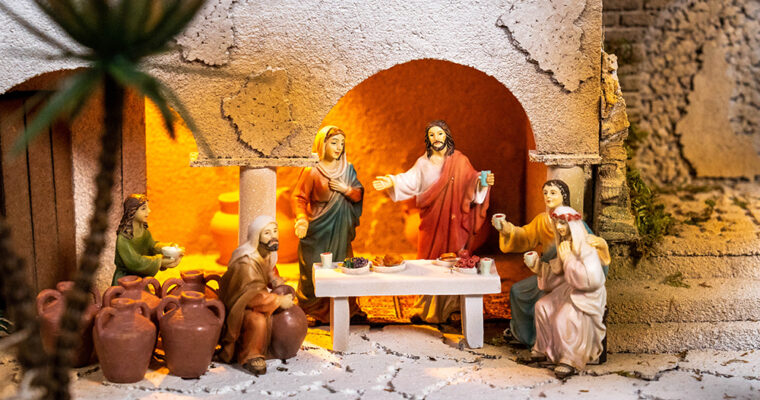
The first miracle attributed to Jesus, at the beginning of his mission, is that of the Wedding at Cana, recounted by the evangelist John (John 2:1–12). It is the famous transformation of water into wine, performed by Jesus while attending a wedding in Cana of Galilee with some disciples and his mother Mary. Since the wine had run out and the guests had nothing to drink, Mary asked her Son to do something, and Jesus had six jars filled with water and turned it into wine.

wedding at Cana

Read more:

The Wedding of Cana: explanation, miracle and message
The Wedding of Cana tells the story of the first miracle performed by Jesus. Let us see what message this…

In addition to representing the institution of the Sacrament of Marriage by Jesus, the Wedding at Cana is the first of the so-called Seven Signs, the seven miracles which in John’s Gospel narrate the path taken by Jesus to reveal to his disciples his Powers and his destiny, before reaching the Last Supper, the Passion and death. In effect, this miracle, encouraged by the Virgin Mary, represents the official beginning of his mission, which would end only with the Passion and death.

The History of the Dogmas of the Catholic Church

The History of the Dogmas of the Catholic Church

Contents1 Dogma: the Etymology of the Word2 The Dogmas of the Catholic Church in History3 What Are the Principal Catholic Dogmas? Dogmas are absolute and essential truths to which every Christian must adhere by virtue of their faith. Here is how they have been defined…

The Holy Shroud: What We Know So Far

The Holy Shroud: What We Know So Far

Contents1 Where the Holy Shroud Is Kept2 The History of the Holy Shroud3 Dating the Holy Shroud It is said to be the cloth that wrapped the body of Christ after His burial. Between faith and science, the Holy Shroud divides and fascinates people of…

Bartolo Longo: His Spiritual Legacy and Canonisation in the Jubilee 2025

Bartolo Longo: His Spiritual Legacy and Canonisation in the Jubilee 2025

Bartolo Longo: The man who rose again in Pompeii. Legacy, faith, and the immortal song of the Supplica in the Jubilee 2025

There is a road, made not only of stones and dust, but of choices, shadows, and redemption. Upon that road walked Bartolo Longo, a man who knew how to cross the darkest night to discover, within himself and in devotion to Our Lady, the flame of a rebirth.
Born in 1841 in Latiano, in the heart of rural Apulia, Bartolo was not always the saint we venerate today. His youth was marked by doubt, by searching, by downfall. In a restless Naples, hungry for spirituality, he let himself be seduced by occult philosophies and was initiated into Satanism, living through the darkest years of his soul. But, as often happens in predestined lives, a light was kindled when everything seemed lost: it was the encounter with the Rosary, with that simple and unyielding faith which for centuries has preserved the hope of the Christian people. Kneeling before Our Lady, Bartolo Longo found the path home. And it was in Pompeii, where misery was most savage and despair most suffocating, that he chose to be reborn.

October – the Month of the Rosary

Read more:

October: the month of the Holy Rosary
What is the connection between the fall month with what is probably the most important and popular …

Today, borne on the wings of the Supplica and within the walls of the Sanctuary of Pompeii, Bartolo Longo still speaks. His voice, woven of tears and laughter, of doubts and certainties, resounds in the hearts of those who seek, of those who rise again, of those who every day set out on their journey.
Announced for 19 October 2025, during the Jubilee, his canonisation will be far more than a rite: it will be the seal upon a story of downfall and resurrection which belongs to each of us. His spiritual legacy is the most powerful of invitations: never cease to pray, to rebuild, to hope.
Never surrender to darkness, for, as Blessed Bartolo Longo teaches, even from the blackest night can be born the brightest day.

Padre Pio and Our Lady of Pompeii

Read more:

Padre Pio’s devotion to Our Lady of Pompeii and the gift rose
May 5 is the feast day of the Saint of Pietrelcina. Discover the evocative birth of devotion to Padre Pio …

Who is Blessed Bartolo Longo?

Bartolo Longo was born in the heart of the South, where the red earth of Apulia mingles with the dreams and torments of generations. Yet, as often happens to great hearts, the road to light was, for him, shrouded in thick shadows. The son of a doctor and of a profoundly Christian mother, after his classical and legal studies in Lecce and Naples, Bartolo immersed himself in the restless atmosphere of nineteenth-century Naples: a time in which philosophical passions, political ferment, and the seductions of occultism roamed the salons and alleyways. A brilliant but troubled young man, Bartolo Longo was swept away by the fascination of mystery; he drew close to spiritism and esoteric circles, until he was initiated into Satanism, even becoming a “priest of Satan”. And yet despair devoured him, his mind wavering between dark visions and a sense of utter loss. In those nights of torment, his mother, constantly at prayer for him, seemed like a distant anchor. But it was precisely in that abyss that an encounter changed the course of his life: Don Alberto Radente, a Dominican with words both simple and profound, offered him the way of redemption. Bartolo then chose the hardest path: to climb back from the depths. He confessed, renounced the errors of the past, and, guided by the Rosary, re-embraced the Catholic faith. It was in this fierce struggle between shadow and light that Blessed Bartolo Longo became, for himself and for the world, a living symbol of a mercy without limits.

But the journey of redemption is never solitary. Every true conversion creates ripples, transforming places and lives it touches. After the inner deluge and the rediscovered salvation, Bartolo Longo remained in Naples, the city of a thousand contrasts, suspended between devotion and despair. He was a redeemed young lawyer, but his soul still found no rest. Amid the fervour of the metropolis, Bartolo became an apostle of his rediscovered faith: he visited prisoners, aided the poor, became the voice of those without a voice.
Yet Providence had for him an even broader design. It was here that he met a woman destined to be not only a partner in his works, but also a sister of the soul: Countess Marianna Farnararo, the young widow De Fusco. Marianna, a woman of deep faith and sensitivity, was herself engaged in helping the weak and generously administered some lands in the valley of Pompeii, then a forgotten place, plagued by malaria and marked by the darkest misery.
The meeting between Bartolo Longo and Marianna was like the spark that sets alight a sacred fire. United by the same thirst for charity, they began to work together to aid orphans and widows, to educate children without a future, to build small schools where before there had only been neglect.
Between them grew a profound spiritual friendship, an understanding that knew how to speak the language of the Rosary and of selfless love.

Bartolo Longo and the Sanctuary of Pompeii

The destiny of Bartolo Longo and of the Valley of Pompeii intertwined almost by chance, in 1872, when he was sent to take care of the administrative affairs of Countess De Fusco’s lands. But what he found went far beyond his expectations: the valley was a mosaic of poverty and abandonment, a place where countless lives survived on the margins, bereft of comfort and of future.
Even the small church, ancient heart of that community, lay in wretched condition, forgotten like its people.
It was in that context, amid silence and ruins, that Bartolo felt what seemed like a mysterious calling: an inner impulse urging him to change the destiny of that place. In a moment of deep solitude, while the countryside vibrated with the simple prayers of the humble, he intuited that his life must intertwine with that of Pompeii through the Rosary. From that day on, he understood that his mission would be to bring light, education, and faith precisely to that forgotten valley, gathering the people into a new community devoted to the Holy Rosary. Thus was born the vision that would change everything: no longer merely managing earthly affairs, but becoming a sower of hope, beginning that work which, from nothing, would transform Pompeii into a beacon of charity and prayer.
Bartolo Longo moved to Pompeii, a land then forgotten, marked by misery, malaria, and abandonment. Here his existence became an offering, a seed cast among the ruins of the ancient Roman city. It was among the poor and the orphans that Bartolo found his mission: to rebuild souls by rebuilding walls.

In 1875 he purchased a modest painting of Our Lady of the Rosary, the icon that would become the heart of the Sanctuary of Pompeii. Miracles began immediately to multiply. Humble folk and the powerful, the desperate and the noble, all flocked to Pompeii in search of grace, of a sign.
The partnership between Bartolo Longo and Countess Marianna changed forever the history of Pompeii. It was she who donated the land on which the future sanctuary would rise. Together they fought against misery and superstition, entrusting every effort and every dream to Our Lady of Pompeii, Mother of wounded souls. In time, their bond grew even stronger: at the counsel of Pope Leo XIII, in 1885 Bartolo and Marianna married, consecrating their union not to earthly love, but to a shared mission of good. They were spouses in chastity, companions in prayer, co-founders of immortal works.
From their combined strength were born not only the Sanctuary of Pompeii, but also institutions for orphans and the children of prisoners, schools for poor girls, hospices for the elderly and the sick. Every day, side by side, they faced toil and the scepticism of the world with the sole weapon of faith. The partnership between Bartolo Longo and Marianna Farnararo De Fusco was the lifeblood of a social miracle which still beats today in the heart of Pompeii. Without their meeting, perhaps the sanctuary would never have been built, the Supplica would never have found its voice, and the valley would have remained but a place of ruin and desolation.

The Supplica to Our Lady of the Rosary: The Heart of Devotion

Yet none of Bartolo Longo’s works would be complete without evoking the poetry of his Supplica to Our Lady of the Rosary.

Supplication to Our Lady of Pompeii

Read more:

How to recite the supplication to Our Lady of Pompeii
The Virgin of the Rosary is celebrated on 8 May. Today, we shall dwell upon the foundation of the Shrine…

Written in 1883, the Supplica to Our Lady of the Rosary of Pompeii is far more than a simple prayer: it is a collective voice which, each year, on 8 May and on the first Sunday of October, rises like a wave from the squares, from the homes, from the hearts of the people. In Pompeii, thousands gather before the sanctuary: some bring a secret sorrow, some a hope, some a whispered thanksgiving. The Supplica thus becomes a thread uniting generations and diverse stories, a plea for help and for entrustment to Mary, Mother and guardian of all who feel fragile.
In the text, real life can be felt beating: the trust of the simple, the weight of tears, the search for a protection which knows how to embrace everything. Every word of the Supplica is an open space where faith meets daily struggle and transforms it into hope.
It is not only a prayer, but an emotional wave crossing the centuries. Bartolo Longo wrote it kneeling, with his soul laid bare, offering to the Virgin his past of sorrow and his yearning to be reborn.
Some say that the notes of this Supplica, in the silence of the Sanctuary of Pompeii, seem to caress souls like a breeze rising from the Vesuvian plain. And it is true: those who listen, who pray, who entrust themselves, feel the presence of Bartolo Longo, a man become the voice of mercy, a poet of resurrected faith.

Bartolo Longo, Saint in the Jubilee 2025

The miracle of Pompeii, the rebirth of the city, the blossoming of charity, the prodigy of the Supplica, are today the stone upon which is founded the long-awaited announcement: Bartolo Longo will be proclaimed a saint during the Jubilee 2025.

Calendar of Events for the Jubilee 2025

Read more:

The Jubilee 2025 Events Calendar
The calendar of events for the Jubilee 2025 has been published, twelve months of events and occasions…
Pope Francis, during his stay at the Agostino Gemelli Policlinic in Rome, had already recognised in the life of this “layman in love with the Rosary” a message of striking relevance. Bartolo Longo was not a priest, not a monk, he founded no orders, but he revolutionised history from below, with the quiet force of faith and the tenacity of one who has risen again from the blackest sin. The canonisation, which will take place during the Holy Year, will be a feast for all Pompeii and for all those, worldwide, who have invoked prayer through Bartolo Longo. It will be the triumph of mercy over every judgement, the demonstration that no downfall is definitive, that even from the depths of the abyss a saint may arise. Bartolo Longo, saint in the Jubilee 2025, is the story of a second chance offered to all, the echo of a voice that continues to say: “No one is lost, as long as there is a Mother who prays.”

Papa Francesco

Read more:

How Pope Francis transformed the Church
What did Pope Francis do that was important? His pontificate was a revolution of mercy…

Prayer to Bartolo Longo

O Blessed Bartolo Longo,
who loved Mary with the tenderness of a son
and spread devotion to her through the recitation of the Holy Rosary,
and through her intercession received abundant grace
to love and serve Christ in abandoned childhood,
obtain for us the grace to live in a spirit of prayer united with God,
to love Him as you did in our brothers and sisters.

You, who at the end of your earthly pilgrimage
declared never to have tired of praying
for every sorrow, for every anguish, for every calamity,
trusting in the omnipotence of God
and in the intercession of His Divine Mother,
continue to intercede for all those who are called
to carry on your work of faith and love in Pompeii
and for all Rosary devotees throughout the world.

Obtain for us that, after the earthly contemplation
of the joyful and sorrowful mysteries,
we may, together with you and with Mary,
Queen of Angels and of Saints,
share the joy of the glorious mysteries in heaven.
Amen.

Thun and its Limited Edition Nativity Dedicated to the 2025 Jubilee

Thun and its Limited Edition Nativity Dedicated to the 2025 Jubilee

Contents1 A nativity that welcomes humanity on its journey2 THUN: when art becomes a caress for the soul3 When beauty becomes a gift: art that heals, art that unites THUN Nativity Jubilee 2025: when faith takes shape in the hands of angels In the silence…

2 October: Feast of the Guardian Angels

2 October: Feast of the Guardian Angels

Contents1 The Feast of the Guardian Angels and Grandparents’ Day2 Who Are the Guardian Angels in Christian Tradition?3 Prayer to the Guardian Angel Guardian Angels have always accompanied the existence of human beings, acting as messengers, counsellors in everyday life, and protectors against temptations and…

From Don Bosco to Pier Giorgio Frassati: Who are the social saints

From Don Bosco to Pier Giorgio Frassati: Who are the social saints

From Don Bosco to Pier Giorgio Frassati: Who are the social saints who have changed the world

In the heart of Piedmont, in that nineteenth-century Turin poised between the roar of the first industries and the subdued cry of the poor, a new holiness blossomed. Not made of ecstasies or resounding miracles, but of hands soiled with soot, of steps consumed in the alleys, of looks that sought Christ in the face of the forgotten. They were the social saints, ardent souls who chose to live the Gospel among the wounds of the world. Women and men who made Savoy a living laboratory of charity and justice, transforming compassion into a daily practice. Unforgettable figures such as Don Bosco, Cottolengo, Giulia di Barolo and Pier Giorgio Frassati, capable of responding to misery with tenacity, to injustice with concrete works, to despair with the audacity of hope.

Even today, the social saints of 1800 and the twentieth century from Turin speak to us, in a world that has changed its poor, but not poverty, which has changed its forms of injustice but not its roots; their voice is more urgent than ever. They were not legendary heroes: they were men and women who chose to say yes to life, even when it was dirty, hurt, or uncomfortable. They did not change the world with slogans or power, but with the humble strength of those who love without measure.

Who are the social saints? They are the ones who do not run away from pain, but inhabit it. Those who build bridges, schools, hospitals, and relationships. Those who know that every gesture of charity is a prophecy, every embrace an announcement of resurrection. And perhaps, in our small way, we too can one day become social saints. Because holiness is not for the chosen few, but for those who dare to dirty their hands with love.

Pier Giorgio Frassati

Read more:

From the mountain to the sky: the life and message of Pier Giorgio Frassati
From the mountains to heaven: the life and message of Pier Giorgio…

Who are the social saints

Who are the social saints? They are those who, driven by the Christian faith, did not accept that prayer remained closed in churches while outside, one died of hunger, cold or loneliness. In this article, we discuss the social saints of Piedmont, particularly those in Turin, who, between the nineteenth and twentieth centuries, transformed collective pain into a forge of holiness. They were not only benefactors but reformers of the collective soul. They not only created hospitals and schools, but also culture, dignity, and future. In no other city has such a constellation of social saints from the 1800s gathered, making it a unique case in the history of the Church.
They were priests and marquises, workers and students. Some came from palaces, others from farmhouses, but they all looked at the same horizon: a world in which no one was discarded. The Piedmontese saints were not content to give a piece of bread: they offered occasions, listening, and redemption. Their charity was intelligence, their zeal, and political vision. And their holiness, deeply embodied.
Turin, from a “city of priest eaters”, thus became the capital of social holiness. A paradox that tells how, right where cynicism seemed to reign, the purest flowers of active faith blossomed.

the Process of Sanctification

Read more:

How Does One Become a Saint? Explaining the Process of Sanctification
The process of sanctification consists of various stages and unfolds over…

Don Bosco

Giovanni Bosco, or simply Don Bosco, is the icon par excellence of the social saints of Turin. Born in 1815 in the hills of Castelnuovo, he bore in his eyes the sweetness of Monferrato and in his heart the temper of the prophets. When he arrived in Turin, the city was an industrial jungle where young people were swallowed up by factories and sent back to the streets, without education or hope. Don Bosco looked for them one by one, listened to them, and welcomed them. Thus, the oratory was born, a place that was not only a prayer but also a school, a play, and a future. His educational method, founded on reason, religion, and loving kindness, was a revolution: no punishments, only trust. “Here, holiness consists in being very cheerful”, he told his boys, returning to the faith and the smile of childhood.
He did not stop there: he founded professional schools, printers, and laboratories. He offered young people not only spiritual salvation, but also tools for living with dignity. And when he founded the Salesians, his dream multiplied in the world, becoming a universal work.
He died in 1888, and Turin mourned the loss of its father, the poor. He was canonised in 1934, but even before that, he was already alive in the hearts of millions of young people who, thanks to him, had rediscovered themselves.

Pier Giorgio Frassati

Pier Giorgio Frassati is the fresh, modern and scandalously simple face of twentieth-century social sanctity. A tall, smiling young man, who climbed mountains and crossed poor neighbourhoods with the same light step, guided by a hunger for justice that gave him no respite.
Born in 1901 into a wealthy family, he could have easily settled into a life of privilege. Instead, he chose the narrow path, that of radical charity. If we ask ourselves who the social saints of Turin are, Pier Giorgio was the youngest and most surprising answer.
His room was a storehouse of clothes and medicines for the poor. His free time was dedicated to needy families. His coat? Donated. Your passion for politics? Always by the side of the last. He studied engineering, loved sports, prayed at dawn and served at night.
He died at the age of 24, almost in silence. But at his funeral, there were not only illustrious relatives: there were thousands of poor people, his true friends, those whom no one knew, but whom he had loved with heroic discretion.
Beatified in 1990, he is today the patron saint of young Catholics, but Pier Giorgio remains, above all, a topical example: one can be a saint without a halo, among universities, mountains, and subways, loving every day with silent ferocity.

Pier Giorgio Frassati will be canonised on Sunday, 7 September 2025. The news came on 13 June 2025, during the first Ordinary Consistory of Pope Leo XIV. He will be proclaimed a saint together withCarlo Acutis. A joint long-awaited canonisation that will unite two figures much loved by young people and the Church today. Initially, the date chosen for Frassati was 3 August 2025, but with the death of Pope Francis and the reorganisation of the jubilee events, everything was reorganised. The new calendar caused the ceremony to be postponed in September, on a Sunday that promises to be very well attended, especially by those who found inspiration in these two young, beautiful men. The canonisation will be held in Rome, and a large turnout is expected, comprising students, scouts, educators, parish groups, and ordinary people. All united by the desire to pay tribute to two young people who have lived the faith in a simple, authentic and contagious way. Frassati and Acutis, although they are so different, share a commonality: Pier Giorgio, with his mountain excursions and commitment to serving the poor, and Carlo, with his talent for digital media and devotion to the Eucharist. Both have shown that you can live the Gospel in everyday life, without the need for striking gestures. Just put love into it.
7 September will not only be a day to remember for the faithful. It will be a strong signal: holiness is not a distant ideal, but something that can speak even today, even to young people, even to those who feel normal.

carlo acutis

Read more:

Carlo Acutis: The Blessed of the Digital Age
Carlo Acutis, the millennial saint who dedicated his short life to Jesus and helping the poor and needy…

Giuseppe Benedetto Cottolengo

Alongside Don Bosco and Pier Giorgio Frassati, another figure emerges among the social saints of Piedmont: Giuseppe Benedetto Cottolengo. Born in Bra in 1786, he was a priest, theologian and tireless apostle of charity. Faced with the death of a poor woman rejected by hospitals, he understood that mercy cannot wait: he then opened a small infirmary that soon became the famous Little House of Divine Providence, known to all as the Cottolengo. His was a silent and radical revolution: unconditional welcome, absolute trust in Providence, integral care of the person. Disabled, chronically ill, orphaned, homeless, deaf-mute: no one was excluded, all were brothers. With his prophetic work, Cottolengo has anticipated modern welfare, offering not only assistance but dignity. Canonised in 1934, he continues to inspire those who believe that charity is not a gesture, but a way of life.

Giulia di Barolo

A feminine voice of Piedmontese social sanctity, Giulia Colbert Falletti of Barolo, demonstrated how a woman with a clear and courageous soul could transform nobility into service. Born in France in 1786, she became a marquise by marriage and mother of the poor by choice. Without children, she decided, along with her husband Carlo Tancredi, to dedicate her time, her palace, and her wealth to the last of Turin. Giulia was a pioneer, especially in the fields of female and prison assistance: she visited prisons, spoke with inmates, and offered them education, work, and faith. She founded the Rifugio, the first reintegration centre for ex-prisoners, and created schools, orphanages, kindergartens, and hospitals. Every day, she distributed food and care, but above all, dignity.
She didn’t just help: she built the future. She collaborated with Don Bosco and welcomed intellectuals and saints into her living room, including Silvio Pellico.
Today, she rests in the church of Santa Giulia, which she wanted. Her life was a seed planted in the heart of the city: a charity made not of isolated gestures, but of system, vision, love that is organised.

Giuseppe Cafasso

Among the great social saints of Piedmont, Giuseppe Cafasso holds a special place: that of a man who did not seek visibility but chose to stay behind the scenes, enlightening others. Born in Castelnuovo d’Asti in 1811, into a simple and profoundly devout family, he became a priest at a very young age. In Turin, at the Convitto Ecclesiastico di San Francesco d’Assisi, he trained generations of priests capable of living the faith in society, including a restless young man who would become Don Bosco.
His mission, however, took him even to the darkest places in the city: prisons. Cafasso entered the cells of the condemned with a light step and a firm voice, bringing comfort, listening, and mercy. He was called “the priest of the gallows” because he accompanied the condemned to death to the gallows, embracing their last hours with a tenderness that snatched them from despair. His presence was discreet, but essential: he brought bread, forgiveness, and dignity.
He did not found religious orders, nor did he leave material works, but his “foundation” was the consciences he touched, the hearts he raised, the priests he formed. He died in 1860, and the Church proclaimed him a saint in 1947, entrusting prisoners to him as their patron. His remains rest today in the Sanctuary of the Consolata, next to the people he has always loved. Cafasso is the silent face of social sanctity: the one that consoles, that educates, that accompanies without ever asking for anything in return.

The Story of Saint Vincent de Paul and His Work of Charity

The Story of Saint Vincent de Paul and His Work of Charity

Contents1 Saint Vincent de Paul and the Fight Against the Divide Between Rich and Poor2 The Daughters of Charity3 The Regulae of Saint Vincent Saint Vincent de Paul made charity his mission, preaching the model of Christ, equality among men, and greater social justice. Today,…

Padre Pio’s Prayer Groups: A Strong Devotion to the Saint in England

Padre Pio’s Prayer Groups: A Strong Devotion to the Saint in England

Contents1 Padre Pio’s Prayer Groups: What They Are and What They Do2 Padre Pio in the World3 The Padre Pio Prayer Group in the United Kingdom Padre Pio’s Prayer Groups are widespread in Italy and across the world. In the United Kingdom in particular, they…

How to apply for the Pope’s Apostolic Blessing

How to apply for the Pope’s Apostolic Blessing

The Papal Blessing, also known as the Apostolic Blessing, is a special blessing bestowed for specific occasions. It is often associated with plenary indulgence, the remission of all temporal penalties due to sins.

The Apostolic Blessing, also known as the Papal Blessing, is a special blessing recognised by the Catholic Church. It is called apostolic because it is granted directly or indirectly by the Pope, Bishop of Rome, whose church is named after the apostles Peter and Paul. We have written directly or indirectly, as the Pope can personally impart this blessing, confer it as part of a ceremony, or send it in writing to those who request it, following a particular procedure, which we will examine. The titular bishop or archbishop of a diocese, which is also its residential seat, or the titular priest of a diocese, can also dispense the Apostolic Blessing.
This particular blessing is requested on special occasions, such as weddings, baptisms, anniversaries, and other significant religious events.

Apostolic Blessing

Read more:

Saint Peter and Paul, why are they celebrated together?
On June 29, Saint Peter and Paul are celebrated. Two apostles, two very different men, both fundamental…

The Apostolic Blessing is released on a special, artistic parchment, making it even more memorable. In this article, we will explore the process of applying for the Apostolic Blessing, its associated costs, and the individuals who can grant it.

How much does the Apostolic Blessing cost?

The cost of the Apostolic Blessing is not fixed and varies depending on the size and style of the parchment chosen. The costs mainly cover the production and shipping costs of the parchment.

To request the Apostolic Blessing, it is necessary to contact the Apostolic Alms Office Scrolls. This office is responsible for handling requests and issuing official scrolls. The Apostolic Almsgiving is the Office of the Holy See in charge of exercising charity towards the poor in the name of the Pope. In the early Church, it was the Deacons who were in charge of collecting offerings and redistributing them among the most needy; however, over the centuries, official institutions were established for this activity.
The Almoner of His Holiness, who has archbishopric dignity, is part of the Papal Family and participates in the liturgical celebrations and official audiences of the Pope. Under Pope Leo XIII, the Almoner was granted the faculty to issue the Apostolic Blessing on parchment, authenticated with his signature and the stamp of the office.

Deacon functions

Read more:

How to become a deacon: duties and education
Who is a deacon and what does he do? How to become a deacon? Let’s find out more about this figure…

To obtain the Apostolic Blessing on parchment, you can visit the offices of the Apostolic Almsgiving in the Vatican, located in Sant’Anna’s Church (to the right of the Colonnade of St. Peter’s Square), or follow the online procedure. The only site authorised for online application is the official site of the Apostolic Almsgiving. In both cases, you can request the scrolls by choosing from various models available, for direct collection or shipment.
It is necessary to select the event for which the Apostolic Blessing is requested, the scroll model according to the occasion, and provide the details required for the compilation of the scroll. If you choose the online mode, you will also need to create a personal account for any future requests and select between collection in the Vatican (available only for requests from Rome) or international shipping via DHL express courier.
donation is then made by credit card.
Delivery times for receiving your Episcopal Blessing are approximately 15 days for collection at the Almoner and about 20 days for shipping by DHL express courier.

Here is the link to the official page of the Apostolic Almsgiving to choose your parchment and carry out the online procedure: Apostolic Blessing request form.

Apostolic Almsgiving Contacts
For more information or assistance, you can contact Apostolic Almsgiving through the following channels:

Address: Apostolic Almsgiving, Cortile Sant’Egidio, 00120 Vatican City

Phone:
(+39) 06.69873279
(+39) 06.69871100

As for the costs of the Apostolic Blessing, the parchment ranges from €20.00 to €28.00, depending on the chosen model, to which are added any shipping costs of the DHL express courier. The costs of the Papal Blessing cover the diploma, the expenses of preparation and shipping and a contribution to the Pope’s charitable works. All revenues received from the Apostolic Almsgiving, in particular the offerings for the diplomas of Blessing, are entirely donated to charity. This Office uses these funds to directly help those in need who turn to the Successor of Peter for assistance every day.

Who can give the Apostolic Blessing?

Blessings have always accompanied the lives of the faithful with ancient formulas and rituals rich in significant gestures, often taken for granted, but deeply rooted in the millennial history of religion. The term blessing defines a liturgical Act, or a ceremony by which someone or something is blessed, such as the blessing of water, or even an Act of grace, a rite by which divine grace is invoked on the faithful, as in the case of the blessing urbi et orbi, the solemn papal blessing of the city of Rome and the world. The blessing is invoked by a religious minister, such as a bishop, priest, or deacon, to obtain God’s grace over a person or an object. It is an invocation of divine favour and benevolence on someone or something.

Apostolic Blessings are special blessings that can be imparted only by the Pope, currently Pope Francis, therefore, but also by a bishop or a minister of the same level.
Before the Second Vatican Council, even the blessing imparted by a priest during the Anointing of the Sick (formerly known as Extreme Unction) was considered a papal blessing. The papal blessing is granted on the occasion of some sacraments, such as Baptism, First Communion, Confirmation and Marriage. It is also granted on the occasion of the ordination of a priest, the profession of religious vows, the secular consecration of a layman, the permanent ordination of a deacon, significant wedding anniversaries (such as the silver or golden wedding anniversary) and important birthdays (such as the 18th, 50th or 100th).

Papal blessings, given by the Pope or a bishop, often include a plenary indulgence. The plenary indulgence is granted at special times, such as after receiving the Apostolic Blessing during particular sacramental and liturgical celebrations. Both are powerful means of grace in the Catholic Church. While the Apostolic Blessing invokes divine protection and grace, the plenary indulgence purifies the soul, eliminating the temporal penalties of sin. Both are profound expressions of God’s mercy and love, and have always been tools to strengthen the faith and spirituality of the faithful.

Plenary indulgence

Read more:

Plenary indulgence: meaning, origins and how to get it
What is a plenary indulgence? Here’s why Pope Francis granted it to those participating in the Year of St. Joseph…