Homepage | Religion | Saint Philomena: the story of the virgin and martyr
Saint Philomena: the story of the virgin and martyr
12 August 2026
Reading Time: 5minutes
The remains of Saint Philomena the virgin and martyr were discovered in the catacombs of Rome, but they are kept in the Shrine of Mugnano del Cardinale. Here is the story of this mysterious child saint
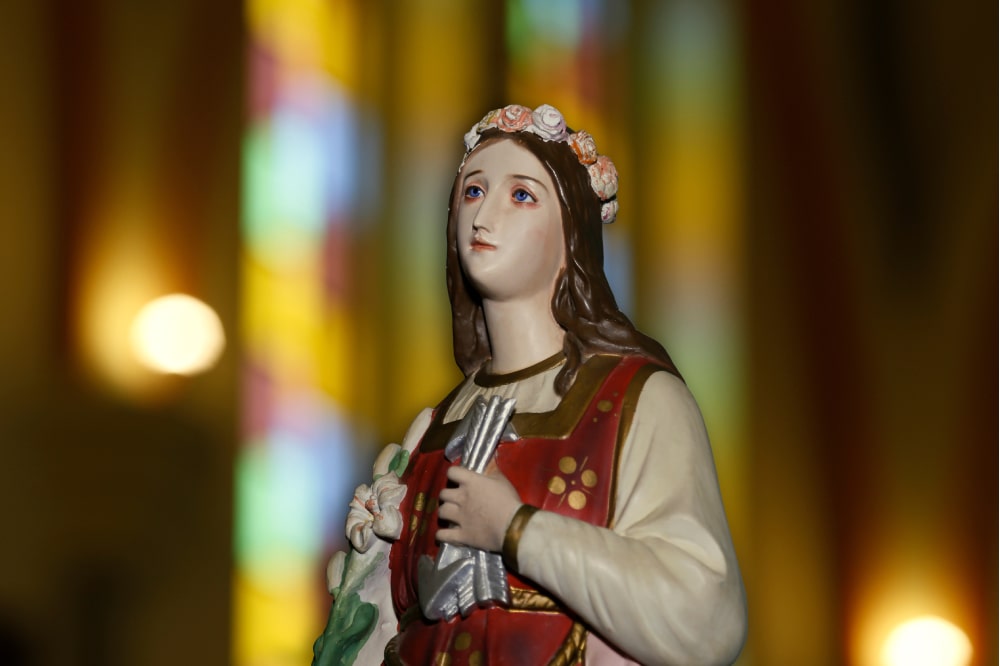
A great and fascinating mystery surrounds the figure of Saint Philomena, a very young Christian martyr who probably lived in the bosom of the early Church of Rome. Tradition holds that she was martyred under the Emperor Diocletian, whose love she is said to have rejected, but since the discovery of her tomb during excavations in the Catacomb of Priscilla on the Via Salaria in 1802, it has not been possible to discover anything certain about her. Even the name, Philomena, was deduced from the fragments of terracotta dating back to the 3rd-4th century AD that sealed her burial niche, and which formed the phrase: “LUMENA PAX TE CUM FI”. By rearranging them, the inscription obtained was: “PAX TE / CUM FI / LUMENA”, Peace be with you, Philomena.
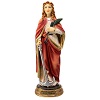
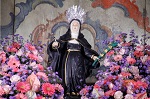
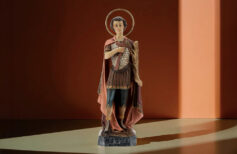
Saint Philomena, painted resin statue, 30 cm. Statue of Saint Philomena with her symbols (anchor, palm tree and arrows), made of hand-painted resin, measuring 30×9.5×6.5 cm
History of Saint Philomena
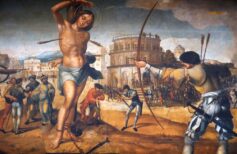
According to tradition, Saint Philomena was a Greek princess, perhaps from the island of Corfu, who, at the age of 13, converted to Christianity. Having travelled to Rome with her family, she was noticed by the Emperor Diocletian who, captivated by her beauty, asked her to marry him. But the young girl had decided to consecrate her chastity to Jesus, and she rejected the illustrious suitor. Furious, Diocletian had her arrested and tortured, but the faith of the young princess remained unshakeable. Finally, she was beheaded.
It was Sister Maria Luisa of Jesus, a Franciscan tertiary from Naples, a devout nun who lived in the 1800s, who told the story of Philomena. According to Sister M. Luisa of Jesus, the story was revealed to her directly by the saint herself. In 1833, the Pious Revelation was published, in which the life of the young saint and her martyrdomwere described.
Saint Philomena, despite the veneration she has received since the discovery of her remains and the fervour of her devotees, was never included in the Roman Martyrology, and in 1961 the Sacred Congregation of Rites decided to remove her name from the Roman Missal.
Despite these decisions, devotion towards the Saint is still alive and passionate. Sister Luisa’s writings contributed to its spread throughout Europe and America. In addition to the biography of Saint Philomena, the expansion of her cult was supported by testimonies of miracles attributed to her intercession, such as that of Pauline Jaricot, founder of the Society for the Propagation of the Faith and the Living Rosary, and that of the Holy Curé of Ars, who were fervent devotees of hers. Both recounted that they had been completely healed by Saint Philomena and promoted her devotion.
As we have mentioned, Philomena’s tomb was found in 1802 during excavations in the Catacomb of Priscilla on the Via Salaria. In addition to the inscriptions on the aforementioned terracotta fragments, it was the symbols of martyrdom engraved on them that made it possible to formulate hypotheses regarding the identity of the person buried in that tomb. Two anchors, three arrows, a palm and a flower suggested the tomb of a young martyr, although the inscription *martyr* did not appear anywhere. An ampulla was also found in the burial niche which, at first, was thought to contain the saint’s blood, but upon closer examination it was discovered to contain perfume, as often happened in burials of the time. Studies carried out over the years have led to the conclusion that there is no certainty about the true identity of the young girl buried in the tomb, but the cult and devotion to Saint Philomena have never diminished.
What does Saint Philomena protect?
Venerated by the Catholic Church and by the Eastern Orthodox Church, Saint Philomena is considered the patron saint of the Children of Mary and the protector of impossible causes, particularly of young married couples in difficulty, infertile mothers, the sick and prisoners. Those who turn to her seek comfort and protection from temptation, spiritual darkness and physical dangers. Furthermore, she is said to be a guide for those seeking spiritual relief and healing.
One of the most venerated places associated with Saint Philomena is the Shrine of Saint Philomena in Mugnano del Cardinale, a small town in the province of Avellino, where since 10 August 1805 the saint’s remains, transferred from the Catacombs of Priscilla, have been kept. It was Pope Pius VII who gave the remains of Saint Philomena to Don Francesco De Lucia, originally from Mugnano and the first Rector of the Shrine, which was originally dedicated to Our Lady of Grace, together with an ampulla presumably containing the saint’s blood. Even today, the relics are kept in the votive Chapel consecrated to Saint Philomena, and the shrine is a place of pilgrimage for faithful from all over the world, who travel to Mugnano to pray before the relics and seek the help of the young saint. The shrine is enriched with works of art and preserves testimonies of graces and miracles attributed to the intercession of Saint Philomena.
The Shrine of Saint Philomena is part of the Diocese of Nola, famous for the Feast of the Lilies dedicated to Saint Paulinus. On 13 August the Church commemorates Saint Philomena and Mugnano del Cardinale celebrates its child saint with great affection and devotion.
For five hundred years, the Swiss Guards have protected the Pope's security and watched over the Vatican. Here is who...
What’s the Future of Religion?
What’s the Future of Religion?
A Beginner’s Guide to Christianity
A Beginner’s Guide to Christianity
Mind-Blowing Statistics About Christianity You Need to Know
Mind-Blowing Statistics About Christianity You Need to Know
8537
Enter the Holyart world: $20 discount voucher valid on over 60,000 items
Come and discover Holyart, the largest e-commerce of religious articles in Europe and immediately receive a $20 voucher to use with your first purchase.
Check your mailbox: you will receive your discount within 5 minutes





 7 October 2026