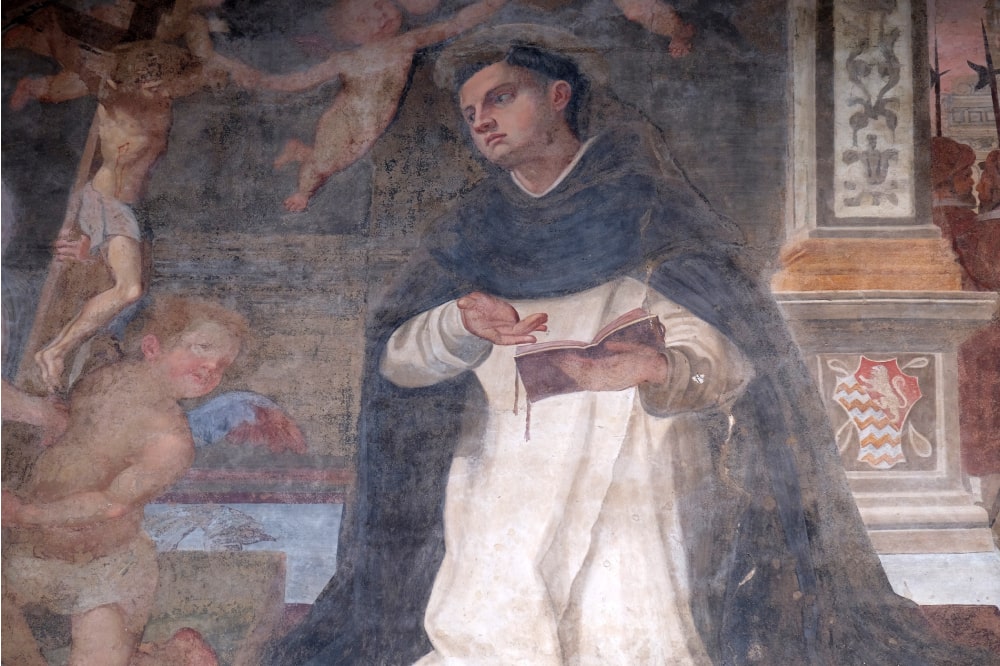
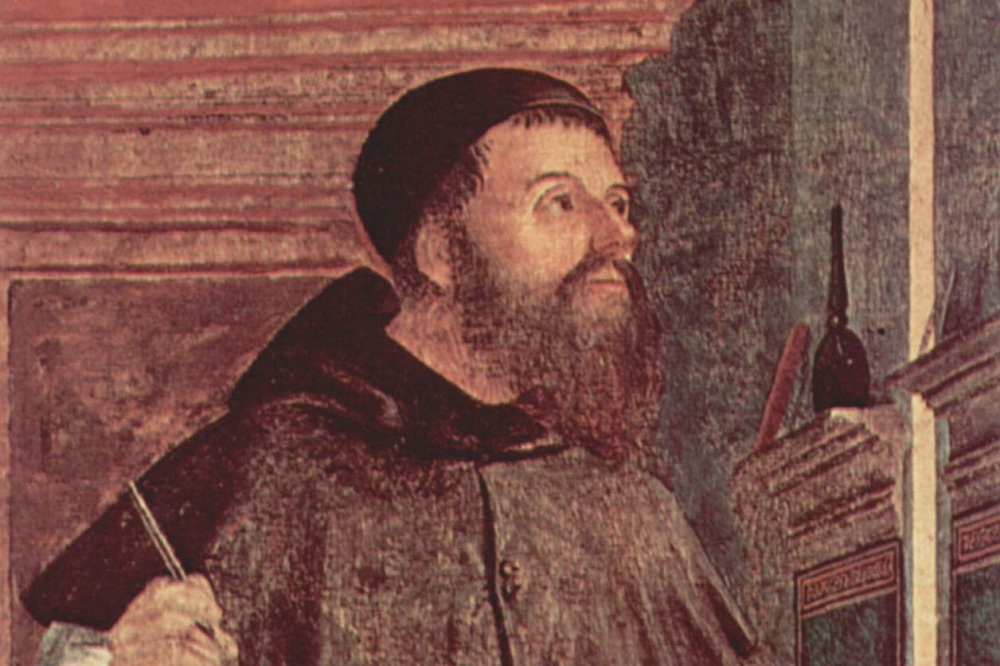
On 28 January, the liturgical memory of St. Thomas Aquinas, ‘angelic doctor’ and author of the most famous treatise on medieval theology, is celebrated.
Thomas Aquinas lived in the 12th century. He was a Dominican friar, but he is remembered above all for his merits as a theologian, philosopher and Doctor of the Church. His merit is that he identified the junction point and combined classical and Hellenistic philosophy with Christian theology, and that he outlined the principles of Western Christian doctrine in the Middle Ages, with pillars of thought that remain valid today.
The cadet son of a Sicilian noble family, he was initiated into ecclesiastical studies at a very young age and sent by his parents to the Abbey of Monte Cassino. Later, as a teenager, he moved to Naples and enrolled in the University created by Frederick II, King of Sicily, for the nobles and scholars of his Empire. Here, he also took his vows in the Dominican order, contravening the orders of the family, who hoped to see him one day abbot of Montecassino. To convince him to change his plans, the family imprisoned him for two years in the castle of Monte San Giovanni Campano, but in the end, they had to resign and send him back to Naples.
Thomas continued his studies in Rome, Paris, and Cologne, becoming a pupil and then an assistant to Albertus Magnus, a master in theology, who deeply transmitted his knowledge to him during these crucial years of his education. It was Albertus Magnus who introduced him to teaching at the University of Paris, although he was only 27 years old. Here, he could learn about and appreciate the work ofAristotle, which he would become a great scholar and commentator on. He is credited with adapting Aristotelian thought from a Christian perspective.
Back in Italy, he taught in Orvieto, then in Rome, where he continued to analyse Aristotle’s work thanks to the translator and friend William of Moerbeke, and again in Paris, where he wrote some of his most important works. In the meantime, he worked to reorganise the schools of the Dominican order and teach theology.
In the last period of his life, Thomas Aquinas lived in San Domenico Maggiore, in Naples, divided between study and prayer. One day, while celebrating Mass in the chapel of St. Nicholas at the church of San Michele Arcangelo in Morfisa, Thomas had a vision that so shocked him that he decided not to write anything anymore. “I can’t anymore. Everything I have written seems like straw compared to what I have seen, “ he revealed to his friend and secretary, Reginaldo da Piperno. He died a short time later, at just 49 years old, and his remains are preserved in the Dominican church of Les Jacobins in Toulouse. At the same time, other relics are distributed in various Italian churches.
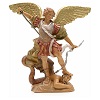
In Hebrew, the name Michael means “who is like God” and he is famous for having defeated evil forces.
At the base of St. Thomas’ philosophy is the awareness that faith and reason must collaborate to lead to the truth. Man can know the truths of the world through reason and philosophy, but only divine revelation elevates reason to certainty and perfection. The reason, therefore, serves as a basis:
demonstrating the preambles of faith;
explaining the truths of the faith;
defending the faith from objections.
In his desire to combine faith and reason, Saint Thomas Aquinas goes so far as to demonstrate the existence of God on a rational basis.
Furthermore, in line with Aristotelian principles, Thomas considered man the fruit of the union of soul and body. Still, to Aristotle he added that the soul is created “in the image and likeness of God”, so much so that it derives completely from Him, and like Him is transcendent, immaterial and yet contained entirely in every part of the body.
The Summa Theologiae
In his short life, Saint Thomas wrote a considerable amount of theological and philosophical works. Among the most famous are: the Summa contra gentiles, four books aimed at explaining with truths that concern reason alone combined with divine truths the truthfulness of the Catholic faith to the Gentiles, that is, to the pagans; the Scriptum super libros Sententiarum, the Commentary on the Sentences of Peter Lombard, a treatise on medieval theology at the basis of Scholasticism; and the Summa Theologiae, the Summatheologica, perhaps his most important work.
Written in the last years of Thomas’ life and unfinished, it is considered the most important treatise on medieval theology ever written.
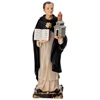
Hand-painted statue of Saint Thomas Aquinas, dressed in white robes and a brown cloak, embellished with a golden sun-shaped pin at the center symbolizing divine wisdom.
The work begins with the Summa contra Gentiles. Still, from the beginning, it demonstrates a more theological than apologetic character, citing many authors of antiquity, from Aristotle to Saint Augustine of Hippo, from Peter Lombard to Pseudo-Dionysius the Areopagite, from Avicenna to Moses Maimonides.
The Summa is written in Latin and divided into three parts, formed by articles that, based on reason, each present a topic examined through questions and issues that would seem to demonstrate the opposite thesis to the truthful one presented and supported at the end. This method refers, on the one hand, to the Aristotelian scientific one, adopting the same principles of rational sciences and metaphysics for theology. On the other hand, Thomas wanted to refer tothe architecture of the great cathedrals, making the foundations of faith visible and understandable through reason, in the same way that architecture showed divine truth to men through something visible and tangible.
The Three Angelic Hierarchies
In the Summa Theologica, Saint Thomas proposes, among other things, the theory of the three angelic hierarchies presented by Pseudo-Dionysius the Areopagite, a 5th-century Neoplatonic philosopher, in the book De coelesti hierarchy.
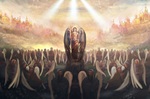
The structure of heaven according to Pseudo-Dionysius is based on passages from the New Testament, from which he deduced a scheme composed of three hierarchies (or spheres), each consisting of three orders (or choirs), arranged in order of decreasing power as they move away from God.
These hierarchies were then identified with the orbits of the celestial bodies, which, as they move, emit a harmony known as “music of the spheres”.
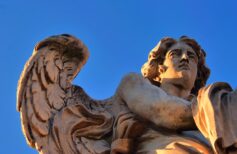
St. Thomas was a passionate student of the activities of angels, so much so that he was nicknamed ‘Doctor Angelicus’. In his opinion, the guardian angels have the task of illuminating our images, helping our intelligence to make us understand the truth.
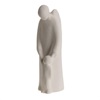
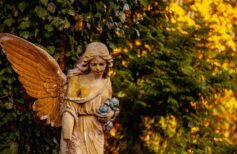
Protective Guardian Angel figurine, stylized, made of fire clay.
He deepened the work of Dionysius, writing in the Summa Theologica that the distinction of angelic hierarchies is based on the different intellectual natures of angels, on the various ways in which the Essence of God illuminates them. This is why the higher angels have a more universal view of things than the lesser angels: they learn the truth of things from God himself, while the angels of the second hierarchy understand them through universal causes, and those of the third through the application of causes to particular effects. In practice, the first hierarchy is composed of angels closer to and more similar to God, and thus capable of knowing all things in a single “form”. Angels of the second hierarchy know divine effects from the way they spring from universal causes and are illuminated by the first hierarchy. The angels of the third hierarchy receive a knowledge of divine effects.
Consequently, according to Thomas, the first hierarchy (Seraphim, Cherubim and Thrones) has a direct relationship with God thanks to which it can consider the End; the second (Dominations, Virtue and Power) the means, that is, the universal arrangement of things to be done, the ordering and governance of the world; the third (Principalities, Archangels and Angels) applies the provisions to the effects, that is, performs the work.
Sacred icons: genuine expressions of religiosity, symbolic works that transcend art. How are they painted? Discovering egg tempera Much of...
2 March 2026
What’s the Future of Religion?
What’s the Future of Religion?
A Beginner’s Guide to Christianity
A Beginner’s Guide to Christianity
Mind-Blowing Statistics About Christianity You Need to Know
Mind-Blowing Statistics About Christianity You Need to Know
8564
Enter the Holyart world: $20 discount voucher valid on over 60,000 items
Come and discover Holyart, the largest e-commerce of religious articles in Europe and immediately receive a $20 voucher to use with your first purchase.
Check your mailbox: you will receive your discount within 5 minutes