On 4 December, the liturgical memory of Saint Barbara is celebrated, recognising her as the protector of firefighters, sailors, and miners. Originally from Turkey, she was martyred in the 3rd century AD for her faith at the hands of her own father, Dioscurus, an associate of Emperor Maximian Hercules.
On the occasion of Saint Barbara’s feast on 4 December, when the faithful commemorate her martyrdom, processions, prayers, and, in many communities, fireworks are held to honour the saint, who is also the patroness of pyrotechnicians. In particular, in Paternò, in the province of Catania, of which Saint Barbara is patron, solemn celebrations take place every year from 3 to 11 December, as well as on 27 May, the date of Saint Barbara’s patronage after she halted the eruption of Mount Etna in 1780, and on 27 July, the day of the translation of her relics.
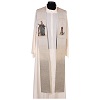
Deacon stole dedicated to the martyr Santa Barbara embroidered on an ivory stole and depicted with a palm branch in her arms and resting on a tower…
The Santa Barbara Mining Trail is among the most evocative routes in Italy. It forms a roughly circular path of about 500 kilometres in the western area of southern Sardinia, covering the regions of Sulcis, Iglesiente, and Guspinese, and follows the ancient paths of miners, the routes connecting mines to each other and to settlements. It is a journey through breathtaking landscapes and historical trails, but also through other eras, discovering the stories of countless men who dedicated their lives to those mines, helping to shape their land.
Inside the San Giovanni di Bindua mine, near Iglesias, lies the Santa Barbara Cave, discovered by chance only in 1952. It is accessed via a small train, which traverses a labyrinth of underground galleries for over 700 metres. The Santa Barbara Cave is not only a fascinating subterranean complex but also a testimony to the geological past and the millennial work of nature, with its walls lined with dark brown tabular barite crystals, and stalactites and stalagmites forming columns that can reach up to 25 metres in height.
In Rome, near Campo de’ Fiori, stands the church of Santa Barbara de’ Librari, also known as Santa Barbara alla Regola, a small church dating back to the early 1300s, entrusted to the confraternity of de’ Librari until its dissolution, and enriched over the centuries with Baroque decorations and splendid frescoes.
The Story of Saint Barbara and Her Martyrdom
Originally from present-day Turkey, Saint Barbara was the daughter of a wealthy pagan named Dioscurus, who worked for the Roman emperor. Jealous of her beauty, her father raised her in absolute isolation, in a high tower inaccessible to external influences. However, the young woman nurtured a fervent Christian faith and, defying her father’s wishes, secretly embraced Christianity. Her beauty and intelligence attracted many suitors, but she refused them all, steadfast in her desire to dedicate herself entirely to God.
When her father discovered her conversion, he first tried to persuade her to renounce her faith, but Barbara burned the pagan idols and fled into the forest. Dioscurus then invoked the intervention of the Roman authorities against his rebellious daughter. Barbara was dragged before Prefect Marcian and subjected to terrifying tortures. Her body was scourged with rough, stinging cloths until her skin was flayed, and her flesh was burnt with red-hot metal, yet she miraculously emerged unharmed from each torment, growing ever stronger in faith. Eventually, it was Dioscurus himself who raised the sword and beheaded his daughter, but a moment later, according to legend, the sky split open, and a lightning bolt struck him dead.
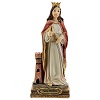
This Catholic statue depicts Saint Barbara with the chalice of Communion and the sword in her hand, while next to her there’s a tower…
In the 6th century, the relics of the martyred Saint Barbara were transferred from Egypt to Constantinople, and subsequently to Venice, in the church of San Giovanni Evangelista in Torcello in 1009. The veneration of this martyr spread widely between East and West, acquiring over the centuries a profound symbolic meaning, becoming a beacon of protection and courage for those who work in dangerous conditions and face sudden risks and imminent peril.
Who Saint Barbara Protects
Saint Barbara is remembered not only among the Holy Martyrs, men and women who sacrificed their lives, often young, for the sake of faith. She is also one of the fourteen helper saints to whom remedies for various diseases and health problems were historically associated, with a collective feast originally on 8 August, later suppressed. Among them are Saint Blaise of Sebaste, protector against sore throats, Saint Christopher, who protected against plague, hurricanes, and travel accidents, and Saint Barbara, who offered protection against fever, lightning, and sudden death.
The patronage against sudden death likely stems from the legendary death of her father, but over time, Saint Barbara has become the saint invoked for the protection of all those who, through their work or way of life, face the danger of instant death every day, such as pyrotechnicians, firefighters, artillerymen, carpenters, and miners. Ammunition depots on warships are named “Santa Barbara” in her honour.
Symbols of Saint Barbara
Common depictions of the saint show her as a beautiful young woman elegantly dressed, often captured at the moment of her beheading, the final act of her long path of martyrdom.
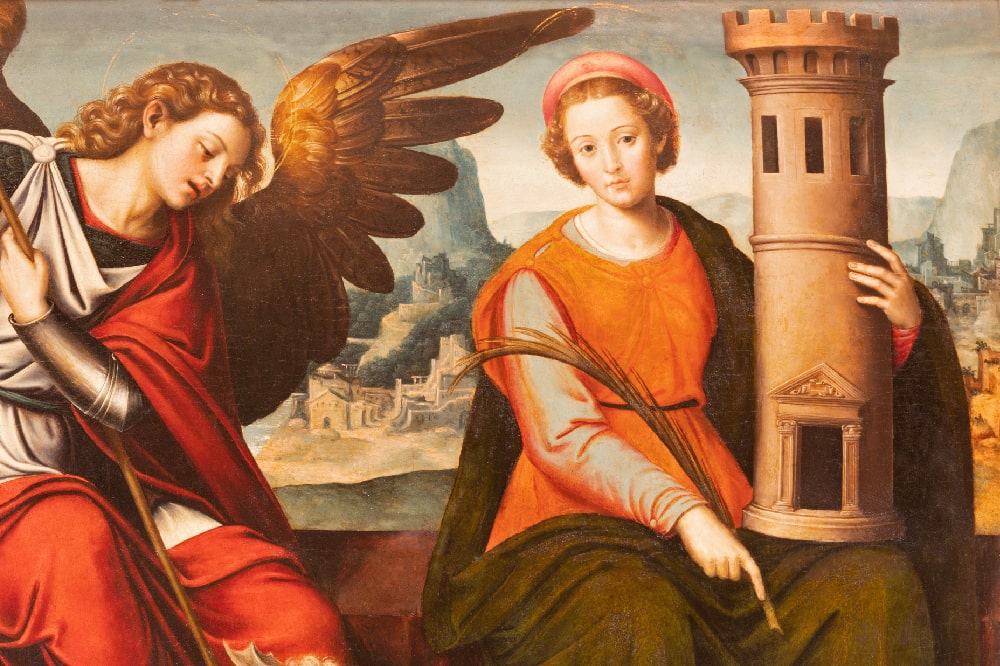
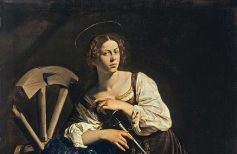
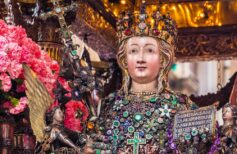
Saint Barbara is often depicted with the symbols of her martyrdom, a torch or the sword with which her father executed her. In many statues and paintings, she holds only the palm of martyrdom and wears a crown, or the chalice and host, symbols of her unwavering faith. Other times, she is shown holding the tower in which her father imprisoned her— a three-windowed tower, as she had requested, one for each Person of the Holy Trinity.
Saint Barbara became the patron saint of artillerymen. She is also traditionally the patron of armourers, military engineers, gunsmiths…
Another of the oldest symbols associated with Saint Barbara is the peacock feather, evoking immortality and apotheosis, as well as beauty. Some versions of the legend recount that during her torture, the rods used by her executioners turned into peacock feathers. Other recurring symbols linked to Saint Barbara include cannons and catapults, recalling her patronage of artillery, and the book, representing her scholarly life.
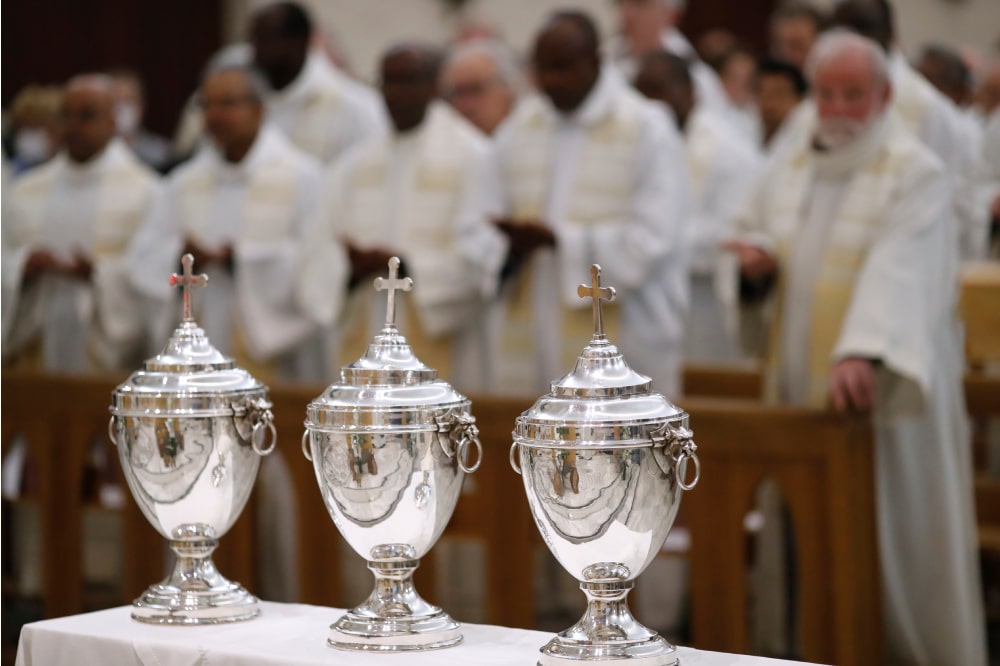
The chrism mass celebrates the mystery of the church, its unity and communion while waiting for Easter. It is also...
What’s the Future of Religion?
What’s the Future of Religion?
A Beginner’s Guide to Christianity
A Beginner’s Guide to Christianity
Mind-Blowing Statistics About Christianity You Need to Know
Mind-Blowing Statistics About Christianity You Need to Know
7597
Enter the Holyart world: $20 discount voucher valid on over 60,000 items
Come and discover Holyart, the largest e-commerce of religious articles in Europe and immediately receive a $20 voucher to use with your first purchase.
Check your mailbox: you will receive your discount within 5 minutes



 4 March 2026