Homepage | Religion | Jesus and the Samaritan woman at the well: the explanation of the parable
Jesus and the Samaritan woman at the well: the explanation of the parable
25 March 2026
Reading Time: 7minutes
With the meeting with the Samaritan woman at the well, Jesus reveals his identity as Messiah and speaks revolutionary words, anticipating the work of evangelisation of the disciples
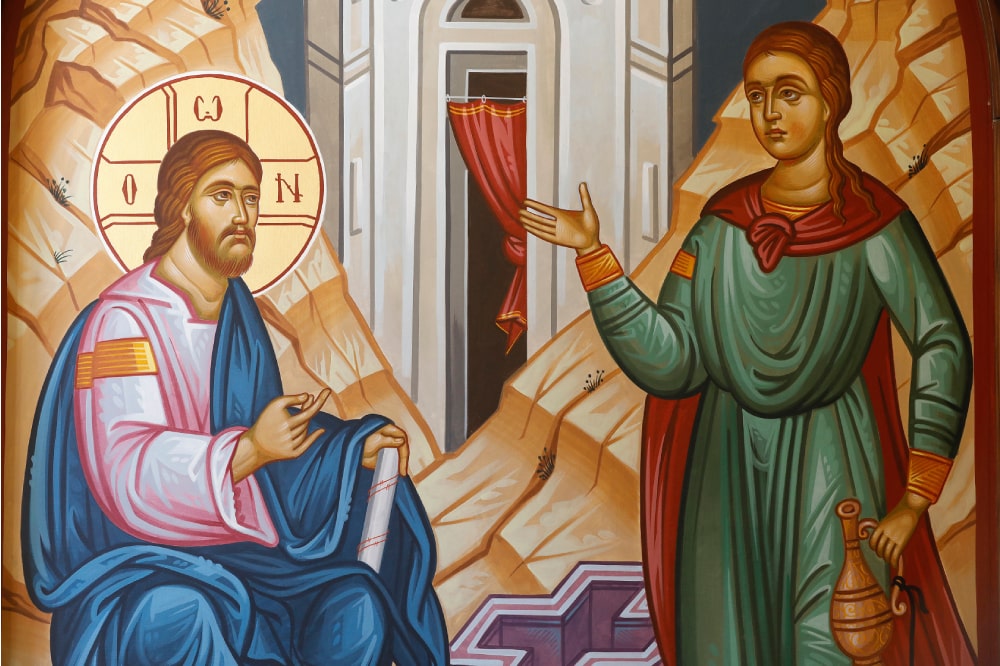
The story of Jesus and the Samaritan woman at the well is told in the Gospel of John (Jn 4:5-42). While travelling from Judea to Galilee, Jesus meets a Samaritan woman at Jacob’s well in Samaria. The result is a dialogue between the most revolutionary of the New Testament, which makes the encounter with the Samaritan woman not a parable in the traditional sense, but a story full of symbolic and metaphorical meanings that illustrate theinclusiveness of Jesus’ message, his offer of salvation and eternal life through faith in him and theimportance of a personal relationship with God.
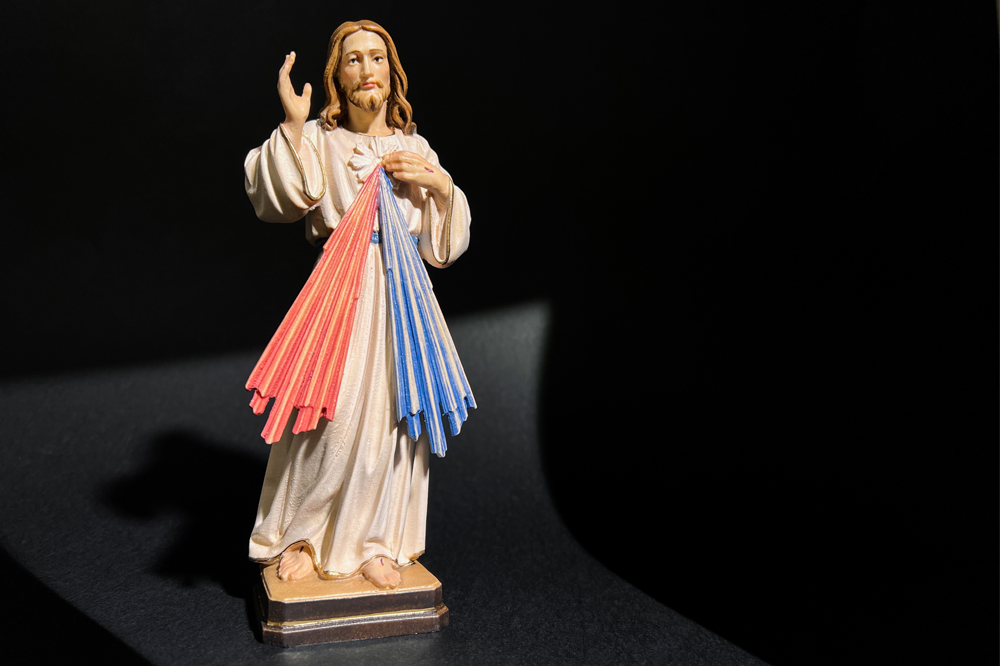
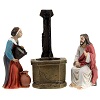
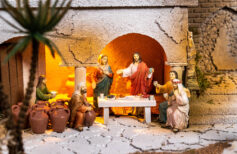
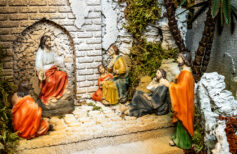
Statuettes for Easter crib representing a scene from the life of Christ, specifically the moment when Jesus found himself crossing the Samaria.
The Gospel of the Samaritan woman
The Gospel of the Samaritan woman is a passage from the New Testament, precisely chapter 4, verses 1-42 of the Gospel according to John.
This narrative is often referred to as “The Story of the Samaritan woman” or “The Dialogue of Jesus with the Samaritan woman at the Well”. In short, Jesus travels through the region of Samaria and stops at a well, where he meets a Samaritan woman and engages in a substantive discussion with her about her physical and spiritual thirst. During this meeting, Jesus reveals to the woman His identity as the Messiah and His mission to bring eternal life to those who believe in Him.
The woman’s name is not given in the text, but she is commonly known as “the Samaritan woman” or “the Samaritan woman.” Given her origin, the woman represented a double minority in the eyes of the Jews of the time, as a woman and because the Samaritans were considered marginalised by the Jews. In His interaction with her, Jesus breaks down all social and cultural barriers by speaking to her and even revealing His identity as the Messiah. After the encounter with Jesus, the Samaritan woman, shaken by a great spiritual upheaval, runs into the city and witnesses her experience, leading many others to meet Jesus and believe in Him as the Saviour of the world. Thus, despite her social and cultural background, the Samaritan woman exemplifies faith and witness in Christ, demonstrating that He came for everyone, regardless of their origin or social status.
Here are the fundamental points of the Gospel account and their interpretation.
5 So he came to a town in Samaria called Sicàr, near the land that Jacob had given to his son Joseph. 6 Here was Jacob’s well.
It is no coincidence that the meeting between Jesus and the Samaritan woman occurs at Jacob’s well, mentioned in both the Old and New Testaments. In fact, this place has a profound symbolic and historical value. It is associated with the patriarch Jacob, son of Isaac, who, according to biblical tradition, excavated it near the city of Shechem (or Sichar). It has since become an important landmark and a symbol of family bonds and spiritual heritage for the Israelites. The use of Jacob’s well in the gospel account links Jesus’ message to the Old Testament roots of Judaism. This demonstrates the continuity between the Old Testament promise and its fulfilment in Christ in the New Testament.
7 Meanwhile, a woman from Samaria came to draw water. Jesus said to her, “Give me a drink.” 8 For his disciples had gone away into the city to buy food. 9 But the Samaritan woman said to him, “Why do you, a Jew, ask me, a Samaritan woman, for a drink?” In fact, the Jews do not maintain good relations with the Samaritans. 10 Jesus answered and said to her, “If you knew the gift of God, and who it is who says to you, ‘Give Me a drink,’ you would have asked Him, and He would have given you living water.”
This is how the subversive scope of the dialogue between Jesus and the Samaritan woman, the longest of the Gospels, emerges. In contrast to the water of the traditional well, the water that Jesus proposes symbolises the new Law that He brings, which overcomes and replaces the old one. Jesus offers living water, a symbol of salvation and source of eternal life, freely to anyone who needs it, without distinction of race, gender or social status. This reflects the inclusive nature of the gospel message and the love of God that is available to all. It is an invitation to faith and abundant spiritual life that is offered to all who believe in Him. In addition,
Faced with the woman’s perplexity about how she thinks she can draw water from such a deep well, Jesus replies:
13 Jesus answered, “Whoever drinks of this water will thirst again; 14 but whoever drinks of the water that I will give him will never thirst again; indeed, the water that I will give him will become in him a spring of water welling up to eternal life.”
Jesus says that whoever drinks of living water will never thirst again. This suggests that only through a personal relationship with Jesus Christ can true spiritual satisfaction be found. Living water represents the satisfaction of an individual’s spiritual needs. Elsewhere in Scripture, “living water” is associated with the Holy Spirit. So, in the encounter with the Samaritan woman, Jesus could also allude to the gifts of the Holy Spirit that would be given to believers after his ascension. The Holy Spirit gives spiritual life and guides believers in the truth.
The dialogue continues. Jesus and the woman discuss the places where it is right to worship God: the Samaritans claim that it is Mount Gerizim, the Jews claim that it is Jerusalem. In this case, Jesus’ response also runs counter to the prevailing opinions of the time.
21 Jesus said to her, “Woman, believe Me, an hour is coming when neither in this mountain nor in Jerusalem will you worship the Father. […] 23 Yet the time is coming, and now is when the true worshipers will worship the Father in spirit and truth; for such people the Father seeks to be His worshipers. 24 God is spirit, and those who worship him must worship in spirit and truth.”
In Jesus’ time, there were two main temples where the one God was worshipped: the renowned Temple in Jerusalem and another located in Samaria. The latter fact is crucial to understanding the Samaritan woman’s question about the proper place to worship God. Jesus’ answer to this question emphasises that true worship is not tied to physical places or external rituals, but is a matter of an inner, authentic relationship with God. True worship requires deep spiritual involvement and total sincerity of heart. God is not limited by geographical boundaries or ceremonial forms, but desires an authentic and sincere relationship with those who seek Him. In this way, Jesus invites the Samaritan woman and all who listen to his teaching to overcome religious divisions and turn to God with sincerity and spiritual devotion.
25 And the woman said unto him, I know that the Messiah cometh: when he cometh, he shall declare all things unto us. 26 “I am he,” Jesus replied, “the one who is speaking to you.”
Jesus’ statement could not be more explicit. The woman expresses her conviction that the Messiah will come, and Jesus openly reveals to her that he is the One for whom everyone is waiting. The Samaritans saw the Messiah as a human prophet, announced by Moses in Deuteronomy 18:15-18 and similar to Moses himself. The Samaritan woman thus recognises Jesus as the prophet and the expected Messiah. She leaves him to go and share her discovery with her fellow citizens, a forerunner of the Gospel message that the disciples will bear after the death of Christ.
35 “Do you not say, ‘There are yet four months, and then comes the harvest’? Behold, I say unto you. Lift your eyes, and behold the fields which are already blond for the harvest. 36 Already he who reaps is receiving wages and is gathering fruit for eternal life; so that he who sows and he who reaps may rejoice together. 37 For in this case the saying is true, One sows and another reaps. 38 I sent you to reap that for which you have not laboured; others have laboured, and you have entered into their labour.”
In this passage of the parable of the Samaritan woman, Jesus uses the term “reapers” or “harvest” to refer to the process of evangelisation and the reaping of souls in the Kingdom of God. This reference is symbolic and reflects the work that awaits Jesus’ disciples in proclaiming the Gospel and leading people to faith. Jesus urges the disciples to look at the fields, which are already ripe for harvest. This image of the harvest symbolises the opportunity to carry forward God’s work in the world, particularly through evangelism. The reference to harvesting indicates that the time has come for Jesus’ disciples to spread the gospel and gather those who are ready to accept it. This recalls the idea that the Kingdom of God is near and that the disciples are tasked with bringing the good news to all who are ready to hear and respond.
The chrism mass celebrates the mystery of the church, its unity and communion while waiting for Easter. It is also...
What’s the Future of Religion?
What’s the Future of Religion?
A Beginner’s Guide to Christianity
A Beginner’s Guide to Christianity
Mind-Blowing Statistics About Christianity You Need to Know
Mind-Blowing Statistics About Christianity You Need to Know
8013
Enter the Holyart world: $20 discount voucher valid on over 60,000 items
Come and discover Holyart, the largest e-commerce of religious articles in Europe and immediately receive a $20 voucher to use with your first purchase.
Check your mailbox: you will receive your discount within 5 minutes










 4 March 2026