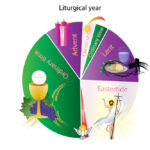
The Trial of Jesus represents one of the first, dramatic acts of His Passion and tragically opens the last part of Holy Week. Holy Week is a time of deep reflection and spirituality for Christians around the world, perhaps the most important of the Liturgical Year. It commemorates the final events of Jesus Christ’s life before His death and resurrection. In particular, the Easter Triduum, the time between the evening of Holy Thursday, when the Last Supper was celebrated, and Easter Sunday, focuses on the most important rites of Holy Week. These are the days of Jesus’ Passion, the last days of His life on Earth, considered the heart of Christianity, because they represent the supreme sacrifice He made for the forgiveness of sins and the salvation of humanity.
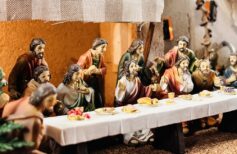
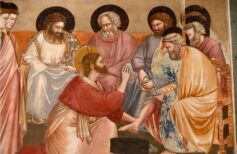
The sequence of events during Holy Week begins with Holy Thursday, which celebrates the Last Supper of Jesus with his disciples. During this supper, Jesus institutes the Eucharist and the Sacrament of Holy Orders, and foretells Judas’ betrayal and his own betrayal by the other disciples. This is also the occasion when Jesus performs the humble act of washing His disciples’ feet, teaching them the importance of service and humility.
It follows Good Friday, the day of Jesus’ Passion and death on the Cross. This is the day Jesus is arrested in Gethsemane, brought before various courts, and sentenced to death by crucifixion. Jesus undergoes physical torture and humiliation before being crucified on Mount Calvary, where He offers His life as a sacrifice for humanity. His death on the Cross is considered the culmination of His earthly mission, through which the divine plan of Redemption is fulfilled.
It is on the process of Jesus that we want to dwell, which in the Passion of Jesus, as told in the four canonical gospels, always appears, albeit with some variations.
We must always consider that the accounts of the Evangelists offer different perspectives, especially on the events that took place during the last days of Jesus’ earthly life. These are the only historical sources available to us to reconstruct those facts. Still, it is necessary to filter the information to understand which are historically reliable and which should be read as subsequent theological interpretations. The early Christians, in formulating their sacred texts, may have sought to mitigate the responsibilities of Roman figures such as Pilate in condemning Christ, since the Roman Empire held predominant political power at the time. At the same time, there was a tendency to emphasise the Jewish responsibilities in arrest and condemnation, reflecting the tensions between the early Christian and Jewish communities.
These tensions have led to anti-Semitism and persecution against Jews, who have been considered for centuries responsible for the death of Jesus, and as a result, targets of discrimination and violence.
Only with the Second Vatican Council was the innocence of the Jewish people recognised in the condemnation of Jesus, desired by God as a fundamental piece in his plan of Redemption.
Last Supper and Jesus’ arrest
Here is a summary of the events that led to the most decisive process in the history of humanity.
On Thursday evening, Jesus ate His last meal in the company of His closest friends, the Disciples. After what would go down in history as the Last Supper, he was arrested while praying in the Garden of Gethsemane, just outside Jerusalem. The soldiers were led by Judas Iscariot, one of the Twelve Disciples, who had agreed with the high priests of the Sanhedrin.
It was before them that Jesus was initially led to be questioned. According to Matthew, Mark and Luke (Matthew 26:57-68; Mark 14:53-65; Luke 22:63-65) Jesus was immediately brought before the high priest Caiaphas, according to John (John 18:12-13 and 18:19-23) they first took him to Anna, who was Caiaphas’ father-in-law, and only later to the house of the high priest, who was already waiting for him surrounded by the scribes and elders of the Sanhedrin. Here, with false witnesses, they accused him of cursing and blasphemy, for comparing himself to God, and invoked upon him the death penalty.
What is the meaning of Sanhedrin?
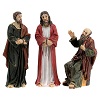
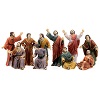
The statues are made of resin and have a maximum height of 8 cm.
Before Caiaphas and the Sanhedrin
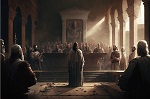
The Sanhedrin at the time of Jesus was the supreme judicial organ of ancient Jewish Jerusalem. It consisted of members of the priestly class, elders, and scribes, representing the various Jewish religious factions. The Sanhedrin had both religious and civil powers and served as both a legislative council and a supreme court. The functions of the Sanhedrin included interpreting Jewish law (the Torah), supervising worship in the Temple in Jerusalem, and adjudicating legal cases, including criminal cases. The Sanhedrin had the power to pronounce sentences, even death, in the most serious judicial cases.
In the context of Jesus’ trial, the Sanhedrin played a significant role. The scribes and religious leaders who made up the Sanhedrin were among those who judged Jesus and condemned him for blasphemy. They interpreted Jesus’ statements, in which He referred to Himself in divine or messianic terms, as a form of cursing and blasphemy against God according to their interpretation of Jewish law. Therefore, they considered him guilty of these religious crimes and decided to bring the case before the Roman authorities to obtain a death sentence.
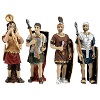
The statues are made of resin and have a maximum size of 10 cm.
Pontius Pilate and Jesus
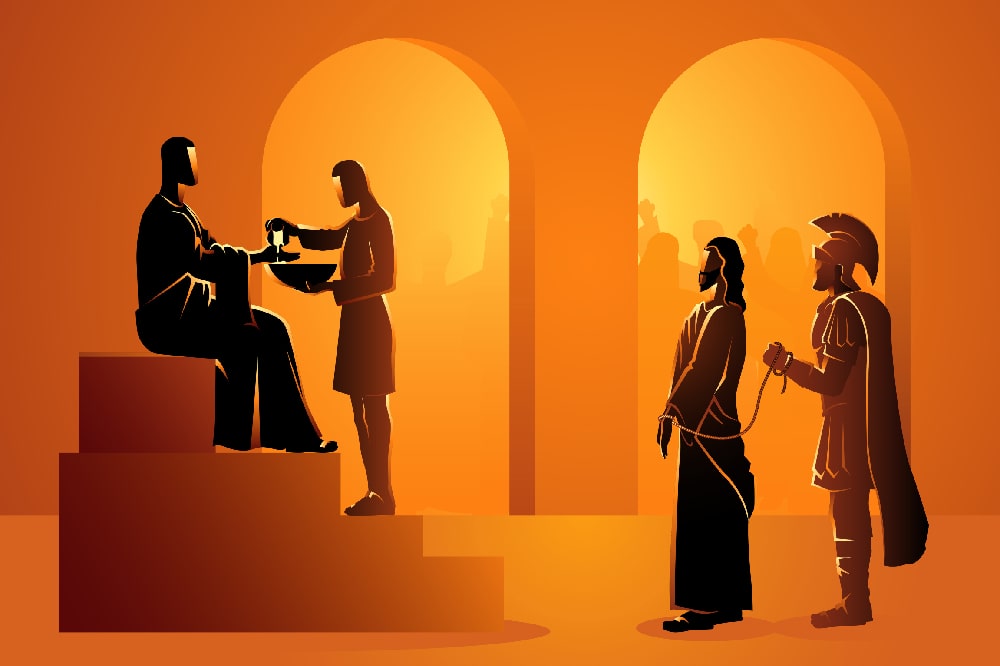
Since neither Caiaphas nor the Sanhedrin had the right to sentence a man to death, after the first trial Jesus suffered various ill-treatment, and was then led in chains before Pontius Pilate, the Roman prefect in Judea (Matthew 27:1-2; Mark 15:1; Luke 23:1; John 18:28). Accompanied by the prisoner in the Praetorium, the official residence of the Roman governor in Jerusalem, the members of the Sanhedrin accused him of various crimes, including sedition, self-proclamation to kings and Messiah, but also incitement not to pay taxes to Rome. This is because the mere accusation of blasphemy would not have been enough for Pilate to sentence a man to death.
Pilate’s interrogation of Jesus (Matthew 27:1-2 and Mark 15:1) and the subsequent death sentence by Crucifixion represent one of the central events of the narrative of the Passion according to Christian tradition. According to the Gospel accounts, Pilate, after questioning Jesus, would have found the accusations made against him not so severe as to justify his death sentence. According to Luke and John (Luke 23:2-5 and John 18:28-38), Pilate judged Jesus innocent. However, this meekness attributed to Pilate may seem at odds with his historical reputation for firmness and severity in applying Roman laws. Some scholars suggest that early Christian communities’ interest may have influenced this mitigated portrayal of Pilate in distancing Roman authority from responsibility for Jesus’ death. According to Luke’s Gospel (Luke 23:6-12), Pilate would have tried to avoid responsibility for condemning Jesus by sending him to the tetrarch Herod Antipas. Still, even he would not have found sufficient grounds to condemn him and send him back to Pilate. However, it is more likely that Pilate would have condemned Jesus to death immediately, considering him a dangerous political agitator, without going through such a complex and lengthy process as described in the gospels.
And so we come to the last, terrible act of this announced tragedy. The previous stages of the process differ little between the different Gospels. According to Matthew, Claudia, Pilate’s wife, tried to intervene to help her husband, so that he would not condemn an innocent man. Still, the Prefect, overwhelmed by the anger of the crowd, who invoked the crucifixion, first tried to appease them by releasing the thief Barabbas, as was customary on the occasion of the Passover for the Jews, and causing Jesus to be scourged, then surrendered, washing his hands and declaring that he no longer wanted anything to do with the matter (Matthew 27:15-26).
Also in Mark, we find the liberation of Barabbas, the scourging and finally the surrender of Pilate (Mark 15:6-15). In Luke and John, Pilate insists, declaring Jesus innocent, freeing Barabbas and attempting to commute the death penalty to flogging (Luke 23:13-25 and John 18:39-19:1). After the scourging, Matthew, Mark and Luke describe the mistreatment suffered by Jesus in the Praetorium by the Roman cohort and the coronation with the crown of thorns.
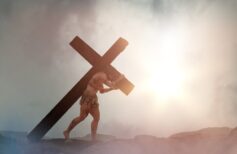
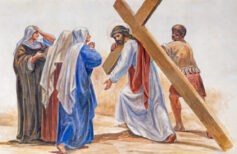
The Way of the Crossis the symbolic path that commemorates the events of Christ’s Passion, including the scourging, condemnation and crucifixion. This account, celebrated around the world on Good Friday, offers a profound insight into Jesus’ sacrifice and suffering for humanity.
On the way to Calvary, Jesus was subjected to cruel torture by Roman soldiers, torture that is an integral part of the Passion account. Roman soldiers forced Simon of Cyrene to help Jesus carry the transverse beam of the cross because He was too weak to continue alone.
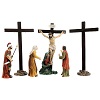
Once arrived at Golgotha, the place of execution, Jesus was nailed to the cross.
The Gospel of John (John 19:28-30) offers us the most touching testimony of the last moments of Jesus’ life on the cross, from when he is quenched by soldiers with vinegar (or perhaps sour wine), to his last words: “All is accomplished.”
With the death of Christ on the cross, the will of God is fulfilled, and the journey of Redemption and hope for all humanity begins.
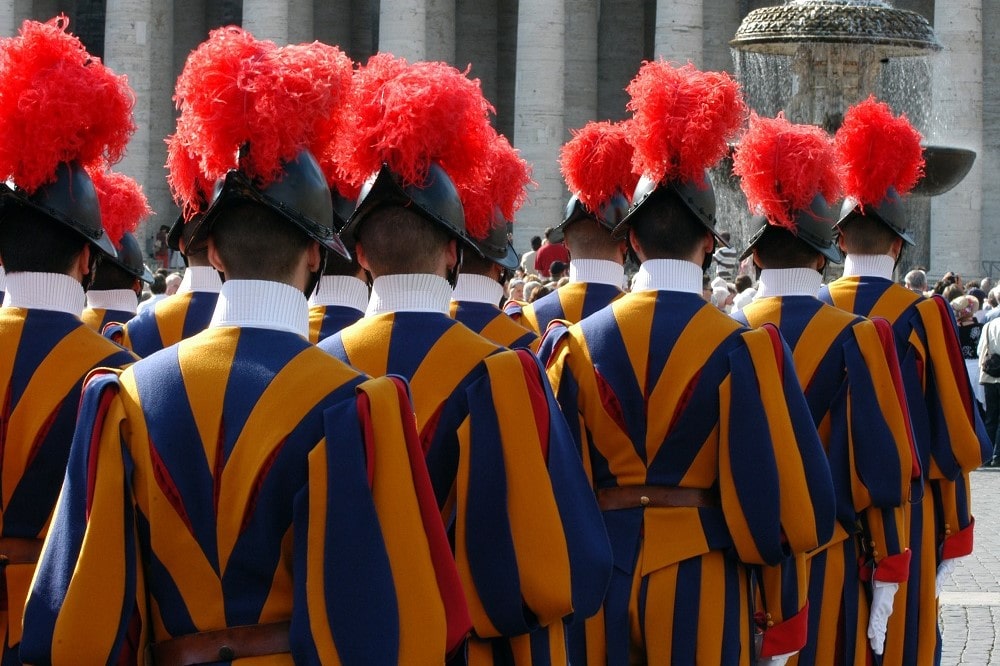
For five hundred years, the Swiss Guards have protected the Pope's security and watched over the Vatican. Here is who...
What’s the Future of Religion?
What’s the Future of Religion?
A Beginner’s Guide to Christianity
A Beginner’s Guide to Christianity
Mind-Blowing Statistics About Christianity You Need to Know
Mind-Blowing Statistics About Christianity You Need to Know
8024
Enter the Holyart world: $20 discount voucher valid on over 60,000 items
Come and discover Holyart, the largest e-commerce of religious articles in Europe and immediately receive a $20 voucher to use with your first purchase.
Check your mailbox: you will receive your discount within 5 minutes











 7 October 2026